
SLIDE 1
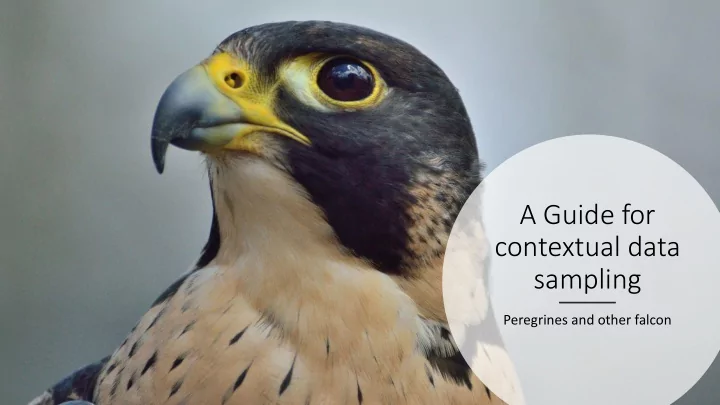
A Guide for contextual data sampling
Peregrines and other falcon
contextual data sampling Peregrines and other falcon Introduction - - PowerPoint PPT Presentation
A Guide for contextual data sampling Peregrines and other falcon Introduction STSM Holder Lucie Michel, MSc. Biology Giacomo DellOmo , PhD Why Peregrines? sensitivity! Peregrines have experienced a dramatic Population decline caused
Peregrines and other falcon
Lucie Michel, MSc. Biology Giacomo Dell‘Omo, PhD
Peregrines have experienced a dramatic Population decline caused by contaminants. Today peregrine populations have recovered and expanded into new habitats. Good distribution across Europe. Vicinity to human settlements. Many nests are easy to access and observe. High popularity in the public and can promote citizen science. Top predators, preying on resident and migrating birds.
sensitivity! webcam network! flag species!
General raptor guidances are already well elaborated... Focus on specific field guidance!
Contextual data Peregrines and other falcons Contaminant studies Harmonized sampling
promote harmonized sampling account for best utilization of data
Literature Workshop Draft Workshop Final
What exists? What is needed? What will it look like? Protocol for Falcons
I am here
Peregrine specifics?
insights into the draft protocol
with latitude
location: Poachers!
Gómez-Ramírez, P., Shore, R. F., Van Den Brink, N. W., Van Hattum, B., Bustnes, J. O., Duke, G., ... & Krone, O. (2014). An
correct handling
Organisation of fieldwork List of equipment