
SLIDE 1
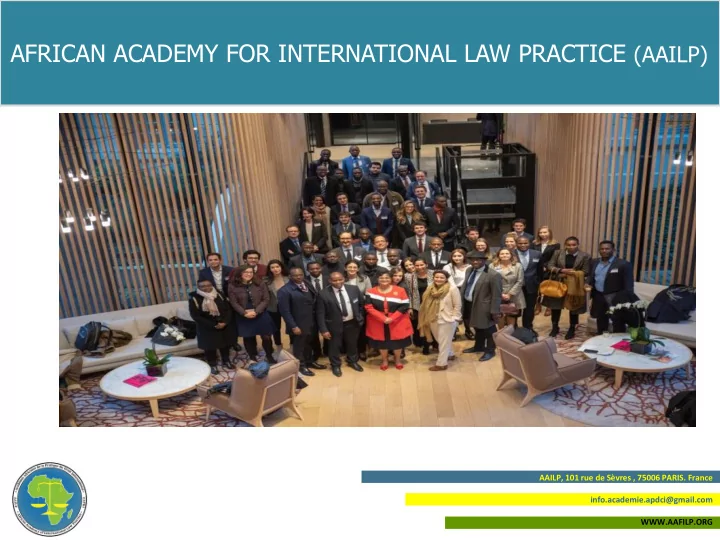
AFRICAN ACADEMY FOR INTERNATIONAL LAW PRACTICE (AAILP)
info.academie.apdci@gmail.com AAILP, 101 rue de Sèvres , 75006 PARIS. France WWW.AAFILP.ORG
CONTENTS I. P RESENTATION PAGE1 II. O BJECTIVES , G OAL , M ISSION - - PowerPoint PPT Presentation
AFRICAN ACADEMY FOR INTERNATIONAL LAW PRACTICE (AAILP) AAILP, 101 rue de Svres , 75006 PARIS. France info.academie.apdci@gmail.com WWW.AAFILP.ORG CONTENTS I. P RESENTATION PAGE1 II. O BJECTIVES , G OAL , M ISSION & C ORE V ALUES III. O
info.academie.apdci@gmail.com AAILP, 101 rue de Sèvres , 75006 PARIS. France WWW.AAFILP.ORG
info.academie.apdci@gmail.com AAILP, 101 rue de Sèvres , 75006 PARIS. France WWW.AAFILP.ORG
I. PRESENTATION PAGE1 II. OBJECTIVES, GOAL, MISSION & CORE VALUES III. OUR SERVICES, BELIEFS & DEPARTEMENTS IV. PROGRAMS V. GOVERNANCE OF AAILP VI. OUR CONTACTS
The African Academy for international law practice (AAILP) is an independent think tank devoted to study and development of international law. Our research, opinion and public voice make a difference in today’s world by bringing clarity and innovative thinking to global policy making. By providing specialized training to practitioners, national judges, government officials and students in various areas of international law, the Academy aims to enhance and reinforce Africa's role and participation in the formulation of international law. We have particular expertise in the field of Jurisdictional challenges in boundary and sovereignty disputes,international human rights law, the law of Africa Union,environmental protection, international trade, international dispute settlement, and international sports law
1
2
AAILP's main objectives are to:
African context;
legal consultancy and training programs, for professionals including judges, attorneys, publics servants and
integrity;
and co-ordination of efforts on African legal, public policy, and international relations issues, including studies on such issues in order to develop practical solutions;
through the dissemination of our research’ results through publications and public events; These objectives serve AAILP’s goal to improve Africa’s capacity to help African leaders navigate legal complexities in the evolving international law landscape and make them more effective at mastering legal constraints and
❖ This goal is in support of the United Nations Sustainable Development Goals (UNSDG) in particular GOAL 16 – Its
all and build effective, accountable and inclusive institutions at all levels". The Goal has 12 targets to be achieved by 2030.
3
The late 20th century has been characterized by an increased interdependence between the nations of the world, and clearly shows the great practical relevance of this area of law for business, society and politics. In Africa, important developments have supplemented those global transformations. At a time when trade is facing incredible headwinds and questions are being raised about the utility of regional integration processes, the establishment of the African Continental Free Trade Area (AfCFTA), signed in March 2018, is a positive move. By seeking to deepen economic integration of the African continent by creating a single continental market with free movement
time, international legal instruments developed in multilateral institutions and applicable to certain cross-border transactions have become increasingly important to the development of a substantive transnational law. As commercial intra-African transactions become increasingly international, it is vital to the legal and business communities to understand and analyze the practices and legal principles that govern relationships between firms and between firms and consumers in the new continental arena. One of the objectives in the AfCFTA Agreement is indeed to “establish a mechanism for the settlement of disputes concerning… rights and obligations”. The Protocol on Dispute Settlement (DS Protocol) proclaims dispute settlement to be “a central element in providing security and predictability to the regional trading system”.
4
AAILP aims to not only promote study, research and analysis on international legal matters of particular interest and relevance to African countries but also to foster the teaching and dissemination of international law in Africa. Our mission is to develop trade capacity and create innovative trade solutions for the African region. Based on this observation and their personal and professional experiences in Africa, the founding members of AAILP have created this
AAILP prides itself on its dynamism and ability to respond to current and emerging global legal issues through its customized services – including the creation of publications, provision of policy advice, legislative drafting, technical assistance and expert level educational courses – AAILP endeavors to ensure the proper and consistent application of international laws and regulations.
Within its defined scope and the programs it conducts, the AAILP promotes its activity by initiating and organizing events, either directly or in partnership (symposia, conferences, meetings, seminars, etc.), by giving financial or logistics support, or through the participation of its members (e.g. appearances as keynote speakers or panelists).
5
expectations of our clientele, we also have a philosophy which is to maintain a standard of excellence in our work, as we strive to set new benchmarks in international law and dispute resolution.
that is needed in order to fulfil future development projects in a sustainable independent manner.
6
7
Our services
TRAINING : AAILP hosts lawyers, judges, and other professionals engaged in public and private sector development in the most relevant and cutting-edge seminars. AAILP seminars are distinguished by a prominent faculty, internationally lauded for their expertise and knowledgeable in the local conditions particular to Africa and the developing world. AAIL develop technical expertise and capacity in international law across Africa with a particular emphasis on the cross-cutting fields of international law and development issues. We bring together legal experts from different countries to work out solutions for a variety of challenges within developing legal systems. The Academy focuses on capacity building amongst African countries and also endeavors to facilitate collaboration amongst practitioners and academics. CONFERENCES AND SUMMITS : AAILP organizes high-level conferences, round-tables and panel discussions. Hence providing a ‘think-thank’ platform to shape international policy and sow the seeds for a positive change by welcoming the most. REASEARCH AND PUBLICATIONS : AAILP’s research team conduct research on global trends, both current and emerging, with particular onus placed on issues with the widest ramifications on development and peace. AAILP’s expert consultants and researchers apply their exceeding experience and knowledge to provide objective, informative contributions to global discussions through their publications. CONSULTANCY and LEGAL ADVISE: AAILP offers technical assistance and policy advice on international law, international relations and geopolitics across all its Areas of Expertise. Our technical advisors can bring a wide range of knowledge and experience to this service from their extensive range of regional, national and international roles. Our consultants have worked for governments, leading law firms, universities, international institutions and major multinational corporations among others. AAILP
advises on (complex) legal issues in the area of international and African law. An important target group is the african legal practice, legal professionals and sometimes also the judiciary. 8
Our beliefs
AAILP believes that a better international governance can improve the lives of people everywhere by increasing prosperity, ensuring global sustainability, addressing inequality and safeguarding human rights, and promoting a more secure world. We believe that better governance and strong institutions are essential elements for inclusive and sustainable growth. The effectiveness of international law as a tool for change is increasingly challenged by major geopolitical shifts, the growing power of non-State actors, and reliance on voluntary approaches to address international problems. Yet experience demonstrates that global challenges demand global solutions, and while voluntary commitments can supplement binding obligations, they are not a substitute. To respond to these challenges and ensure that international law remains a vital (and viable) tool in addressing them, we must ensure that the law is effective - that it responds to existing needs, continually adapts to changing realities, and, above all, leads to real changes in policy, human behavior, and environmental outcome The seminars and training courses at the Academy respond to a strong demand expressed by a varied audience of actors or analysts in international law, who are seeking to deepen their knowledge in a world that is constantly changing, as attested by the three major international events.
9
Our departments
10
One of the goals of the Academy is capacity building in the areas on which the Academy
years, the Academy has hosted many capacity building events around Africa. Using various modes
delivery, the Academy develops, co-ordinates and facilitates seminars, workshops, exchanges, and special lectures, as the primary vehicles for achievement
its
Training and Capacity building
ACADEMY A HIGH-LEVEL TRAINING OFFER : ❑ Short courses (one to two weeks) for the Certificate of Advanced Studies on international law, with a specific mention for each training theme; ❑ Long courses lasting several months leading to specialist qualifications, in partnership with the Universities, master degrees and other graduate qualifications; Customized seminars lasting a day or half-day SUMMER PROGRAMME : Summer Program on International Lawyering in a Public Interest At the International lawyering in a public interest summer program, we brought together leaders in practice, including advocates, activists, academics and members of NGOs, to discuss questions of cutting-edge legal techniques, how to find funding, how to identify causes for advocacy, how to start up your practice, and more. ADVANCED MASTERS in International Law Political of African Union. The University of cartage and the AAILP, have combined their expert knowledge to create a unique advanced master's program: “ International Law Policy of African Union. This Program is a 12-month full-time course that emphasizes critical thinking on international law and policy matters, taught by a unique blend of regional and international scholars, professionals and practitioners. It also engages participants in interactive learning scenarios that emulate the world of advocacy, negotiations and trade diplomacy.
11
SUPPORTED BY DEMANDING, SPECIFICALLY DESIGNED TEACHING PROGRAMMES… : At the leading edge of the information and the new ideas on African legal issues; Based on knowledge gained in the field (compared experience, case studies); Preparing learners for the successful implementation of technical and managerial innovations to address the problems raised; Using innovative teaching approaches involving appropriate use of distance learning through AAILP’s dedicated platform; Guaranteeing learners post-training distance follow-up. FOR A DIVERSIFIED AUDIENCE.. : The seminars and training courses at the Academy are organized specially for senior economic, political and administrative officials, leaders, and decision-makers who are seeking to deepen their knowledge in the area of international litigation: Senior officials and government administrators ,managers in major African and international businesses; Leaders in civil society and NGOs.
12
13
Programs;
AAILP’s work is organized around five programs and a core set of strategic goals that deploys its programming primarily from its office in Paris to Africa. Our brochure provides a snapshot of our strategy and programs. ➢ DISPUTE RESOLUTION IN INTERNATIONAL LAW International dispute settlement is a fundamental, and expanding, part of international relations in the public, private, and public/private spheres.In the public sphere, the obligation to settle disputes by peaceful means has been embedded in the UN Charter. However, only in the last few decades, states have increasingly resorted to international courts and arbitral bodies to solve their differences, including requesting adjudication over boundary disputes entailing the allocation of limited natural resources.In the private sphere, globalization, and political, commercial and technological developments, bring about increasingly mobile and internationally active parties. As their mobility and activities increase, so do their disputes requiring access to effective and competent courts or arbitration bodies.Dispute Resolution and Climate Change. Territorial and Maritime Dispute in africa Recognition or enforcement of an arbitral awards Business and Human Rights Arbitration Alternative dispute resolution approaches and their application in water management Litigation in cultural property in Africa ➢ INVESTISSSEMENT INTERNATIONAL LAW Mining law Oil law, Gas law, Energy law, Water law ,Environment Law ,Intellectual property ,Investment law , International trade law
14
TRAINING PROGRAMS;
➢ AFRICAN STATES’ COMPLIANCE WITH REGIONAL AND INTERNATIONAL INSTRUMENTS ➢ INTERNATIONAL AND JURISDICTIONAL LITIGATION MANAGEMENT IN AFRICA This training pilot programme examining capacity asymmetry” that currently prevails between host LDC countries and investors in contract negotiations and international Arbitration and Dispute Resolution Practice with particular focus on the least African developed countries. LDCs do not have many people trained in the trade of formulating standards in BITs. The ultimate purpose of
judicial officers, Lawyers, lawmakers, academia, business and international, governmental and non-governmental organizations. The programme offers training opportunities through regional courses that will cover key themes and present the latest knowledge available related to International Arbitration and dispute resolution practice ➢ IMPLEMENTATION OF AFRICAN CONTINENTAL FREE TRADE AREA,( AFCFTA). This training pilot program implementing a joint capacity-building programme to support the implementation of the African Continental Free Trade Area (AfCFTA). The African Continental Free Trade Area (AfCFTA), which entered into force on 30 May 2019, represents a unique collaborative effort by African countries to bolster regional and continental economic integration, in a world marked by increasing protectionism and use of unilateral trade measures. ➢ HUMAN RIGHTS, BUSINESS AND ARBITRATION Multinational corporations are operating across international borders with ever-greater ease and very few restrictions. Progressive lowering of barriers to international trade, investment and financial flows; the proliferation of investment treaties; and the now endemic use of investor protection provisions in trade agreements has given companies powerful tools to avoid accountability for foreign actions and to undermine the legitimate public interest policies of States and communities. By contrast, the tools available to address the transboundary harms caused by corporate activities remain limited, weak, slow, and difficult to access. AAILPL explores and develops innovative solutions. 15
Funding;
I. Donations : As a new organization with limited financial resources, The Africa Law Institute is actively seeking core, seed and project funding to carry out the research and other programming envisaged on this web site. As such, we are looking for donations from individuals, governments, foundations, law firms as well as other private corporations. Should you or your corporation wish to discuss our funding requirements, or should you simply wish to make a donation, we strongly encourage you to get in touch with us by e-mail at :info.academie.apdci@gmail.com II. Membership : In addition to paying their membership fees for a year, potential members of the Institute will be required to obtain and complete a Membership Application Form. All applicants must complete our membership application in full, attach their payment, and then return the form to us. For your convenience, the form will be made available on this web site for downloading though it cannot be completed online.
▪ Un demi-siècle africain au CIRDI : regards rétrospectifs et prospectifs, (2019) ▪ L’apport de l’Afrique à la justice pénale internationale (2018) ▪ Justice en Afrique, ce grand corps malade : cas du Mali».2019 ▪ Contentieux frontaliers en Afrique : défis et réponses (2020) ▪ Les 20 du statut de la CPI : défis et espoirs (2020) ▪ Le droit international économique en Afrique (Liber amicorum 2020) ▪ Le droit international africain, un demi-siècle après ( 2020) ▪ Guide Electoral et du Contentieux Electoral( 2020) OGEL/TDM Special Issue: Foreign Direct Investment Operations and Investment Disputes in the African Extractive Sector : Challenges and Opportunities for Africa’s Growth & Development,2019
16
Our books
17
Funding;
IV. MOOT COURT : ❑ The competition will apply proceedings of the International Tribunal of the Law of the Sea (ITLOS), which are stipulated in the Part XV of the United Nations Convention on the Law of the Sea (UNCLOS), or those of other international courts and arbitral tribunals. ❑ The grand final of the competition will be judged by a bench consisting of members from international courts and/or tribunals, including judges from ITLOS that have confirmed to participate in the grand final. The competition aims to become a unique platform for university students across the world to enhance their awareness and understanding on the operation of international dispute resolution mechanism and wishes to provide valuable
18
19
ORGANIGRAM
Governance of AAILP
AAIL is governed by a volunteer Board of Directors. The main role of our directors is to develop and implement the programs, policies and activities of the Academy. In particular, they ensure that AAILP’s mission is carried out in an efficient, transparent and cost-effective manner and that accountability and fundraising for the organization’s operations take place.
20
Governance of AAILP
Jean Baptiste Harelimana President
21
expertise in international human rights law and human rights and international business policy, International Economic Law, International Cultural Law and Sustainable Development. He is a strong advocate for the improvement and modernization of African laws who is often consulted to draft and advise on African Union law and regional
Over the years, he has not only demonstrated an interest in development of arbitration in Africa, assisted a number of African Governments with the creation
in different African countries and economic organizations. He concentrates his practice on international law, international litigation and arbitration matters and frequently represents governments, international
contentious public international law. He has published numerous articles in various publications notably in “Un demi- siècle africain au CIRDI : regards rétrospectifs et prospectifs, 2019 (co-editor) .”
Governance of AAILP
Mamadou Ismaël Konaté Vice - President Mamadou Ismaël KONATE isAttorney at Law, arbitrator and former Malian Minister of Justice.. He started his career at PricewaterhouseCoopers before creating his own firm in Bamako, Jurifis Consult, in 1998. He advises on the structuring of investments between multinationals and
management, particularly in the context of large investment projects in the natural resources and energy sectors in Africa. He is involved in OHADA law and has published communications on the matter. Konate’s practice focuses on international trade and investment arbitration where he regularly acts as counsel in disputes arising under all major rules (in particular ICC, LCIA, ICSID, Swiss Rules, UNCITRAL) as well as in ad hoc proceedings. Konaté has also served as an arbitrator on several
22
Governance of AAILP
Mutoy MUBIALA Vice - President
23
Mutoy MUBIALA is a Specialist of human rights and has been working as a Human Rights Officer with the Office of the United Nations High Commissioner for Human Rights, in Geneva, since 1994, after having been an assistant in international law and international organizations at the University of Kinshasa (1986-1988) and then at the Graduate Institute
International Studies (19921994). Among its members, it was particularly involved in the establishment of the United Nations Centre for Human Rights and Democracy in Central Africa in Yaoundé. He holds a Ph.D. from the Graduate Institute of International and Development Studies, University of Geneva, Switzerland. He has served several UN Commissions of Inquiry. has more than 25 years of experience in multiple jurisdictions in relation to capacity building and technical assistance programs at practitioner, strategic and policy levels. He has also built a strong practice on business and human rights issues and sustainable investment, advising on these topics in Africa. Mubiala has continued to teach international law, international civil service law, as well as human rights in prestigious programs and schools, such as the International Institute for Human Rights (Strasbourg) or the École nationale d'administration (Paris). Mr. Mubiala is also the author of five books and about sixty articles. His expertise is in public international law, and, international human rights and international criminal and humanitarian law. However, it is probably in the field of international courts and tribunals where he has made to date the greatest contribution, publishing numerous articles and books. He has as a particular interest in the area of international law– including: boundary disputes, international investment disputes and international energy law.
Governance of AAILP
Blaise Tckikaya Vice – President In Charge relations with AU and international juridictions
24
Blaise TCKIKAYA is a Judge at the African Court on Human and Peoples’ Rights. He is a former President and Member of the African Union International Law Commission, Blaise Tchikaya is a Professor and Senior Lecturer in international public law, international litigation procedures and human rights in the Inter-American system and in African Union laws in various European, Caribbean and African Universities. Justice Tchikaya is author of many articles in international public law. He has published many books, including International Law Jurisprudence 1922 – 2015, which is currently in its seventh edition. He also published, in 2004, a reference book on the African Union entitled “African Union Law: Principles, Institutions and Jurisprudence”.
Governance of AAILP
Christophe BOUBA Treasurer
25
Christophe BOUBA is a redactor at the French Council of State . He works with diverse stakeholders : decision-makers at various levels. He has been working as Rapporteur at The National Court of asylum rights (CNDA) after having been an administrative and financial manager at Paris Dauphine university. He brings a diverse background in political science and law, with an emphasis on issues of human rights and international relations. His past experience includes research, planning and integrated assessment and documentaries, as well as providing reporting and writing for various jurisdictions Christophe has an academic background in political science and law. He holds a Master’s degree in political science with focus on international and public affairs from Paris Dauphine university.In addition he also holds a master international relations from Jean Moulin Lyon III University and an LL.M. degree from Lyon Catholic Universitys. C
Governance of AAILP
Mahamoud SIDIBE Secretary
26
Mahamoud SIDIBE is a senior international lawyer and president
with over 10 years of legal consultancy experience. He received his LLB from the University of Paris - Nanterre. Sidibe has a particular interest in the area of international law and dispute resolution – including: boundary disputes, international holds a Ph.D. and an LL.M. from University of Paris X-Nanterre. His thesis (in French) is entitled : Intervention before the International Court of Justice. His advisory services have involved the issues of the law of the sea and maritime boundary delimitation, international environmental law and transboundary harm, dispute settlement procedures before international courts and tribunals, the law of treaties, state and international
responsibility, international economic sanctions (UN, US, EU), state immunity.
Governance of AAILP
Jean Didier Boukongou Academic Director
27
Jean Didier Boukongou, Professor of public international law at the catholic University of Yaoundé and Director of peace and human rights academy in central Africa. His areas of expertise include international litigation, international investment law, business and human rights as well as sustainable development. Boukongou has written on a wide range of topics in these areas and edited a series of books. In his extra-university practice, he intervenes as arbitrator. He has a particular interest in the area of international law and dispute resolution – including: boundary disputes, international investment disputes and international energy law.
Governance of AAILP
Jean-François Akandji-Kombé Strategy Director
28
Jean-François Akandji-Kombé, Aggregate Professor of public law at Sorbonne Law School (University Paris 1 Panthéon- Sorbonne). Former dean of the Law School at Caen university, he is a Specialist in international social Law, international human rights, Business law, International Contract Law, business and human rights as well as sustainable development. Jean Francois has written on a wide range of topics in these areas and edited a series of books. He is a regular speaker at conferences and participates in many seminars in universities, both in France and abroad. He regularly acts as a consultant on investment law for a number
major projects in Africa.
Governance of AAILP
Cisse YACOUB Section Coordinator
29
boundaries delimitation matters. As an academic, he has published widely on the Law of the Sea/Maritime Law and taught International Public Law and the law of the Sea at the Law Faculty of the University of Ottawa, Canada for almost ten years. He holds an LL.B.in Public law and an LL.M.in Public Law from the National University of Abidjan, Cote d’Ivoire. His degrees include a Master of Sciences in Marine Affairs from the University of Rimouski, Québec and a Ph.D.in Law from the University of Ottawa. He serves as legal adviser for Côte d’Ivoire delegation to the Legal Committee (Sixth Committee) of the United Nations in New York. He has published a book on African maritime boundaries and a number of articles dealing with the law of the sea, mainly maritime boundary delimitation, marine environmental law, and commercial maritime law. He has also served as researcher and legal adviser for the Government of New Zealand regarding its maritime boundary delimitation with Australia, and was involved, in the same capacity, in the case concerning maritime boundary delimitation between two Canadian Provinces Newfoundland and Labrador and Nova Scotia
Governance of AAILP
Catherine Maia Research Coordinator
29
Catherine MAIA is a Professor of public international law at the Lusófona University of Porto (Portugal), and a visiting professor at Sciences Po Paris and the Catholic University of Lille (France). In addition, she is an international law consultant and a researcher at the Geneva Academy of International Humanitarian Law and Human Rights (Switzerland) and at the Centro de Direito Internacional (Brazil). Author of several publications (Le statut international de la province angolaise du Cabinda à la lumière du droit international public, Pedone, 2015; La protection des prisonniers de guerre en droit international humanitaire, Bruylant, 2014), her main areas of research are the protection of human rights, international criminal law and constitutional law. She is also the founder of the Multipol which deals with issues concerning; inter alia, human rights, international relations, public international law and international criminal justice.
Governance of AAILP
Nahed BENZOURA Director Partnerships,events and protocole
29
Nahed BENZOURA worked for over eight years in bilateral and multilateral diplomacy and specialized in economic affairs, exercising various functions
analyst and consultant in international economic relations. Graduated from Sciences Po Paris in International Affairs, she is a specialist in policies and development management for Africa. She intervened regularly with large companies in which she allows everyone to understand the business environment in Africa and how to decipher with a realistic look at the challenges of the world
A trained Lawyer, graduated with a Master 1 in International Law from the University of Paris 1 Panthéon-Sorbonne and a Master 2 in International Economic Relations Law from the University of Cergy-Pontoise (UCP), Nahed BENZOURA devoted herself to the study of African regional integration and the evaluation of public development policies in order to achieve the goal it sets for itself: investing in the development of Africa and in its dialogue with Europe and the Mediterranean.
Governance of AAILP
Yves OLLIVIER Projets managers central Africa region
29
Yves OLLIVIER is experienced Legal Advisor with a demonstrated history of working in the Africa. Strong legal professional skilled in International law and business law both in the pre-litigation phase by assisting States and economic players during bilateral interstate negotiations, and in the dispute phase by representing them before the tribunals. He also has recognised expertise in employment law matters and assists a number of companies in their human resources management and
complex compliance issues. He also assists foreign clients on their investment projects in sub-Saharan Africa, and over recent years has been involved in a number of major acquisition and investment projects; Yves is graduated from the University of Caen (Basse-Normandie, France) and University of Bordeaux
Governance of AAILP
Hajer Gueldich Special Counsel
29
Hajer GUELDICH is a Professor of public international law at Carthage university and a Member
the African Union International Law Commission. She has over 15 years of experience working with governments and international
the development
international law. She has extensive legal, policy and training experience in the area
rights, international and environmental law. she has published a number of papers and presented at conferences across the world on a wide variety of issues. Furthermore, her practitioner capability allows her to provide up to date subject matter expertise, evaluations, needs analyses and assessments at various levels.
YOUR DONATION IS OUR STRENGTH .
30 11 Bank Code Sort Code Account Number RIB key SWIFT FR7610278 06045 00021344301 83 CMCIFR2A
To donate by cheque, money transfer or electronic fund transfer, contact: info@aailp.org
YOUR DONATION IS OUR STRENGTH .
30 11 Bank Code Sort Code Account Number RIB key SWIFT FR7610278 06045 00021344301 83 CMCIFR2A Credi edit Mu Mutuel uel
AFRICAN ACADEMY FOR INTERNATIONAL LAW PRACTICE (AAILP) 101 rue de Sèvres 75006 Paris France Email : info@aailp.org Website : WWW.AAFILP.ORG
31