CONTENTS 1. History 2. JPMA Promotion Code (1976-) 3. Regulation - - PDF document

contents
SMART_READER_LITE
LIVE PREVIEW

CONTENTS 1. History 2. JPMA Promotion Code (1976-) 3. Regulation - - PDF document

Disclosure of Conflicts of Interest Physician-Pharmaceutical Industry Interaction: Japanese Experiences My department is endowed lab by Towa The Korean Society for Medical Ethics Bi-Annual Conference 2010 Pharmaceuticals. Conflict of


slide-1
SLIDE 1

1 Physician-Pharmaceutical Industry Interaction: Japanese Experiences

Kiichiro TSUTANI, MD, PhD 津谷喜一郎

  • Dept. of Drug Policy and Management, Graduate School
  • f Pharmaceutical Sciences, The University of Tokyo

The Korean Society for Medical Ethics Bi-Annual Conference 2010 “Conflict of Interest and Medical Ethics” 30 October 2010, Seoul, ROK

1

Disclosure of Conflicts of Interest

  • My department is endowed lab by Towa

Pharmaceuticals.

  • Research grant was obtained from the

Ministry of Health, Labor and Welfare, Pfizer Health Foundation, Abbot, Roch Diagnostics.

2

  • 1. History
  • 2. JPMA Promotion Code (1976-)
  • 3. Regulation based on law

Fair Trade Council for Drug (1984-)

  • 4. MR Training Center (1997-)
  • 5. New movements – professional autonomy

3

CONTENTS

What is 1.3 trillion yen drug-price margin ?

4

JPMA Symposium, 28 November 1991

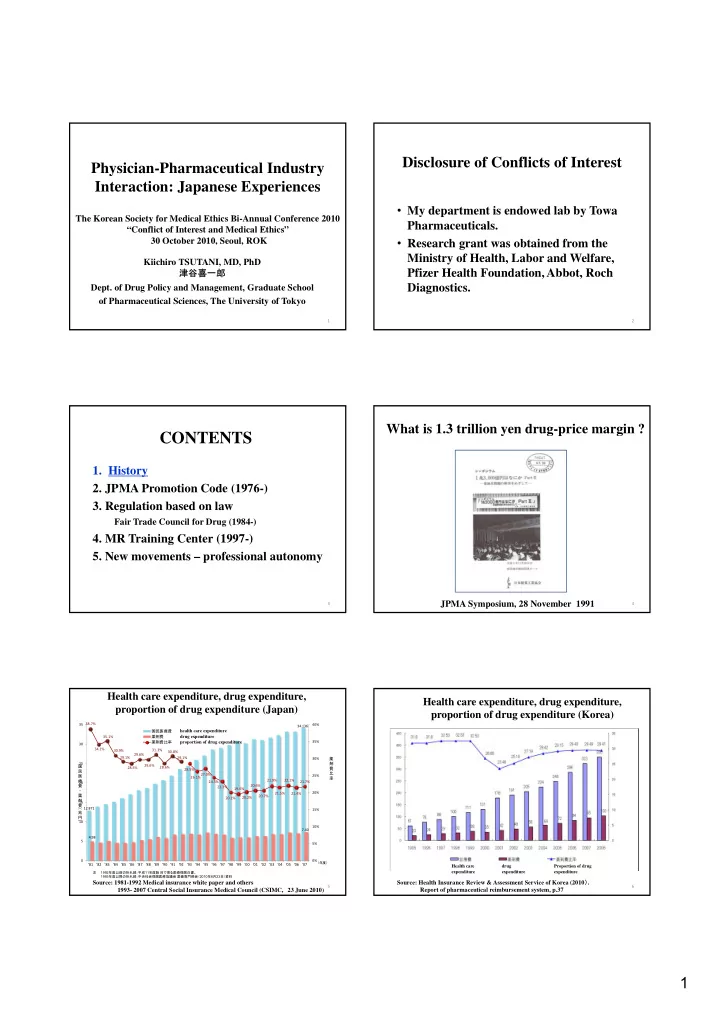
12.871 34.136 4.98 7.40 28.5% 26.1%27.0% 24.5% 23.3% 20.1% 19.6% 20.2% 20.6% 20.7% 21.9% 21.5% 22.1% 21.4% 21.7% 38.7% 34.1% 35.1% 30.9% 29.1% 28.5% 29.6% 29.6% 31.3% 28.6% 30.8% 29.1% 0% 5% 10% 15% 20% 25% 30% 35% 40% 5 10 15 20 25 30 35 '81 '82 '83 '84 '85 '86 '87 '88 '89 '90 '91 '92 '93 '94 '95 '96 '97 '98 '99 '00 '01 '02 '03 '04 '05 '06 '07 薬 剤 費 比 率 国 民 医 療 費 ・ 薬 剤 費 ( 兆 円 ) 国民医療費 薬剤費 薬剤費比率

health care expenditure drug expenditure proportion of drug expenditure

注 1992年度以前の折れ線:平成11年度版 目で見る医療保険白書。 1993年度以降の折れ線:中央社会保険医療協議会 薬価専門部会(2010年6月23日)資料

Source: 1981-1992 Medical insurance white paper and others 1993- 2007 Central Social Insurance Medical Council (CSIMC, 23 June 2010)

(年度)

Health care expenditure, drug expenditure, proportion of drug expenditure (Japan)

5

Health care expenditure, drug expenditure, proportion of drug expenditure (Korea)

6

Source: Health Insurance Review & Assessment Service of Korea (2010). Report of pharmaceutical reimbursement system, p.37

Health care expenditure drug expenditure Proportion of drug expenditure

slide-2
SLIDE 2

2

Separation of prescribing and dispensing in Japan

7

Source: Annual Report of Japan Pharmaceutical Association(2008-2009)

Physicians in health service system in Japan and Korea

8

Japan Korea Membership to medical association Voluntary membership to JMA Compulsory membership to KMA Health insurance physician Non compulsory Compulsory “Mixed payment” Prohibited No-problem Korean physicians seem to be “quasi civil servant”

Human resources in health (2008)

9

Japan (127 million) Korea (48 million) Number per 100,000 Number per 100,000 Physicians 283,915 224 95,013 198 Pharmacists 249,251 196 58,363 122 MR 58,000 46 ? ?

Source: Ministry of Health, Labor and Welfare (MHLW) of Japan Ministry of Health and Welfare (MHW) of Korea

Major stake holders affecting physicians- pharmaceutical industry relation

10

Physician Pharmacist Law/Gov.

Pharmaceutical industry

Short history (1) 1960s “Era of Premiums”(景品)sales

Economic status: rapid economic growth 1961 Universal health insurance coverage ⇒ Drug market expansion ⇒ Overheated non-price competition “extra” attachment (現品給付) “premiums” offer (景品類) “travel invitation”

11

Short history (2) 1970s

Era of “Compensation for discount”

Economics status: stable growth 1970 MHW noticed problems in distribution system

  • Drug company pays money to wholesaler for

compensation

  • Prohibited “extra” attachment
  • Deletion of four drugs from drug tariff

1976 JPMA promotion code 1979 MHW regulated “sample”(試供品) offer

12

slide-3
SLIDE 3

3 Short history (3) 1980s Era of Internationalization

General economic status: matured ⇒ Control medical expenditure 1981 Reduction of drug price (18.6%) Cartel by JPMA was accused by Fair Trade Commission 1984Fair Trade Council for Drug (日本医薬品公正取引協議会) established Early 1980s Trade conflict between US and Japan American pressure for open and transparent market 1985 Market Oriented Sector Selective (MOSS) Discussions 1989 Japan-US Structural Impediments Initiative (SII)

13

  • 1. History
  • 2. JPMA Promotion Code (1976-)
  • 3. Regulation based on law

Fair Trade Council for Drug (1984-)

  • 4. MR Training (1997-)
  • 5. New movements – professional autonomy

14

CONTENTS JPMA Promotion Code

日本製薬工業協会: 製薬協 1976 issued by JPMA, founding member of IFPMA (1968) 1967 WHA20.35 ethical criteria Self-regulation

  • to retain high ethical awareness
  • to comply with applicable regulations and

voluntary standards

  • to respond to social trust

1981 IFPMA Code 1988 WHO criteria for drug promotion JPMA code has been frequently revised.

15

Contents of Promotion Code (JPMA)

  • 1. Responsibility of member companies
  • 2. Responsibility of the top management of member companies
  • 3. Medical Representatives ’ activity standards
  • 4. Production and use of promotional materials and

advertisements

  • 5. Post-marketing safety control operations and post-marketing

surveillance

  • 6. Supply of samples
  • 7. Seminars and Study Meetings
  • 8. Gifts
  • 9. Provision of cash or its equivalents

10.Relations with “the Fair Competition Code of the Ethical Drug Manufacturing Industry” 11.Promotional activities outside Japan

16

FPMAJ Ethics code (1983)

(The Federation of Pharmaceutical Manufacturers’ Association of Japan: FPMAJ, 日本製薬団体連合会:日薬連)

17

http://www.fpmaj.gr.jp/sosikizu/index.htm JPMA→ Generic→ Kampo→ OTC→

  • 1. History
  • 2. JPMA Promotion Code (1976-)
  • 3. Regulation based on law

Fair Trade Council for Drug (1984-)

  • 4. MR Training Center (1997-)
  • 5. New movements – professional autonomy

18

CONTENTS

slide-4
SLIDE 4

4

19

Japan Korea

JPMA

Fair Trade Commission Fair Trade Commission

KPMA

Dual Punishment Law

Criminal Law Criminal Law

Criminal law case in 2000

Asahi Shimbun 18June 2000

20

“Bribery” charge is for civil servant only i.e. physicians at public hospital Bribery giver (pharm. company) Fine(罰金): up to 1 mil. yen Bribery taker (physician) imprisonment: 2 years with 3 years suspension

21

Sentence by the court,

  • n the basis of criminal law

Medical Ethics Council (医道審議会)

  • ne year and a half suspension of

medical practice of the physician

  • -- Bribery taker

Possible actions by Fair Trade Council for Drug (医療用医薬品公正取引協議会)

  • 1. Delisting from the enrollment in the Code
  • 2. Imposing Penalty (up to 1 mil. yen)
  • 3. (Stern Warning 厳重警告)
  • 4. Warning
  • 5. (Caution 注意)

22

Criticism to FTCD from media

Asahi shinbun 11 January 2001 “Too lenient to companies” Stern Warning

23

Fair Trade Council of the Ethical Pharmaceutical Drugs Marketing Industry (FTCD) 医療用医薬品製造販売業公正取引協議会

  • Established in 1984
  • Industry self regulatory body, supervised by Free Trade

Commission (FTC)

  • Function
  • to promote of knowledge and understanding of Code
  • to counsel, guide and dispose of complaints of Code
  • to investigate of suspected violation of Code
  • to spread of information concerning “the Act against

unjustifiable premiums and misleading representations” and laws and regulations

24

slide-5
SLIDE 5

5

Fair Competition Code in Ethical Pharmaceutical Drugs Marketing Industry

  • Objective

to prevent inducement of customers by restricting offers of unjustifiable premiums and misleading representations to ensure consumer’s independent and rational choice and fair competition between businesses entities

  • “Act against unjustifiable premiums and misleading

representations” (不当景品類及び不当表示防止法)

  • Authorized by Consumer Affairs Agency and Fair Trade

Commission (FTC) (公正取引委員会, 消費者庁 )

  • Three documents
  • Code(規約, 12 articles),
  • Enforcement rules(施行規則, 6 articles)
  • Guidelines(運用基準, 10 guidelines)

25

Contents of Code (12)

  • 1. Purpose and
  • 2. Definitions
  • 3. Principle of restriction on premium offers
  • 4. Examples of restricted premium offers
  • 5. Examples of non-restricted premium offers
  • 6. Restriction on premium offers to ethical

pharmaceutical drugs wholesalers

  • 7. Fair trade council
  • 8. Entrepreneurs’ obligation to cooperate
  • 9. Investigation of suspected violations
  • 10. Penalties for violations
  • 11. Decision on violation
  • 12. Establishment of enforcement rules

26

Contents of Guidelines (11)

I-1 The principle of premium offers I-2 Donations II The operation of article 4 of the Code III-1 Necessary and useful goods and services III-2 Medical or pharmaceutical information III-3 Drug samples III-4 Entrustment of research and studies III-5 Lecture meetings, etc. of an offerer’s pharmaceutical drugs Ⅳ-1 Small and fair premiums Ⅳ-2 Social gatherings Ⅳ-3 Memorial events

27

FTCD action for violation

Yr. HQ Branch(caution) 2004 2 7(1) 2005 1 1(1) 2006 6(3) 2007 1 3(2) 2008 2(1) 2009 17(7)

28

Source: FTCD(2010)

Example of “warning” on lecture meeting, 2010

29

  • 1. History
  • 2. JPMA Promotion Code (1976-)
  • 3. Regulation based on law

Fair Trade Council for Drug (1984-)

  • 4. MR Training Center (1997-)
  • 5. New movements – professional autonomy

30

CONTENTS

slide-6
SLIDE 6

6

MR Education & Accreditation Center of Japan (医療情報担当者教育センター)

  • Pre history

1991 FTC issued “antitrust act”guidelines. Price negotiation by “proper” prohibited. 1991 “Proper” ⇒ medical representative (MR)

  • Needs for qualification system-
  • Formally established in 1997
  • President: Dr. Fumimaro TAKAKU, President of JAMS

(日本医学会会長)

  • Objective
  • Qualifying examination of MR
  • MR training and education support
  • Research about MR

31

Pictures of text book (1996-)

32

2006 edition

Text books in Korean edition (2002- )

33

Trends in Numbers of MR in Japan

34

Source: MR Education & Accreditation Center of Japan

Total Male MR Female MR

Booklets to raise professionalism of MR Booklet of “Good things as a MR”

  • From negative image to positive one-

35

Source: MR Education & Accreditation Center of Japan

First “Proper” in Japan

  • Mr. Ninomiya & Dr. Rudolf Ebering

36

There will be 100 years anniversary ceremonial meeting of MR in 2012 in Japan

Source: Chugai pharmaceutical Co., Ltd.

slide-7
SLIDE 7

7

  • 1. History
  • 2. JPMA Promotion Code (1976-)
  • 3. Regulation based on law

Fair Trade Council for Drug (1984-)

  • 4. MR Training Center (1997-)
  • 5. New movements – professional autonomy

37

CONTENTS

New movements started two years ago

  • Working group of professionalism in the Japanese

Society of Internal Medicine was established since 2008.

  • Project “Sound relation between physicians and

pharmaceutical industry” started.

  • Conflict between “public interest” (EBM) and

“private interest” (gift and others from pharm. industries) is considered as COI

  • Introduce foreign studies, conduct studies in

Japan and stimulate constructive discussion.

38

Internet survey of Physician’s attitude towards gift from drug companies

39

Often sometimes rare never ball pen lunch box cocktail / memo text/CPG seasonal gift at meeting reception taxi ticket travel fee hotel fee copy/slide academic conf. ditto ditto ditto manuscript fee fee for clinical golf / travel lecture fee research private issues eating/drink / leisure

  • Miyata. Y. Igaku kyoku (Medical Education (Japan) ) 2000; 40(2): 95-104

Attitude toward relationships with pharmaceutical representatives

40

Saito S, et.al. Japanese practicing physicians’ relationships with pharmaceutical representatives: A national survey. PLoS One 2010; 5(8): e12193 “Self-serving bias”

Summary

  • There has been no “dual punishment” law in medical

field in Japan.

  • Activities by three sectors has been effective to

develop sound relation between physicians and industry to certain extent , i.e., i) Promotion code by industry association, ii) FTCD, and iii) MR education center.

  • Strict view by public and media to the relation

between physicians and industry have been effective.

  • Last few years, new movement on COI has evolved

among young physicians on the basis of professional autonomy

41

Acknowledgements

Ilsun SON, Dept. of Drug Policy and Management, Graduate School of Pharmaceutical Science, The Univ. of Tokyo Tsunehiko IWABUCHI, The Fair Trade Council of the Ethical Pharmaceutical Drugs Marketing Industry Toshihiko HIRABAYASHI, MR Education & Accreditation Center of Japan Masatoshi SHIBATA, Director, Japan Pharmaceutical Manufacturers Association (JPMA) Keiji YAMAMOTO, Biotech Bay Co. Ltd.; Former Representative, Eisai Korea Yasushi MIYATA, Center for Faculty of Community Oriented Medicine, Hokkaido University Hospital

42

slide-8
SLIDE 8

8

Kamsahamnida Thanks you

43