Contents 1 3 Executive summary - - PDF document

contents
SMART_READER_LITE
LIVE PREVIEW

Contents 1 3 Executive summary - - PDF document

Deliverable D7.1.3 Project Title: Developing an efficient e-infrastructure, standards and data-flow for metabolomics and its interface to biomedical and life science e- infrastructures in Europe and world-wide Project Acronym: COSMOS Grant


slide-1
SLIDE 1

Deliverable D7.1.3

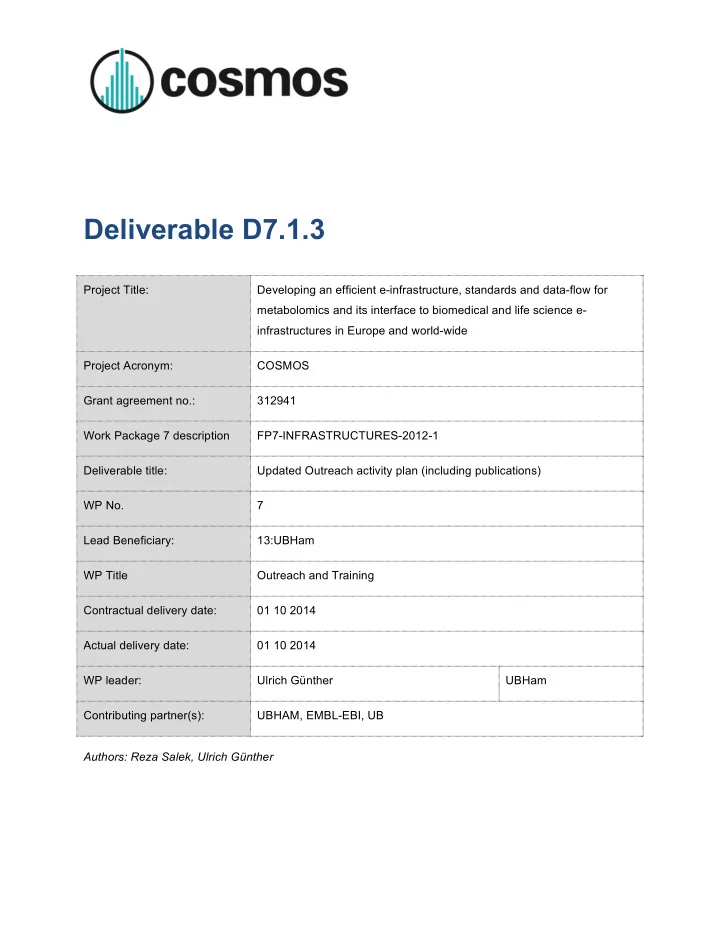
Project Title: Developing an efficient e-infrastructure, standards and data-flow for metabolomics and its interface to biomedical and life science e- infrastructures in Europe and world-wide Project Acronym: COSMOS Grant agreement no.: 312941 Work Package 7 description FP7-INFRASTRUCTURES-2012-1 Deliverable title: Updated Outreach activity plan (including publications) WP No. 7 Lead Beneficiary: 13:UBHam WP Title Outreach and Training Contractual delivery date: 01 10 2014 Actual delivery date: 01 10 2014 WP leader: Ulrich Günther UBHam Contributing partner(s): UBHAM, EMBL-EBI, UB Authors: Reza Salek, Ulrich Günther

slide-2
SLIDE 2

2 | 21 COSMOS Deliverable D7.1.3

Contents

1 ¡ Executive summary ................................................................................................................................. 3 ¡ 2 ¡ Project objectives .................................................................................................................................... 3 ¡ 3 ¡ Detailed report on the deliverable ........................................................................................................... 3 ¡ 3.1 ¡ Background ...................................................................................................................................... 3 ¡ 3.2 ¡ Description of Work .......................................................................................................................... 4 ¡ 3.2.1 COSMOS related publications ...................................................................................................... 4 ¡ 3.2.2 Workshops, Meetings, Conferences and Presentations ............................................................... 6 ¡ 3.2.3 COSMOS related news articles, and media activity .................................................................... 11 ¡ 3.2.4 Websites and articles referring COSMOS ................................................................................... 15 ¡ 3.3 ¡ Next steps ....................................................................................................................................... 16 ¡ 4 ¡ Publications ........................................................................................................................................... 16 ¡ 5 ¡ Delivery and schedule ........................................................................................................................... 18 ¡ 6 ¡ Adjustments made ................................................................................................................................ 18 ¡ 7 ¡ Efforts for this deliverable ...................................................................................................................... 18 ¡ Appendices .................................................................................................................................................. 18 ¡ Background information .............................................................................................................................. 19 ¡

slide-3
SLIDE 3

3 | 21 COSMOS Deliverable D7.1.3

1 Executive summary

The aim of this deliverable is to summarize outreach activity by the partners:

  • 1. Report on COSMOS outreach activity
  • 2. Report on COSMOS related publications
  • 3. Report on news article related to COSMOS activity and media relate

2 Project objectives

With this deliverable, the project has reached or the deliverable has contributed to the following

  • bjectives:

No. Objective Yes No 1 Out reach activity X 2

Report on the COSMOS related publications

X 3

Report on news articles and media activity related to COSMOS

X 4

Link to websites and articles where there is a reference to COSMOS

X 5

Future Outreach plans

X

3 Detailed report on the deliverable

3.1 Background

We will initially employ the usual channels for the disseminations of COSMOS standards, including scientific publications, workshops and presentations at metabolomics conferences to reach the wider metabolomics community. The project will plan activities adequately resourced

slide-4
SLIDE 4

4 | 21 COSMOS Deliverable D7.1.3

devoted to dissemination for specialised constituencies and the general public, in particular for awareness and educational purposes. The dissemination plan deliverable will consider adequate messages about the objectives of the project and its societal and economic impact. The tools we will use will include web-based communication, press releases, brochures, booklets, multimedia material, etc. The 'dissemination material' will be regularly updated to provide the latest version

  • f the project status and objectives. In all material produced in all dissemination activities we will

properly acknowledge the source of funding by prominently placing the FP7 and the European Commission logos.

3.2 Description of Work

3.2.1 COSMOS related publications

To date, several publications related to COSMOS have been published, with further papers in press or in preparation.

  • RM Salek, S Neumann, D Schober, J Hummel, K Billiau, J Kopka, E Correa, T Reijmers,

A Rosato, L Tenori, P Turano, A Marin, C Deborde, D Jacob, D Rolin, B Dartigues, K Haug, P Rocca-Serra, S O’Hagan, Jie Hao, M van Vliet, M Sysi-Aho, C Ludwig, J Bouwman, M Cascante, T Ebbels, JL. Griffin, A Moing, M Nikolski, M Oresic, SA Sansone, MR. Viant, R Goodacre, UL Günther, T Hankemeier, C Luchinat, D Walther and C Steinbeck. COSMOS - COordination of Standards in MetabOlomicS: Facilitating integrated metabolomics data access. Submitted to Metabolomics.

  • Orchard S, Albar JP, Binz PA, Kettner C, Jones AR, Salek RM, Vizcaino JA, Deutsch

EW, Hermjakob H. Meeting New Challenges: The 2014 HUPO-PSI/COSMOS Workshop: 13-15 April 2014, Frankfurt, Germany. Proteomics [2014]

  • Griss J, Jones AR, Sachsenberg T, Walzer M, Gatto L, Hartler J, Thallinger GG, Salek

RM, Steinbeck C, Neuhauser N, Cox J, Neumann S, Fan J, Reisinger F, Xu QW, Del Toro N, Pérez-Riverol Y, Ghali F, Bandeira N, Xenarios I, ... The mzTab Data Exchange Format: Communicating Mass-spectrometry-based Proteomics and Metabolomics Experimental Results to a Wider Audience. Mol Cell Proteomics [2014, 13(10):2765-2775

  • Alcarraz-Vizán, G., Sánchez-Tena, S., Moyer, M.P. and Cascante, M. 2014. Validation of

NCM460 cell model as control in antitumor strategies targeting colon adenocarcinoma metabolic reprogramming: Trichostatin A as a case study. Biochimica et Biophysica Acta (BBA) - General Subjects. 1840, 6 (Jun. 2014), 1634–1639.

  • Cacciatore, S., Luchinat, C. and Tenori, L. 2014. Knowledge discovery by accuracy
  • maximization. Proc. Natl Acad Sci USA. 111, 14 (Apr. 2014), 5117–5122.
  • Cortés, R., Tarrado-Castellarnau, M., Talancón, D., López, C., Link, W., Ruiz, D.,

Centelles, J.J., Quirante, J. and Cascante, M. 2014. A novel cyclometallated Pt( ii )– ferrocene complex induces nuclear FOXO3a localization and apoptosis and synergizes with cisplatin to inhibit lung cancer cell proliferation. Metallomics. 6, 3 (2014), 622–633.
slide-5
SLIDE 5

5 | 21 COSMOS Deliverable D7.1.3

  • Gracie, K., Correa, E., Mabbott, S., Dougan, J.A., Graham, D., Goodacre, R. and Faulds,
  • K. 2014. Simultaneous detection and quantification of three bacterial meningitis

pathogens by SERS. Chemical Science. 5, 3 (2014), 1030–1040.

  • Martín-Bernabé, A., Cortés, R., Lehmann, S.G., Seve, M., Cascante, M. and Bourgoin-

Voillard, S. 2014. Quantitative Proteomic Approach to Understand Metabolic Adaptation in Non-Small Cell Lung Cancer. Journal of Proteome Research. (Aug. 2014), 140825102233004.

  • Salamanca, B.V., Ebbels, T.M.D. and Iorio, M.D. 2014. Variance and covariance

heterogeneity analysis for detection of metabolites associated with cadmium exposure. Statistical Applications in Genetics and Molecular Biology. 13, 2 (Apr. 2014), 191–201.

  • Sánchez-Tena, S., Lizárraga, D., Miranda, A., Vinardell, M.P., García-García, F.,

Dopazo, J., Torres, J.L., Saura-Calixto, F., Capellà, G. and Cascante, M. 2013. Grape antioxidant dietary fiber inhibits intestinal polyposis in ApcMin/+ mice: relation to cell cycle and immune response. Carcinogenesis. 34, 8 (Aug. 2013), 1881–1888.

  • Sánchez-Tena, S., Vizan, P., Dudeja, P.K., Centelles, J.J. and Cascante, M. 2013.

Green tea phenolics inhibit butyrate-induced differentiation of colon cancer cells by interacting with monocarboxylate transporter 1. Biochimica et Biophysica Acta (BBA) - Molecular Basis of Disease. 1832, 12 (Dec. 2013), 2264–2270.

  • Valcárcel, B., Ebbels, T.M.D., Kangas, A.J., Soininen, P., Elliot, P., Ala-Korpela, M.,

Järvelin, M.-R. and De Iorio, M. 2014. Genome metabolome integrated network analysis to uncover connections between genetic variants and complex traits: an application to

  • besity. Journal of The Royal Society Interface. 11, 94 (May 2014), 20130908–

20130908.

  • Hao, J., M. Liebeke, W. Astle, M. De Iorio, J.G. Bundy, and T.M.D. Ebbels, Bayesian

deconvolution and quantification of metabolites in complex 1D NMR spectra using

  • BATMAN. Nature Protocols, 2014. 9(6): p. 1416-1427.
  • Valcarcel, B., T.M. Ebbels, A.J. Kangas, P. Soininen, P. Elliot, M. Ala-Korpela, M.R.

Jarvelin, and M. de Iorio, Genome metabolome integrated network analysis to uncover connections between genetic variants and complex traits: an application to obesity. J R Soc Interface, 2014. 11(94): p. 20130908.

  • Valcarcel Salamanca, B., T.M. Ebbels, and M.D. Iorio, Variance and covariance

heterogeneity analysis for detection of metabolites associated with cadmium exposure. Stat Appl Genet Mol Biol, 2014. 13(2): p. 191-201.Quantitative Proteomic Approach to Understand Metabolic Adaptation in Non-Small Cell Lung Cancer. J Proteome Res.(2014) In press. doi: 10.1021/pr500327v.

  • Martín-Bernabé, A.; Cortés, R.; Lehmann, S.G.;, Seve, M.; Cascante, M.; Bourgoin-

Voillard, S. Validation of NCM460 cell model as control in antitumor strategies targeting colon adenocarcinoma metabolic reprogramming: trichostatin A as a case study. Biochim Biophys Acta (2014) 1840(6):1634-9. doi: 10.1016/j.bbagen.2013.12.024

  • Gromski P., Xu Y., Kotze K.L., Correa E., Ellis D.I., Armitage E.G., Turner M.L.,

Goodacre R. Influence of missing values substitutes on multivariate analysis of metabolomics data. Metabolites 2014 4 pp. 433-452.

  • Gromski P., Xu Y., Correa E., Ellis D.I., Turner M.L., Goodacre R. A comparative

investigation of modern feature selection and classification approaches for the analysis of mass spectrometry data. Analytica Chimica Acta, 2014, 829, pp. 1-8.

slide-6
SLIDE 6

6 | 21 COSMOS Deliverable D7.1.3

  • Cacciatore et. al. Knowledge discovery by accuracy maximization. Proc Natl Acad Sci U

S A. 2014 Apr 8;111(14):5117-22

  • Emwas et al. Standardizing the Experimental Conditions for Using Urine in NMR-based

Metabolomic Studies with a Particular Focus on Diagnostic Studies: A Review, submitted

  • Wallner-Liebmann et al. The impact of free or standardized lifestyle and urine sampling

protocol on metabolome recognition accuracy, submitted

  • linkedISA: semantic representation of ISA-Tab experimental metadata. Alejandra

Gonzalez-Beltran, Eamonn Maguire, Susanna-Assunta Sansone, Philippe Rocca- Serra. BMCBioinformatics, in press. [acknowledgement to EU COSMOS EC312941).

  • Khanim F, Davies N, Veliça P, Hayden R, Ride J, Pararasa C, Chong MG, Gunther U,

Veerapen N, Winn P, Farmer R, Trivier E, Rigoreau L, Drayson M, Bunce C. Selective AKR1C3 inhibitors do not recapitulate the anti-leukaemic activities of the pan-AKR1C inhibitor medroxyprogesterone acetate. Br J Cancer. 18;110(6):1506-16 (2014).

  • Katarzyna M. Koczula, Christian Ludwig, Rachel Hayden, Laura Cronin, Guy Pratt,

Helen, Parry, Daniel Tennant, Mark Drayson, Christopher M. Bunce, Farhat L. Khanim, Ulrich L. Günther. Using NMR to Detect Metabolic plasticity in CLL: Adaptation to the hypoxic niche. Submitted.

3.2.2 Workshops, Meetings, Conferences and Presentations

All EMBL-EBI involved

  • 1. COSMOS/MetaboLights meeting, Imperial College London, 22nd January

2014 workshop for the Imperial college metabolomics groups

  • 2. NIH
  • The

Common Funds Metabolomics Infrastructure

  • workshop. Presentation on COSMOS & MetaboLights. San Diego, USA,

5th-8th February 2014 including participation in their group debates and discussion

  • 3. EMBL-EBI Agricultural-Omics course 17-21 February: This course was

setup to provide an overview of data resources, tools and analysis pipelines for 'omics datasets within the agricultural sciences. It was delivered using a mixture of lectures, practical computer sessions and discussions based on agricultural case studies and public domain data. Additionally there was

  • pportunity to review the key opportunities and challenges within this field. On

day five we provided and introduced hands on metabolomics databases, resources and standards. The course was located at EMBL-EBI, Cambridge

  • UK. http://www.ebi.ac.uk/training/course/agricultural-omics.
  • 4. RIKEN-MPI Joint Workshop On Forefront of Metabolomics and Future

Prospect RIKEN Japan 26 Feb 1 March. Presenting MetaboLights: Metabolomics data repository and the role of COSMOS" - COordination Of Standards In MetabOlomicS.

  • 5. A workshop and hand on MetaboLights and COSMOS and Tokyo

University 1 March. Presentation to participant and discussions on data standards and metabolomics data reposetories.

  • 6. First mzTab for metabolomics workshop, March 6-7 2014 - COSMOS

members together with the PSI community are holding the first “mzTab for metabolomics” workshop in Tübingen, Germany. Our aim is to drive reporting

  • f metabolomic results further using a standardized, open, easy accessible

and human readable tabular format. MzTab (version 1.0) already provides

slide-7
SLIDE 7

7 | 21 COSMOS Deliverable D7.1.3

basic support for reporting small molecules that we plan to extend and harmonize with the more advanced reporting scheme for proteins and peptides available in MzTab.

  • 7. EMBO Practical Course on Metabolomics Bioinformatics for Life

Scientists 2014. Metabolomics, COSMOS & MetaboLights. EMBL-EBI, UK, 17th-21st March 2014

  • 8. Metabolomics International Data Exchange meeting. COSMOS &
  • MetaboLights. EMBL-EBI, UK, 2nd-3rd April 2014
  • 9. Joint COSMOS and HUPO PSI meeting April 2014

In April 13-16 2014 the COSMOS (COordination Of Standards In MetabOlomicS) had a joint meeting with the proteomics HUPO Proteomics Standards Initiative community. This meeting will take place in Schloss Reinhartshausen Kempinski, Nr Frankfurt, Germany. HUPO-PSI has defined community standards for data representation in proteomics and has facilitated data comparison, exchange and verification within the proteomics community. Many open source MS formats including: mzML, mzTab, mzIdentML and mzQunatML as well guidelines for minimum information reporting requirement for proteomic and peptide identification have been developed within this

  • initiative. Working closely with the HUPO-PSI community should benefit the

metabolomics community, particularly the COSMOS effort in development of

  • pen MS exchange formats for metabolomics. We also hope to contribute to

the development of the MS based controlled vocabulary by PSI-MS by including the metabolomics community

  • ntology

requirement and terminology.

  • 10. Workshop: Hands on data submission to MetaboLights using ISATools.

And Maximizing ‘-Omics’ interoperability by promoting metabolomics

  • pen standards data exchange formats: The biologist view. Wednesday

21st May 2 hours during the 8th Meeting of the French Metabolomics and Fluxomics Network. https://colloque6.inra.fr/8_js_rfmf_lyon_2014/Ateliers/MetaboLights-CosMos

  • 11. EAWAG data management workshop, COSMOS & MetaboLights.

Switzerland, 25th June 2014

  • 12. Joint workshop with Biomed Central Gigascience Team at BGI Hong

Kong, and the ISA Team at the University of Oxford e-Research Centre who organized a hackathon in Hong Kong, June 2014. In June 2014, also supported by a BBSRC UK-China partnering award (BB/J020265/1), the Biomed Central Gigascience Team at BGI Hong Kong, and the ISA Team at the University of Oxford e-Research Centre organized a hackathon in Hong Kong, with participation of young scientists and ‘-omics’ data producers from local university and the UK metabolomics standards community (EMBL-EBI, COSMOS and Birmingham Metabolomics Centre). The goal was to establish common standards and curation practices for ‘omics’ data as well implement new ISA software (http://isatab.sourceforge.net), functionalities to facilitate deposition to MetaboLights repository (http://www.ebi.ac.uk/metabolights/), and support feature requests from journals using ISA formats, such as GigaScience (http://www.gigasciencejournal.com) and Scientific Data (http://www.nature.com/sdata/). The fruitful interaction between the participants over the duration of the meeting resulted in the delivery of an ISA-

slide-8
SLIDE 8

8 | 21 COSMOS Deliverable D7.1.3

Tab viewing component for web browsers (http://dx.doi.org/10.5281/zenodo.11084 for the code and http://isatab.sourceforge.net/examples.html), and the conversion

  • f

MetaboLights ISA-Tab content to RDF. Finally, efforts to deliver an API supporting the programmatic creation of an ISA-Tab document are well under

  • way. Owing to the success on this first ISA-thon event, the same teams will be
  • rganizing a follow-up meeting.
  • 13. Workshop was organized by COSMOS and the Data Standards Task

Group of the Metabolomics Society during the annual Metabolomics Society conference in Tsuruoka June 2014. Reza Salek (EMBL-EBI, UK) presented the current status and on-going developments worldwide on data standards, particularly the role of COSMOS (http://www.cosmos-fp7.eu). Steffen Neumann (Leibniz IPB, Halle Germany) gave an overview of data exchange formats in MS and how to get the users and instrument vendors

  • involved. Philippe Rocca-Serra (Oxford e-Research Centre, UK) presented

ISA-Tools for capturing metabolomics metadata, semantics and usage of RDF in metabolomics. In the second session, Scott Edmunds and Rob Davidson (GigaScience, Hong Kong) presented the Gigajournal point of view on publishing metabolomics data and workflows with the GigaScience, GigaDB and GigaGalaxy platforms. Susanna-Assunta Sansone (Nature Scientific Data) introduced NScD’s role in placing importance on data and the role that the NScD is playing on putting value in your datasets. The last two presentations were by Reza Salek and Padma Maruvada (NIH/NIDDK, USA) giving an overview of metabolomics repositories, MetaboLights and NIH Metabolomics WorkBench. We had plenty of interested discussion points on usage and promotion of standard, metabolomics data deposition and dissemination.

  • 14. TMIC - Metabolomics Data Standards and Data Processing Workshop,

COSMOS & MetaboLights. University of Edmonton, Canada, 15th-18th July 2014 Key areas covered during this meeting and workshop: ⎯ Overview of the current metabolomics data/metadata infrastructure. ⎯ Discussion of the key metadata items required for translation of experimental studies to online formats, which may be searched and analyzed ⎯ Discussion of conversion of different data types to formats suitable for transfer to the DRCC

  • Raw data (NMR,MS, etc)
  • Analytical metadata (including protocols),
  • Associated biological and clinical data

⎯ Final result datasets of quantitative/semi-quantitative metabolite values and appropriate substance identifiers. ⎯ Discussion on data upload issues ⎯ Discussion on online data presentation, search tools and statistical methods. (http://www.metabolomicsworkbench.org)

slide-9
SLIDE 9

9 | 21 COSMOS Deliverable D7.1.3

During this meeting we were able to have one-on-one discussions regarding COSMOS formats and data sharing as well as understanding the bioinformatics infrastructure of both project. We also agreed on next steps of collaboration in future.

  • 15. Metabomeeting 2014. COSMOS & MetaboLights. London, UK. 10th-12th

September 2014

  • 16. Summer Schools: Data Acquisition and Analysis in Metabolomics (Pula,

Cagliari), Italy, 15-20 September 2014, Topic covered Data standardisation in metabolomics and the role of COSMOS initiative, database and resources from EMBL-EBI for metabolomics data dissemination including data repository (MetaboLights) small molecular and metabolite (ChEBI) and pathways (Reactome). Other databases and open resource out there for metabolomics data handling, capturing results and data analysis were discussed. Also talks about a LIMS systems from collaboration work with Australia metabolomics for capturing metabolomics data and metadata that links to MetaboLights submission via ISA-tab format.

  • 17. MET-GR III workshop: Metabolic and Protein Network Analysis in

Systems Biology, Conference and Cultural Center of the University of Patras, September 18-20, 2014. Metabolomics data repositories MetaboLights (http://www.ebi.ac.uk/metabolights) at the European Bioinformatics Institute and the Metabolomics Work bench by the NIH (http://www.metabolomicsworkbench.org/) in US and many more specialized

  • repositories. Open exchange formats for data to make it as widely accessible

as possible, vendor independent, enriched with terminological artifacts to ease exchange and query metabolomics experiments were discussed. Overview of COSMOS and its aims to develop and maintain exchange formats for raw data and processed information (identification, quantification), building

  • n

experience from standards developed within the Metabolomics Standards Initiative (MSI) and Proteomics Standards Initiative, (PSI) was presented. Also, the role that metabolomics repositories can play in adoption of such standards and making metabolomics results more extensively accessible.

  • 18. Annual COSMOS meeting. Wittenberg, Germany. 24-26 September 2014.

COSMOS Partners involved

  • Computational Lab-based course. Szeged, Hungary. 21-22 October 2013. Workshop

attended by Dr. Marta Cascante and Dr. Pedro de Atauri.

  • Metabolic flux and Cancer Meeting. Budapest, Hungary. 23-25 October 2013.

Meeting attended by Dr. Marta Cascante and Dr. Pedro de Atauri. Marta Cascante gave an oral presentation: Estimation of metabolic fluxes by tracer based metabolomics: application in targeting metabolic reprogramming of cancer cells. Marta Cascante. (25th October 2013).

  • Symposium “Metabolism, at the core of disease”. Barcelona, Spain. 22 November
  • 2013. Symposium attended by Dr. Marta Cascante and Dr. Silvia Marin. Silvia Marin

gave an oral presentation: Estimation of metabolic fluxes in health and diseases by tracer-based metabolomics.

slide-10
SLIDE 10

10 | 21 COSMOS Deliverable D7.1.3

  • EMBO Practical Course on Metabolomics Bioinformatics for Life Scientists.

Hinxton, Cambridgeshire, UK. 17-21 March 2014. Course attended by Dr. Marta Cascante, Mr. Igor Marin de Mas and Ms. Anusha Jayamaran. Anusha Jayamaran attended as student. Marta Cascante and Igor Marin de Mas were teachers of Metabolomics flux and genome scale session (21st March 2014, 9:45-13:00h).

  • Cellular signalling and cancer therapy Meeting. Cavtat, Croatia. 23-27 May 2014.

Meeting attended by Ms. Erika Zodda, who presented one poster (detailed in Poster presentation section).

  • 10th Annual International Conference of the Metabolomics Society, Metabolomics
  • 2014. Tsuruoka, Japan. 23-27 June 2014. Meeting attended by Dr. Marta Cascante and
  • Dr. Pedro de Atauri. Pedro de Atauri presented one poster (detailed in Poster

presentation section). Marta Cascante gave an oral presentation: Identification of the metabolic reprogramming underlying metastasis in prostate cancer by combining multi-

  • mic approaches and model-driven data analysis. Marta Cascante (Session 2A-D: Flux,

microbiology and parasitology; 24th June 2014, 10:30-12:10h).

  • ENC 2014, Boston. U Günther presented “Deciphering Cancer Metabolism by

Metabolic Flux Analysis”.

  • October, 16th, 2014 User meeting of the IR-RMN THC, Grenoble. Invited speaker,

Claudio Luchinat

  • FEBS EMBO 2014 Conferencem September, 1th 2014. Presentation given by Claudio

Luchinat

  • Italian congress of food chemistry, Florence July, 6th, 2014. Presentation given by

Claudio Luchinat

  • GIDRM Workshop on food chemistry, Rome May, 27th, 2014. Presentation given by

Claudio Luchinat

  • XII International Conference on the Applications of Magnetic Resonance in Food

Science May, 20th, 2014. Presentation given by Leonardo Tenori

  • GIDRM Workshop on quantitative NMR, Rome May, 12th, 2014. Presentation given by

Leonardo Tenori

  • Applications of metabolomics: from individual fingerprint to milk analysis.

Coimbra (Portugal) January, 7th, 2014 - Seminar given at University of Coimbra by Claudio Luchinat

  • Workshop: Hands on data submission to MetaboLights using ISATools. And

Maximizing ‘-Omics’ interoperability by promoting metabolomics open standards data exchange formats: The biologist view. Wednesday 21st May 2 hours during the 8th Meeting of the French Metabolomics and Fluxomics Network. https://colloque6.inra.fr/8_js_rfmf_lyon_2014/Ateliers/MetaboLights-CosMos

  • Brief presentation of COSMOS objectives in two seminars: Moing A (2013)

Multiplatform metabolomics analysis of melon, grapes, Prunus species and tomato.

  • Workshop on Plant Metabolomics, 9-13 December 13, PRI, Wageningen,

Netherlands, Invited Seminar.

  • Moing A (2014) Metabolomics: principles and applications for the study of fruit

metabolism and quality. 17 April 2014, Department of Agronomy, Food, Natural resources, Animals and Environment, University of Padova, Italy, Invited Seminar

  • Barcelona development Meeting, January 2014: Preliminary requirement gathering for

furthering fluxomics data reporting standards. Collaboration with Pr Marta Cascante and Dr Silvia Marin.

  • ISATeam- BMC GigaScience -Metabolight - University of Birmingham Hackathon,

Hong-Kong 2014. Hackathon organized to train users to create ISA-Tab files for Metabolomics Datasets.

slide-11
SLIDE 11

11 | 21 COSMOS Deliverable D7.1.3 Poster presentation:

  • MetaboLights - A cross-species database for metabolomics experiments and derived
  • information. Kenneth Haug, Reza M. Salek, Pablo Conesa, Janna Hastings, Mark

Williams, Eamonn Maguire, Alejandra González-Beltrán, Philippe Rocca-Serra, Susanna-Assunta Sansone, Jules Griffin and Christoph Steinbeck

  • Authors: Zodda E., Aguilar E., Marin De Mas I., Marin S., Selivanov V., de Atauri P.,

Meca-Cortés O., Thomson T., Papp B., Cascante M. Title: Identification of the metabolic reprogramming underlying metastasis in prostate cancer by combining multi-omic approaches and model-driven data analysis.

  • Meeting: Cellular signalling and cancer therapy. EMBO Conference 50 years. Place:

Cavtat, Croatia. Data: 23-27 May 2014. Authors: de Atauri P., Tarrado-Castellarnau M., Tarrago-Celada J., Marin S., Yuneva M., Cascante M. Title: Computational analysis of gene expression involved in metabolic reprogramming associated to CDK4/CDK6 inhibition in HCT116 colon tumour-derived cells.

3.2.3 COSMOS related news articles, and media activity

MetaboNews December issue: Status of Data Standards: The COordination of Standards in MetabOlomicS (COSMOS) consortium (http://www.cosmos-fp7.eu) together with Proteomics Standards Initiative (PSI) is working towards completing the existing mzTab format (http://www.psidev.info/) to better capture small molecules data and meta-data. mzTab can be used for reporting both metabolite identification and metabolomics quantification. After extensive research and discussions within the consortium and members of the MSI and PSI community, we concluded that mzTab is the medium of choice for capturing and reporting such metabolomics results. To test and evaluate the standard, the mzTab development is accompanied by early implementations, e.g., in development versions of the OpenMS (http://open-ms.sourceforge.net/), or separate export functions for XCMS and CAMERA (http://www.bioconductor.org/) software tools. In addition, the MetaboLights metabolomics database (http://www.ebi.ac.uk/metabolights) accepts the quantification and identification of metabolites in a subset of mzTab, soon to be updated to the full compatible version, once the final discussions on the mzTab format for small molecules are completed. We are planning to have an “mzTab for metabolomics” workshop in Tübingen (in March 2014) for discussion and work on metabolomics extensions for mzTab. We hope to adopt and finalize the format and eventually submit it to the community for review. The workshop is organised jointly by Steffen Neumann (Leibniz Institute of Plant Biochemistry, IPB Halle) and Oliver Kohlbacher (Tübingen University), one of the leading members in the mzTab development in the PSI. For details, please visit http://cosmos-fp7.eu/mzTab. MetaboNews January issue: Status of Data Standards: One of the aims of the COordination

  • f Standards in MetabOlomicS (COSMOS) consortium (http://www.cosmos-fp7.eu) is to gather

metabolomics requirements for other major e-infrastructures such as BioMedBridges (http://www.biomedbridges.eu/), BBMRI (http://bbmri.eu/), ELIXIR (http://www.elixir-europe.org/) and EU-OPENSCREEN (http://www.eu-openscreen.de/). The University of Florence as a third party of CIRMMP (http://www.cerm.unifi.it/about-cerm/cirmmp) coordinates the gathering and requirements of metabolomics data with the above-mentioned e-infrastructures. Coordination

slide-12
SLIDE 12

12 | 21 COSMOS Deliverable D7.1.3

with BioMedBridges and biomedical ESFRI infrastructures (the European Strategy Forum on Research Infrastructures), aims to foster their co-operation and interaction with COSMOS. The interaction with BioMedBridges occurred through the participation of COSMOS delegates at meetings and workshops organized by the BioMedBridges. Strong interactions between COSMOS and BBMRI have been established to coordinate efforts. For this reason, Kurt Zatloukal, coordinator of BBMRI has been nominated among the Advisory Board of COSMOS. The ELIXIR Hub will be connected to ELIXIR Nodes to provide infrastructure for data, computing tools and standards as well as training and support for the ESFRI biological and medical science infrastructures. The link from COSMOS to ELIXIR is via MetaboLights (http://www.ebi.ac.uk/metabolights/); an open access repository housing metabolomics-based

  • experiments. The coordination outcome will be published on the COSMOS (http://www.cosmos-

fp7.eu) website. MetaboNews February and March issue: Status of Data Standards: Development of nmrML format: Currently, the most widely used data exchange format for NMR data is JCAMP-DX version 6.0 by the Joint Committee on Atomic and Molecular Physical Data (Davies and Lampen, 1993), but the specification is not very rigorous and many different flavors exist in the wild, which can lead to incompatibilities between different software packages. It is also not easily extendable to capture supplementary information. The MSI workgroups have provided detailed suggestions about the minimum information metadata to be captured for a NMR experiment. In particular, the MSI, had put forth recommendations to report instrument descriptions and configurations, instrument-specific sample preparation and data acquisition parameters (Rubtsov, Jenkins et al., 2007), which resulted in a first round of NMR XML data standard development, focusing on raw and processed one- and two-dimensional NMR experiments and associated metadata (Ludwig, Easton et al., 2012). Inspired by the huge success of mzML in mass spectrometry, the COSMOS COordination Of Standards In MetabOlomicS (http://cosmos- fp7.eu) consortium has joined forces with other groups and has now merged and adopted existing schemata into a new nmrML format (http://nmrml.org). The format consists of the XML schema that defines the structure of an nmrML file. This structure is deliberately kept simple to ease the task of implementation, and avoid the need for frequent changes when the terminology needs to accommodate upcoming new technologies and parameters. Instead, these will be annotated in the nmrML file using the second component of nmrML, the controlled vocabulary terms from the nmrCV ontology. The nmrCV is based on earlier work at the EMBL-EBI (Sansone, Schober et al., 2007) and efforts at The Metabolomics Innovation Centre (David Wishart Group). The nmrCV contains nearly 600 terms and partly relies on external sources like ChEBI for chemical information, thus making it an integrative resource. Term request can be channeled through the issue tracker/mailing list. We also provide early prototypes for file converters from vendor formats to nmrML, as well as parser libraries for Java, R and python, which can be used by open NMR processing and analysis software. The development of nmrML is taking place on Github (https://github.com/nmrML/nmrml), where the specification documents, more detailed descriptions of our use cases, examples files and the parser libraries can be

  • found. We are now providing a first nmrML release candidate at http://nmrml.org for public

consultation and feedback. MetaboNews April issue: Status of Data Standards: Joint COSMOS and HUPO PSI Meeting: In April 13-16 the COSMOS (COordination Of Standards In MetabOlomicS) is planning to participate and to have a joint meeting with the proteomics HUPO Proteomics Standards Initiative community. This meeting will take place in Schloss Reinhartshausen Kempinski, Nr Frankfurt, Germany. HUPO-PSI has defined community standards for data representation in proteomics and has facilitated data comparison, exchange and verification within the proteomics

  • community. Many open source MS formats including: mzML, mzTab, mzIdentML and
slide-13
SLIDE 13

13 | 21 COSMOS Deliverable D7.1.3

mzQuantML as well as guidelines for minimum information reporting for proteomic and peptide identification have been developed within this initiative. Working closely with the HUPO-PSI community should benefit the metabolomics community, particularly the COSMOS effort in development of open MS exchange formats for metabolomics. We also hope to contribute to the development of the MS-based controlled vocabulary by PSI-MS by adding the metabolomics community ontology requirement and terminology artifacts. More details can be found at: http://cosmos-fp7.eu/PSI and http://www.psidev.info/psi2014 MetaboNews March 2013: MetaboLights - The new EBI Metabolomics database: Kenneth Haug, Dr. Reza M. Salek, Pablo Conesa, Tejasvi Mahendraker, Dr. Mark Williams, Dr. Julian L. Griffin, Dr. Christoph Steinbeck. (http://www.metabonews.ca/Mar2013/MetaboNews_Mar2013.htm#spotlight): ABSTRACT MetaboLights - The new EBI Metabolomics database. Over the past ten years a significant number of databases for Metabolomics have been created, differing in the types of data, species and applications they cover. Recently, efforts are underway to establish large- scale repositories for metabolomics data as they exist for the other omics areas, both in Europe as well as in the United States. MetaboNews: September 2013: Metabointerview with Dr Tim Ebbels, highlights work of COSMOS. http://www.metabonews.ca/Sep2013/MetaboNews_Sep2013.htm#MetaboInterviews MetaboNews July 2014: Metabolomics Data Interoperability Interest Group (https://www.rd- alliance.org/group/metabolomics.html) has been formed as part of the Research Data Alliance (RDA, https://www.rd-alliance.org/). The RDA is dedicated to enabling open data sharing in science and is supported by, for example, the National Science Foundation (NSF) in the USA and the European Commission.

  • The Metabolomics Data Interoperability Interest Group (IG) in the RDA aims to provide a

forum to discuss all aspects of metabolomics data management and harmonisation. The initial membership of the Metabolomics Data Interoperability IG is drawn from the leaders

  • f several internationally recognised research programmes that are developing

metabolomics databases and from the international Metabolomics Society’s Board of

  • Directors. It encourages a broad group of researchers, technologists, and curators to join

as members to address issues of data interoperability and sharing in metabolomics. Currently, the interest group is chaired by Christoph Steinbeck, whose team develops the MetaboLights database at EMBL-EBI in Hinxton, as well as Shankar Subramaniam, leader of the Metabolomics workbench project in the US.

  • In particular, this IG will address interoperability of databases and the coordination of
  • standards. In addition, there are obvious synergies with other existing technical and

domain specific Interest Groups and Working Groups in the Research Data Alliance, including (but not limited to) the Big Data Analytics IG, Data Foundation and Terminology Working Group, or the Toxicogenomics IG.

slide-14
SLIDE 14

14 | 21 COSMOS Deliverable D7.1.3

MetaboNews August 2014: A workshop was organized by COSMOS and the Data Standards Task Group of the Metabolomics Society during the annual Metabolomics Society conference in June held at Tsuruoka, Japan. Reza Salek (EMBL-EBI, UK) presented the current status and

  • n-going developments worldwide on data standards, particularly the role of COSMOS

(http://www.cosmos-fp7.eu). Steffen Neumann (Leibniz IPB, Halle Germany) gave an overview

  • f data exchange formats in MS and how to get the users and instrument vendors involved.

Philippe Rocca-Serra (Oxford e-Research Centre, UK) presented ISA-Tools for capturing metabolomics metadata, semantics and usage of RDF in metabolomics. In the second session, Scott Edmunds and Rob Davidson (GigaScience, Hong Kong) presented the Gigajournal point

  • f view on publishing metabolomics data and workflows with the GigaScience, GigaDB and

GigaGalaxy platforms. Susanna-Assunta Sansone (Nature Scientific Data) introduced NScD’s role in placing importance on data and the role that the NScD is playing on putting value in your

  • datasets. The last two presentations were by Reza Salek and Padma Maruvada (NIH/NIDDK,

USA) giving an overview of metabolomics repositories, MetaboLights and NIH Metabolomics

  • WorkBench. We had plenty of interested discussion points on usage and promotion of standard,

metabolomics data deposition and dissemination.

  • In June 2014, also supported by a BBSRC UK-China partnering award (BB/J020265/1),

the Biomed Central Gigascience Team at BGI Hong Kong, and the ISA Team at the University of Oxford e-Research Centre organized a hackathon in Hong Kong, with participation of young scientists and ‘-omics’ data producers from local university and the UK metabolomics standards community (EMBL-EBI, COSMOS and Birmingham Metabolomics Centre). The goal was to establish common standards and curation practices for

  • mics

data as well implement new ISA software (http://isatab.sourceforge.net) functionalities to facilitate deposition to MetaboLights repository (http://www.ebi.ac.uk/metabolights/) and support feature requests from journal using ISA formats, such as GigaScience (http://www.gigasciencejournal.com) and Scientific Data (http://www.nature.com/sdata/). The fruitful interaction between the participants over the duration of the meeting resulted in the delivery of an ISA-Tab viewing component for web browsers (http://dx.doi.org/10.5281/zenodo.11084 for the code and http://isatab.sourceforge.net/examples.html), and the conversion

  • f

MetaboLights ISA-Tab content to RDF. Finally, efforts to deliver an API supporting the programmatic creation of an ISA-Tab document are well under way. Owing to the success on this first ISA-thon event, the same teams will be organizing a follow-up meeting. The UB: partner of the European project COSMOS to generate and promote new models to exchange metabolomics data: News of Universitat de Barcelona, 04/2013 (http://www.ub.edu/web/ub/en/menu_eines/noticies/2013/04/091.html) The UB: partner of the European project COSMOS to generate and promote new models to exchange metabolomics data: News of Fundació Bosch I Gimpera, 04/2013 (http://www.fbg.ub.edu/index.php/en/home-7/18-noticies/699-13-projecte-cosmos-eng)

slide-15
SLIDE 15

15 | 21 COSMOS Deliverable D7.1.3

BioSiIMeC jointly organizing the project COSMOS-FP7: News of the XRQTC (Xarxa de Referència de Química Teòrica i Computacional), 02/2013 (http://www.xrqtc.com/index.php/en/News/biosiimec-jointly-organizing-the-project-cosmos- fp7.html) Brochure, BioTOP Annual Report 2013, BioTOP is an organization that coordinates health- and bioscience-related research and commercial activities in the Berlin/Brandenburg region http://www.healthcapital.de/fileadmin/biotop/Dokumente/BioTOPics/BioTOPics46.pdf Press release, MPI for Molecular Plant Physiology, 2012 http://www.mpimp- golm.mpg.de/81899/2012-10-17

Social media:

https://twitter.com/cosmosfp7 https://www.facebook.com/Cosmosfp7 Blogs: http://blogs.biomedcentral.com/gigablog/2014/08/22/aint-no-party-like-a-bring-your-own-data- party/

3.2.4 Websites and articles referring COSMOS

COSMOS has been mentioned on numerous websites. These are:

  • COSMOS website with content management system, separate login for partners and

work package leaders in production (http://www.cosmos-fp7.eu)

  • The EMBL-EBI Group website, with references to the group’s publications

(http://www.ebi.ac.uk/metabolights, http://link.springer.com/article/10.1007%2Fs11306- 012-0462-0, and http://www.ebi.ac.uk/steinbeck/publications.html).

  • The Genome web: http://www.genomeweb.com/informatics/ebi-launches-cosmos-

initiative-standardize-metabolomics-data-sharing

  • EBI Australia: http://www.ebi.edu.au/research/metabolomics-standards-project-

launches

  • Technology Networks- Metabolomics and lipidomics:

http://www.technologynetworks.com/metabolomics/news.aspx?id=145425

  • The Golm Metabolome Database (GMD,http://gmd.mpimp-golm.mpg.de/) website

acknowledge and links back to the COSMOS website.

  • Bordeaux Metabolome Facility Website: http://www.cgfb.u-bordeaux2.fr/en/metabolome
  • A free sourceforge site for storing documents and data related to software and tools

development: http://sourceforge.net/projects/cosmos-fp7/

  • Link to COSMOS within “about-crem” webpage under “EU project”:

http://www.cerm.unifi.it/about-cerm/eu-projects

  • NewsLetter COSMOS 2013 : NewsLetter-COSMOS(CGFB/CBIB)
slide-16
SLIDE 16

16 | 21 COSMOS Deliverable D7.1.3

COSMOS related activity source code

  • http://sourceforge.net/projects/cosmos-fp7/
  • http://cosmos-fp7.eu/nmrML/
  • https://github.com/nmrML/nmrML/wiki
  • http://www.bq.ub.es/bioqint/Proyectoseng.html
  • A web link towards COSMOS website added in News on Bordeaux Metabolome Facility website:

http://www.cgfb.u-bordeaux2.fr/en/metabolome

  • A

github repository for Xeml Lab Designer-version 1.0 (for Linux, Windows and Mac).https://github.com/cbib/XEML-Lab

3.3 Next steps

  • 1. Prepare a specific New Article, distribute as a pdf newsletter.
  • 2. Further links to WEB sites.
  • 3. Update press release after establishment of online tools.

4 Publications

  • 1. Orchard S, Albar JP, Binz PA, Kettner C, Jones AR, Salek RM, Vizcaino JA, Deutsch

EW, Hermjakob H. Meeting New Challenges: The 2014 HUPO-PSI/COSMOS Workshop: 13-15 April 2014, Frankfurt, Germany.rchard S, Albar JP, Binz PA, Kettner C, Jones AR, Salek RM, Vizcaino JA, Deutsch EW, Hermjakob H. Proteomics [2014] 2.Griss J, Jones AR, Sachsenberg T, Walzer M, Gatto L, Hartler J, Thallinger GG, Salek RM, Steinbeck C, Neuhauser N, Cox J, Neumann S, Fan J, Reisinger F, Xu QW, Del Toro N, Pérez-Riverol Y, Ghali F, Bandeira N, Xenarios I. The mzTab Data Exchange Format: Communicating Mass-spectrometry-based Proteomics and Metabolomics Experimental Results to a Wider Audienc. Mol Cell Proteomics [2014, 13(10):2765- 2775]

  • 3. Hao, J., M. Liebeke, W. Astle, M. De Iorio, J.G. Bundy, and T.M.D. Ebbels, Bayesian

deconvolution and quantification of metabolites in complex 1D NMR spectra using

  • BATMAN. Nature Protocols, 2014. 9(6): p. 1416-1427.
  • 4. Valcarcel, B., T.M. Ebbels, A.J. Kangas, P. Soininen, P. Elliot, M. Ala-Korpela, M.R.

Jarvelin, and M. de Iorio, Genome metabolome integrated network analysis to uncover connections between genetic variants and complex traits: an application to obesity. J R Soc Interface, 2014. 11(94): p. 20130908.

slide-17
SLIDE 17

17 | 21 COSMOS Deliverable D7.1.3

  • 5. Valcarcel Salamanca, B., T.M. Ebbels, and M.D. Iorio, Variance and covariance

heterogeneity analysis for detection of metabolites associated with cadmium

  • exposure. Stat Appl Genet Mol Biol, 2014. 13(2): p. 191-201.
  • 6. Alcarraz-Vizán, G., Sánchez-Tena, S., Moyer, M.P. and Cascante, M. 2014.

Validation of NCM460 cell model as control in antitumor strategies targeting colon adenocarcinoma metabolic reprogramming: Trichostatin A as a case study. Biochimica et Biophysica Acta (BBA) - General Subjects. 1840, 6 (Jun. 2014), p. 1634– 1639.

  • 7. Cacciatore, S., Luchinat, C. and Tenori, L. 2014. Knowledge discovery by accuracy
  • maximization. Proc. Natl Acad Sci USA. 111, 14 (Apr. 2014), p. 5117–5122.
  • 8. Cortés, R., Tarrado-Castellarnau, M., Talancón, D., López, C., Link, W., Ruiz, D.,

Centelles, J.J., Quirante, J. and Cascante, M. 2014. A novel cyclometallated Pt( ii )– ferrocene complex induces nuclear FOXO3a localization and apoptosis and synergizes with cisplatin to inhibit lung cancer cell proliferation. Metallomics. 6, 3 (2014), p. 622–633.

  • 9. Gracie, K., Correa, E., Mabbott, S., Dougan, J.A., Graham, D., Goodacre, R. and

Faulds, K. 2014. Simultaneous detection and quantification of three bacterial meningitis pathogens by SERS. Chemical Science. 5, 3 (2014), p. 1030–1040.

  • 10. Martín-Bernabé, A., Cortés, R., Lehmann, S.G., Seve, M., Cascante, M. and

Bourgoin-Voillard, S. 2014. Quantitative Proteomic Approach to Understand Metabolic Adaptation in Non-Small Cell Lung Cancer. Journal of Proteome

  • Research. (Aug. 2014).
  • 11. Salamanca, B.V., Ebbels, T.M.D. and Iorio, M.D. 2014. Variance and covariance

heterogeneity analysis for detection of metabolites associated with cadmium

  • exposure. Statistical Applications in Genetics and Molecular Biology. 13, 2 (Apr. 2014),
  • p. 191–201.
  • 12. Sánchez-Tena, S., Lizárraga, D., Miranda, A., Vinardell, M.P., García-García, F.,

Dopazo, J., Torres, J.L., Saura-Calixto, F., Capellà, G. and Cascante, M. 2013. Grape antioxidant dietary fiber inhibits intestinal polyposis in ApcMin/+ mice: relation to cell cycle and immune response. Carcinogenesis. 34, 8 (Aug. 2013), p. 1881–1888.

  • 13. Kirsten Gracie, Elon Correa, Samuel Mabbott, Jennifer A. Dougan, Duncan Graham,

Royston Goodacre and Karen Faulds. “Simultaneous detection and quantification of three bacterial meningitis pathogens by SERS”. Chem. Sci., 2014, 5, 1030.

  • 14. Royston Goodacre, “Water, water, every where, but rarely any drop to drink”

Metabolomics February 2014, Volume 10, Issue 1, pp 5-7

slide-18
SLIDE 18

18 | 21 COSMOS Deliverable D7.1.3

  • 15. Gromski P., Xu Y., Kotze K.L., Correa E., Ellis D.I., Armitage E.G., Turner M.L.,

Goodacre R. Influence of missing values substitutes on multivariate analysis of metabolomics data. Metabolites 2014 4 pp. 433-452

5 Delivery and schedule

The delivery is delayed: Yes No

6 Adjustments made

N/A

7 Efforts for this deliverable

Institute Person-months (PM) Period actual estimated 1:EMBL-EBI

0.5

2:LU/NMC 7:UB

0.2

13:UBHAM Total

0.7 1

Appendices

  • 1. N/A
slide-19
SLIDE 19

19 | 21 COSMOS Deliverable D7.1.3

Background information

This deliverable relates to WP7; background information on this WP as originally indicated in the description of work (DoW) is included below. WP7 Title: Outreach and Training Lead: Ulrich Günther, UBHam Participants: Ulrich Günther This work package will provide a close link between the COSMOS consortium and the wider metabolomics and the biomedical community. We will raise community awareness for the services provided by the COSMOS consortium, from data submission support to different views on metabolomics data, but also for the increasingly stringent requirements for data availability as part

  • f the metabolomics publication process. Through the existing framework of the Metabolomics

Society, we will ensure broad community input into the services developed by the COSMOS consortium and the standards for Metabolomics data representation developed in this proposal. This deliverable relates to WP7; background information on this WP as originally indicated in the description of work (DoW) is included below. Work package number WP7 Start date or starting event: Month 1 Work package title Outreach and Training Activity Type COORD Participant number 1: EMBL-EBI 2: LU/NC 7: UB 13UBHam Person-months per participant 8 2 4 8 Objectives

  • 1. Provide link between the COSMOS consortium and the wider metabolomics and the

biomedical community

  • 2. Raise community awareness for the services provided by the COSMOS consortium
  • 3. Collect broad community input into services developed by the COSMOS consortium

Description of work and role of participants We will initially employ the usual channels for the disseminations of COSMOS standards, including scientific publications, and workshops and presentations at metabolomics conferences to reach the wider metabolomics community. The project will plan activities adequately resourced devoted to dissemination for specialised constituencies and general public, in particular for awareness and educational purposes. The

slide-20
SLIDE 20

20 | 21 COSMOS Deliverable D7.1.3

dissemination plan deliverable will consider adequate messages about the objectives of the project and its societal and economic impact. The tools we will use will include web-based communication, press releases, brochures, booklets, multimedia material,etc. The 'dissemination material' will be regularly updated to provide the latest version of the project status and objectives. Electronic and/or paper versions of this 'dissemination material' will be made available to the Project Officer beforehand for consultation and upon its final release. In all material produced in all dissemination activities we will properly acknowledge the source of funding by prominently placing the FP7 logo and the European Commission logo. We will create and maintain the consortium website in an open source content management

  • system. The website will have an EU domain such as www.cosmos-fp7.eu. This website will have a

specific COSMOS branding with a professionally designed COSMOS logo to reflect the collaborative and international nature of the consortium. The COSMOS website will allow for content management by the partners, additional component (intranet, calendar, web site search), advanced analytics, functional testing, and communication via mailing lists. COSMOS will also build close links between the COSMOS consortium and the European and International metabolomics community, and the wider biomedical community. For this COSMOS will build on existing links with other EU and International initiatives (e.g. EU projects including the ESFRI infrastructures ELIXIR, BioMedBridges, EU Openscreen, and the IRSES Word Wide NMR to build links international stakeholders in China, specifically the Wuhan metabolomics center, India, and South America). Moreover, COSMOS will build links metabolomics groups in Canada (HMDB, Wishart) and the US (BMRB; see letters of support), both running major metabolomics WEB portals. COSMOS will also build an intensive dialog between mass spectrometry and NMR instrument vendors, search engine providers, experimentalists, data resources, and journal offices. This will require travel funds for all COSMOS stakeholders. Stakeholders are key members and opinion makers of the wider metabolomics community worldwide, in particular the USA, Canada and Japan. These will be invited to workshops and the annual stakeholder meetings where COSMOS standards are disseminated. COSMOS will react dynamically to requests from participants and outside advisors. The stakeholder meetings will preferably be held attached to the annual Metabolomics society meeting or the MetaboMeeting, where the majority of the metabolomics community is present. Two ELearning WEB tutorials on “Metabolomics Data Deposition” through COSMOS will be made available through partner websites, links from conferences, and announcements on the project web

  • site. The tutorials will be step-by-step 20-30 minutes guides to “Metabolomics Data Deposition and

Dissemination through COSMOS”.These tutorials need to be carefully scripted, rehearsed and produced in the Media Production room of the Wellcome Trust Genome Campus.We expect that COSMOS standards will be adapted quickly considering this wide-spread array of dissemination channels involved. Task 1: Development of outreach material (Website, flyer, brochures, etc) Task 2: Publication of results in scientific journals Task 3: Presentation of work of the consortium at conferences, in particular the MetaboMeeting and the annual meeting of Metabolomics Society. Task 4: Development and dissemination of a web tutorial about the workflows and standards developed in this consortium. Task 5: Provide training workshops on Metabolomics data deposition, dissemination and access through the general EBI outreach department. (EMBL-EBI) Deliverables No. Name Due month

slide-21
SLIDE 21

21 | 21 COSMOS Deliverable D7.1.3

D7.1.1 Outreach activity plan (including publications) 2 D7.1.2 Updated Outreach activity plan (including publications) 12 D7.1.3 Updated Outreach activity plan (including publications) 24 D7.2 Report on the COSMOS consortium website 2 D7.3.1 Report on annual stakeholder meetings 12 D7.3.2 Report on annual stakeholder meetings 24 D7.4.1 Web-based tutorial 18 D7.4.2 Updated web-based tutorial 24 D7.5.1 Report about training workshops 24 D7.5.2 Report about training workshops 36