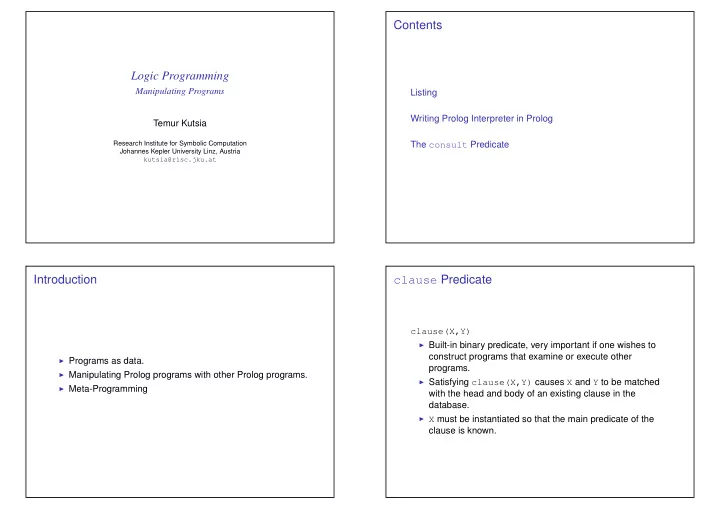
SLIDE 1
Logic Programming
Manipulating Programs Temur Kutsia
Research Institute for Symbolic Computation Johannes Kepler University Linz, Austria kutsia@risc.jku.at
Contents
Listing Writing Prolog Interpreter in Prolog The consult Predicate
Introduction
◮ Programs as data. ◮ Manipulating Prolog programs with other Prolog programs. ◮ Meta-Programming
clause Predicate
clause(X,Y)
◮ Built-in binary predicate, very important if one wishes to
construct programs that examine or execute other programs.
◮ Satisfying clause(X,Y) causes X and Y to be matched
with the head and body of an existing clause in the database.
◮ X must be instantiated so that the main predicate of the
clause is known.
SLIDE 2 clause Predicate
Satisfying clause(X,Y)
◮ If there are no clauses that match X, the goal fails. ◮ If there is more than one clause that matches, Prolog
returns the first one. The other matches will be chosen,
- ne at a time, when Prolog backtracks.
clause Predicate. Examples
append([], X, X). append([A|B], C, [A|D]) :- append(B, C, D). ?- clause(append(L1,L2,L3), Y). L1 = [] L2 = L3 Y = true ; L1 = [_G463|_G464] L3 = [_G463|_G467] Y = append(_G464, L2, _G467) ; No
A Version of listing Predicate
list1(X)
◮ Satisfying the goal list1(X) will print out the clauses in
the database whose head matches X.
◮ The definition of list1(X) will involve clause with X as
the first argument.
◮ Therefore, X has to be sufficiently instantiated.
Definition of list1
list1(X) :- clause(X, Y),
write(’.’), nl, fail. list1(_).
!, write(X).
write((X:-Y)).
SLIDE 3
How Does list1 Work?
◮ The first clause causes a search for a clause whose head
matches X.
◮ If one found, it is printed and a failure is generated. ◮ Backtracking will reach the clause goal and find another
clause, if there is one, and so on.
◮ When there is no more clause to be found, the clause
goal will fail.
◮ At this point, the second clause for list1 will be chosen,
so the goal will succeed.
◮ As a “side effect", all the appropriate clauses will have
been printed out.
How Does output_clause Work?
◮ Specifies how the clauses will be printed. ◮ It looks for a special case of the body true. In this case it
just prints the head.
◮ Otherwise, it writes out the head and the body, constructed
with the functor :-.
◮ The “cut” in the first rule for output_clause says that the
first rule is the only valid possibility if the body is true.
◮ The “cut” is essential because the example relies on
backtracking.
Writing Prolog Interpreter in Prolog
Idea:
◮ Define what it is to run a Prolog program by something
which is itself a Prolog program.
The interpret Predicate
Idea:
◮ interpret(X) succeeds as a goal exactly when X
succeeds as a goal.
◮ interpret is similar to built-in predicate call, but is
more restricted: It does not deal with cuts or built-in predicates
SLIDE 4 The interpret Predicate
interpret(true) :- !. interpret((G1, G2)) :- !, interpret(G1), interpret(G2). interpret(Goal) :- clause(Goal, MoreGoals), interpret(MoreGoals).
The interpret Predicate
◮ The first clause of interpret deals with the special case
when the goal is true.
◮ The second clause deals with the case when a goal is a
conjunction.
◮ The third clause covers a simple goal: The procedure is
the following:
- 1. Find a clause whose head matches the goal
- 2. interpret the goals in the body of that clause.
◮ Limitations: The program will not cope with programs using
built-in predicates, because such predicates do not have clauses in the usual sense.
The consult Predicate
◮ consult is provided as a built-in predicate in most
systems.
◮ Interesting to see how it can be defined in Prolog. ◮ A simplified definition.
retractall
First we define retractall: retractall(X) :- retract(X), fail. retractall(X) :- retract((X:-Y)), fail. retractall(_).
SLIDE 5 Program for consult
consult(File):- retractall(done(_)), current_input(Old),
repeat, read(Term), try(Term), close(Stream), set_input(Old), !.
Program for consult, Cont.
try(end_of_file) :- % End of file marker read !. try((?- Goals)) :- !, call(Goals), !, fail. try((:- Goals)) :- % ignore directives !. try(Clause) :- head(Clause, Head), record_done(Head), assertz(Clause), fail.
Program for consult, Cont.
:- dynamic done/1. record_done(Head) :- done(Head), !. record_done(Head) :- functor(Head, Func, Arity), functor(Proc, Func, Arity), asserta(done(Proc)), retractall(Proc), !. head((A :- B), A) :- !. head(A, A).
Program for consult. Explanations.
◮ current_input(Old) and set_input(Old) ensure
that the current input file stays the same after the consult.
◮ try is to cause an appropriate action to be taken for each
term read from the input.
◮ try only succeeds when its argument is the end of file
mark.
◮ Otherwise, a failure occurs after the appropriate action,
and backtracking goes back to the repeat goal.
◮ The “cut” at the end of the consult definition cuts out the
choice introduced by repeat.
SLIDE 6 Program for consult. Explanations.
The actions try performs:
◮ Question read:
try((?- Goals)) :- !, call(Goals), !, fail. Attempt to satisfy the appropriate goal and fails.
◮ Directive read:
try((:- Goals)) :- !.
- Ignore. (Different systems treat them differently.
SWI-Prolog makes no difference between questions and directives.)
Program for consult. Explanations.
try(Clause) :- head(Clause, Head), record_done(Head), assertz(Clause), fail.
◮ When the first clause for a given predicate appears in a
file, all the clauses in the database for that predicate must be removed before the new one is added.
◮ Clauses must not be removed when later ones for that
predicate appear, because then we will be removing clauses that have just been read in.
◮ How to determine whether a clause is the first one in the
file for its predicate?
Program for consult. Explanations.
:- dynamic done/1. record_done(Head) :- done(Head), !. record_done(Head) :- functor(Head, Func, Arity), functor(Proc, Func, Arity), asserta(done(Proc)), retractall(Proc), !.
◮ Keep record of the predicates for which we have found
clauses in the file.
◮ When the first clause of a predicate (e.g., of the binary
predicate foo) is found, then
◮ remove from the database the existing clauses for it, and ◮ add the new clause in the database.
◮ In addition, the fact done(foo(_,_)) is added.
Program for consult. Explanations.
:- dynamic done/1. record_done(Head) :- done(Head), !. record_done(Head) :- functor(Head, Func, Arity), functor(Proc, Func, Arity), asserta(done(Proc)), retractall(Proc), !.
◮ When a later clause for predicate foo is read from the file,
we will be able to see that the old clauses have already been removed, and so we avoid removing new clauses.
◮ The test is done(Head) in the first clause, with Head
instantiated by the head of the clause for predicate foo.