Containment and Control WHO Pandemic Phases Phase Period Level of - - PDF document

containment and control who pandemic phases
SMART_READER_LITE
LIVE PREVIEW

Containment and Control WHO Pandemic Phases Phase Period Level of - - PDF document

Containment and Control WHO Pandemic Phases Phase Period Level of Risk 1 Interpandemic period Low risk of human cases 2 New virus in animals, Higher risk of human cases no human cases 3 Pandemic alert No or very limited human-to-


slide-1
SLIDE 1

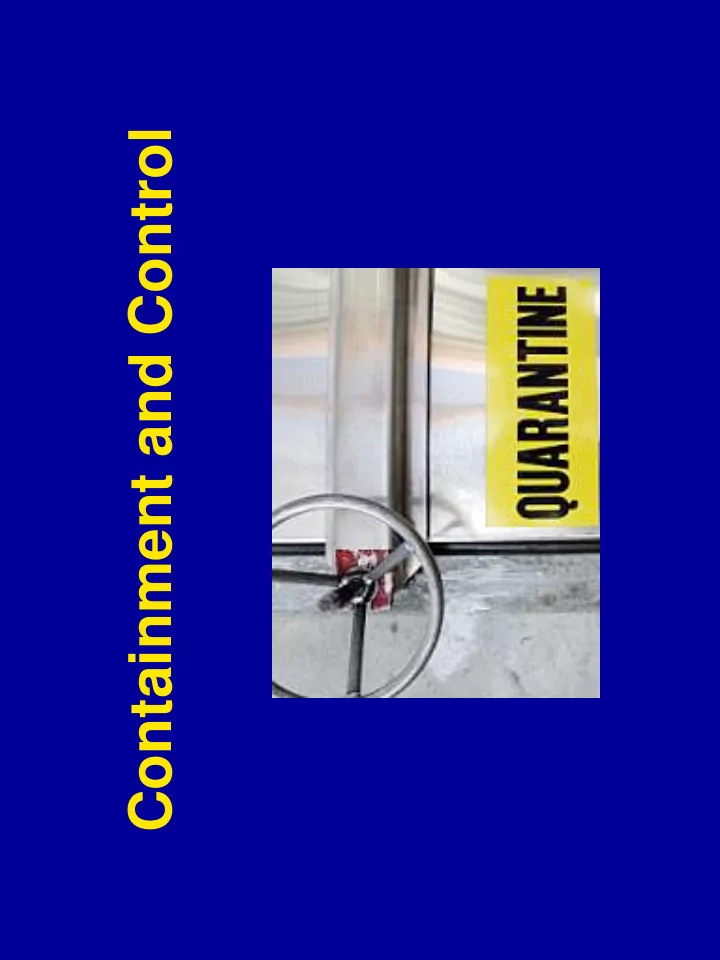
Containment and Control

slide-2
SLIDE 2

WHO Pandemic Phases

Phase Period Level of Risk 1 Interpandemic period Low risk of human cases 2 New virus in animals, no human cases Higher risk of human cases 3 Pandemic alert No or very limited human-to- human transmission 4 New virus causes human cases Evidence of increased human- to-human transmission 5 New virus causes human cases Evidence of significant human- to-human transmission 6 Pandemic Efficient and sustained human- to-human transmission

slide-3
SLIDE 3

Overview of NPI

Individual level

  • Isolation
  • Quarantine
  • Infection control

practices

  • Personal protective

equipment Community level

  • Cordon sanitaire
  • Social distancing
slide-4
SLIDE 4

Individual Level NPI

slide-5
SLIDE 5

Isolation

  • Isolate severe and mild cases
  • Do not wait for lab confirmation
  • Isolation location depends on several

factors

  • Provide medical and social care
slide-6
SLIDE 6

Quarantine

  • Reduces likelihood of virus transmission
  • Quarantine all case contacts

– Necessary even if cases are undergoing antiviral prophylaxis

  • Voluntary quarantine preferable

– Educate the public – Authorities should prepare to enforce quarantine

  • Provide medical and social care
slide-7
SLIDE 7

Principles of Modern Quarantine

  • Works best when obtain and maintain public

trust

  • Use the least restrictive measures
  • If persons in quarantine become sick, isolate

(separate) them from healthy persons

  • Provide essential services and medical care;

address financial, mental health, stigma, workforce depletion, legal, human rights issues

slide-8
SLIDE 8

Quarantine

Determine who to quarantine:

  • Identify case contacts during medical exam
  • Conduct contact tracing

During quarantine:

  • Actively monitor contacts for development of

symptoms

  • Implement self-health monitoring
slide-9
SLIDE 9

Infection Control Practices and Personal Protective Equipment

  • Hand washing
  • Cough etiquette
  • Disinfecting surfaces
  • Masks and other PPE
slide-10
SLIDE 10

Masks

  • SARS, in some

areas, required for

– travel on subway – taxi drivers – inside hospitals

slide-11
SLIDE 11

Community Level Interventions

Social Distancing Measures

slide-12
SLIDE 12

Quarantine of Groups or Sites

  • Use when there is evidence or

suspicion of human-to-human transmission

  • Actively monitor household members

for illness

  • Provide medical care
slide-13
SLIDE 13

Quarantine of Groups or Sites

Cordon sanitaire

  • Prevents ill, exposed persons from mixing

with society

  • Barrier restricts travel in and out of an area
  • Helpful in closed settings
  • Impractical in some settings

– Not recommended by WHO

slide-14
SLIDE 14

Cordon sanitaire Challenges

  • Site selection
  • Logistics
  • Provision of basic

needs

  • Monitoring for

illness

  • Providing medical

care

  • Communication
slide-15
SLIDE 15

Movement Restrictions

  • Possible measures:

– Restricting public transportation – Restricting public gatherings – Voluntary or involuntary work holidays

  • Logistical considerations:

– Effectiveness – Implementation – Alternative transportation infrastructure

slide-16
SLIDE 16

Cancellation of Events

  • Practice based on observations during the

1957 – 1958 influenza pandemic

  • In response to a presumed AI cluster

– Likely to contribute to successful pandemic containment

  • In response to an established pandemic

– Consider impact on economy – Consider cultural significance of events

slide-17
SLIDE 17

Closure of Facilities

  • Schools

– Practice based on observations during the 1957 – 1958 influenza pandemic – Useful if high morbidity, mortality among children – Most effective early in an outbreak

  • Businesses and markets

– Consider access to and availability of necessities – Consider economic impact

slide-18
SLIDE 18

Study of Containment of Emerging Virus in Rural Thailand

  • Antivirals to 90% of people in 5 km radius within 2

days after detection of 20 cases was estimated to contain a new influenza subtype

  • If also close 90% of schools, 50% workplaces; 80%

reduction in movement in and out of area, 90% chance of containment of new subtype

  • Containment predicted if <200 cases; or at least

delay spread by a month or more

Source: Ferguson et al. Nature 2005;437:209-14

slide-19
SLIDE 19

Study of Containment of Emerging Virus in Rural Thailand

  • If no antivirals given, and
  • If every case stayed at home, and
  • 70% of susceptible people did not travel out of their

neighborhood,

  • Probability of containment:

– 98% if Ro=1.4 – 57% if Ro= 1.7 Source: Longini et al. Science 2005;309:1083-7

slide-20
SLIDE 20

International and National Containment Measures

slide-21
SLIDE 21

Health Alert Notices

  • Health advice for travelers
  • Risks, precautions, defer travel to affected areas
  • Symptoms, early self-isolation
  • Seek medical care (call ahead), lab diagnosis
  • Notify public health authorities

References: WHO Global Influenza Plan, 2005; WHO Writing Group. Emerg Inf Dis 2006;12:81-7

slide-22
SLIDE 22

Screening

  • EXIT screening for

travelers from affected countries

  • Entry screening

considered only exceptionally

– Infection-free isolated areas (islands) – If exit screening not done in affected countries – If limited internal surveillance capacity

slide-23
SLIDE 23

Screening: International Travelers

  • Entry screening /

quarantine was ineffective in 1918, except in some island countries

– In Australia, delayed introduction for 3 months

  • Likely even less

effective today (air travel)

– Not cost-effective during SARS

slide-24
SLIDE 24

Thermal Scanning

  • Displays a thermal

image of pedestrians

  • Can be used to detect

body temperature above a set threshold

– e.g. 37° C

  • Used to screen and

identify persons requiring further assessment by medical personnel

slide-25
SLIDE 25

Thermal Scanning at International Borders (2003)

Area # scanned (millions) # febrile by scan(confirme d by oral) # SARS found by scanning Canada 0.6 248 (215) China-mainland 13.0 4070 (351) China-Hong Kong SAR* 15.1 NA (451) China-Taiwan 1.0 1211 (0) Singapore 6.0 5200 (3160) TOTAL 35.7 10729 (4177)

*includes border with China-mainland Source: Bell D Emerging Inf Dis J 2004:10:1900

slide-26
SLIDE 26

National Measures

1. Ill persons should voluntarily stay at home (at the first sign of symptoms) 2. If pandemic is severe, measures to “increase social distance” should be considered 3. “Non-essential domestic travel to affected areas should be deferred if many areas of a country remain unaffected”

  • Prohibition on travel from affected areas is usually

impractical

References: WHO Global Influenza Plan, 2005; WHO Writing Group. Emerg Inf Dis 2006;12:88-94

slide-27
SLIDE 27

Country Responsibilities

  • Implementation and maintenance of

quarantine area and all public health measures

  • Distribution and administration of antiviral

drugs

  • Monitoring the well-being and physical needs

in quarantine zone

  • Conducting surveillance of surrounding

areas to detect cases

Source: WHO pandemic influenza draft protocol for rapid response and containment

slide-28
SLIDE 28

Triggers for Non- Pharmaceutical Interventions

slide-29
SLIDE 29

Contextual Factors

  • Shift in the pandemic phase
  • Local public health and emergency

infrastructure

  • Community understanding
slide-30
SLIDE 30

Outbreak-Specific Factors

  • Number of cases

– Moderate to severe illness in 3 or more health care workers – Moderate to severe illness in 5 to 10 people with some evidence of human-to-human transmission

  • Geographic extent

– Area small enough that containment would be logistically possible – Can supply food, shelter, medical care to affected area

  • Pandemic potential

– Presence of clusters in defined area over short period of time – Pattern of unexplained respiratory illness

slide-31
SLIDE 31

WHO Recommendations for NPI Implementation

Phase 3 (Current) Phase 4 & 5 (Rapid response) Phase 6 (Pandemic) Isolation Yes Yes Yes Quarantine No Yes Possibly Identification of contacts and health monitoring Yes Yes No Cordon sanitaire No Possibly No Facility closure, movement restrictions, cancellation of events Possibly Yes Possibly

slide-32
SLIDE 32

Implementation of NPI

slide-33
SLIDE 33

Coordination

Non-governmental Organizations (NGOs):

  • Help governments disseminate health

messages

  • Get community buy-in for interventions
  • Assist directly with health monitoring,

supplies, medical care

slide-34
SLIDE 34

Concurrent Measures

Combining measures reduces spread

  • f infection more than using only one

measure

slide-35
SLIDE 35

Security

  • Collaborative effort of health officials,

local police, and military

  • Social distancing measures may

require security considerations

slide-36
SLIDE 36

Logistics

  • Medical care

– Ensure health care providers are available – Train and inform health care providers – Have contingency plans for provider absence

  • Self-health monitoring

– Distribute ‘signs and symptoms’ information to the population – Establish hotlines to answer questions about signs and symptoms

slide-37
SLIDE 37

Risk Communication

  • Designate one source for official

information

  • Deliver clear, consistent messages
  • Target the majority of the population
  • Abate or counter incorrect information
slide-38
SLIDE 38

Psychological and Social Impact

  • Impact on the public:

– Anxiety – Depression

  • Measures to lessen impact:

– Explain why NPI measures are necessary – Provide updates on when ban will be lifted – Staff hotlines to answer questions

slide-39
SLIDE 39

Evaluation

  • Little evidence about NPI effectiveness

– Opportunity to add to the body of evidence

  • Plan evaluation prior to a pandemic

– Track the number of cases prevented – Identify unforeseen positive and negative impacts – Assess the utility of the intervention for

  • ther nations or future epidemics
slide-40
SLIDE 40

Scaling Back

Officials must first determine that disease has been effectively contained

  • Assess number of new cases
  • Assess spread of disease to

surrounding areas

slide-41
SLIDE 41

Legal Authorities and Ethical Framework

slide-42
SLIDE 42

Legal Authority

  • Public health officials have authority

– Laws differ by country

  • Issues to explore:

– Which agency has legal authority? – Under what conditions can authority be used? – How are quarantine and isolation enforced? – What are the consequences for quarantine violation?

slide-43
SLIDE 43

Ethical Issues

  • Restriction of individual freedom
  • Lost household wages
  • Lost business revenue
slide-44
SLIDE 44

Administrative Communication

  • Identify the agency responsible for NPI

decisions

  • Identify the agency responsible for NPI

implementation and enforcement

  • Rapid response teams, MOH, and WHO

should communicate regularly and coordinate activities

slide-45
SLIDE 45

Conclusion

  • NPI may be useful in delaying spread of

disease

  • Plan, implement, and evaluate

interventions within the local context

slide-46
SLIDE 46

Summary

  • Consider social distancing measures
  • Public mask use not recommended, but

permitted

  • Respiratory and hand hygiene recommended;

also disinfection of household surfaces contaminated by patients’ respiratory secretions

  • For emerging inter-human transmission

(phases 4 and 5), isolation/quarantine measures and consider geographically targeted anti-viral therapy

Source: WHO Global Influenza Plan, 2005