
SLIDE 1
We will begin promptly on the hour. The silence you hear is normal. If you do not hear anything when the images change, e-mail Caryn Koplik ckoplik@nationalhumanitiescenter.org for assistance.
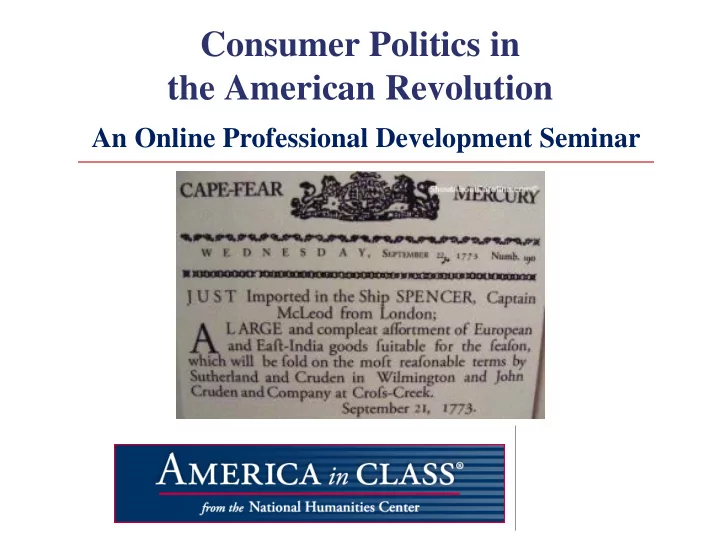
Consumer Politics in the American Revolution An Online Professional - - PowerPoint PPT Presentation
Consumer Politics in the American Revolution An Online Professional Development Seminar We will begin promptly on the hour. The silence you hear is normal. If you do not hear anything when the images change, e-mail Caryn Koplik
We will begin promptly on the hour. The silence you hear is normal. If you do not hear anything when the images change, e-mail Caryn Koplik ckoplik@nationalhumanitiescenter.org for assistance.
americainclass.org 2
americainclass.org 3
americainclass.org 4
National Humanities Center Fellow Professor of American History Northwestern University Director, Chabraja Center for Historical Studies at Northwestern University
Tobacco Culture: the Mentality of the Great Tidewater Planters on the Eve of Revolution (T. Saloutos Prize) Imagining the Past: East Hampton Histories (Historical Preservation Book Prize) Marketplace of Revolution: How Consumer Politics Shaped American Independence (Colonial War Society Prize)
americainclass.org 5
marketplace was able to generate innovative forms of political resistance to Great Britain.
by the massive importation of British made cloth--suggested to Americans that by sacrificing the objects of desire and by forcing neighbors and friends to boycott British goods, they could create a genuine revolutionary movement.
century consumer marketplace--buying manufactured cloth from Great Britain, for example--they acquired a meaningful voice in the colonial political protest, for without their cooperation, the boycott movement between 1764 and 1775 would have failed.
producers spinning and weaving, but rather, a sophisticated commercial system involving long-distance exchange.
americainclass.org 6
We have an English Proverb that says, He that would thrive Must ask his Wife; it was lucky for me that I had one as much dispos’d to Industry and Frugality as my self. She assisted me cheerfully in my Business, folding and stitching Pamphlets, tending Shop, purchasing old Linen Rags for the Paper-makers, &c., &c. We kept no idle Servants, our Table was plain and simple, our Furniture of the cheapest. For instance, my Breakfast was a long time Bread and Milk (no Tea), and I ate it out of a twopenny earthen Porringer, with a Pewter Spoon. But mark how Luxury will enter Families, and make a Progress, in Spite of Principle. Being call’d one Morning to Breakfast, I found it in a China Bowl, with a Spoon of Silver. They had been bought for me without my Knowledge by my Wife, and had cost her the enormous Sum of three and twenty Shillings, for which she had no
China Bowl as well as any of his Neighbours. This was the first Appearance of Plate and China in our House, which afterward, in a Course of Years, as our Wealth increas’d, augmented gradually to several Hundred Pounds in Value. Discussion Questions: How would you characterize Franklin’s attitude toward consumer goods? What does this passage tell us about the colonial marketplace?
americainclass.org 7
americainclass.org 8
Then, taking off his worsted nightcap, he pulled a linen one out of his pocket, and clapping it upon his head, — “Now,” says he, “I’m upon the borders of Pennsylvania and must look like a gentleman; t’ other was good enough for Maryland, and damn my blood, if ever I come into that rascally Province again if I don’t procure a leather jacket, that I may be in a trim to box the saucy jacks there and not run the hazard of tearing my coat.” This showed, by the bye, that he paid more regard to his modesty and self-denyal. He then made a transition to politicks, and damned the late Sir R—— W—— for a rascal. We asked him his reasons for cursing Sir R——, but he would give us no other but this,—that he was certainly informed by some very good gentlemen who understood the thing right well, that the said Sir R—— was a damned rogue, and at the conclusion of each rodomontade he told us that tho’ he seemed to be but a plain, homely fellow, yet he would have us know that he was able to afford better than many that went finer; he had good linen in his bags, a pair of silver buckles, silver clasps, and gold sleeve buttons, two Holland shirts and some neat nightcaps, and that his little woman at home drank tea twice a day, and he himself lived very well and expected to live better so soon as that old rogue B——t died, and he could secure a title to his land. Discussion Question: How does the cursing man distinguish his status?
americainclass.org 9
americainclass.org 10
“I would therefore propose Stratagem and Capitulation. Many excellent Resolves have been come into, I propound these to be resolved by both Sexes, which if complied with, and I should call a blow at the Root. These conclusions therefore, I offer to both Sexes for consideration; as we have all Liberty of offering our thoughts to the Publick. And first let the Men Resolve, viz.
Spinning.
Publick or Private, but what is dressed in Ditto. And if we meet any of the said Female Sex, dressed in Foreign Silks, and Laces &c. we will pass by them, as persons that have been too free with some Merchant, and are Adulteresses forsaking the interest of their Country.
Badge of the excellent soil and industry of the Country with her.
as make use of Tea the growth of our own Country. Discussion Question: How do consumer politics place women at the center of the Revolution?
americainclass.org 11
americainclass.org 12
americainclass.org 13
“If the people of America, in the midst of so much might sink into a state of slavery, they must counteract the convictions of their own breasts and obstinately refuse to be free. The nature and causes of our disease have been sufficiently explored, and a remedy, a safe and easy, a sovereign and an efficacious remedy prescribed and held up to view; the medicine is cheap, it is within our reach, and its virtues abundantly manifest, and we are invited to the application of it be every thing that is tender and valuable in life; our own interests, the rights of posterity and the happiness of unborn millions bespeak our attention, and plead with us to be a free and a flourishing people. The means of safety are so easy to come at, and so thoroughly known, that to plead ignorance would serve only to enhance the criminality of our actions in the eyes of posterity. The capacity of an Hottentot at this time
fellow subjects in Great Britain can’t deprive us of our rights if we mind our own business and let theirs alone. The truth is we have no occasion for British manufactures; they are rank poison to the constitution of this country; and the absurdity and danger of importing them at this juncture, have been affected with a conjugation of arguments, and a cloud of witnesses sufficient to open the eyes of the blind. We live in a land that flows with milk and honey, and with suitable culture will presently yield us the necessaries and conveniences of life in rich abundance.” ….. (cont’d.)
americainclass.org 14
“To conclude, let us all my countrymen, resolve to be free; and not barter away our birthright privileges for that which profiteth not. Let us save our money in order to save
dangerous to pursue, come to a period, and those who promote it to the disadvantage of the cuase of liberty, be look’d upon with an eye of contempt; let us by no means promote or esteem those who are pursuing interests daimetrically opposite to the interest of the public, and who to gratify an unconquerable appetite for filthy lucre, would fell their country, and comp[????]es and land for to obtain articles, which if
PHILO PATRIA
americainclass.org 15
At a time when our lordly Masters in Great Britain will be satisfied with nothing less than the deprivation of American freedom, it seems highly necessary that something shou’d be done to avert the stroke and maintain the liberty which we have derived from our Ancestors; but the manner of doing it to answer the purpose effectually is the point in question. That no man shou’d scruple, or hesitate a moment to use a--ms in defence of so valuable a blessing, on which all the good and evil of life depends; is clearly my opinion; Yet A--ms I wou’d beg leave to add, should be the last resource; the de[r]nier resort. Addresses to the Throne, and remonstrances to parliament, we have already, it is said, proved the inefficacy of; how far then their attention to our rights & priviledges is to be awakened or alarmed by starving their Trade & manufactures, remains to be tryed. The northern Colonies, it appears, are endeavouring to adopt this scheme--In my opinion it is a good one; & must be attended with salutary effects, provided it can be carried pretty generally into execution; but how far it is practicable to do so, I will not take upon me to determine. That there will be difficulties attending the execution of it every where, from clashing interests, & selfish designing men (ever attentive to their own gain, & watchful of every turn that can assist their lucrative views, in preference to any other consideration) cannot be denied; (cont’d)
americainclass.org 16
The extravagant & expensive man has the same good plea to retrench his Expences--He is thereby furnished with a pretext to live within bounds, and embraces it--prudence dictated economy to him before, but his resolution was too weak to put it in practice; for how can I, says he, who have lived in such & such a manner change my method? I am ashamed to do it: and besides, such an alteration in the System of my living, will create suspicions of a decay in my fortune, & such a thought the world must not harbour; I will e'en continue my course: till at last the course discontinues the Estate, a sale of it being the consequence of his perseverance in error. This I am satisfied is the way that many who have set out in the wrong tract, have reasoned, till ruin stares them in the face. And in respect to the poor & needy man, he is only left in the same situation he was found; better I might say, because as he judges from comparison, his condition is amended in proportion as it approaches nearer to those above him.
americainclass.org 17
Our All is at Stake, & the little Conveniencys & Comforts of Life, when set in
americainclass.org 18
americainclass.org 19
To obtain redress of these grievances, which threaten destruction to the lives liberty, and property
consumption, and non-exportation agreement, faithfully adhered to, will prove the most speedy, effectual, and peaceable measure: And, therefore, we do, for ourselves, and the inhabitants of the several colonies, whom we represent, firmly agree and associate, under the sacred ties of virtue, honour and love of our country, as follows: 1. That from and after the first day of December next, we will not import, into British America, from Great-Britain or Ireland, any goods, wares, or merchandise whatsoever, or from any other place, any such goods, wares, or merchandise, as shall have been exported from Great-Britain or Ireland; nor will we, after that day, import any East-India tea from any part of the world; nor any molasses, syrups, paneles, coffee, or pimento, from the British plantations or from Dominica; nor wines from Madeira, or the Western Islands; nor foreign indigo. Discussion Question: How did the boycott force colonists to take sides?
americainclass.org 20