Construction OS&H Workers perspectives Trade Union approach - - PowerPoint PPT Presentation

construction os amp h workers perspectives trade union
SMART_READER_LITE
LIVE PREVIEW

Construction OS&H Workers perspectives Trade Union approach - - PowerPoint PPT Presentation

Construction OS&H Workers perspectives Trade Union approach ILO Construction OS&H The three sections of the workers perspectives The Trade Union Approach to Health and Safety Organising for a Healthy and Safe Workplace


slide-1
SLIDE 1

ILO Construction OS&H
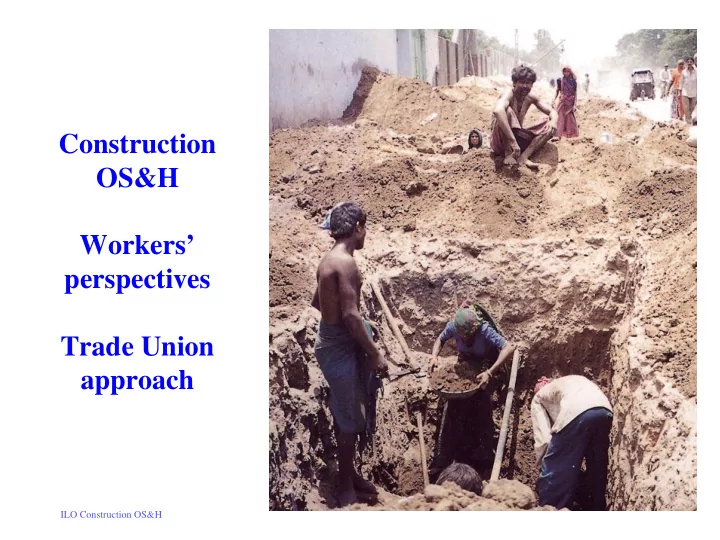
Construction OS&H Workers’ perspectives Trade Union approach

slide-2
SLIDE 2

ILO Construction OS&H

The three sections of the workers’ perspectives The Trade Union Approach to Health and Safety Organising for a Healthy and Safe Workplace Getting Management to Make Improvements

slide-3
SLIDE 3

ILO Construction OS&H

Workplace inspections

Communication with workers is the key to finding out the information we need and to negotiating improvements. It is important that we involve workers at all stages of the inspection and make sure we have their support for: Finding out their problems and complaints before we inspect Talking to them during the inspection Reporting back to them after the inspection

slide-4
SLIDE 4

ILO Construction OS&H

Workplace inspections - physical hazards

  • Falls from heights, scaffolds, roofs, ladders, trips and slips
  • Excavation hazards and confined spaces
  • Machinery, entrapment, cuts
  • Transport (forklifts, hoists, cranes)
  • Electricity (temporary installations, tools and plant, systems for

identifying underground cables)

  • Noise and vibration
  • Manual handling and lifting, repetitive work, forced postures
slide-5
SLIDE 5

ILO Construction OS&H

Workplace inspections - chemical hazards

  • Solvents (paints, laquers, varnishes, strippers, glues)
  • Pesticides (e.g. timber treatments)
  • Dust (wood, cement, MMF, silica, gypsum)
  • Cement burns
  • Asbestos dust
slide-6
SLIDE 6

ILO Construction OS&H

Workplace inspections - biological hazards

  • Contaminated water supply
  • Malaria
  • Dengue fever
  • Weil’s disease (rats)
  • Infectious diseases, such as hepatitis or tuberculosis
slide-7
SLIDE 7

ILO Construction OS&H

Workplace inspections – psycho-social hazards

  • Poor work organisation, instruction and supervision
  • Work overload: long hours, shift work, fast pace, lack of breaks,

productivity pressure, being pushed to take shortcuts, low pay

  • Insecure contractual conditions
  • Lack of information and training needed to carry out work and to prevent

hazards

  • Lack of welfare facilities (toilets, washing and changing facilities, facilities

for eating and taking breaks)

  • Stress, due to being exposed to risks
  • Bullying
  • Lack of participation and consultation
slide-8
SLIDE 8

ILO Construction OS&H

Risk mapping

AIMS Identify priority risks Develop plans to deal with the risks TASK In small groups, draw a typical work activity/workplace with which you are all familiar (or you may prefer to work from the handout given to you) Put in as much detail as possible: people, tools, materials etc When the map is complete, mark the Risk Factors on the drawings We will then look at the drawings and discuss the risks you have identified

slide-9
SLIDE 9

ILO Construction OS&H

Taking up OS&H problems

Use the approach of Problem Information Plan

slide-10
SLIDE 10

ILO Construction OS&H

Health surveys

If one person has a bad back or constant headaches then it’s probably an individual health problem If everyone or several people doing the same job have similar health problems it’s almost certainly occupational Follow your instincts and follow up with some detective work

slide-11
SLIDE 11

ILO Construction OS&H

Health survey

AIMS:

  • Help us to find information on health at work
  • Design a Survey

TASK: In small groups:

  • Choose a health hazard – perhaps paint, varnish, or dust
  • Where do you find existing information?
  • What are the main health problems workers might have?
  • Write a short list of questions you will ask workers about their

experience of working with these substances

  • How will you collect the information?
  • How can you use this information to improve working conditions?
slide-12
SLIDE 12

ILO Construction OS&H

Body mapping

AIM: Help us to find information at work TASK:

  • We have some coloured stickers
  • We need volunteers who have aches and pains they think are caused by

their job - especially from lifting, or from repetitive tasks

  • Volunteers will mime this task for some minutes at their normal pace of

work

  • The rest of us can ask them questions about the job, and we place the

stickers on their bodies where we think they have pains

  • The volunteers tell us if we’re right
  • What are the main things, or risk factors, that are causing these pains?
slide-13
SLIDE 13

ILO Construction OS&H

Inspections & information gathering

AIM:

  • Identify priority risks
  • Develop plans to deal with the risks

TASK:

  • In your small group choose a priority health and safety risk from one of your

workplaces

  • Then use the Action Plan which follows to decide what needs to be done
  • Elect a spokesperson to report back
slide-14
SLIDE 14

ILO Construction OS&H

Tackling risks Action Plan: the problem

  • What are the facts?
  • Which workers and union members are affected?
  • What are the apparent causes?
  • What are the real causes?
  • Is it a short-term or a long-term problem?
slide-15
SLIDE 15

ILO Construction OS&H

Tackling risks Action Plan: investigation

What information do we need? What do workers and union members want? What does our union say? What do our agreements say? Will national law or international standards help?

slide-16
SLIDE 16

ILO Construction OS&H

Tackling risks action plan: plan for action

How can we involve workers and Union members? What are our short- and long-term aims? How should we take up the issue with management? What pressure and arguments can we use to win improvements?