Construction OS&H Workers perspectives Getting Management to - - PowerPoint PPT Presentation

construction os h workers perspectives getting management
SMART_READER_LITE
LIVE PREVIEW

Construction OS&H Workers perspectives Getting Management to - - PowerPoint PPT Presentation

Construction OS&H Workers perspectives Getting Management to Make Improvements Part 1 ILO Construction OS&H The three sections of the workers perspectives The Trade Union Approach to Health and Safety Organising for a


slide-1
SLIDE 1

ILO Construction OS&H
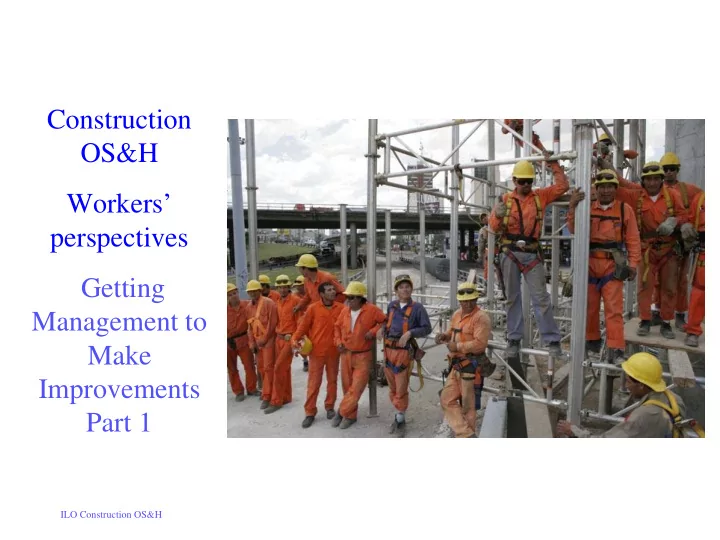
Construction OS&H Workers’ perspectives Getting Management to Make Improvements Part 1

slide-2
SLIDE 2

ILO Construction OS&H

The three sections of the workers’ perspectives The Trade Union Approach to Health and Safety Organising for a Healthy and Safe Workplace Getting Management to Make Improvements

slide-3
SLIDE 3

ILO Construction OS&H

Reminder of the aims

  • 1. Identify the main health and safety problems in our workplaces
  • 2. Develop a Trade Union approach to occupational safety and health
  • 3. Investigate hazards at work
  • 4. Build workers’ involvement, awareness, and support on occupational

safety and health

  • 5. Develop Trade Union organisation to ensure that employers eliminate
  • r control risks
  • 6. Develop confidence, knowledge and skills

Which will:

  • Lead to practical action in the workplace
  • Improve health and safety conditions for workers
slide-4
SLIDE 4

ILO Construction OS&H

Union Health and Safety Representatives’ Role

As we have already seen, the most important job of the health and safety representative is to take up workplace health, safety and welfare problems,

  • n behalf of the workers and Union members.

Each problem that the safety representative tackles will be different. However, the method of approach will be similar.

slide-5
SLIDE 5

ILO Construction OS&H

Taking up OS&H problems

AIMS: Identify key steps to take when taking up problems on safety Develop a systematic approach TASK: In your small group discuss a health and safety problem Make a checklist of all the steps that you would take to try to resolve the problem

slide-6
SLIDE 6

ILO Construction OS&H

Taking up OS&H problems

Use the approach of Problem Information Plan

slide-7
SLIDE 7

ILO Construction OS&H

Problem: What are the Facts?

Talk to people, check the workplace, equipment and the systems of working for the presence of risk factors. Find out as much as you can: Talk to workers to find out if anyone else has a similar problem Obtain information from management. Does the employer recognise the problem? If so, have they done enough? If not, what will happen when the Union raises it? Obtain information from maintenance workers and maintenance records Use information from suppliers Study accident records Use official information and legal standards

slide-8
SLIDE 8

ILO Construction OS&H

Problem: What are the causes?

Management often put problems down to workers’ carelessness & apathy The real problem may be:

  • Defective equipment
  • Poor systems of work
  • Inadequate training
  • Poor supervision
  • The employer wanting the job done quickly, irrespective of OS&H
slide-9
SLIDE 9

ILO Construction OS&H

Problem: What are the causes?

One-off or broader problems? Does the problem raise broader issues? For example:

  • Is just one vehicle faulty, or is the whole system of maintenance

inadequate?

  • Is a single chemical a problem, or do we need to look at the whole

procedure for introducing new chemicals, getting information, training, storage and use?

slide-10
SLIDE 10

ILO Construction OS&H

Investigation

The safety representative must look in detail at a whole range of matters. The different ways of investigating include asking:

  • What do workers and Trade Union members want? They may have ideas

about what should be done and their support will be vital if management does not respond

  • What does my Union say? Unions have developed policies on safety issues.

Check what your Union’s policies say

  • What does the employer’s safety policy say? It may say, for example, that

vehicles should be maintained on a regular basis, and should not be used if they are not roadworthy

  • What does the agreement (CBA) say? There may be agreements about safe

working practices; management responsibilities; procedures for handling safety problems. Union representatives should ensure that management stick to agreements

  • What does the law say? There are National laws, ILO Conventions and

Standards laid down for safe working. Check what they say

slide-11
SLIDE 11

ILO Construction OS&H

Plan

Before you raise an issue with management: You must work out what the workers and members want, and try to pursue those objectives with the broadest support possible. This will depend upon: What results you want to achieve Trade Union strength Take stock From the information that you have gathered draw conclusions about: The degree of risk The location of risk What has been done so far?

slide-12
SLIDE 12

ILO Construction OS&H

Deciding on action

What needs to be done next?

  • Check on what is already being done
  • Raise the issue with the employer
  • Meet a more senior manager, if the initial response is not favourable
  • Put the matter in writing
  • Use the grievance procedure if necessary
  • Make sure that agreed improvements are made
  • Keep workers and Union members informed of progress on the

problem, win their support, and use it to put pressure on the employer

  • Keep other Union officials informed and involved
slide-13
SLIDE 13

ILO Construction OS&H

Negotiating in a safety committee

AIMS: Practise negotiating skills Use a safety committee productively TASK: The main group will be divided into two ‘Role-play Safety Committees’ comprising management and Union reps The Union side will decide on priority risks they would like to discuss with management When they have notified management, adequate time will be given for both sides to prepare, and then a negotiation will take place The Chairperson from each Union side, will report back to the other half of the group after the negotiation