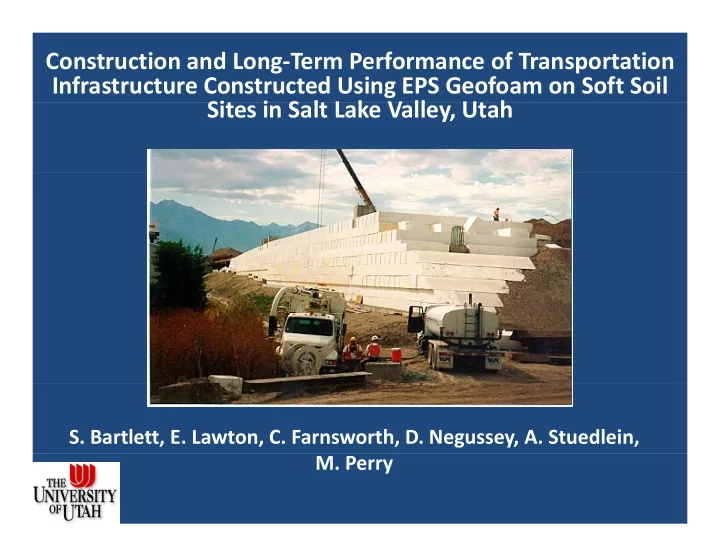
SLIDE 1 Construction and Long‐Term Performance of Transportation Infrastructure Constructed Using EPS Geofoam on Soft Soil Sit i S lt L k V ll Ut h Sites in Salt Lake Valley, Utah
- S. Bartlett, E. Lawton, C. Farnsworth, D. Negussey, A. Stuedlein,
- M. Perry
SLIDE 2 Objectives (UDOT contract) j ( )
- Monitor the long-term performance of geofoam embankments and
compare its settlement performance with other embankment systems.
- Measure the differential settlement in MSE wall transition zones
- Measure the differential settlement in MSE wall transition zones.
- Measure the vertical stress distribution that develops in the
geofoam embankment.
- Measure the vertical and horizontal stress that develops in a
Measure the vertical and horizontal stress that develops in a typical bridge abutment.
- Develop and calibrate a numerical model (FLAC) for predicting the
vertical and horizontal static stress distribution in the geofoam mass for g the instrumented embankment and abutment areas.
- Use the FLAC model to predict the seismic response and sliding
stability of typical geofoam configurations.
- Evaluate the possible magnitude of the vertical stress transfer that is
- ccurring to the tilt-up panel wall at 3500 South using FLAC.
- Measure the temperature profile in the pavement section.
SLIDE 3 Objectives
- Long Term Monitoring
- Construction Settlement
- Post-Construction Settlement
- Transition Zones
- Settlement Performance Comparison
d d li f f
- Assessment and Modeling of Performance Data
- Settlement
- Pressure Distribution
- Vertical
- Vertical
- Horizontal
- Connections and Panel Walls
- Seismic Design
Seismic Design
SLIDE 4 UDOT Reports
- Bartlett, S.F., Lawton, E.C., Farnsworth, C.B., and Newman, M.P.,
2011,“Design and Evaluation of Geofoam Embankment for the I-15 Reconstruction Project Salt Lake City Utah Prepared for the Utah Reconstruction Project, Salt Lake City, Utah, Prepared for the Utah Department of Transportation Research Division, Report No. UT-???, Oct. 2011, 184 p.
- Bartlett, S.F. and Farnsworth, C.B., 2004. “Monitoring and Modeling of
Innovative Foundation Treatment and Embankment Construction Used on the I-15 Reconstruction Project, Project Management Plan and Instrument j j g Installation Report,” UDOT Research Report No. UT-04.19, 202 p.
- Farnsworth, C. B. and Bartlett, S. F. (2008). “Evaluation of Rapid
Construction and Settlement of Embankment Systems on Soft Foundation Soils.” UDOT Research Report No. UT-08.05, Utah Department of Transportation, Salt Lake City, Utah.
SLIDE 5 Papers
- Farnsworth C. F., Bartlett S. F., Negussey, D. and Stuedlein A. 2008,
“Construction and Post-Construction Settlement Performance of Innovative Embankment Systems, I-15 Reconstruction Project, Salt Lake City, Utah,” Journal f G h i l d G i l E i i ASCE (V l 134 289
- f Geotechnical and Geoenvironmental Engineering, ASCE (Vol. 134 pp. 289-
301).
- Newman M P Bartlett S F Lawton E C 2010 “Numerical Modeling of
- Newman, M. P., Bartlett S. F., Lawton, E. C., 2010, Numerical Modeling of
Geofoam Embankments,” Journal of Geotechnical and Geoenvironmental Engineering, ASCE, February 2010, pp. 290-298.
- Bartlett, S. F. and Lawton E. C., 2008, “Evaluating the Seismic Stability and
Performance of Freestanding Geofoam Embankment,” 6th National Seismic Conference on Bridges and Highways, Charleston, S.C., July 27th – 30th 2008, 17 g g y , , , y , p.
- Bartlett, S. F., Negussey, D., Farnsworth, C. B., and Stuedlein, A., 2011,
“Construction and Long-Term Performance of Transportation Infrastructure Constructed Using EPS Geofoam on Soft Soil Sites in Salt Lake Valley, Utah,” EPS 2011 Geofoam Blocks in Construction Applications, Oslo Norway.
SLIDE 6 Papers (cont.)
- Bartlett, S. F., Trandafir, A. C., Lawton E. C. and Lingwall, B. N., 2011,
“Applications of EPS Geofoam in Design and Construction of Earthquake Resilient Infrastructure,” EPS 2011 Geofoam Blocks in Construction Resilient Infrastructure, EPS 2011 Geofoam Blocks in Construction Applications, Oslo Norway.
- Bartlett S. F., Farnsworth, C., Negussey, D., and Stuedlein, A. W., 2001,
“Instrumentation and Long-Term Monitoring of Geofoam Embankments, I-15 Reconstruction Project, Salt Lake City, Utah,” EPS Geofoam 2001, 3rd International Conference, Dec. 10th to 12th, 2001, Salt Lake City, Utah, 23 p.
- Negussey, D., Stuedlin, A. W., Bartlett, S. F., Farnsworth, C., “Performance of
Geofoam Embankment at 100 South, I-15 Reconstruction Project, Salt Lake Cit Ut h ” EPS G f 2001 3rd I t ti l C f D 10th t 12th City, Utah,” EPS Geofoam 2001, 3rd International Conference, Dec. 10th to 12th, 2001, Salt Lake City, Utah, 22 p.
SLIDE 7 Primary Uses of Geofoam on the I‐15 Project
- Reduce Settlement to Protect Buried Utilities
- Improve Slope Stability of Embankments
- Improve Slope Stability of Embankments
- Rapid Construction in Time Critical Areas
SLIDE 8 EPS Density
Property ASTM Test Type XI Type I Type VIII* Type II Type IX Test C 578 Nominal Density (kg/m3) C303 / D 1622 12 16 20 24 32 Minimum Density (k /
3)
C303 / D 1622 11 15 18 22 29 (kg/m3) * Type VIII was used for I-15 Reconstruction
SLIDE 9 Objectives
- Long Term Monitoring
- Construction Settlement
- Post-Construction Settlement
- Transition Zones
- Settlement Performance Comparison
d d li f f
- Assessment and Modeling of Performance Data
- Settlement
- Pressure Distribution
- Vertical
- Vertical
- Horizontal
- Connections and Panel Walls
- Seismic Design
Seismic Design
SLIDE 10 Geotechnical Instrumentation
LEVEL 4 LEVEL 6
LEVEL 0
LEVEL 4
LEVEL 2
SLIDE 11
Geotechnical Instrumentation
SLIDE 12
Geotechnical Instrumentation Surveying y g
SLIDE 13 Geofoam Placement Areas
400 S
- 900 S
- 1300 S
- State St
- 2100 S
- 3300 S
SLIDE 14
100 South Array (Construction) ( )
SLIDE 15
100 South Array (cross‐section view) ( )
SLIDE 16
100 South Array (profile view) (p )
SLIDE 17
100 South Array (Load and Pressure Cells) ( )
SLIDE 18
100 South Array (Vertical Strain) ( )
SLIDE 19
100 South Array (Creep Settlment) ( p )
SLIDE 20 3300 South Instrumentation Array
3300 S h
3300 South 400 S
- 900 S
- 1300 S
- State St
- 2100 S
- 3300 S
SLIDE 21
3300 South Array (Construction) ( )
SLIDE 22
3300 South Geofoam Array (Cross‐Sectional View) ( )
SLIDE 23
3300 South Array (Load and Pressure Cells) ( )
SLIDE 24
3300 South Array (Vertical Settlement / Strain) ( / )
1 % vertical strain (end of construction)
SLIDE 25 3300 South Array (Settlement in Transition Zones) ( )
Transition slope 3.5 H : 1 V
25 0
t
face of wall 5/30/00 face of wall 3/18/01 15 0 20.0 25.0
n Settlement
3/18/01 inside edge of moment slab 5/30/00 inside edge of 5 0 10.0 15.0
Construction (mm)
g moment slab 3/18/01
lane 5/30/00
0.0 5.0 25340 25350 25360 25370 25380 25390 25400 25410 25420 25430 25440 25450 25460 25470 25480 25490
Post-C
lane 3/18/01 baseline survey completed on 11/10/99. 2 2 2 2 2 2 2 2 2 2 2 2 2 2 2 2
Mainline Stationing (m)
SLIDE 26
3300 South Array (Creep Settlement) ( p )
SLIDE 27 State Street Instumentation
State Street
State Street 400 S
- 900 S
- 1300 S
- State St
- 2100 S
- 3300 S
SLIDE 28
State Street Construction
State Street Array
SLIDE 29
State Street Array
SLIDE 30
State Street Array (Pressure Cells Measurements) ( )
SLIDE 31
Geotechnologies’ Settlement Performance
SLIDE 32 Conclusions
- EPS geofoam exhibited the best overall settlement performance of
the I-15 geotechnologies
- Compression, seating and inter-block gap closure of EPS
produced about 1 percent vertical deformation during construction loading.
- Vertical pressure levels are in reasonable agreement with
Vertical pressure levels are in reasonable agreement with allowable design limits of about 30 kPa. I 15 EPS b k t h d b t 0 2 t 0 4 t
- I-15 EPS embankment has undergone about 0.2 to 0.4 percent
creep deformation in a 10-year post construction period.
- The 10-year design criterion has been met and the 50-year design
criterion of 1.5 percent total strain will most likely be met.
SLIDE 33 Objectives
- Long Term Monitoring
- Construction Settlement
- Post-Construction Settlement
- Transition Zones
- Settlement Performance Comparison
- Assessment and Modeling of Performance Data
- Settlement
- Pressure Distribution
- Vertical
- Vertical
- Horizontal
- Connections and Panel Walls
- Seismic Design
Seismic Design
SLIDE 34
Bi‐linear Settlement Model
SLIDE 35
Modeling of Vertical Displacement with EPS Embankment
3300 South 100 South
SLIDE 36
Modeling of Vertical Pressure
3300 South 100 South (No pressure cells in EPS)
SLIDE 37
Modeling of Horizontal Stresses ( ) (State Street Array)
SLIDE 38
Modeling of Horizontal Stresses
State Street Array
SLIDE 39 Connections
Damaged Connection
loading strain can be expected. expected.
untrimmed block and elastic compression elastic compression.
was later repaired by dowels.
avoided.
SLIDE 40 Objectives
- Long Term Monitoring
- Construction Settlement
- Post-Construction Settlement
- Transition Zones
- Settlement Performance Comparison
- Assessment and Modeling of Performance Data
- Settlement
- Pressure Distribution
- Vertical
- Vertical
- Horizontal
- Connections and Panel Walls
- Seismic Design
Seismic Design
SLIDE 41 Horizontal Acceleration Response S t Spectra
Response Spectra (5% Damping) S 2.0 2.5 pectral Acce 1.5 2.0 leration (g) 0.5 1.0 0.0 1 2 3 4 5 Motion 1 Motion 2 Motion 3 Motion 4 Motion 5 Motion 6 Motion 7 Motion 8 Period (sec)
SLIDE 42 Vertical Acceleration Response S t Spectra
Response Spectra (5% Damping) 2 5 (g) 2.0 2.5 al Acceleration 1.5 Spectra 0.5 1.0 Period (sec) 0.0 1 2 3 4 5 Motion 4 Motion 1 Motion 2 Motion 3 Period (sec)
SLIDE 43 Numerical Modeling Approach g pp
- FLAC (Fast Lagrangian Analysis of Continua)
- 2D or 3D
- Explicit Finite Difference Method
- Large Strain Mode
- Sliding and Separation at Nodal Interfaces
- Nonlinear Modeling capability
- Elasto-Plastic Model w/ Mohr-Coulomb Failure
Criteria and Plastic Post-Yield Behavior
SLIDE 44
Sliding Evaluations
To = 0.5 s (8 m high x 20 m wide) Combined cap geofoam Interfaces soil Free-field (infinite) boundary) Quiet boundary (non-reflective) base
SLIDE 45 Elastic Properties for Sliding E l ti Evaluations
M t i l T Layer ρ (k /
3
E
K (MP )7 G (MP ) Material Type Layer No. (kg/m3 )4 E (MPa)5 K (MPa)7 (MPa)
8
F d ti Foundation Soil 1-10 1840 174 0.4 290.0 62.1 Geofoam 11-18 18 10 0.103 4.2 4.5 UTBC1 19 2241 570 0.35 633 211 LDS2 & PCCP3 19 2401 30000 0.18 15625 12712
1 Untreated base course, 2 Load distribution slab, 3 Portland concrete cement pavement, 4
Mass density, 5 Initial Young’s modulus, 6 Poisson’s ratio, 7 Bulk modulus, 8 Shear modulus
SLIDE 46 Interface Properties for Sliding Evaluations Evaluations
Interface number Normal and Shear Contact Surface number (bottom to top) Shear Stiffness (kn = ks) (MPa) Friction angle (degrees) Geofoam-soil 1 102 311 Geofoam-Geofoam 2-8 102 38 Geofoam Lump Mass 9 102 382 Geofoam-Lump Mass 9 102 382
1 A glued interface was used for interface 1 in FLAC because the geofoam
is abutted against the panel wall footing and cannot slide.
2 Neglects any
is abutted against the panel wall footing and cannot slide. Neglects any tensile or shear bonding that may develop between the top of geofoam and base of the load distribution slab.
SLIDE 47
Displacement Vectors from FLAC
Video
SLIDE 48
Relative and Total Sliding Di l t Displacement
SLIDE 49
H i t l Di l t
Sliding Displacement Summary Sliding Displacement Summary
Case Horizontal Motion Vertical Motion Displacement (m) 1a 1 Not applied 0.06 1 1 0.06 1b 1 1 0.06 2a 2 Not applied 0.01 2b 2 1 0.05 3 3 Not applied 0.06 3a 3b 3 2 0.06 4a 4 Not applied 1.3 4b 4 2 1.3 4b 5a 5 Not applied 0.005 5b 5 3 0.01 6a 6 Not applied 0.05 6 3 0 06 6a 6b 6 3 0.06 7a 7 Not applied 0.5 7b 7 4 0.6 8 Not applied 0 6 8a 8 Not applied 0.6 8b 8 4 0.5
SLIDE 50
Shear Keys to Prevent Sliding Shear Keys to Prevent Sliding
SLIDE 51 Rocking/Uplift and Sway Evaluations
Model Modifications
- interface nodes removed (no sliding between layers)
- overlying concrete was “bonded” to geofoam
- basal sliding prohibited
- M-C model with hysteretic damping including tensile, compression
d h ti ifi d and shear properties specified
- both vertical and horizontal component present
SLIDE 52 Rocking and Uplift Results
M lif (l f ) M lif ( i h Case
- Max. uplift (left corner)
(m)
corner) (m) 1b 0.06 0.05 2b 0.02 0.04 3b 0 2 0 2 3b 0.2 0.2 4b 0.2 ? rotation due to tensile yielding 5b 0.01 0.01 6b 0.03 0.03 7b ? rotation due to tensile yielding 0.2 8b 0.25 0.25
SLIDE 53
Sliding Calculations (simplified)
SLIDE 54 Conclusions
- Modeling offers insight into dynamic behavior of EPS
embankments subjected to large, nearby earthquake and can be used for design and improving construction can be used for design and improving construction practices.
- Interlayer sliding is possible for large, near source
earthq akes and is sensiti e to long period p lses in the earthquakes and is sensitive to long‐period pulses in the input motion.
- Shear keys can be employed to prevent such sliding.
- Rocking and uplift do not appear to governing failure
modes.
- Yielding (tension) appears to be possible in some basal
Yielding (tension) appears to be possible in some basal layers, if sliding is prohibited.
SLIDE 55 Objectives
- Long Term Monitoring
- Construction Settlement
- Post-Construction Settlement
- Transition Zones
- Settlement Performance Comparison
- Assessment and Modeling of Performance Data
- Settlement
- Pressure Distribution
- Vertical
- Vertical
- Horizontal
- Connections and Panel Walls
- Seismic Design
Seismic Design
- General Design - Allowable Stress in EPS
SLIDE 56 2 Layer Model
FLAC (Version 5 00)
JOB TITLE : .
FLAC (Version 5.00)
LEGEND 11-Jul-11 10:44 step 0
- 1.667E-01 <x< 1.167E+00
- 1.167E+00 <y< 1.667E-01
X X X X X X
0.000
bulk_mod 1.670E+06 1.670E+09 Grid plot 2E -1 Net Applied Forces t 3 283E 03 X X X X X X X X
max vector = 3.283E+03 1E 4 Fixed Gridpoints X X X X X X X B B B B B B B B B B B B B BBBBB B B B B B B B B B B X X-direction B Both directions
0.000 0.200 0.400 0.600 0.800 1.000
Steven F. Bartlett University of Utah
SLIDE 57 V ti l St (kP )
Vertical Stress Distributions 18 kip tire dual tire load
0.00 100 200 300 400 500 600 700 800 Vertical Stress (kPa) ‐0.20 ‐0.10 0 50 ‐0.40 ‐0.30 h (m) ‐0.70 ‐0.60 ‐0.50 Depth 2V:1H homogeneous 10:1 ‐0.90 ‐0.80 100:1 1000:1 6" LDS ‐1.00
SLIDE 58 3 Layer Model
FLAC (Version 5.00)
LEGEND X X
0.000
JOB TITLE : . 11-Jul-11 8:59 step 0
- 1.667E-01 <x< 1.167E+00
- 1.167E+00 <y< 1.667E-01
bulk_mod 1.670E+06 1.670E+08 1.670E+09 Grid plot 2E 1 X X X X X X X X X X
Thin base
FLAC (Version 5.00)
X X
0.000
JOB TITLE : . 2E -1 Net Applied Forces max vector = 3.283E+03 1E 4 Fixed Gridpoints X X X X X X X X B B B B B B B B B B B B B BBBBB B B B B B B B B B B X X-direction B Both directions
LEGEND 11-Jul-11 9:49 step 27421
- 1.667E-01 <x< 1.167E+00
- 1.167E+00 <y< 1.667E-01
bulk_mod 1.670E+06 1.670E+08 1.670E+09 Grid plot X X X X X X X X X X X X X X X X X X X X X X
0.000 0.000 0.200 0.400 0.600 0.800 1.000
Steven F. Bartlett University of Utah
Base with
p 2E -1 Net Applied Forces max vector = 3.283E+03 1E 4 Fixed Gridpoints X X X X X X X X X X X X X X X X X X X B B B B B B B B B B B B B BBBBB B B B B B B B B B B X X-direction B Both directions
Base with CLSM
0.000 0.200 0.400 0.600 0.800 1.000
Steven F. Bartlett University of Utah
SLIDE 59 V ti l St (kP )
Vertical Stress Distributions 18 kip tire dual tire load
0.00 100 200 300 400 500 600 700 800 Vertical Stress (kPa) ‐0.20 ‐0.10 0 50 ‐0.40 ‐0.30 h (m) ‐0.70 ‐0.60 ‐0.50 Depth homogeneous 1000:100:1 ‐0.90 ‐0.80 1000:100:100:1 ‐1.00
SLIDE 60 General Design Conclusions
- Review of Current Design Methods for Allowable Stress in EPS
- Japanese Practice
Japanese Practice
- European Design Codes (2011)
- NCHRP 529
- I-15 Design was done using Draft European Design Codes (1998)
- Based on performance data, this methodology is acceptable
- Recommend a Combination of:
- NCHRP 529 and European Design Codes (2011)
- Neither Code Fully Addresses Vertical Stress Distributions for
Layered Systems with Load Distribution Slabs
- Typical Vertical Stress Distributions from Numerical
M d li Modeling
SLIDE 61
Questions