Considerations for Teaching Early Reading Skills and Its Relation - - PDF document

considerations for teaching early reading skills and its
SMART_READER_LITE
LIVE PREVIEW

Considerations for Teaching Early Reading Skills and Its Relation - - PDF document

16:34 Considerations for Teaching Early Reading Skills and Its Relation to an Analysis of Verbal Behavior August 2 nd , 2017 National Autism Conference State College, PA Amiris Dipuglia Pennsylvania Training and Technical Assistance Network


slide-1
SLIDE 1

16:34 1

Pennsylvania Training and Technical Assistance Network

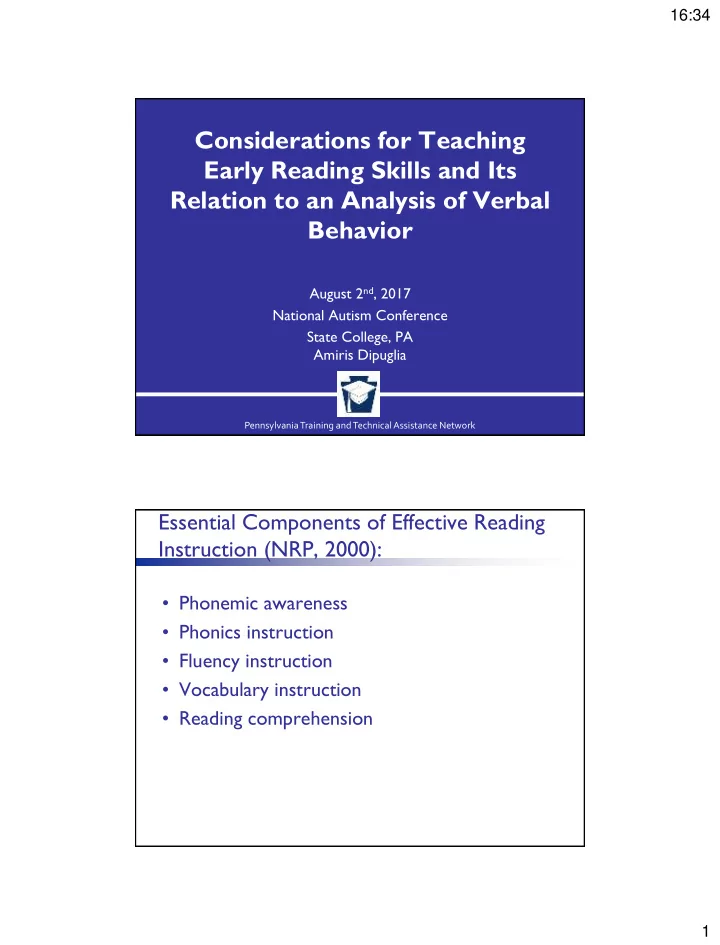
Considerations for Teaching Early Reading Skills and Its Relation to an Analysis of Verbal Behavior

August 2nd, 2017 National Autism Conference State College, PA Amiris Dipuglia

Essential Components of Effective Reading Instruction (NRP, 2000):

  • Phonemic awareness
  • Phonics instruction
  • Fluency instruction
  • Vocabulary instruction
  • Reading comprehension
slide-2
SLIDE 2

16:34 2

Phonemic Awareness

  • Ability to notice, think about, and work with

the individual sounds in spoken words.

  • Children need to become aware of how the

sounds in words work.

  • They must understand that words are made

up of speech sounds, or phonemes.

National Institute for Literacy

Phonemic Awareness

  • Isolating phonemes (e.g., “What is the first sound in the

word man?”- “m”)

  • Identifying phonemes (e.g., “What sound is the same in

man, mop, and my?”- “m”)

  • Categorizing phonemes (e.g., “Which one does not

belong? dog, dance, top, dice”- “top”

  • Blending phonemes to form words (e.g., “What

word is /m/ /o/ /m/?”- “/m/o/m/ is mom”)

National Institute for Literacy

slide-3
SLIDE 3

16:34 3

Phonemic Awareness

  • Segmenting words into phonemes (e.g. “How many

sounds in the word mop?”- (m/o/p-3 sounds)

  • Deleting or adding phonemes to form new words

(e.g., “What is stop without the /s/?”-“Smile without the /s/ is top.”

  • Substituting phonemes to make new words (e.g.,

“The word is mop. Change /m/ to /t/. What’s the new word?”- “top.”

National Institute for Literacy

Phonemic Awareness

  • Most effective when:

– when children are taught to manipulate phonemes by using the letters of the alphabet. – when instruction focuses on only one or two rather than several types of phoneme manipulations. – When students begin blending the sounds together as early as possible

National Institute for Literacy

slide-4
SLIDE 4

16:34 4

Phonics Instruction

  • Teaches children the relationships between

the letters (graphemes) of written language and the individual sounds (phonemes) of spoken language. It teaches children to use these relationships to read and write words National Institute for Literacy

Phonics Instruction

  • Knowing these relationships will help children

recognize familiar words accurately and automatically, and “decode“ new words

  • Systematic and explicit phonics instruction is more

effective than non-systematic or no phonics instruction

  • A program of systematic phonics instruction clearly

identifies a carefully selected and useful set of letter- sound relationships and then organizes the introduction of these relationships into a logical instructional sequence

slide-5
SLIDE 5

16:34 5

Phonics Instruction

  • Most effective if:

– Systematic—the plan of instruction includes a carefully selected set of letter-sound relationships that are organized into a logical sequence. – Explicit—the programs provide teachers with precise directions for the teaching of these relationships.

Fluency Instruction

  • Ability to read a text accurately and quickly.
  • Allows readers to recognize words automatically.

National Institute for Literacy

  • Developmental

progression of

  • ral reading

fluency

  • Need to ensure

accuracy and automaticity at every level as indicated in the chart

  • Oral reading

fluency is more than just speed!

slide-6
SLIDE 6

16:34 6

Vocabulary Instruction

  • Vocabulary refers to the words we must

know to communicate effectively

– listening vocabulary—the words we need to know to understand what we hear. – speaking vocabulary—the words we use when we speak. – reading vocabulary—the words we need to know to understand what we read. – writing vocabulary—the words we use in writing. National Institute for Literacy

Reading Comprehension Instruction

  • Comprehension is the reason for
  • reading. If readers can read the words

but do not understand what they are reading, they are not really reading.

  • Reading is more than textual behavior

– Textual: a written verbal stimulus sets occasion for a corresponding spoken verbal response

National Institute for Literacy

slide-7
SLIDE 7

16:34 7

Reading is a multifaceted skill, gradually acquired over years of instruction and practice. The Many Strands that are Woven into Skilled Reading

(Scarborough, 2001) BACKGROUND KNOWLEDGE VOCABULARY KNOWLEDGE LANGUAGE STRUCTURES VERBAL REASONING LITERACY KNOWLEDGE

  • PHON. AWARENESS

DECODING (and SPELLING) SIGHT RECOGNITION SKILLED READING: fluent execution and

coordination of word recognition and text comprehension. LANGUAGE COMPREHENSION WORD RECOGNITION

Skilled Reading- fluent coordination

  • f word reading

and comprehension processes Courtesy of Pam Kastner

Reading Instruction for Individuals with ASD

  • Generally, converging evidence from a handful of

studies describes the reading skills of children with ASD as having relative strengths in decoding while experiencing greater difficulty with language and reading comprehension (Calhoon, 2001; Frith, 2003; Lord & Paul, 1997; Nation, Clarke, Wright, & Williams, 2006) Evidence-Based Reading Instruction for Individuals with Autism Spectrum Disorders, Whalon et al.

slide-8
SLIDE 8

16:34 8

“direct instruction Viewpoint on Improving

Student Performance (Carnine, Silbert, Kame’enui, & Tarver, 2004)

  • Students will learn if we teach essential

skills in the most effective and efficient manner possible; focus is placed on explicit and systematic teacher-led instruction. Arranging Reading Instruction to Established Generalized Responses

  • Teach component skills that will lead to

generative responding

  • Sequence instruction/stimuli from easy to

hard

  • Distinguish between the cumulative and

generalized repertoires (phonics vs. blending)

slide-9
SLIDE 9

16:34 9

What are relevant component skills?

  • Echoic: repeating wat others say, using self-

echoic to mediate other responses

  • Broad range of tacts, including items, actions,

adverbs, adjectives, multiple component tacts, and prepositions

  • Verbal conditional discriminations
  • Listener: follow simple directions, follow

multiple component directions

What are some relevant component skills?

  • Answering questions and early inferences

(initially in presence of the tact)

– How are ____ and ____ alike – How are ____and ___ different – How do you know?

slide-10
SLIDE 10

16:34 10

slide-11
SLIDE 11

16:34 11

What is Direct Instruction?

Published, research-validated curriculum used in combination with direct instruction (effective teaching procedures)

slide-12
SLIDE 12

16:34 12

Three Main Components of Direct Instruction Programs

  • Program Design
  • Instructional Organization
  • Teaching Techniques

Main Components of Direct Instruction

  • Program Design:
  • 1. Analysis of content matter and

identification of organizing ideas and generalizable strategies to enable more learning in less time

slide-13
SLIDE 13

16:34 13

Main Components of Direct Instruction

  • Program Design:

2. Clear communication is designed:

  • Wording Principle: use wording that is similar across all items so

students can focus on the details of instruction (minimizes distractions and confusion likely caused by variation in teacher language).

  • The setup Principle: Examples and non-examples share the greatest

possible number of irrelevant features.

  • The Difference Principle: Examples shown are similar to one

another except in the critical feature and the difference of the non- example is just enough to change the positive example to a negative example.

  • The sameness Principle: Show the range of variation (full range of

positive examples and limit of variation shown by negative examples).

  • Testing Principle: Test for new examples and non-examples to test

for generalization.

Main Components of Direct Instruction

  • Program Design:

3. Instructional formats are designed to structure the student-teacher interactions: clear and concise and specify the way teachers will present each example. 4. Skills sequenced to maximize success and minimize confusion: emphasis on teaching skills that will allow students to be successful at strategies they will learn later on. 5. Topics and objectives are organized into tracks to allow for systematic skill development and support cumulative review and application

slide-14
SLIDE 14

16:34 14

General Case Instruction

“The general case has been taught when, after instruction on some tasks in a particular class, any task in that class can be performed correctly.”

Becker and Engelmann, 1978 Teaching Set

Set of all instances

General Case Instruction

10 whole words vs. 10 sounds and blending skill =

– 720 three-sound words – 4,320 four-sound words – 21,600 five-sound words

Becker, 1971 (An Empirical Basis for Change in Education)

slide-15
SLIDE 15

16:34 15

Main Components of Direct Instruction

  • Organization of Instruction:
  • 1. Organize students into groups to best meet their

needs.

  • 2. Allocate sufficient time for teaching: allow

sufficient time for students to be involved in learning activities that they can perform successfully.

  • 3. Implement precise and careful plans through

presentation of scripted lessons.

  • 4. Engage in continuous assessment of student

performance.

Scripted Presentation

  • Provides examples
  • Standardized wording
  • Ensures precision
  • Provides efficient corrections
  • Controlled time per activity
  • Increased academic learning time
slide-16
SLIDE 16

16:34 16

Rules for Reviewing Scripts

  • Decide where to add think time and

get ready

  • Where to add pause and punch
  • Where to verify responses
  • Where to add overt responses
  • Where to add meaningful

repetition

  • Where to modify or add examples

Grouping

  • Group size and composition adjusted to

accommodate and reflect student progress and lesson objectives. – Grouping is flexible and dynamic

  • Group size is differentiated according to the

needs of students – Students with the greatest needs are taught in the smallest groups.

  • Cross-class or cross-grade grouping may be used

when appropriate to maximize opportunity to tailor instruction to students performance level. – Groups are homogeneous

slide-17
SLIDE 17

16:34 17

Main Components of Direct Instruction

  • Student-Teacher Interactions:
  • 1. Active student participation
  • 2. Group unison responding
  • 3. Signals
  • 4. Pacing
  • 5. Teaching to mastery
  • 6. Correction procedures
  • 7. Motivation

Set-Up for Successful Teacher-Student Interactions

  • Clear expectations (rules and routines)
  • Materials organization
  • Seating

– Assign seating – Lower performers closest to teacher – All students can see the teacher/materials – Teacher can see all students in the group – Teacher can see independent workers

slide-18
SLIDE 18

16:34 18

Basic Teaching Template: Instructional Format Model-Lead-Test-Verify

Frame: The teacher states the learning task at hand. Model: The teacher provides the expected response verbally or through

  • demonstration. If needed, the teacher repeats the model to make sure all

students heard or saw it. Lead: The teacher and students respond together—several times if needed to ensure that all students practice responding correctly with teacher. Test/Check: Students perform the task independently, several times if needed to do it correctly.

  • Verification. The teacher provides specific praise—stating what the

students learned.

Sample Format

Model Teacher

My turn to sound

  • ut this word.

man “mmmaaannn”

Lead

Teacher and Students

“Say it with me, man “Sound it out with me, mmmaaannn”

Test

Students

“What sound?” “All by yourselves, sound it out.” mmmaaannn”

Verify Teacher

“Yes, /mmm/” “Yes, mmmaaannn”

slide-19
SLIDE 19

16:34 19

Signals

  • Visual or auditory cues that are used

to control the timing of students’ responses.

  • Purpose of signals:

– Increases the likelihood of ALL students initiating a response. – Allows ALL students to practice the task. – Allows the instructor to monitor every student. – Allows the instructor to hear incorrect responses and correct them immediately.

  • 4 Basic steps:

– A focus cue to gain students’ attention and present the task – Brief pause (about 1 second) – A verbal cue (“get ready”) – A signal

  • Rule of Thumb: Signal for student to respond

– Instructor only talks on focus position – Instructor never talks and moves at the same time

slide-20
SLIDE 20

16:34 20

Language for Learning/Thinking Signals

  • Hand Drop

– At the beginning of each step of the exercise, raise your hand. DO NOT move your hand while talking. – Ask the question or give the instruction. – Pause for about one second, and then quickly drop your hand to signal for students to respond.

  • Point/touch:

– Look at the picture. – Point to the picture (make sure all students can see it). – Ask the question or give the instruction. – Hold your finger in the point position for one second. – Signal with a tap.

Reading Mastery Signals

  • Continuous sound signal: loop
  • 1. Focus
  • 2. Preparation 1/5
  • 3. Response 3/4
  • 4. Release 2
  • 5. Verify

m

slide-21
SLIDE 21

16:34 21

Reading Mastery Signals

  • Stop sound signal: slash
  • 1. Focus
  • 2. Response 1/3 2
  • 3. Verify

d

Reading Mastery Signals

  • Pronunciation signal: hold up finger

– 2 seconds for continuous sounds – Flash for stop sounds

slide-22
SLIDE 22

16:34 22

Reading Mastery Signals

  • Saying Sounds:

– Hold up finger: slow sounds – Hand Drop: Say it fast

  • Sound out: man

– Loop-Loop

  • Rhyming Signals:

– Loop stopping for one second at ball then slash to arrow (loop & slash): for sounding out – Slash quickly: For say it fast

slide-23
SLIDE 23

16:34 23

ERROR CORRECTION

slide-24
SLIDE 24

16:34 24

General Corrections

  • Student not attending:

– Teacher corrects by saying, “Let’s try again”, and returns to beginning of task.

– Review effective teaching practices (VR, prompt procedures, error correction)

  • If a student fails to answer when the

signal is given…

– Teacher corrects by saying, “I have to hear everybody”, and then returns to the beginning of the task.

General Corrections

If a student responds either before or too long after the signal… Teacher corrects by saying, “I need everybody to respond on my signal”, and returns to the beginning of the task. Alternatives: “You have to wait until I signal. Let’s try it again.” “You have to answer as soon as I signal.”

slide-25
SLIDE 25

16:34 25

Specific Corrections

  • Vary depending on the specific response

errors.

  • Correction procedures are presented in the

teacher’s presentation book under the exercise for which they apply.

  • .

Statement Corrections

All statement corrections start with “My turn” and end with “starting over” Error Correction Template:

  • Model: “My turn”
  • Lead: “Say it with me”
  • Test: “Your turn by yourself”
  • Verify: “Yes, ____”
  • Starting Over: Start at beginning of task
slide-26
SLIDE 26

16:34 26

Correcting Alternative Responding

Used when student responds with correct but alternative response (different from response

  • n presentation book).
  • Teacher indicates response is correct by

saying, “right, some people call this ____, but it is also called a ____. Let’s use ____.”

  • This is important for consistency across

students and on future lessons.

Correct but Inappropriate Responding

  • Teacher immediately stops the students and

follows this sequence:

  • Models an acceptable way of responding

(Example: “I can say that sentence the nice

  • way. Listen. I am touching my head.”)
  • Leads students through response (“Let’s all

say that sentence the nice way”)

  • Tests students (“Let’s hear you say that

sentence the nice way all by yourselves”).

slide-27
SLIDE 27

16:34 27

Motivation

Important Considerations on Motivation and Reinforcement:

  • Tell student the goal
  • Use specific praise
  • Don’t spend a great deal of time in reinforcement…reinforce

quick and move on.

  • Challenge the student
  • Use tangible reinforces if necessary…Check for

MOTIVATION!

  • Don’t forget differential reinforcement and student’s VR

applies here too!!

  • Reinforce only when student performs according to

acceptable standards.

slide-28
SLIDE 28

16:34 28

Goal for DI :Criteria for Mastery

All students responding correctly on signal in the scripts original context.

DATA COLLECTION-DBDM AND TREATMENT INTEGRITY

slide-29
SLIDE 29

16:34 29

Graphing

  • Graph lessons

mastered

  • Use a different

color/marker to graph mastery tests

  • If needed for

further analysis: use response data sheet/graph percent correct

  • n specific task

DI Treatment Fidelity

YES NO N/A

Organization

  • 1. Is the instructional area neat and clean?
  • 2. Are all teaching materials organized and ready?
  • 3. Have all placement tests been conducted?
  • 4. Did instructor practice the lesson prior to teaching?

Teaching the Lesson

  • 5. Does instructor start the lesson immediately?
  • 6. Does instructor follow the script?
  • 7. Does the instructor use clear signals?
  • 8. Does the instructor reinforce throughout the lesson?
  • 9. Does the instructor keep a good pace?

10. Does the instructor speak clearly and with expression? 11. Does the instructor maintain instructional control? 12. Does instructor ensure ALL students are responding correctly on signal? 13. Is the book at the child’s eye level?

Error Correction

14. Does the instructor correct error(s) immediately? 15. Does the instructor model? 16. Does the instructor lead? 17. Does the instructor test? 18. Does the instructor verify? 19. Does instructor start at beginning of task following error correction? 20. Does the instructor provide extra practice (if needed) to firm up response(s)?

Data

21. Does the instructor conduct mastery tests? 22. Does the instructor graph the data? Notes:

____ / 22

Percentage of Y’s:

slide-30
SLIDE 30

16:34 30

STUDENT READINESS SKILLS

Can he/she start DI yet?

Pre-Requisite Skills for Reading Mastery

  • Echo sounds/words
  • Imitate prosody…speed (fast and slow)
  • Imitate prosody…duration (sustain a sound

for about 3 seconds)

  • Follow simple instructions
slide-31
SLIDE 31

16:34 31

Language for Learning

  • Echo words/phrases
  • Discriminate and Tact many items and actions
  • Respond to simple yes/no questions
  • Perform simple actions on command
  • Describe objects (parts/features)
  • Respond to name

A critical point!

  • Remember that the placement tests included

with Reading Mastery materials do not account for language and other relevant skill deficits

  • Part of the assessment for placement should

be to ensure students have the readiness skills as well as the component language skills that will lead to effective reading

slide-32
SLIDE 32

16:34 32

Assessment for Placement

  • To determine what lesson to start on the

following should be considered:

– Rather than using placement tests, which can

  • ften be misleading, consider using the mastery

tests at the end of each unit – Place student at first lesson pertaining to the first mastery test where they did not meet passing criteria – It may be appropriate to start at easier lessons to teach responding to signals (can be taught in isolation as well)

So what do I teach if he/she is not ready?

  • Start with “show me ready”:
  • Ready hands (hands folded on lap)
  • Seated in chair
  • Feet on floor
  • Body and eye gaze oriented toward teacher
  • Teach first in imitation, then transfer to

listener response

slide-33
SLIDE 33

16:34 33

Other critical skills:

  • Choral/unison: Students’ ability to respond

along with others in a group setting (responding on signal).

  • Individual Responding: Student’s ability to

respond when called on in a group setting.

  • Waiting for others individual responses:

Student’s ability to remain quiet and attentive when it is another student’s individual turn to respond.

References

American Federation of Teachers. (1999). Building on the Best, Learning from What Works: Five Promising Remedial Reading Intervention Programs. Washington, DC Becker, W.C. (1971). Parents as Teachers. Champaign, IL: Research Press. Brophy, J., & Good, T. (1986). Teacher behavior and student achievement: Third handbook of research on teaching (pp. 328-375). New York: Macmillan. Carbone, V. 2005 Advanced Training: Teaching Children with Autism. Manual provided in conjunction with PA Verbal Behavior Project; Carbone Clinic: Valley Cottage, NY Carnine, D. (1991). Curricular interventions for teaching higher order thinking to all students: Introduction to the special series. Journal of Learning Disabilities, 24, 261-269. Carnine, D., Silbert, J., Kame’ennui, E., & Tarver, S. (2004). Direct Instruction Reading, Pearson Education, Upper Saddle River, NJ Catania, C. (2017). The ABCs of Behavior Analysis, An Introduction to Learning and

  • Behavior. Sloan Publishing, Cornwall on Hudson, NY

Duran, E. (1982). Hispanic children can be taught: Or which teaching method is most effective. Teaching and Learning Review, 2, 4-6.
slide-34
SLIDE 34

16:34 34

References

Engelmann, S. (1999). Student-program alignment and teaching to mastery. Paper presented at the 25th annual National Direct Instruction Conference, Eugene, OR. Engelmann, S., & Carnine, D. (1982). Theory of Instruction: Principals and

  • Applications. New York: Irvington.

Marchand-Martella, N.E., Slocum, T.A., & Martella, R.C. (2004). Introduction to Direct Instruction. Pearson Education Inc. Martella, R.C., & Nelson, J.R. (2003). Managing Classroom Behavior. Journal of Direct Instruction, Vol. 3, No. 2, pp. 139–165. Skinner, B.F. (1957). Verbal Behavior. New York: Appleton-Century.

Contact Information www.pattan.net

Amiris Dipuglia Adipuglia@pattan.net Phone # 717-901-2214

Commonwealth of Pennsylvania Tom Wolf, Governor