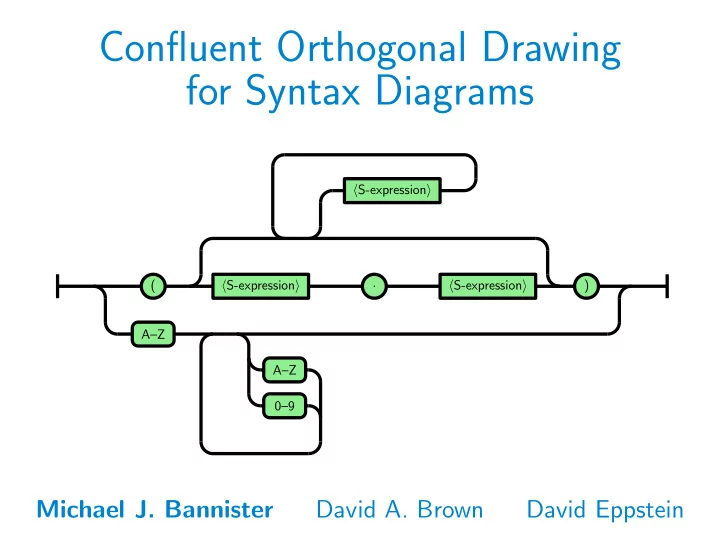
SLIDE 1 . S-expression S-expression ( ) S-expression A–Z 0–9 A–Z
Confluent Orthogonal Drawing for Syntax Diagrams
Michael J. Bannister David A. Brown David Eppstein
SLIDE 2 Context-Free Grammars
S-expression → atomic symbol | (S-expression.S-expression) | (S-expression list) S-expression list → ǫ | S-expressionS-expression list atomic-symbol → LETTERatom part atom part → ǫ | LETTERatom part | numberatom part LETTER → A | B | C | · · · | Z number → 0 | 1 | 2 | · · · | 9 (defun factorial (x) (if (zerop x) 1 (* x (factorial (- x 1)))))
Grammar for LISP 1.5: LISP 1.5 S-expression:
SLIDE 3
Syntax Diagrams
Syntax Diagram from the CANDE Information Manual
SLIDE 4
Syntax Diagrams
Syntax Diagram from the Pascal User Manual and Report
SLIDE 5
Syntax Diagrams
JSON Data Interchange Standard
SLIDE 6 Extended Backus–Naur Form
- More expressive than BNF
- Notation for lists:
natural number = digit { digit }
integer = [ ”-” ] natural number
- More expressive than BNF
- Notation for lists:
natural number = digit { digit }
integer = [ ”-” ] natural number
- Direct translation to syntax diagrams
digit − −
SLIDE 7 Extended Backus–Naur Form
- More expressive than BNF
- Notation for lists:
natural number = digit { digit }
integer = [ ”-” ] natural number
- More expressive than BNF
- Notation for lists:
natural number = digit { digit }
integer = [ ”-” ] natural number
- Direct translation to syntax diagrams
digit − −
SLIDE 8 Extended Backus–Naur Form
- More expressive than BNF
- Notation for lists:
natural number = digit { digit }
integer = [ ”-” ] natural number
- More expressive than BNF
- Notation for lists:
natural number = digit { digit }
integer = [ ”-” ] natural number
- Direct translation to syntax diagrams
digit − −
SLIDE 9
Hand Optimizations
JSON Data Interchange Standard
SLIDE 10
Software Pipeline
NFA Conversion Global Optimization Local Optimization Layered Drawing Confluent Conversion Syntax Diagram BNF Grammar
SLIDE 11
NFA Representation
S-expression → atomic symbol | (S-expression.S-expression) | (S-expression list) S-expression list → ǫ | S-expressionS-expression list atomic-symbol → LETTERatom part atom part → ǫ | LETTERatom part | numberatom part LETTER → A | B | C | · · · | Z number → 0 | 1 | 2 | · · · | 9
Grammar for LISP 1.5:
SLIDE 12
NFA Representation
S-expression → atomic symbol | (S-expression.S-expression) | (S-expression list)
SLIDE 13
NFA Representation
S-expression list → ǫ | S-expressionS-expression list
SLIDE 14
NFA Representation
SLIDE 15 NFA Representation
S-expression → atomic symbol | (S-expression.S-expression) | (S-expression list) S-expression list → ǫ | S-expressionS-expression list atomic-symbol → LETTERatom part atom part → ǫ | LETTERatom part | numberatom part LETTER → A | B | C | · · · | Z number → 0 | 1 | 2 | · · · | 9
SLIDE 16 Global Optimization Can modify the entire NFA representation NFA state minimization
- Combine graphs to reduce states
SLIDE 17
Global Optimization Nesting!
SLIDE 18 Local Optimizations
- Hard to approximate
- Existing heuristic applicable,
but complicated and slow
- Use fast heuristics, motivated
by hand optimizations NFA state minimization: Crossing minimization:
- Add states to reduce crossings
Changes one st-digraph at a time
SLIDE 19
Local Optimizations Loop back!
SLIDE 20
Local Optimizations Parallel state elimination!
SLIDE 21
Local Optimizations Confluent pinch!
SLIDE 22
Optimization
Global Optimization Local Optimization
SLIDE 23
Sugiyama Layering
SLIDE 24
Sugiyama Layering
SLIDE 25
Sugiyama Layering
SLIDE 26
Confluent Conversion
SLIDE 27
Experimental Results Subset of JSON grammar
SLIDE 28
Experimental Results Pascal Type Declarations
SLIDE 29 Conclusion
Software pipeline producing syntax diagrams, uses standard GD techniques for final drawing. which optimizes the input grammar and Further directions:
- Compare our simple heuristics against
existing NFA min heuristics
- Reduce bends and crossings in layering
- Perform user studies
SLIDE 30 Conclusion
Software pipeline producing syntax diagrams, uses standard GD techniques for final drawing. which optimizes the input grammar and Further directions:
- Compare our simple heuristics against
existing NFA min heuristics
- Reduce bends and crossings in layering
- Perform user studies
Thank you!