Conflict of Interest Statement I have no financial disclosures of - - PDF document

conflict of interest statement
SMART_READER_LITE
LIVE PREVIEW

Conflict of Interest Statement I have no financial disclosures of - - PDF document

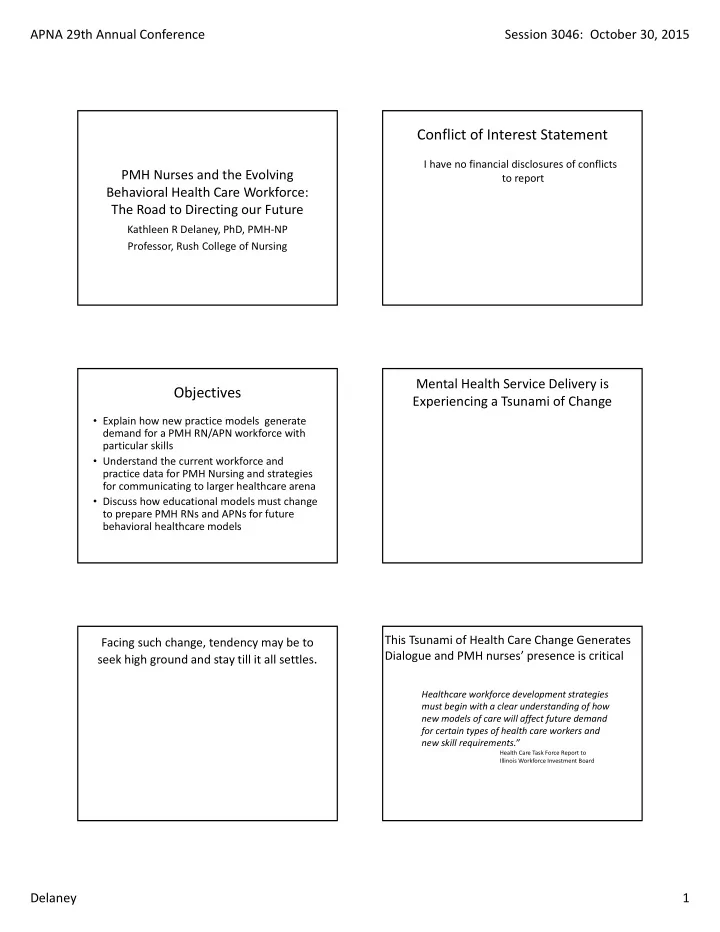
APNA 29th Annual Conference Session 3046: October 30, 2015 Conflict of Interest Statement I have no financial disclosures of conflicts PMH Nurses and the Evolving to report Behavioral Health Care Workforce: The Road to Directing our Future Kathleen


slide-1
SLIDE 1

APNA 29th Annual Conference Session 3046: October 30, 2015 Delaney 1 PMH Nurses and the Evolving Behavioral Health Care Workforce: The Road to Directing our Future

Kathleen R Delaney, PhD, PMH‐NP Professor, Rush College of Nursing

Conflict of Interest Statement

I have no financial disclosures of conflicts to report

Objectives

  • Explain how new practice models generate

demand for a PMH RN/APN workforce with particular skills

  • Understand the current workforce and

practice data for PMH Nursing and strategies for communicating to larger healthcare arena

  • Discuss how educational models must change

to prepare PMH RNs and APNs for future behavioral healthcare models

Mental Health Service Delivery is Experiencing a Tsunami of Change

Facing such change, tendency may be to seek high ground and stay till it all settles. This Tsunami of Health Care Change Generates Dialogue and PMH nurses’ presence is critical

Healthcare workforce development strategies must begin with a clear understanding of how new models of care will affect future demand for certain types of health care workers and new skill requirements.”

Health Care Task Force Report to Illinois Workforce Investment Board

slide-2
SLIDE 2

APNA 29th Annual Conference Session 3046: October 30, 2015 Delaney 2 PMH nursing skills are essential to the fundamental changes of health care transformation‐but our voice is sporadic

Heisler & Bagalman, 2013

We need to craft an effective message and find our collective voice

What would an effective message convey

  • Our commitment to the mental health and

well being of individuals and populations

  • Our disciplinary foundation in relationship‐

based care

  • Positions our work and capabilities in new

health care delivery models Demand …… Capacity …… Capabilities

Let’s Build a Statement that Marries Essential Elements of that Message

Connect the dots from workforce Demand to PMH RN/APN Capacity to PMH Nursing Capabilities: What PMH Nursing will bring

How to anticipate and depict demand?

Judging Demand from New Care Models: Dig into Assumptions, Support, Incentives, Policy Milieu

slide-3
SLIDE 3

APNA 29th Annual Conference Session 3046: October 30, 2015 Delaney 3

Policy Environment: ACA Reform: Provisions by Year

2010

Review of Health Plan Premium Increases Changes in Medicare Provider Rates Qualifying Therapeutic Discovery Project Credit Medicaid and CHIP Payment Advisory Commission Comparative Effectiveness Research Prevention and Public Health Fund Medicare Beneficiary Drug Rebate Small Business Tax Credits Medicaid Drug Rebate Coordinating Care for Dual Eligible Generic Biologic Drugs New Requirements on Non‐profit Hospitals Medicaid Coverage for Childless Adults Reinsurance Program for Retiree Coverage Pre‐existing Condition Insurance Plan New Prevention Council Consumer Website Tax on Indoor Tanning Services Expansion of Drug Discount Program Adult Dependent Coverage to Age 26 Consumer Protections in Insurance Insurance Plan Appeals Process Coverage of Preventive Benefits Health Centers and the National Health Service Corps Health Care Workforce Commission Medicaid Community‐Based Services

2011

Minimum Medical Loss Ratio for Insurers Closing the Medicare Drug Coverage Gap Medicare Payments for Primary Care Medicare Prevention Benefits Center for Medicare and Medicaid Innovation Medicare Premiums for Higher‐Income Beneficiaries Medicare Advantage Payment Changes Medicaid Health Homes Chronic Disease Prevention in Medicaid National Quality Strategy Changes to Tax‐Free Savings Accounts Grants to Establish Wellness Programs Teaching Health Centers Medical Malpractice Grants Funding for Health Insurance Exchanges Nutritional Labeling Medicaid Payments for Hospital‐Acquired Infections Graduate Medical Education Medicare Independent Payment Advisory Board Medicaid Long‐Term Care Services

2012

Accountable Care Organizations in Medicare Uniform Coverage Summaries for Consumers Medicare Advantage Plan Payments Medicare Independence at Home Demonstration Medicare Provider Payment Changes Fraud and Abuse Prevention Annual Fees on the Pharmaceutical Industry Medicaid Payment Demonstration Projects Data Collection to Reduce Health Care Disparities Medicare Value‐Based Purchasing

Team Based, Capitated Models of Care Will Increase Demand For New Skills

  • RN: Screening for mental health/substance use

conditions; Telephone triage; proficiency in stepped care decisions; deliver basic behavioral health interventions; wellness; engagement

  • APN: Leveling care; tracking patient progress;

population health; quality improvement around attrition and premature treatment dropout.

The Educational Implications are Rather Obvious

Demand …… Capacity …… Capabilities What is the Capacity of PMH Nursing Workforce?

I stock photo 22843139 purchased 3/2015

Depicting Workforce Capacity Requires Data: On the size, distribution, and practice sites

Graph compiled by Kathleen Delaney

What do we know about our current PMH RN Workforce

Estimated ‐ 4% of respondents practice in a Mental Health Setting

PMH/substance abuse RN workforce 4%‐ Hospital 5%‐ Community

From: Budden, J. S., Zhong, E. H., Moulton, P., & Cimiotti, J. P. (2013). Highlights of the national workforce survey of registered nurses. Journal of Nursing Regulation, 4(2), 5-14.

slide-4
SLIDE 4

APNA 29th Annual Conference Session 3046: October 30, 2015 Delaney 4

From: Budden, J. S., Zhong, E. H., Moulton, P., & Cimiotti, J. P. (2013). Highlights of the national workforce survey of registered nurses. Journal of Nursing Regulation, 4(2), 5-14.

Where we Practice and What we Do?

APNs in psychiatry very small numbers in NP surveys, (5.6%) Geographic/state distribution: Not sure about density in APN in rural

  • counties. State by state. can tell

general APN/RN distribution

HRSA (2014) Highlights from the 2012 National Sample Survey of Nurse Practitioners.

Limited Data available for PMH RN Role in Integrated Care: Care Coordination Roles Demand …… Capacity …… Capabilities Depicting the Capabilities of PMH Nursing Workforce?

I‐Stock Photo – 17871965 purchased 9‐2014

PMH RNs: Education creates a unique skill base particularly for integrated services

In addition to providing a full range of therapeutic interventions, PMH RNs are:

  • Capable of monitoring medical conditions and thus

manage an integrated treatment plan

  • Skilled in screening for a wide variety of MH/SU issues
  • Able to assess how medical and behavioral issues create

an intensity of need and match with intensity of services

  • Focused on assisting individuals to successfully navigate

the continuum of care from hospital to home

  • Address health issues with understanding of how serious

mental illness can bring with it behaviors that impact how health issues are addressed, i.e. poor sleep, poor eating.

PMH‐APNs: Educated in Multiple Sciences Create a Provider with Wide Breadth of Skills

  • Licensed to provide the full spectrum of mental health

services; assessment and diagnosis, implementing psychotherapeutic interventions, and prescribing medications

  • Trained to provide mental health care across the life

span, including older adults and children

  • Skilled provider of Integrated (medical/behavioral)

care since they are educated to address both mental health/substance abuse and physical health concerns.

  • Provide services in a wide variety of settings (primary

care, hospital, long term care, forensic, schools)

  • Practice within the full spectrum of behavioral health

care services, from prevention, through intervention to long term care

slide-5
SLIDE 5

APNA 29th Annual Conference Session 3046: October 30, 2015 Delaney 5

PMH RN/APNs have Multiple Layers of Requisite Interpersonal Skills for Service Engagement

From: Russinova, Rogers, & Ellison, 2006

Be clear why PMH Nurses are equipped to Shape Engaging/Healing Environments

  • Know how to access narratives of illness,

meanings and distill what is important

  • Know how to navigate between every day

needs and the broader picture of treatment

  • Know how to instill the hope requisite of

recovery

  • DISCIPLINARY FOUNDATON

I‐Stock Photo – 17871965 purchased 9‐2014

  • Understand what is needed in evolving systems
  • f care
  • Articulate the fit of your skills and service system

needs

  • Draw a distinction to what you can provide

We Have Arrived At Our Message

  • PMH RNs are a large professional workforce practicing

in both inpatient and outpatient settings

  • PMH RNs are the linchpins in front‐line triaging, care

coordination, transitional care , stepped care systems

  • PMH RNs’ training and education uniquely prepares

them to address medical/psychiatric needs of clients

  • PMH‐RNs Disciplinary Foundation in relationship‐based

care promotes service engagement

Message for the PMH RN workforce Message for the PMH APN Workforce

PMH APNs (along with physician colleagues) are the two professional disciplines licensed to provide the full spectrum of mental health services; including prescribing medications PMH APNs are trained in multiple sciences to evaluate and implement evidence‐ based, cost‐effective treatment plans which assures individuals will receive the right care at the right time and at the right place PMH APNs are educated to build innovative transition processes, stepped care, and integrated care models for complex, often underserved, populations. PMH APNs use population health knowledge to plan treatment that addresses social determinants of health and bringing mental health expertise to communities PMH APNs have been leaders in disseminating Screening, Brief Intervention, Referral and Treatment (SBIRT), PMH APNs are skilled at shaping outcomes focused on the patient experience and building patient‐engagement in services to reduce attrition

How to assure our work force presence in strategic planning

Educators: What do you need to populate a state with PMH nurses ? What new training foci will build ambulatory Sklls? PMH‐ RNs: Volunteer for State/County Mental Health Planning Boards Become involved with your state’s Center for Nursing – join one of it’s action groups RESPOND TO WORKFORCE SURVEYS

slide-6
SLIDE 6

APNA 29th Annual Conference Session 3046: October 30, 2015 Delaney 6

We cannot wait for the health care world to come to us: Delivering Effective Messages is Critical

I‐Stock Photo – 10325846 purchased 9‐2009

Thank You for coming today Questions or Comments?

References

American Association of Colleges of Nursing (AACN) (ND) State nursing workforce reports. American Academy of Ambulatory Care Nursing. (2012).American Academy of Ambulatory Care Nursing position paper: The role of the registered nurse in ambulatory care.. Pitman, NJ: Author. Budden, J. S., Zhong, E. H., Moulton, P., & Cimiotti, J. P. (2013a). Highlights of the national workforce survey of registered nurses. Journal of Nursing Regulation, 4(2), 5-14. Burke, B. T., Miller, B. F., Proser, M., Petterson, S. M., Bazemore, A. W., Goplerud, E., & Phillips, R. L. (2013). A needs-based method for estimating the behavioral health staff needs of community health centers. BMC health services research, 13(1), 245. Delaney, K. R., Robinson, K.M, & Chafetz, L. (2013) Development of Integrated Mental Health Care: Critical workforce competencies. Nursing Outlook. 61(6), 384-391. Drew, B. L. (2014). The Evolution of the Role of the Psychiatric Mental Health Advanced Practice Registered Nurse in the United States. Archives of Psychiatric Nursing, 28(5), 298-300.

References Cont.

Doescher, M. P., Andrilla, C. H. A., Skillman, S. M., Morgan, P., & Kaplan, L. (2014). The Contribution of Physicians, Physician Assistants, and Nurse Practitioners Toward Rural Primary Care: Findings From a 13-State Survey. Medical care, 52(6), 549-556. Druss, B. G., von Esenwein, S. A., Compton, M. T., Rask, K. J., Zhao, L., & Parker, R. M. (2010). A randomized trial of medical care management for community mental health settings: The primary care access, referral, and evaluation (PCARE) study. American Journal of Psychiatry, 167(2), 151- 159. Frogner, B. K., Spetz, J., Parente, S. T., & Oberlin, S. (2015). The demand for health care workers post-ACA. International Journal of Health Economics and Management, 15(1),139-151. Garfield, R. L., Lave, J. R., & Donohue, J. M. (2010). Health reform and the scope of benefits for mental health and substance use disorder services. Psychiatric Services, 61(11), 1081-1086. Garfield, R. L., Zuvekas, S. H., Lave, J. R., & Donohue, J. M. (2011). The impact of national health care reform on adults with severe mental disorders. American Journal of Psychiatry, 168, 486-494. Gerrity, M. (2014) Integrating Primary Care into Behavioral Health Settings: What works for individuals with serious mental illness. Milbank Memorial Fund. Heisler, E.J., Bagalman, E. (2013) The Mental Health Workforce: A Primer. Congressional Research Service, Washington, D.C.