Confinement of Alpha Particles in a Low-Aspect-Ratio Tokamak Reactor - - PowerPoint PPT Presentation

confinement of alpha particles in a low aspect ratio
SMART_READER_LITE
LIVE PREVIEW

Confinement of Alpha Particles in a Low-Aspect-Ratio Tokamak Reactor - - PowerPoint PPT Presentation

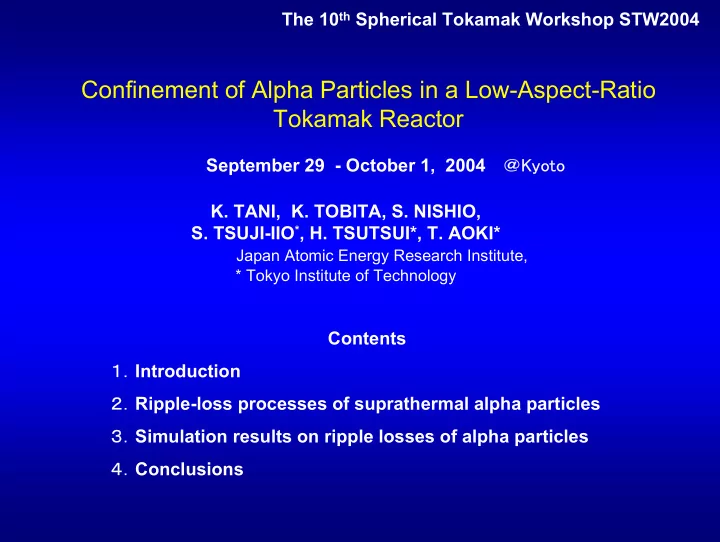
The 10 th Spherical Tokamak Workshop STW2004 Confinement of Alpha Particles in a Low-Aspect-Ratio Tokamak Reactor September 29 - October 1, 2004 Kyoto K. TANI, K. TOBITA, S. NISHIO, S. TSUJI-IIO * , H. TSUTSUI*, T. AOKI* Japan Atomic


slide-1
SLIDE 1

Confinement of Alpha Particles in a Low-Aspect-Ratio Tokamak Reactor

  • K. TANI, K. TOBITA, S. NISHIO,
  • S. TSUJI-IIO*, H. TSUTSUI*, T. AOKI*

Japan Atomic Energy Research Institute, * Tokyo Institute of Technology

September 29 - October 1, 2004 @Kyoto Contents 1.Introduction 2.Ripple-loss processes of suprathermal alpha particles 3.Simulation results on ripple losses of alpha particles 4.Conclusions The 10th Spherical Tokamak Workshop STW2004

slide-2
SLIDE 2

Introduction Important features of spherical tokamak (ST) reactors

  • 1. High elongation、
  • 2. High triangularity
  • 3. Low aspect ratio

improvement of level of symmetry line symmetry ⇒ point symmetry

  • 4. Non-inductive plasma current (hollow current profile)

no use of center solenoid improvement of plasma performance

  • negative shear
  • access to the 2nd stability region

Confinement of alpha particles in an ST reactor is very interesting. Neoclassical confinement (ripple loss), Non-neoclassical confinement (TAE mode etc.) Here we focus our attention only on the neoclassical confinement.

slide-3
SLIDE 3

Introduction

Objectives

Preliminary results indicate that the ripple loss of alpha particles shows a marked reduction in a low-aspect-ratio system . The number of toroidal field (TF) coils is one of the key parameters for the design of tokamak system. The smaller the number of TF coils is, the easier the design of reactor system becomes.

Preliminary results also show that in a tokamak system with a

conventional aspect ratio, the reduction of the number of TF coils results in a considerable increase of alpha particle losses. Is there a possibility to reduce the number of TF coils in a low- aspect- ratio tokamak?

  • to investigate the confinement of alpha particles in a

low-aspect-ratio tokamak by using an orbit-following Monte-Carlo code.

  • to investigate the possibility to design a tokamak system with a

low aspect ratio and a low number of TF coils.

slide-4
SLIDE 4

Ripple-loss processes of suprathermal alpha particles Neoclassical confinement of α particles ≡ ripple loss of α particles Ripple losses

  • ripple-trapped loss

・collisional trapping ・collisionless trapping in a non-uniform ripple distribution (a)

  • ripple-enhanced banana

drift (b) If the drift exceeds a critical value, the trajectory becomes stochastic [Goldston, White and Boozer (1981)].

(a) (b)

ripple-trapped

  • rbit

banana

  • rbit

α ≤ 1.0 r/a 1.0

B B Z Z

φ φ (a) (b)

ripple-trapped

  • rbit

banana

  • rbit

α ≤ 1.0 r/a 1.0

B B Z Z

φ φ

slide-5
SLIDE 5

[ ]

2 2 2 2

) ( ) ( 1 ) (

t t

R R Z R R a − + − ∆ + = = κ ρ ρ ψ ψ

  • Model MHD equilibrium (uniform ellipticity κ and triangularity ∆)

a : minor radius,

t

R : major radius

Hereafter, variables with the superscript ‘c’ denote those in a circular plasma with the same qs(a).

1) ripple-well parameter

c t R

a R R B B N α δ α / ) ( 1 1 − ∆ + ≅ ≅

N δ

:number of toroidal field coil, : local field ripple

Ripple wells are developed in the region | α | α | < 1.0. | α | = 1.0 r/a 1.0 Ripple-loss processes of suprathermal alpha particles

c R t R c t

B a R R B Z a R R Z / ) ( 1 / ) ( 1 − ∆ + ≈ − ∆ + = κ

slide-6
SLIDE 6

[ ]

c a c t a L R

P a R R P Z B B N Z Z P ψ κ ψ ψ δ ρ π ψ

φ φ φ * 4 / 1 * 2 / 3 * *

/ ) ( 1 1 − ∆ + ≅ ∂ ∂ ≅ ∂ ∂ =

2) ripple-enhanced banana drift Z* 3) critical field ripple for stochastic orbits :Z displacement enhanced by ripple,

*

Z

: Larmor radius

L

ρ N P d d

b

1

* ≥ φ

ψ ϕ

s L s t c s

q q R N ′ ≈ ρ ρ π δ

2 / 3

) / ( 1

b

ϕ

:toroidal angle difference between two banana tips

c s s s t s

q q R R a δ ρ π κ δ             ′ + + − ∆ + ≈ ) / ( 1 ) ( 4 1 1 Banana orbits in the region δ>δs become stochastic.

(By Goldston-White-Boozer)

Ripple loss processes of suprathermal alpha particles

slide-7
SLIDE 7

Summary of dependence of

  • ripple-well parameter α,
  • ripple-enhanced banana drift Pφ

* and

  • critical field ripple of stochastic orbit δs
  • n some important system parameters

Ripple-loss processes of suprathermal alpha particles 1) dependence on the elongation κ (Tani et.al in Nucl.Fusion1993)

2 / 3 2 / 3 *

/ 1 , , / 1 A A P A

s ∝

∝ ∝ δ α

φ

κ δ κ α

φ

∝ ∝ ∝

s

P t independen , / 1 ,

*

2) dependence on the aspect ratio A 3) dependence on the local field ripple δ and the number of TF coils N

2 / 3 2 / 1 *

/ 1 , , /( 1 N N P N

s ∝

∝ ) ∝ δ δ δ α

φ

slide-8
SLIDE 8

Simulation studies on the ripple loss of alpha particles by using an orbit-following Monte-Carlo code 1-1) the dependence of the aspect-ratio 1-2) the dependence of ripple losses on the number of TF coils

Simulation results on ripple losses of alpha particles

(1) Qualitative investigations of the ripple loss using analytical MHD equilibria into 2-1) the dependence on the edge field ripple for a hollow and a parabolic plasma current profile 2-2) the dependence on the number of TF coils for a hollow and a parabolic plasma current profile 2-3) the allowable field ripple and the number of TF coils (2) Quantitative investigations of the ripple loss using a realistic MHD equilibrium of VECTOR into

slide-9
SLIDE 9

0.0 1.0 2.0 3.0 0.0 0.2 0.4 0.6 0.8 1.0

Ψ

safety factor q(Ψ)

N = 4 ~ 18 Number of TF coils Zimp = 6.0 (carbon) Charge number of impurity Zeff = 1.9 (uniform) Effective Z ∆ = +0.5 Tiangularity κ = 1.55 Elipticity qs = 2.56 Safety factor j(Ψ) = j0 (1-Ψ

1.3)

Plasma current ne0 = 2x10²⁰ m-3 nD(Ψ) = nT(Ψ) = n i(Ψ) ne(Ψ) = ne0 (1-Ψ)0.3 Plasma density Te0 = Ti0 = 35 keV TD(Ψ) = TT(Ψ) = T i(Ψ) Ti(Ψ) = Ti0 (1-Ψ) Te(Ψ) = Te0 (1-Ψ) Plasma temperature Bt = 3.1 T Toroidal field @R=Rt a = 1.9m Minor radius Rt = 3.7 ~9.2m Major radius

Analytical MHD equilibria Simulation results on ripple losses of alpha particles R(m) Z(m)

0.0 2.0 4.0 6.0 8.0 0.0 5.0 10.0 15.0

TF coils plasma first wall

slide-10
SLIDE 10

Simulation results on ripple losses of alpha particles

1 1 −       − + −         + ≅ N R a R i N a R R

  • t

t

δ δ δ

  • δ

i δ

:field ripples at outer and inner plasma edge

,

Distribution of the field ripple in a system with vertically long TF coils

1.0E-05 1.0E-04 1.0E-03 1.0E-02 1.0E-01 1.0E+00

  • 1.0
  • 0.5

0.0 0.5 1.0

A=1.95 A=2.47 A=3.79 A=4.84

(R-Rt)/a Field ripple δ (%) The distribution of the field ripple is strongly depends on the aspect ratio.

slide-11
SLIDE 11

Simulation results on ripple losses of alpha particles

1.0 10.0 100.0 1.0 10.0

A Total power loss fraction Gt (%)

qa=2.56 δo=1% N=12

∼A4.3

2 / 3 2 / 3 *

/ 1 , , / 1 A A P A

s ∝

∝ ∝ δ α

φ

1-1) dependence on the aspect ratio A (1) Qualitative investigations of the ripple loss using analytical MHD equilibria

As the aspect ratio is reduced,

  • the area of ripple-well region ,
  • the ripple-enhanced banana drift ,
  • the area of stochastic orbit region

The distribution of the field ripple also strongly depends on A. The ripple loss shows a very strong dependence on A by the synergy of all of these effects

slide-12
SLIDE 12

Simulation results on ripple losses of alpha particles

1-2) dependence on the number of TF coils N

2 / 3 2 / 1 *

/ 1 , , /( 1 N N P N

s ∝

∝ ) ∝ δ δ δ α

φ

(1) Qualitative investigations of the ripple loss using analytical MHD equilibria

0.0 5.0 10.0 15.0 20.0 2 6 10 14 18

N Total power loss fraction Gt (%)

A=2.21 A=4.32 qa=2.56 δo=1% N=12 As the number of TF coils is reduced,

  • the area of ripple-well region ,
  • the ripple-enhanced banana drift ,
  • the area of stochastic orbit region

Note that the distribution of δ strongly depends on N.

slide-13
SLIDE 13

Simulation results on ripple losses of alpha particles

N = 4 ~ 12 Number of TF coils Zimp = 6.0 (carbon) Charge number of impurity Zeff = 1.9 (uniform) Effective Z ne0 = 2x10²⁰ m-3 nD(Ψ) = nT(Ψ) = n i(Ψ) ne(Ψ) = ne0 (1-Ψ)0.3 Plasma density Te0 = Ti0 = 35 keV TD(Ψ) = TT(Ψ) = T i(Ψ) Ti(Ψ) = Ti0 (1-Ψ) Te(Ψ) = Te0 (1-Ψ) Plasma temperature Bt = 3.1 T Toroidal field a = 1.9m Minor radius Rt = 3.7m Major radius

R(m) Z(m)

0.0 2.0 4.0 6.0 0.0 2.0 4.0 6.0 8.0 10.0

TF coil first wall plasma

Geometry and plasma parameters of VECTOR 0.0 1.0 2.0 3.0 4.0 5.0 6.0 7.0 8.0 9.0 10.0 0.0 0.2 0.4 0.6 0.8 1.0 Ψ safety factor q(Ψ)

hollow current parabolic current

slide-14
SLIDE 14

Simulation results on ripple losses of alpha particles

Total power loss fraction Gt (%)

0.0 2.0 4.0 6.0 8.0 10.0 12.0 0.0 0.5 1.0 1.5 2.0 2.5

A=1.95 N=4 hollow current parabolic current

δo(%)

  • 5.0
  • 4.0
  • 3.0
  • 2.0
  • 1.0

0.0 1.0 2.0 3.0 4.0 5.0 1.0 3.0 5.0

R(m) Z(m) starting point with v//=0

(2) Quantitative investigations of the ripple loss using a realistic MHD equilibrium of VECTOR 2-1) the dependence on the edge field ripple

Some axi-symmetric loss has been found in a hollow current plasma.

slide-15
SLIDE 15

Simulation results on ripple losses of alpha particles

Total power loss fraction Gt (%)

0.0 1.0 2.0 3.0 4.0 5.0 6.0 2 4 6 8 10 12

N

A=1.95

δo=1%

parabolic current hollow current

(2) Quantitative investigations of the ripple loss using a realistic MHD equilibrium of VECTOR 2-2) the dependence on the number of TF coils

slide-16
SLIDE 16

Simulation results on ripple losses of alpha particles Allowable heat loads: ∼ 2Mw/m2 (with cooling system) , ∼ 1Mw/m2 (w/o cooling system) hollow parabolic with cooling without cooling ∼ 1.5 % below 1% ∼ 2 % ∼ 1 % current profile Allowable field ripple assuming a toroidal peaking factor ( =peak/average over toroidal angle) about 2,

(2) Quantitative investigations of the ripple loss using a realistic MHD equilibrium of VECTOR 2-3) the allowable field ripple and the number of TF coils (preliminary results using

  • nly 4000 test particles)

Toroidal average of heat load <Pw>max (Mw/m2)

without cooling with cooling

δo(%)

hollow current

0.0 0.5 1.0 1.5 2.0 2.5 0.0 1.0 2.0 3.0

0.0 1.0 2.0 3.0 4.0 5.0 0.0 2.0 4.0 6.0

hitting

zone first wall

R(m) Z(m)

A=1.95 N=6 parabolic current

slide-17
SLIDE 17

Simulation results on ripple losses of alpha particles Original VECTOR

2 4 6 8 10 12 14 16 18 6.0 8.0 10.0 12.0

Rout(m) Number of TF coils N

δo=1% δo=2% Rin Rout TF coil N=12, δo= 0.5-1.0% Low N VECTOR N=6, δo= 1.5% - 2.0% About 30% increase in the TF-coil size (weight). (preliminary results) A trade-off between the weight of TF coils and the space for blankets, poloidal coils and maintenance.

slide-18
SLIDE 18

Conclusions

  • 1. The ripple loss is strongly reduced as the aspect ratio becomes low

(proportional to A4.3 for A>∼ 3) . Consequently, alpha particles are well confined in a low-aspect-ratio tokamak.

  • 2. In a low-aspect-ratio system, the dependence of the ripple loss on

the number of TF coils is very weak, if the edge field ripple is kept constant.

  • 3. Thanks to the good confinement of alphas in a low-aspect-ratio

system, the number of TF coils can be reduced to about 6 by making allowances for a small amount of ripple loss and some increase in the size of TF coils. Future works

  • 1. Optimization of plasma and TF coil shapes to reduce ripple losses of

alpha particles. Our target : a low A and low N tokamak without cooling system for loss alphas

  • 2. Improvement of Monte-Carlo error bars for 2D wall heat load by using

large number of test particles (>100,000).

slide-19
SLIDE 19

Thank you for your attention !!!