configurations in course of accident Valery Strizhov Presentation - - PowerPoint PPT Presentation

configurations in course
SMART_READER_LITE
LIVE PREVIEW

configurations in course of accident Valery Strizhov Presentation - - PowerPoint PPT Presentation

RUSSIAN ACADEMY OF SCIENCES Nuclear Safety Institute (IBRAE) Corium debris configurations


slide-1
SLIDE 1

РОССИЙСКАЯ АКАДЕМИЯ НАУК

Институт проблем безопасного развития атомной энергетики

RUSSIAN ACADEMY OF SCIENCES

Nuclear Safety Institute (IBRAE)

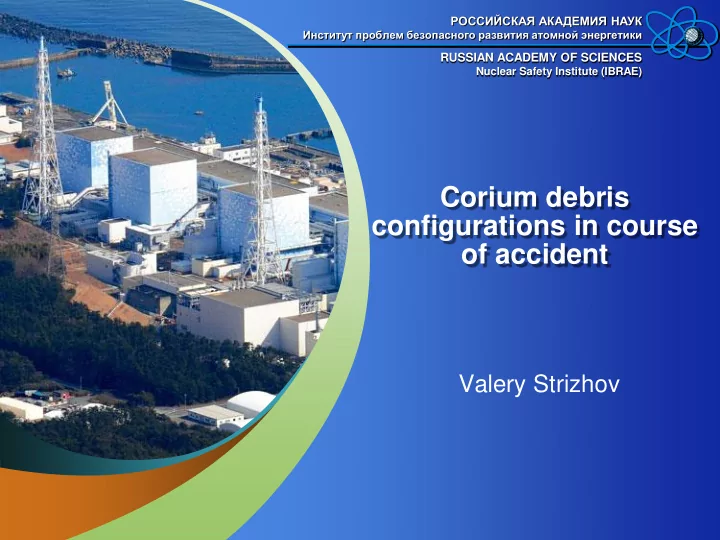
Corium debris configurations in course

  • f accident

Valery Strizhov

slide-2
SLIDE 2

Presentation outline

  • Results of BSAF Project on corium location in the

containment

  • Configurations of molten materials in the reactor

pressure vessel based on the results of OECD/NEA RASPLAV-MASCA Project

  • Nuclear fuel behavior modeling during active phase of

the Chernobyl accident (Results of ISTC-2916 Project)

  • Results of investigations lava-like Fuel Containing

Masses (LFCM)

  • Modeling of formation, spreading and cooling of LFCM
slide-3
SLIDE 3

Corium debris stabilization in course of accident

In-vessel:

  • TMI-2
  • Fukushima unit 2 (?)

Ex-vessel:

  • Chernobyl-4
  • Fukushima units 1 and 3

“Reactor core conditions of unit 1 – 3 of Fukushima Daiichi Nuclear Power Station” (Nov.30, 2011) “Evaluation of the situation of cores and containment vessels of Fukushima Daiichi Nuclear Power Station Units-1 to 3 and examination into unsolved issues in the accident progression” (Aug 6, 2014) BSAF Project Summary Report (June 2015)

slide-4
SLIDE 4

Significant issues

In-vessel:

  • Debris composition:

UO2-Zr-ZrO2-SS

  • Melt configurations:

Depends upon composition

  • Chemical Interactions:

OECD RASPLAV-MASCA Project

  • Fission products

partitioning between phases Ex-vessel:

  • Debris composition:

UO2-ZrO2-FeO-CC

  • Melt configurations:

Usually metal phase below

  • xides
  • MCCI: Extensive

experimental database (USA, Germany)

  • Fission products release
  • Spreading of molten

materials (France, Chernobyl accident)

slide-5
SLIDE 5

Possible melt configurations in the reactor pressure vessel

Test MA-3 Test MA-2 (reconstruction) Test MA-6 Metal phase Oxide phase

Three possible configurations of molten materials in the lower head

  • Top left – Low zirconium oxidation degree,

small amount of steel (30 – 40%)

  • Top right – High zirconium oxidation

degree (>70%)

  • Left down – Large amount of steel, high Zr
  • xidation degree
slide-6
SLIDE 6

Melt in the reactor pressure vessel

  • Goals of OECD RASPLAV-MASCA Project
  • Material interactions at high temperatures (U-Zr-O-Fe)
  • Conditions for pool stratifications (U/Zr ratio, degree of
  • xidation)
  • U-Zr-O-Fe(SS)+Oxidation atmosphere (steam/air)
  • Assessments of corium debris for Fukushima Daiichi

Unit 1 in the RPV:

  • Zirconium oxidation degree about 50%
  • U to Zr ratio 0,8
  • Mass ratio of steel in the melt: 0,3
  • This parameters indicate that most probably the

classic configuration of phases (metal layer atop of

  • xides) will be observed
slide-7
SLIDE 7

Accident initiation

  • April 26, 1986 reactor shut down

was planned for maintanance purposes

  • The test of was planned on

electric power supply due to turbine rundown

  • Some safety systems were

turned off

  • Due to different reasons reactor
  • perated with the violation of

requirements for save operation

  • Operation at small power and

reactor shut down by emergency protection rods lead to introduction of positive reactivity

  • All these reasons lead to the

positive reactivity and reactor explosion

slide-8
SLIDE 8

Stages of Fuel Investigations

  • 1986 – 87: Study of contaminated areas
  • Study of fallouts
  • More than 95% of fuel was located inside the Shelter
  • 1988 – 92: Investigations in the Shelter
  • Observations of lava-like fuel containing masses

(LFCM)

  • Drilling of boreholes and data accumulation of
  • 1991 – 95: Extensive analysis of samples
  • Methods for LFCM mass assessments
  • Chemical analysis and generalization of data
  • 2005 – 2007: ISTC-2916 Project
  • Systematic data analyses
  • Development of the model for molten fuel behavior and

interactions

slide-9
SLIDE 9

Molten core concrete interaction

  • Sources of data:
  • Visual and remote
  • bservations
  • Bore holes data
  • btained in 1988 –

1992

  • level of about 9m: 25

holes

  • level of about 10 m: 10

holes

  • level of about 11 m: 8

holes

slide-10
SLIDE 10

Main streams of LFCM

Horizontal flow Vertical flow

  • Initial melt was formed in the south-eastern part of the reactor after interaction

with the serpentine filling of the “OR” scheme

  • Spreading of the melt was in horizontal (through the breach through the wall

between rooms 305/2 and 304/3)

  • Spreading in the vertical directions (through the steam outlet valves of the

accident localization system)

  • Interaction with the concrete
slide-11
SLIDE 11

Visual observations of LFCM

11

slide-12
SLIDE 12

LFCM Source – under reactor room

  • 1 – Dominantly black ceramic
  • 2 – Dominantly brown ceramic
  • 3 – LFCM with high fuel

concentration

Black ceramics Brown ceramics Slag like from PSP “Pumice” U 4.7±1.1 8.4±0.2 8.3±0.2 8.3±1.0 Zr 3.2±1.2 4.8±1.1 4.5±1.4 3.3±0.5 Mg 2.4±0.8 4.0±0.9 6.2±2.2 4.6±0.4 Si 29.8 ±4.8 30.9±3.6 32.3±2.8 36.6±0.5 Ca 5.5 ±2.0 4.7 ±0.8 4.0 ±1.1 4.8 ±0.6 Al 4.8 ±1.3 3.5 ±0.7 3.4 ±1.4 2.8 ±0.4 Na 4.2 ±0.7 4.0 ±0.4 1.5 ±0.5 1.4 ±0.2

slide-13
SLIDE 13

1 - Serpentinite of the “ОR” component and the inter-compensatory gap 2 - Crushed “С” component (“Cross”) 3 - Fuel, fuel assemblies, fuel elements, process channels, graphite blocks, fragmented concrete 4 - ¾ ОR 5 - BWC tubes 6 - Additional support 7 - Reflector (channels and graphite blocks) 8 - Reinforced-concrete plate (fragments of wall of separator box) 9 - “L” tank 10 - Heat shielding lining of separator box’s wall 11 - “D” tank 12 - ¼ ОR 13 - Damaged wall 14 - Vault’s filling-up-origin sand 15 - Debris of reinforced-concrete constructions 16 - Fragment of reinforced-concrete construction

Reconstruction of initial data for LFCM generation

slide-14
SLIDE 14

Computational model (Pancake model)

  • 1. Basemate concrete
  • 2. Under reactor structures

(Steel, sand)

  • 3. “OR” Scheme (steel,

serpentine)

  • 4. Fuel containing masses

(zirconium, steel, graphite, etc.)

  • 5. Materials from upper

structures (concrete, materials dropped into the reactor wreck)

Initial data: 3D geometry of rooms Varied temperature (Base case 1400 K) Assume two layers: black ceramics atop Model includes Advection of the melt Radiation from melt top surface Heat conductivity Temperature dependence of viscosity Melt source in the room 305/2 Characteristic time for graphite burning and melting through

  • f reactor basemate was assessed (between 7 to 10 days)
slide-15
SLIDE 15

Spreading

  • Through wall break

between 305 and 304 rooms (0.5 m)

  • Melt flow rate through

the wall break

  • Total volume of

LFCM: 170 – 200 m3 (Mass of 460 – 540 tons)

  • Mass source varied:

25 – 80 kg/s

  • Duration varied: 6000

– 20000 s

  • Temperature: 1400 K
slide-16
SLIDE 16

Summary

  • OECD RASPLAV-MASCA Project results

demonstrate possible melt configuration in the reactor pressure vessel

  • Chernobyl lava location demonstrates high

corium flow-ability and long distances for spreading even for small uranium content

  • There is significant differences in the geometry

and configuration of debris and its locations between Chernobyl and Fukushima

  • Fukushima has more difficulties in terms of the

accessibility

  • Urania content of Fukushima corium seems to be

higher

  • Molten materials may spread up to PCV walls due

to high corium flow-ability

slide-17
SLIDE 17

References

  • E.Anderson, B.Burakov,

E.Pazukhin, Secondary variations

  • f fuel containing masses (FCM) of

4-th Chernobyl NPP unit, Radiochemistry, 34, pp. 135-138, 1992 (In Russian).

  • Object “Shelter” – 10 years. Main

results of studies (In Russian) Chernobyl, 1996

  • R. V. Arutyunyan, L. A. Bolshov,
  • A. A. Borovoi, E. P. Velikhov, A. A.
  • Klyuchnikov. Nuclear Fuel in the

«Shelter» encasement of the Chernobyl NPP, 2010. Moscow, Nauka.

Detailed information on characteristics of Chernobyl fuel containing materials such as physical and chemical properties, structure, and other issues can be found in references: