Conducting Effective Workplace Investigations Thursday, June 3, - - PDF document

conducting effective workplace investigations
SMART_READER_LITE
LIVE PREVIEW

Conducting Effective Workplace Investigations Thursday, June 3, - - PDF document

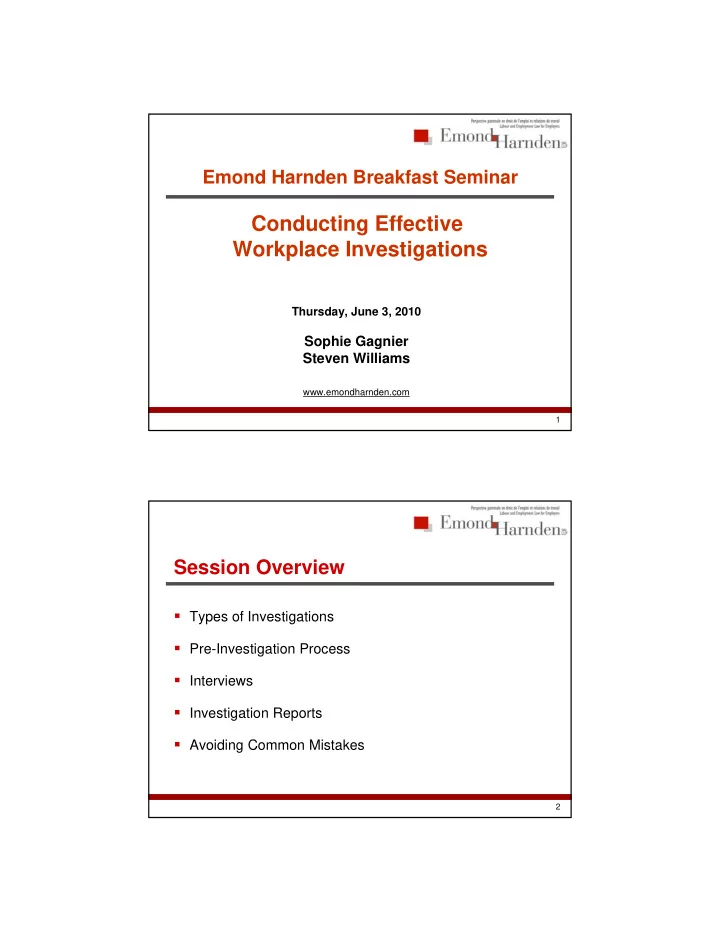
Emond Harnden Breakfast Seminar Conducting Effective Workplace Investigations Thursday, June 3, 2010 Sophie Gagnier Steven Williams www.emondharnden.com 1 Session Overview Types of Investigations Pre-Investigation Process


slide-1
SLIDE 1

1

Thursday, June 3, 2010

Sophie Gagnier Steven Williams

www.emondharnden.com

Emond Harnden Breakfast Seminar

Conducting Effective Workplace Investigations

2

Session Overview

  • Types of Investigations
  • Pre-Investigation Process
  • Interviews
  • Investigation Reports
  • Avoiding Common Mistakes
slide-2
SLIDE 2

3

GTAA v. P.S.A.C. (2010)

“…since the GTAA's conduct in both its investigation and also in its ultimate determination was not only unreasonable but also in bad faith, the Grievor is entitled to an appropriate remedy including damages.”

  • Awarded more than $500,000 in damages

4

Roe v. Schneider National Carriers (2006)

“…the employer should afford an employee a meaningful

  • pportunity to respond to allegations of misconduct

and should conduct a reasonable investigation in order to successfully raise such conduct in support of a just cause dismissal.”

slide-3
SLIDE 3

5

Negligent Investigation

  • An employee can sue for a negligent investigation
  • Liability?
  • Private investigation firm hired by employer – YES
  • Against employers – NOT YET

6

Types of Investigations

  • Just Cause Investigations
  • Human Rights Investigations
  • Personal Harassment Investigations
  • Workplace Injury Investigations
  • Violence Investigations (Bill 168)
slide-4
SLIDE 4

7

Pre-Investigation Process

  • Receive complaint – incident occurs
  • Timing issues
  • Interim measures

8

Pre-Investigation Process

  • Suspension with pay
  • Transfer
  • Change reporting relationships
  • Leave of absence
slide-5
SLIDE 5

9

Pre-Investigation Process

  • Disclosure of allegations to respondent
  • Fact-finding – gather documentary and witness evidence
  • Confidentiality

10

Dealing with Represented Parties

  • Lawyer
  • Union
  • Support person
  • Procedural fairness
slide-6
SLIDE 6

11

Selecting Investigators

  • Neutral
  • Qualified
  • Internal vs External

12

Interviewing Parties and Witnesses

  • Order of interviews
  • Be prepared
  • Private location
  • Cover ground rules
slide-7
SLIDE 7

13

Interviewing Parties and Witnesses

  • Convey seriousness of interview
  • Watch tone
  • Be neutral
  • Don’t interrupt the flow of narrative

14

Interviewing Parties and Witnesses

  • Take time, be patient
  • Take notes!
  • Written summary from witness
  • Ensure accurate, thorough information
slide-8
SLIDE 8

15

Interview Questions

  • Break the ice
  • Seek specific information – W5
  • Invite a narrative – chronological works well
  • Lead with open questions
  • Clarify with specific questions

16

Types of Questions

  • Credibility questions
  • Solicit other relevant information
  • Be careful of leading questions
slide-9
SLIDE 9

17

Wrapping up the Interview

  • Review notes
  • Any questions/additions?
  • Follow-up
  • Confidentiality reminder

18

Confidentiality

  • X recognizes the Complainant’s and the Respondent’s

interest in confidentiality. To protect the interests of the Complainant, the Respondent and any others who may report or be witnesses to such incidents, confidentiality will be maintained throughout the investigatory process to the extent practicable and appropriate under the

  • circumstances. Only those with a need to know about

the complaint will be made aware that an investigation is

  • ngoing. The results of any investigation will also be kept

confidential and will be disclosed to individuals only on a need to know basis.

slide-10
SLIDE 10

19

Obtaining Other Evidence

  • Retrieve quickly!
  • Secure any relevant documents
  • Expert documentation analysis
  • Taking a view
  • Photos/diagrams

20

Reviewing the Evidence

  • Standard of proof
  • Create a chronological summary of ALL evidence
  • Assess credibility
slide-11
SLIDE 11

21

The Investigation Report

  • Contents
  • Scope of Retainer
  • Description of Complaint
  • Description of Methodology
  • Analysis of Evidence
  • Recommendations
  • Circulation
  • Action

22

Contacting Police and/or Regulatory Body

  • When?
  • Continue with your investigation
  • Results of police investigations
slide-12
SLIDE 12

23

Common Mistakes

  • 1. Failing to promptly investigate
  • 2. Failing to provide procedural fairness
  • 3. Failing to take complaint seriously
  • 4. Choosing untrained investigators
  • 5. Choosing internal over external
  • 6. Failing to remain neutral

24

Common Mistakes

  • 7. Failing to properly document
  • 8. Failing to appreciate psychological dynamics
  • 9. Mishandling reluctant complainants
  • 10. Applying wrong standard of proof
  • 11. Failing to advise of outcome
slide-13
SLIDE 13

25

Common Mistakes

  • 12. Failing to gather all relevant information
  • 13. Failing to follow policy and procedure

26

Questions?