Conditional Probability, Independence, Bayes Theorem 18.05 Spring - - PowerPoint PPT Presentation

conditional probability independence bayes theorem 18 05
SMART_READER_LITE
LIVE PREVIEW

Conditional Probability, Independence, Bayes Theorem 18.05 Spring - - PowerPoint PPT Presentation

Conditional Probability, Independence, Bayes Theorem 18.05 Spring 2014 January 1, 2017 1 / 23 Sample Space Confusions 1. Sample space = set of all possible outcomes of an experiment. 2. The size of the set is NOT the sample space. 3.


slide-1
SLIDE 1

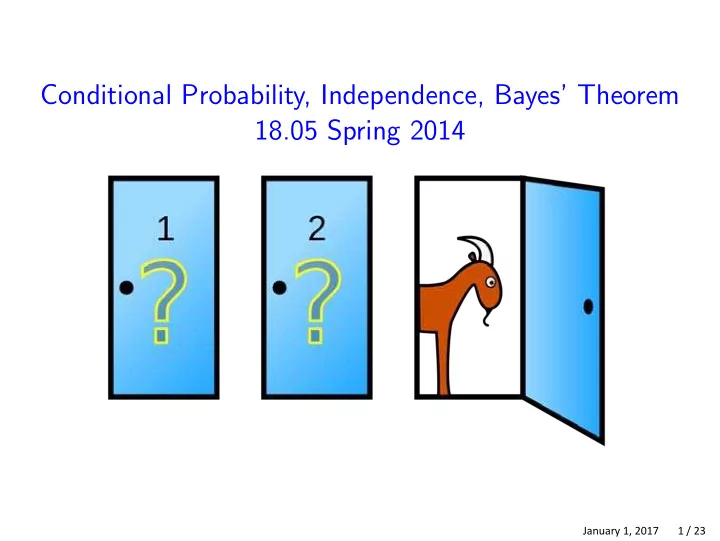
Conditional Probability, Independence, Bayes’ Theorem 18.05 Spring 2014

January 1, 2017 1 / 23
slide-2
SLIDE 2

Sample Space Confusions

  • 1. Sample space = set of all possible outcomes of an experiment.
  • 2. The size of the set is NOT the sample space.
  • 3. Outcomes can be sequences of numbers.

Examples.

  • 1. Roll 5 dice: Ω = set of all sequences of 5 numbers between 1 and

6, e.g. (1, 2, 1, 3, 1, 5) ∈ Ω. The size |Ω| = 65 is not a set.

  • 2. Ω = set of all sequences of 10 birthdays,

e.g. (111, 231, 3, 44, 55, 129, 345, 14, 24, 14) ∈ Ω. |Ω| = 36510

  • 3. n some number, Ω = set of all sequences of n birthdays.

|Ω| = 365n .

January 1, 2017 2 / 23

slide-3
SLIDE 3

Conditional Probability ‘the probability of A given B’. P(A ∩ B) P(A|B) = , provided P(B) = 0. P(B)

B A

A ∩ B

Conditional probability: Abstractly and for coin example

January 1, 2017 3 / 23

slide-4
SLIDE 4

Table/Concept Question

(Work with your tablemates, then everyone click in the answer.)

Toss a coin 4 times. Let A = ‘at least three heads’ B = ‘first toss is tails’.

  • 1. What is P(A|B)?

(a) 1/16 (b) 1/8 (c) 1/4 (d) 1/5

  • 2. What is P(B|A)?

(a) 1/16 (b) 1/8 (c) 1/4 (d) 1/5

January 1, 2017 4 / 23

slide-5
SLIDE 5

Table Question “Steve is very shy and withdrawn, invariably helpful, but with little interest in people, or in the world of reality. A meek and tidy soul, he has a need for order and structure and a passion for detail.”∗ What is the probability that Steve is a librarian? What is the probability that Steve is a farmer?

∗From Judgment under uncertainty: heuristics and biases by Tversky and

Kahneman.

January 1, 2017 5 / 23

slide-6
SLIDE 6

Multiplication Rule, Law of Total Probability Multiplication rule: P(A ∩ B) = P(A|B) · P(B). Law of total probability: If B1, B2, B3 partition Ω then P(A) = P(A ∩ B1) + P(A ∩ B2) + P(A ∩ B3) = P(A|B1)P(B1) + P(A|B2)P(B2) + P(A|B3)P(B3)

Ω B3 B2 B1

A ∩ B1 A ∩ B2 A ∩ B3

January 1, 2017 6 / 23

slide-7
SLIDE 7

Trees

Organize computations Compute total probability Compute Bayes’ formula

  • Example. : Game: 5 red and 2 green balls in an urn. A random ball

is selected and replaced by a ball of the other color; then a second ball is drawn.

  • 1. What is the probability the second ball is red?
  • 2. What is the probability the first ball was red given the second ball

was red?

G1 R1 R2 G2 R2 G2 5/7 2/7 4/7 3/7 6/7 1/7

First draw Second draw

January 1, 2017 7 / 23

slide-8
SLIDE 8

Concept Question: Trees 1

A1 A2 B1 B2 B1 B2 C1 C2 C1 C2 C1 C2 C1 C2

x y z

  • 1. The probability x represents

(a) P(A1) (b) P(A1|B2) (c) P(B2|A1) (d) P(C1|B2 ∩ A1).

January 1, 2017 8 / 23

slide-9
SLIDE 9

Concept Question: Trees 2

A1 A2 B1 B2 B1 B2 C1 C2 C1 C2 C1 C2 C1 C2

x y z

  • 2. The probability y represents

(a) P(B2) (b) P(A1|B2) (c) P(B2|A1) (d) P(C1|B2 ∩ A1).

January 1, 2017 9 / 23

slide-10
SLIDE 10

Concept Question: Trees 3

A1 A2 B1 B2 B1 B2 C1 C2 C1 C2 C1 C2 C1 C2

x y z

  • 3. The probability z represents

(a) P(C1) (b) P(B2|C1) (c) P(C1|B2) (d) P(C1|B2 ∩ A1).

January 1, 2017 10 / 23

slide-11
SLIDE 11

Concept Question: Trees 4

A1 A2 B1 B2 B1 B2 C1 C2 C1 C2 C1 C2 C1 C2

x y z

  • 4. The circled node represents the event

(a) C1 (b) B2 ∩ C1 (c) A1 ∩ B2 ∩ C1 (d) C1|B2 ∩ A1.

January 1, 2017 11 / 23

slide-12
SLIDE 12

Let’s Make a Deal with Monty Hall One door hides a car, two hide goats. The contestant chooses any door. Monty always opens a different door with a goat. (He can do this because he knows where the car is.) The contestant is then allowed to switch doors if she wants. What is the best strategy for winning a car? (a) Switch (b) Don’t switch (c) It doesn’t matter

January 1, 2017 12 / 23

slide-13
SLIDE 13

Board question: Monty Hall Organize the Monty Hall problem into a tree and compute the probability of winning if you always switch. Hint first break the game into a sequence of actions.

January 1, 2017 13 / 23

slide-14
SLIDE 14

Independence Events A and B are independent if the probability that

  • ne occurred is not affected by knowledge that the other
  • ccurred.

Independence ⇔ P(A|B) = P(A) (provided P(B) 0) ⇔ P(B|A) = P(B) (provided P(A) 0) (For any A and B) ⇔ P(A ∩ B) = P(A)P(B) = =

January 1, 2017 14 / 23

slide-15
SLIDE 15

Table/Concept Question: Independence

(Work with your tablemates, then everyone click in the answer.)

Roll two dice and consider the following events A = ‘first die is 3’ B = ‘sum is 6’ C = ‘sum is 7’ A is independent of (a) B and C (b) B alone (c) C alone (d) Neither B or C .

January 1, 2017 15 / 23

slide-16
SLIDE 16

Bayes’ Theorem Also called Bayes’ Rule and Bayes’ Formula. Allows you to find P(A|B) from P(B|A), i.e. to ‘invert’ conditional probabilities. P(B|A) · P(A) P(A|B) = P(B) Often compute the denominator P(B) using the law of total probability.

January 1, 2017 16 / 23

slide-17
SLIDE 17

Board Question: Evil Squirrels Of the one million squirrels on MIT’s campus most are good-natured. But one hundred of them are pure evil! An enterprising student in Course 6 develops an “Evil Squirrel Alarm” which she offers to sell to MIT for a passing

  • grade. MIT decides to test the reliability of the alarm by

conducting trials.

January 1, 2017 17 / 23

slide-18
SLIDE 18

Evil Squirrels Continued When presented with an evil squirrel, the alarm goes

  • ff 99% of the time.

When presented with a good-natured squirrel, the alarm goes off 1% of the time. (a) If a squirrel sets off the alarm, what is the probability that it is evil? (b) Should MIT co-opt the patent rights and employ the system?

January 1, 2017 18 / 23

slide-19
SLIDE 19

One solution (This is a base rate fallacy problem)

We are given: P(nice) = 0.9999, P(evil) = 0.0001 (base rate) P(alarm | nice) = 0.01, P(alarm | evil) = 0.99 P(alarm | evil)P(evil) P(evil | alarm) = P(alarm) P(alarm | evil)P(evil) = P(alarm | evil)P(evil) + P(alarm | nice)P(nice) (0.99)(0.0001) = (0.99)(0.0001) + (0.01)(0.9999) ≈ 0.01

January 1, 2017 19 / 23

slide-20
SLIDE 20

Squirrels continued Summary: Probability a random test is correct = 0.99 Probability a positive test is correct ≈ 0.01 These probabilities are not the same! Alternative method of calculation: Evil Nice Alarm 99 9999 10098 No alarm 1 989901 989902 100 999900 1000000

January 1, 2017 20 / 23

slide-21
SLIDE 21

healthy/

Washington Post, hot off the press Annual physical exam is probably unnecessary if you’re generally healthy For patients, the negatives include time away from work and possibly unnecessary tests. “Getting a simple urinalysis could lead to a false positive, which could trigger a cascade of even more tests, only to discover in the end that you had nothing wrong with you.” Mehrotra says.

http://www.washingtonpost.com/national/health-science/ annual-physical-exam-is-probably-unnecessary-if-youre-generally- 2013/02/08/2c1e326a-5f2b-11e2-a389-ee565c81c565_story.html

January 1, 2017 21 / 23

slide-22
SLIDE 22

Table Question: Dice Game

1 2 3

The Randomizer holds the 6-sided die in one fist and the 8-sided die in the other. The Roller selects one of the Randomizer’s fists and covertly takes the die. The Roller rolls the die in secret and reports the result to the table. Given the reported number, what is the probability that the 6-sided die was chosen? (Find the probability for each possible reported number.)

January 1, 2017 22 / 23

slide-23
SLIDE 23

MIT OpenCourseWare https://ocw.mit.edu

18.05 Introduction to Probability and Statistics

Spring 2014 For information about citing these materials or our Terms of Use, visit: https://ocw.mit.edu/terms.