Concurrent Programing: 52% /year Why you should care, deeply 100 - - PDF document

concurrent programing
SMART_READER_LITE
LIVE PREVIEW

Concurrent Programing: 52% /year Why you should care, deeply 100 - - PDF document

Uniprocessor Performance Not Scaling Performance (vs. VAX-11/780) 10000 20% /year 1000 Concurrent Programing: 52% /year Why you should care, deeply 100 Don Porter 10 25% /year Portions courtesy Emmett Witchel 1 1978


slide-1
SLIDE 1 1

Concurrent Programing: Why you should care, deeply Don Porter Portions courtesy Emmett Witchel

2

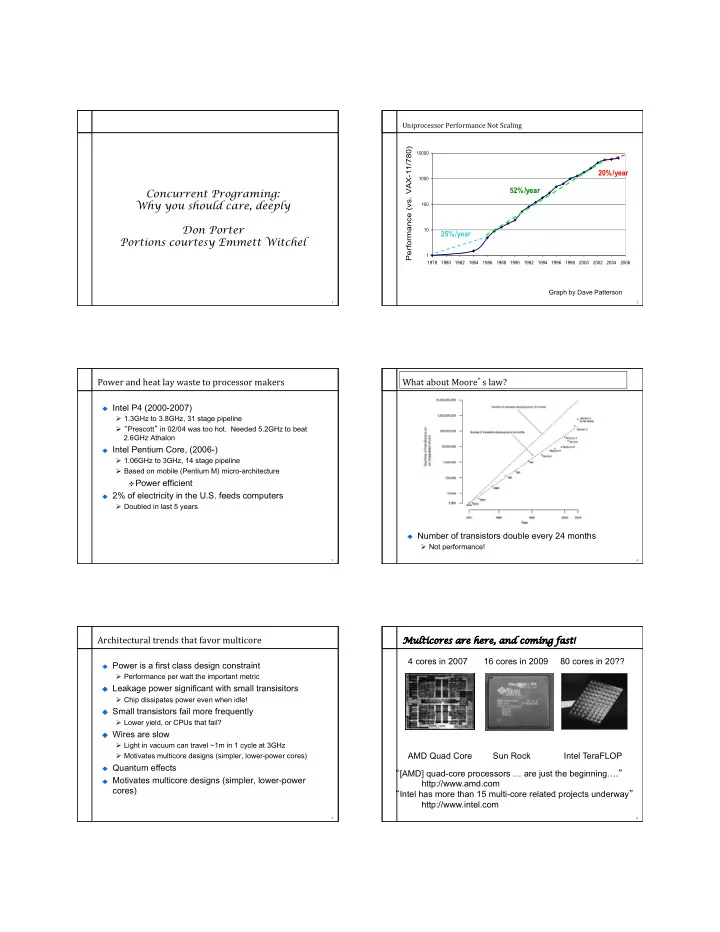
Uniprocessor ¡Performance ¡Not ¡Scaling ¡

1 10 100 1000 10000 1978 1980 1982 1984 1986 1988 1990 1992 1994 1996 1998 2000 2002 2004 2006

Performance (vs. VAX-11/780) 25% /year 52% /year 20% /year

Graph by Dave Patterson

3

Power ¡and ¡heat ¡lay ¡waste ¡to ¡processor ¡makers ¡

Intel P4 (2000-2007)

Ø 1.3GHz to 3.8GHz, 31 stage pipeline Ø “Prescott” in 02/04 was too hot. Needed 5.2GHz to beat 2.6GHz Athalon

Intel Pentium Core, (2006-)

Ø 1.06GHz to 3GHz, 14 stage pipeline Ø Based on mobile (Pentium M) micro-architecture

❖ Power efficient

2% of electricity in the U.S. feeds computers

Ø Doubled in last 5 years

4

What ¡about ¡Moore’s ¡law? ¡

Number of transistors double every 24 months

Ø Not performance!

5

Architectural ¡trends ¡that ¡favor ¡multicore ¡

Power is a first class design constraint

Ø Performance per watt the important metric

Leakage power significant with small transisitors

Ø Chip dissipates power even when idle!

Small transistors fail more frequently

Ø Lower yield, or CPUs that fail?

Wires are slow

Ø Light in vacuum can travel ~1m in 1 cycle at 3GHz Ø Motivates multicore designs (simpler, lower-power cores)

Quantum effects Motivates multicore designs (simpler, lower-power cores)

6

Multicore res a are re h here re, a and c d coming f fast! Sun Rock “[AMD] quad-core processors … are just the beginning….” http://www.amd.com “Intel has more than 15 multi-core related projects underway” http://www.intel.com Intel TeraFLOP AMD Quad Core 4 cores in 2007 16 cores in 2009 80 cores in 20??

slide-2
SLIDE 2 7

Multicore ¡programming ¡will ¡be ¡in ¡demand ¡

Hardware manufacturers betting big on multicore Software developers are needed Writing concurrent programs is not easy You will learn how to do it in this class

8

Concurrency ¡Problem ¡

Order of thread execution is non-deterministic

Ø Multiprocessing

❖ A system may contain multiple processors è cooperating

threads/processes can execute simultaneously

Ø Multi-programming

❖ Thread/process execution can be interleaved because of time-

slicing

Operations often consist of multiple, visible steps

Ø Example: x = x + 1 is not a single operation

❖ read x from memory into a register ❖ increment register ❖ store register back to memory

Goal:

Ø Ensure that your concurrent program works under ALL possible interleaving Thread 2 read increment store

9

Questions ¡

Do the following either completely succeed or completely fail? Writing an 8-bit byte to memory

Ø A. Yes B. No

Creating a file

Ø A. Yes B. No

Writing a 512-byte disk sector

Ø A. Yes B. No

10

Sharing ¡among ¡threads ¡increases ¡performance… ¡

int a = 1, b = 2; main() { CreateThread(fn1, 4); CreateThread(fn2, 5); } fn1(int arg1) { if(a) b++; } fn2(int arg1) { a = arg1; } What are the values of a & b at the end of execution?

11

Sharing ¡among ¡theads ¡increases ¡performance, ¡but ¡can ¡ lead ¡to ¡problems!! ¡

int a = 1, b = 2; main() { CreateThread(fn1, 4); CreateThread(fn2, 5); } fn1(int arg1) { if(a) b++; } fn2(int arg1) { a = 0; } What are the values of a & b at the end of execution?

12

Some ¡More ¡Examples ¡

What are the possible values of x in these cases?

Thread1: x = 1; Thread2: x = 2; Initially y = 10; Thread1: x = y + 1; Thread2: y = y * 2; Initially x = 0; Thread1: x = x + 1; Thread2: x = x + 2;

slide-3
SLIDE 3 13

Critical ¡Sections ¡

A critical section is an abstraction

Ø Consists of a number of consecutive program instructions Ø Usually, crit sec are mutually exclusive and can wait/signal

❖ Later, we will talk about atomicity and isolation

Critical sections are used frequently in an OS to protect data structures (e.g., queues, shared variables, lists, …) A critical section implementation must be: Ø Correct: the system behaves as if only 1 thread can execute in the critical section at any given time Ø Efficient: getting into and out of critical section must be fast. Critical sections should be as short as possible. Ø Concurrency control: a good implementation allows maximum concurrency while preserving correctness Ø Flexible: a good implementation must have as few restrictions as practically possible

14

The ¡Need ¡For ¡Mutual ¡Exclusion ¡

Running multiple processes/threads in parallel increases performance Some computer resources cannot be accessed by multiple threads at the same time

Ø E.g., a printer can’t print two documents at once

Mutual exclusion is the term to indicate that some resource can only be used by one thread at a time

Ø Active thread excludes its peers

For shared memory architectures, data structures are

  • ften mutually exclusive

Ø Two threads adding to a linked list can corrupt the list

15

Exclusion ¡Problems, ¡Real ¡Life ¡Example ¡

Imagine multiple chefs in the same kitchen

Ø Each chef follows a different recipe

Chef 1

Ø Grab butter, grab salt, do other stuff

Chef 2

Ø Grab salt, grab butter, do other stuff

What if Chef 1 grabs the butter and Chef 2 grabs the salt?

Ø Yell at each other (not a computer science solution) Ø Chef 1 grabs salt from Chef 2 (preempt resource) Ø Chefs all grab ingredients in the same order

❖ Current best solution, but difficult as recipes get complex ❖ Ingredient like cheese might be sans refrigeration for a while

16

The ¡Need ¡To ¡Wait ¡

Very often, synchronization consists of one thread waiting for another to make a condition true

Ø Master tells worker a request has arrived Ø Cleaning thread waits until all lanes are colored

Until condition is true, thread can sleep

Ø Ties synchronization to scheduling

Mutual exclusion for data structure

Ø Code can wait (await) Ø Another thread signals (notify)

17

Example ¡2: ¡Traverse ¡a ¡singly-­‑linked ¡list ¡

Suppose we want to find an element in a singly linked list, and move it to the head Visual intuition:

lhead lptr lprev

18

Example ¡2: ¡Traverse ¡a ¡singly-­‑linked ¡list ¡

Suppose we want to find an element in a singly linked list, and move it to the head Visual intuition:

lhead lptr lprev

slide-4
SLIDE 4 19

Even ¡more ¡real ¡life, ¡linked ¡lists ¡

Where is the critical section? lprev = NULL; for(lptr = lhead; lptr; lptr = lptr->next) { if(lptr->val == target){ // Already head?, break if(lprev == NULL) break; // Move cell to head lprev->next = lptr->next; lptr->next = lhead; lhead = lptr; break; } lprev = lptr; }

20

Even ¡more ¡real ¡life, ¡linked ¡lists ¡

A critical section often needs to be larger than it first appears

Ø The 3 key lines are not enough of a critical section // Move cell to head lprev->next = lptr->next; lptr->next = lhead lhead = lptr; lprev->next = lptr->next; lptr->next = lhead; lhead = lptr;

Thread 1 Thread 2

lhead elt lptr lprev lhead elt lptr lprev

21

Even ¡more ¡real ¡life, ¡linked ¡lists ¡

Putting entire search in a critical section reduces concurrency, but it is safe.

if(lptr->val == target){ elt = lptr; // Already head?, break if(lprev == NULL) break; // Move cell to head lprev->next = lptr->next; // lptr no longer in list for(lptr = lhead; lptr; lptr = lptr->next) { if(lptr->val == target){

Thread 1 Thread 2

22

Safety ¡and ¡Liveness ¡

Safety property : “nothing bad happens” Ø holds in every finite execution prefix

❖ Windows™ never crashes ❖ a program never terminates with a wrong answer

Liveness property: “something good eventually happens” Ø no partial execution is irremediable

❖ Windows™ always reboots ❖ a program eventually terminates

Every property is a combination of a safety property and a liveness property - (Alpern and Schneider)

23

Safety ¡and ¡liveness ¡for ¡critical ¡sections ¡

At most k threads are concurrently in the critical section

Ø A. Safety Ø B. Liveness Ø C. Both

A thread that wants to enter the critical section will eventually succeed

Ø A. Safety Ø B. Liveness Ø C. Both

Bounded waiting: If a thread i is in entry section, then there is a bound on the number of times that other threads are allowed to enter the critical section (only 1 thread is alowed in at a time) before thread i’s request is granted.

Ø A. Safety B. Liveness C. Both