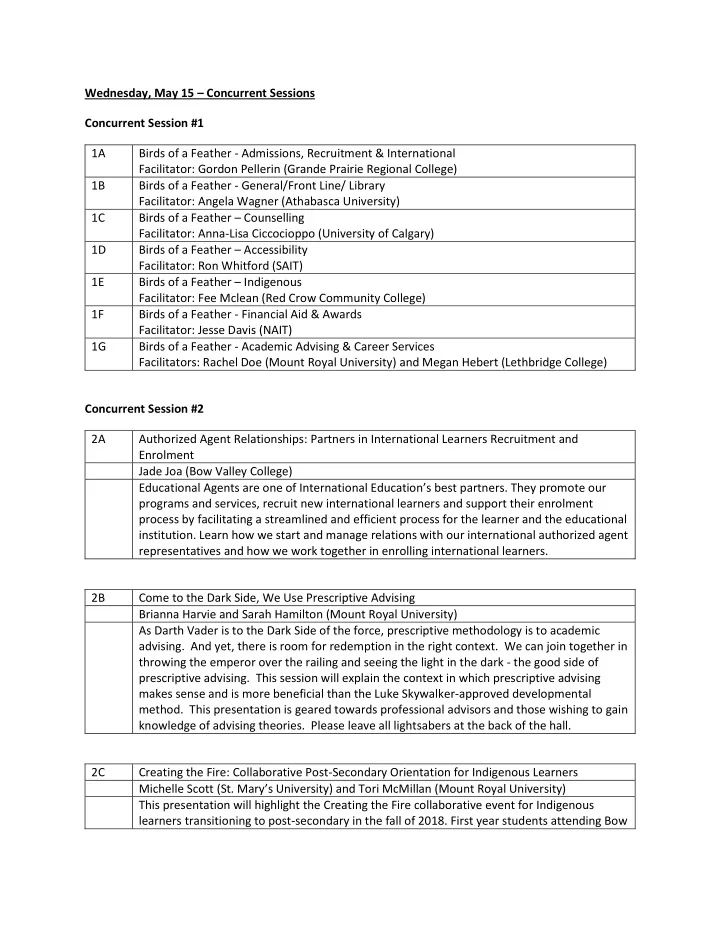
SLIDE 1 Wednesday, May 15 – Concurrent Sessions Concurrent Session #1 1A Birds of a Feather - Admissions, Recruitment & International Facilitator: Gordon Pellerin (Grande Prairie Regional College) 1B Birds of a Feather - General/Front Line/ Library Facilitator: Angela Wagner (Athabasca University) 1C Birds of a Feather – Counselling Facilitator: Anna-Lisa Ciccocioppo (University of Calgary) 1D Birds of a Feather – Accessibility Facilitator: Ron Whitford (SAIT) 1E Birds of a Feather – Indigenous Facilitator: Fee Mclean (Red Crow Community College) 1F Birds of a Feather - Financial Aid & Awards Facilitator: Jesse Davis (NAIT) 1G Birds of a Feather - Academic Advising & Career Services Facilitators: Rachel Doe (Mount Royal University) and Megan Hebert (Lethbridge College) Concurrent Session #2 2A Authorized Agent Relationships: Partners in International Learners Recruitment and Enrolment Jade Joa (Bow Valley College) Educational Agents are one of International Education’s best partners. They promote our programs and services, recruit new international learners and support their enrolment process by facilitating a streamlined and efficient process for the learner and the educational
- institution. Learn how we start and manage relations with our international authorized agent
representatives and how we work together in enrolling international learners. 2B Come to the Dark Side, We Use Prescriptive Advising Brianna Harvie and Sarah Hamilton (Mount Royal University) As Darth Vader is to the Dark Side of the force, prescriptive methodology is to academic
- advising. And yet, there is room for redemption in the right context. We can join together in
throwing the emperor over the railing and seeing the light in the dark - the good side of prescriptive advising. This session will explain the context in which prescriptive advising makes sense and is more beneficial than the Luke Skywalker-approved developmental
- method. This presentation is geared towards professional advisors and those wishing to gain
knowledge of advising theories. Please leave all lightsabers at the back of the hall. 2C Creating the Fire: Collaborative Post-Secondary Orientation for Indigenous Learners Michelle Scott (St. Mary’s University) and Tori McMillan (Mount Royal University) This presentation will highlight the Creating the Fire collaborative event for Indigenous learners transitioning to post-secondary in the fall of 2018. First year students attending Bow
SLIDE 2 Valley College, SAIT, MRU, U of C, St. Mary’s University, ACAD and Ambrose University were invited to attend. We will share the story of our project from seed to visioning next steps. 2D Words at Work: Writing Clearly, Concisely, and Dynamically in the Workplace Elizabeth Gripping (Ambrose University) Want to be heard? In this interactive workshop, you will learn tips to write more clearly, concisely, and engagingly. Whether you’re drafting a marketing message, sending an email, applying for a grant, or writing an annual report, these strategies will help you write so that people will want to hear your voice! Among other things, this presentation will cover wordiness, coherence, the customer-service mindset, and style. 2E What is Clockwork? Data Management, Reporting and Implementation Campus-Wide Presenter: Jocelyn Smith (Grande Prairie Regional College) What is Clockwork? Data Management, Reporting and Implementation Campus-Wide Clockwork is a software that helps accessibility departments at post-secondary institutions manage students with disabilities including in class academic accommodations, exam accommodations, out of class academic accommodations, service providers and other processes related to students with disabilities. Clockwork was developed as a business solution because standard Student Management Systems (SMS) do not offer functionality to support these services. The Clockwork software offers a solution for the major business processes for the ASDS department that will help Faculty and students better interact with the ASDS department. Clockwork will streamline processes and hold student information in an accessible, central location to help make the entire process simpler for Faculty, students and staff. What are the benefits of the Clockwork Data Management Software in ASDS? Rising numbers of students declaring disabilities each year The number of students that sign up with ASDS increasingly rises each year. The Clockwork software offers a solution to help faculty, staff and students coordinate their accommodations. Student expectations of technology and an incoming generation of “Digital Natives” Increasing demands to keep up to date and current with student expectations around
- technology. Students should have the ability to access and manage their academic
accommodations with the utmost confidentiality and discretion. Provincial government reporting requirements and the Duty to Accommodate The provincial government has strict requirements for reporting on students with disabilities. Manually inputting student data and calculating reports is a largely labour intensive process and is no longer viable for ASDS departments to complete accurately and on time without a software solution. 2F Building a Meaningful Career Presenter: Matthew Geddes (University of Calgary) Know your purpose, have a sense of belonging and develop a growth mindset. Individuals with these pillars have more meaningful and resilient careers. In this workshop, these pillars will be presented in an interactive and engaging environment. Participants will learn
SLIDE 3 practical strategies based on these pillars that can be easily applied in their work to foster greater meaning. 2G Counselling at a Distance: Challenges, Opportunities, and Considerations for Practice Presenters: Anna-Lisa Ciccocioppo (University of Calgary), Nikki Pawlitschek (Athabasca University) and Mirjam Knapik (Mount Royal University) Post-secondary institutions in Alberta are addressing their increased awareness of the counselling needs of post-secondary students who are at a distance from their campuses while completing their program requirements. This interactive panel presentation will review the current literature on providing counselling at a distance (e.g., telephone and videoconference counselling) and the current practices taking place across Alberta post- secondary institutions, as well as the perspectives of three panelists who are university counsellors at their institutions. The challenges, opportunities, and considerations for practice regarding counselling at a distance will be explored as part of an interactive discussion with participants. Concurrent Session #3 3A The Coach Approach: Tools from the World of Professional Coaching to Enhance Your Work with Students Carina Huggins (University of Calgary) In this session participants will be introduced to the ethos of professional coaching and receive an overview of how coaching is impacting higher education, with fascinating examples from North America and Europe. Internationally certified coach and academic development specialist Carina Huggins will share her story of using professional coaching models with her students to help them in achieving academic success. The audience will be introduced to a coaching model that they can use with students, or even on themselves to accelerate goal achievement and break through self-limiting beliefs. WORKSHOP TAKEAWAYS
- Registrants will walk away with a greater understanding of the current state of professional
coaching in higher education and exciting new developments.
- Registrants will be introduced to one of Carina’s proprietary coaching models for use with
students, colleagues and in their own personal lives to enhance their goal achievement. 3B Making Volunteerism and Peer-To-Peer Programs Work: Bridging Student Engagement and Academic Success Amanda Fusaro-Smith and Rachel Taylor-Fergusson (Bow Valley College) “Making Volunteerism and Peer-To-Peer Programs Work: Bridging Student Engagement and Academic Success” will describe the Bow Valley College co-curricular record, which records learner participation in college activities, as well as volunteerism in our newly developed peer-to-peer support programs. This session will describe how the co-curricular record is used to track participation and volunteerism. It will also describe the newly developed peer- to-peer support programs implemented in the fall of 2018.
SLIDE 4 3C Indigenous Initiatives at St. Mary’s University; a Relational Journey Michelle Scott (St. Mary’s University) I will share the journey (through my story) of St. Mary’s University’s Indigenous Initiatives beginning in 2014 with a hopeful and modest strategic plan funded through a community grant from the Calgary Foundation. Retracing my steps from the starting place of a temporary 6 month contract position as the First Nations, Métis and Inuit Liaison Specialist and reflect on how scope of the program and position has evolved into what it is today through a relational lens. I offer my story not as a prescription, or in any way as a framework, I simply offer my story so that I may illuminate or inspire the stories of others as we all define our place in this journey toward decolonizing spaces within the academy. 3D The Notebook: A Notetaking Love Story Chris Dodd (University of Alberta) Embrace your love of technology through this presentation with Chris Dodd, Adaptive Technologist with the University of Alberta. GUSH as we explore notetaking accommodations and we look at how we can use technology to solve barriers for students in
- need. SWOON as we tip-toe through a light-hearted discussion of in-the-field tales of tragedy
and triumph. WEEP with joy as you learn time-tested tools and strategies to bring back to your own campus and increase your students’ success. Tissues provided. 3E Implementing Harm Reduction at the University of Calgary Alex Klassen (University of Calgary) A harm reduction approach to substance and alcohol use is an important, evidence-based component within the University of Calgary's Campus Mental Health Strategy. There is a need for non-judgmental education and resources in our campus community around these complex issues because of the prevalence of stigma, silence, and misinformation, which contribute to misuse and reduced help-seeking behaviour. Furthermore, an intersectional lens is crucial when developing harm reduction approaches, in order to develop initiatives that incorporate diversity, and recognize the systemic issues and marginalization connected to substance use. This presentation will provide information and examples of how a harm reduction approach is guiding development of various initiatives at the University of
- Calgary. Information will be shared on the Post-Alcohol Support Space (PASS), naloxone
program, opioid awareness campaign, cannabis education, safer substance use training, and the role of the Harm Reduction Support Advisor. Participants will be invited to ask questions and share developments and reflections from their own campus contexts. 3F Appreciation in the Workplace Lorrie Keon (Bow Valley College) ‘I don’t get it! I told (my coworker) (my staff) they did a good job! Why don’t they understand I appreciate them?!?’ Appreciation means different things to different people. Using the methods from the book The 5 languages of Appreciation in the Workplace by Gary Chapman and Paul White, the Bow Valley College Admissions and Enrollment Services teams explored what appreciation means to them during a planning day for the team.
SLIDE 5 Listen to shared experiences and examples and how as a team we are learning our languages of appreciation to build a stronger team. 3G Exploring International Student Orientation Programming Kirsty Gruber (University of Calgary) International students encounter unique challenges as they navigate their post-secondary experience due to the intersection of cultural adjustment, separation from family and home country, and typical development challenges encountered throughout post-secondary studies (Prieto-Welch, 2016). As such, an important component in supporting students’ success is providing orientation and transitional support that works both proactively and reactively, as student experiences and needs change. The University of Calgary International Student Services team runs several programs that work together to support international students’ experience outside the classroom, as they are adapting to life in a new country, city, and campus, including a mentorship program, orientation events, social programming, and a language-sharing program. This session will examine the ongoing development of international student orientation and transitional support programming. In particular, it will explore:
- how orientation programming fits within a larger institutional and departmental network
- f services and support;
- how changes to orientation format, learning objectives, and operational objectives have
evolved over time; and
- how evaluating successes and challenges along the way has contributed to the continued
enhancement of this programming. Thursday, May 16 – Concurrent Sessions Concurrent Session #4 4A TBD 4B Promoting Postsecondary Success for Indigenous Learners Charlene Bruised Head – Mountain Horse (Blackfoot) and Maria Livingston (Cree) (University of Lethbridge) Protocol and practice of the University of Lethbridge’s Indigenous Student Affairs will be
- presented. Our objective is to increase awareness in a few area. Topics will include;
successful practices to creating resiliency and success for Indigenous Post-Secondary
- graduates. Also learning confidence and gaining knowledge and resources as post-
secondary professionals to encourage this success. Some information on Indigenous postsecondary students and their mental health. From the perspective of the Indigenous Student Affairs team. 4C Stepping into Change Together: Creating a Model of Coordinated Care
SLIDE 6 Jan Crook (University of Calgary) Like other post-secondary institutions in Canada, the University of Calgary has experienced an increase in demand for mental health services. The proposed presentation will provide an overview of the process used at the University of Calgary Wellness Centre to develop a model based on stepped care to meet the unique mental health needs of our institution. The presentation will include a review of the University of Calgary’s context, the resources available and the steps taken to revamp our model of delivery and improve access to mental health services. 4D Reducing information anxiety at point-of-need: Embedded library support in the LMS Fiona Dyer, Kelley Wadson and Matthew Black (Bow Valley College) Now more than ever, navigating the mountain of information available can overwhelm students with anxiety and stress. This session will share a pilot program designed to support students in building the skills needed to navigate the information landscape for both coursework and professional life. We’ll share how we used the college’s learning management system (LMS), Brightspace D2L, to maximize our reach and provide sustainable delivery of research supports for on-campus and remote students. This proactive approach gave students a framework for finding and evaluating sources and showed them tools and techniques for managing the stresses of information overload. Participants will learn about the library’s role in supporting critical information use and strategies for using an institutional LMS to effectively build awareness of and deliver point-
- f-need service to students.
4E I’ve got SKILLS they’re multiplying… Andrea Aarden and Shelly Drefs (Medicine Hat College) Remember that time when you were at work and you felt awesome. What were you doing? Who were you with? What was it about that situation that brought you such joy? In this session, we will discuss SKILLS AND COMPETENCIES how to recognize them, describe them and put them to work. Join us to get a fresh perspective on who you are and the knowledge, skills, and abilities you bring with you to work and share with colleagues and students. 4F Video Counselling – A new and innovative way to connect with students off campus Kudzai Ngwerume (Bow Valley College) How can technology help you be a more efficient counsellor? Don’t let learners miss out on getting the support they need. Video Counselling provides virtual face to face online sessions to students for personal, social and school related issues. Bow Valley College video counselling is provided through Secure Video a secure and confidential portal. This services is available on smartphones, tablets, laptops and desktops as long as the device has a
- camera. This allows learners that are unable to come in for sessions either because they live
- utside of city limits, if there is an illness or if students just cannot make it on campus.
Video counselling has been proven to be very effective and many issues can be discussed in the same manner as one would in an office setting.
SLIDE 7 4G MRU's Academic Strategist Program: Overview of curriculum, materials, and evaluation Janalee Morris (Mount Royal University) Mount Royal University’s Academic Strategist program operates under the umbrella of the Accessibility Services Office. It is designed to offer non-content based study strategies to students with disabilities. Academic Strategists typically meet with students with disabilities individually once a week to provide basic skill building in areas such as time management, reading comprehension, note taking, writing skills, and many more. Academic Strategists endeavor to develop a holistic mentoring approach and to tailor information to the needs and learning style of the student, focusing the program to overcome the functional limitations and barriers the students face as a result of their disability. As this program has evolved, we have strived to create evidence-based programming to meet the unique needs of our diverse student population. In this presentation, I will outline the curriculum and materials developed for providing academic strategist services at MRU, as well as share some of the outcomes and measures we have used to gauge student’s success with the program. Concurrent Session #5 5A Alberta Council on Admissions and Transfer (ACAT) Ann Marie Lyseng and Clare Ard (ACAT) This presentation will introduce participants to the Alberta Council on Admissions and Transfer (ACAT) resources available to students and others seeking information on
- pathways. Information includes high school transitions and post-secondary transfer. We will
cover the principles of the transfer system in Alberta, and the FAQs we receive from
- students. As well, we will walk users through both the public facing Transfer Alberta Search
Tool and then “lift the hood” to demonstrate the back-end reports that are available to advisors through the Alberta Learner Pathways System. Finally, we will give a high-level overview of some best practices in transfer research done by policy organizations in the US, best practices developed by our own ACAT institutional Contact Persons, and share the upcoming ACAT research plan and our current initiatives. For current ACAT events, go to www.acat.alberta.ca > News and Events. *Please bring your own laptop or device to this session. 5B ApplyAlberta – What’s New? Susan Stein ApplyAlberta is the common application and transcript transfer system that anyone can use to apply to one or more of Alberta’s public post-secondary institutions. In this session, we will discuss recent changes to the system, and provide a Q & A session where participants can share questions and issues. 5C Athletics and Academics Paul Armbruster and Gabriel Brandt (Ambrose University)
SLIDE 8 This interactive session will explore the ways in which Ambrose University works with student athletes toward academic success. Discussion will include:
- Programs, software and academic services we’re using to support student success
- The roles within our institution that support athletes
- Accountability and motivation for student-athletes
- Athlete-specific plans and expectations
- Academic standards for the athletic department
5D Challenges International Students Encounter with Canadian Education System Saurabh Vashisht and Connie Grove (Medicine Hat College) When international students come on our campuses, most find it challenging to adapt to the Canadian education system. For the greater part of their education, they have learned under a different education system. Once on Canadian soil, they often struggle with institutional policies and classroom expectations around academic integrity. In this session, we will present some of those student struggles and what Medicine Hat College is doing to assist first year students to understand academic standards in Alberta and avoid serious challenges with academic misconduct or plagiarism. One of the speakers will also share his personal experience as a visa student to Canada. 5E Learner Financial Wellness Stacie Baker (Bow Valley College) Learner Financial Wellness! Learn about the surprising connections between money and mental health for learners. See what learners had to say about how financial stress is affecting their studies and find out what new and unique initiatives/partnerships are happening at BVC! How can you contribute to learners’ health and wellness through things like financial empowerment, food security, and asset building? 5F Fetal Alcohol Spectrum Disorder (FASD) and Prevention Meena Sangha and Katerina Jansen (Calgary Fetal Alcohol Network) Fetal Alcohol Spectrum Disorder (FASD) is a permanent brain disability that is caused by the effects of alcohol on the developing fetus. As seen in the name, FASD is a spectrum, so not everyone will be affected the same. It is dependent on the time, amount and frequency in which alcohol is consumed. Our session will provide an overview of FASD in terms of incidence, prevalence, diagnosis and assessment; and tools that can be used to recognize key characteristics of FASD; a look at prevention and underlying factors that are related to alcohol use during pregnancy and the conversation that is important to minimize rates of FASD related births; and community supports and services in Calgary for individuals diagnosed or suspected of having FASD, caregivers and families and women who are pregnant. 5G RCCC Elder Women Workshop Georgette Fox, Sophie Tail Feathers, Evelyn Striped Wolf and Charlene Plume (Red Crow Community College)
SLIDE 9 The Kaassinnooksi (Elders) Advisory Council consists of four men and four women who are considered grandparents within the sacred societies of Kainai. The Kaassinnooksi (Elders) Advisory Council members have to be a member of our sacred societies: Horn Society, Buffalo Women’s Society, Brave Dogs Society, Doves Society and been given transfer rights to pass on sacred/common knowledge. They are involved in the development of our programs to ensure accuracy-Blackfoot specific knowledge and they also indigenize our
- programs. Their roles include: conducting face paintings, name giving, one-on-one
counselling, accompany students on sacred site field trips, classroom presentations and PR for our college. It’s been in existence for 20 + years and the Kaahasinnoonoksi Coordinator is Mary Weasel Fat (4 yrs.) Concurrent Session #6 6A Leveling Up Digital Literacy Ross Zariski and Rachel Taylor-Fergusson (Bow Valley College) With the explosion of issues like fake news, predatory journals, online privacy, and our increasing reliance on technology, digital literacy is a growing issue affecting many post- secondary institutions. The task of supporting a student population with a diverse technological skill set - ranging from complete beginners to advanced students in our Creative Technology program - by teaching skills and providing resources is becoming critical. “Leveling up Digital Literacy” will demonstrate the initiatives that have been implemented at Bow Valley College to address this issue, including what has seen success and what has seen failure. 6B From Punishment to Plan: Empowering Students on Probation Olivia Hellman and Kendra Kobley (Medicine Hat College) As a small institution, we struggled to support our students on academic probation in a tangible way. In this presentation, we will discuss how we created an academic probation process using our existing resources to empower students to reflect on their path to probation and path to success. We will also discuss how our process allows us to track student engagement. We share initial results and challenges of our pilot project. Participants will engage in a self-reflection and SMART goal activity to simulate the process we
- developed. Learn how you too can initiate a grassroots probation support system with little
budget, time and resources. 6C Part 1 - Indigenous Cultural Insights: Keys to Creating "Calm-unity" Between Two Worldviews Dee Bremner and Brent Collins (Olds College) The presentation will explore:
- Who are Indigenous peoples
- Indigenous terminology – names for Indigenous Peoples, names for non-Indigenous
Canadians
- Who are Elders
- Protocols related to Indigenous culture and ceremony. I.e.: Smudge, Sweat, Pow Wow, the
talking circle
SLIDE 10
6D Career development, the changing world of work and how education must pivot Megan Hebert (Lethbridge College) Career Development is a life-long process, and it happens all around us. This presentation will take you on a journey that analyzes the new world of work and how these changes will impact the skills required to be successful in the workforce. We will look at how our own career journey impacts our perspective on career development and how we can leverage what we are already doing to enrich the career journey of our students. Be Ready to take the steps and be that mentor for both students and colleagues as they begin looking at their future plans and opportunities. In the words of Dave Redekopp “Every decision is a career decision”. 6E What's New in the Student Support Centre Selina Creaser and Stephanie Faubert (Athabasca University) As an institution that provides mostly distance education, Athabasca University strives to provide innovative support tools for our students. Over the past year, the Faculty of Business Student Support Centre has implemented new and exciting ways to help enhance the student experience. We hope to explore our favourite new features that help us support, engage, and reach out to our students. New features include a student support live chat, updated request system, tutorial videos and a customizable study schedule. The tools we have implemented over the last year have had a significant impact on providing students with the support services they need to succeed academically. 6F Sprouts: How we grew our ambassador program from the ground up Kalie Eeles (Ambrose University) Student ambassadors are essential to a thriving institution. Sharing their first-hand experience with potential students opens the door for prospective students to encounter your University. Come hear about how successful ambassador program here at Ambrose University was built from the ground up, what the process was for building the program, and what resources (or lack thereof) were used. Whether you already have an ambassador program at your school and are looking for new ideas to implement, or whether you are beginning the process of building your own program, this session will offer helpful tips for all stages. Concurrent Session #7 7A Lessons Learned as Counsellor Liaison to a University International Education Department Jennifer McCormick (Mount Royal University) International Students, though often referred to as a uniform group in university annual reports, vary not only in their country-of-origin, culture, and language, but also in the stream of international education they have entered (e.g. field school, outgoing/incoming exchange, and international students completing a program). In my first year as a counsellor liaison to the Mount Royal International Student Support Centre, I have come to recognize the similarities and differences between these groups of students and the needs they may
SLIDE 11 have for information/support. This presentation will explore the lessons learned and considerations moving forward in this dynamic and important relationship between Student Counselling Services and International Education. 7B Orientation as a Component of a Multi-dimensional Transitional Process? Danielle Yoo, Ursula Gardynik, Denise Johnston and Vicki Miller (SAIT) Are the transitional needs of students with disabilities being addressed during their pursuit
- f post-secondary learning and beyond? Transition is a multi-dimensional process, involving
different progression, preparation, and participation depending on the student’s maturity levels and needs. One of the components of this multi-dimensional process is the initial transition into the post-secondary learning environment. In the summer of 2018, SAIT’s Accessibility Services provided students with disabilities with a student-centered and integrated orientation that addressed their transitional needs and encouraged a sense of
- community. The orientation was research based.
7C Part 2 - Talking Circle: A Look at Colonial Myth busting Dee Bremner and Brent Collins (Olds College) The focus of the Talking Circle will be on reconciliation, and the delivery format modeled on the initiative: Circles for Reconciliation, Winnipeg Manitoba. (www.circlesforreconciliation.ca). The Talking Circle will look at: “Myth Busting”. Participants will listen to a short, factual, presentation on common societal beliefs / misconceptions related to Indigenous reality. After the reading a Talking Stick will go around the circle giving participants an opportunity to share on what they have just listened to. 7D How to empower, engage and energize your advising teams Jacquie Pohorelic (Bow Valley College) Have you ever wondered what goes into building a strong team? Look to the leaders. Leadership and team building go hand in hand. Build cohesion, trust and stamina into your advising team and learn how to sustain it. In this interactive and informative session, you will use value based exercises to energize your team and guide practice. Introduce the use
- f the Triage Advisor to boost learner response time and support team goals. Discover how
academic advisors show innovation, leadership and active engagement with learners. 7E Self-Care: Looking anew at a well-worn word Mirjam Knapik (Mount Royal University) The recommendation for self-care remains an important theme in the promotion of
- wellness. Typically, the notion of self-care addresses actions that an individual can take to
be healthy: E.g., eat well, exercise, meditate, and practice sleep hygiene. The shift toward thinking more systemically about healthy communities rather than healthy individuals,
- ffers us an invitation to look again at the notion of self-care. In this presentation I will
share what might be added to the idea of self-care if we apply a more relational understanding of well-being. This version of self-care envisions it as a reflective practice, a political act, and essentially relational rather than individual. Examples of relationally
- riented self-care will be provided.
SLIDE 12
7F Advancements Made in Connecting Learners with Services through D2L Brightspace: LSS101 Rachel Taylor-Fergusson, Tracy Inaba and Heather Deacon (Bow Valley College) Last year ASSC was introduced to LSS101. This is an optional course on D2L Brightspace that provides students with access and information to the variety of services offered through Learner Success Services. Through consultation with the student population, we have made a number of changes to the course in an effort to make it more engaging and provide a more personalized experience. In this presentation, we will give a quick overview of LSS101 and highlight the changes that were made over the last year. One of the co-presenters will be joining online from a distance through Adobe Connect. 7G Aistommatop, Connecting Education as a Process for Self Realization Betty Bastien and Babette Many Bears (Red Crow Community College) The presentation is on the pedagogical practices of Indigenous of educational practices. It is informed and triangulated by the language, sacred stories and ceremonialists. Presenters will discuss isskanaitapsi, an experiential pedagogy designed to garner the wisdom of relational knowing. A path for the resurgence of holistic knowledge embodied, aistommatop the self-realization for wellbeing.
SLIDE 13
Wednesday, May 15 – Concurrent Sessions Concurrent Session #1 1A Birds of a Feather - Admissions, Recruitment & International 1B Birds of a Feather - General/Front Line/ Library 1C Birds of a Feather – Counselling 1D Birds of a Feather – Accessibility 1E Birds of a Feather – Indigenous 1F Birds of a Feather - Financial Aid & Awards 1G Birds of a Feather - Academic Advising & Career Services Concurrent Session #2 2A Authorized Agent Relationships: Partners in International Learners Recruitment and Enrolment 2B Come to the Dark Side, We Use Prescriptive Advising 2C Creating the Fire: Collaborative Post-Secondary Orientation for Indigenous Learners 2D Words at Work: Writing Clearly, Concisely, and Dynamically in the Workplace 2E What is Clockwork? Data Management, Reporting and Implementation Campus-Wide 2F Building a Meaningful Career 2G Counselling at a Distance: Challenges, Opportunities, and Considerations for Practice Concurrent Session #3 3A The Coach Approach: Tools from the World of Professional Coaching to Enhance Your Work with Students 3B Making Volunteerism and Peer-To-Peer Programs Work: Bridging Student Engagement and Academic Success 3C Indigenous Initiatives at St. Mary’s University; a Relational Journey 3D The Notebook: A Notetaking Love Story 3E Implementing Harm Reduction at the University of Calgary 3F Appreciation in the Workplace 3G Exploring International Student Orientation Programming Thursday, May 16 – Concurrent Sessions Concurrent Session #4 4A TBD 4B Promoting Postsecondary Success for Indigenous Learners 4C Stepping into Change Together: Creating a Model of Coordinated Care 4D Reducing information anxiety at point-of-need: Embedded library support in the LMS
SLIDE 14
4E I’ve got SKILLS they’re multiplying… 4F Video Counselling – A new and innovative way to connect with students off campus 4G MRU's Academic Strategist Program: Overview of curriculum, materials, and evaluation Concurrent Session #5 5A Alberta Council on Admissions and Transfer (ACAT) 5B APAS 5C Athletics and Academics 5D Challenges International Students Encounter with Canadian Education System 5E Learner Financial Wellness 5F Fetal Alcohol Spectrum Disorder (FASD) and Prevention 5G RCCC Elder Women Workshop Concurrent Session #6 6A Leveling Up Digital Literacy 6B From Punishment to Plan: Empowering Students on Probation 6C Part 1 - Indigenous Cultural Insights: Keys to Creating "Calm-unity" Between Two Worldviews 6D Career development, the changing world of work and how education must pivot 6E What's New in the Student Support Centre 6F Sprouts: How we grew our ambassador program from the ground up Concurrent Session #7 7A Lessons Learned as Counsellor Liaison to a University International Education Department 7B Orientation as a Component of a Multi-dimensional Transitional Process? 7C Part 2 - Talking Circle: A Look at Colonial Myth busting 7D How to empower, engage and energize your advising teams 7E Self-Care: Looking anew at a well-worn word 7F Advancements Made in Connecting Learners with Services through D2L Brightspace: LSS101 7G Aistommatop, Connecting Education as a Process for Self Realization