Computing Game-Theoretic Solutions for Security Vincent Conitzer - - PowerPoint PPT Presentation

computing game theoretic solutions for security
SMART_READER_LITE
LIVE PREVIEW

Computing Game-Theoretic Solutions for Security Vincent Conitzer - - PowerPoint PPT Presentation

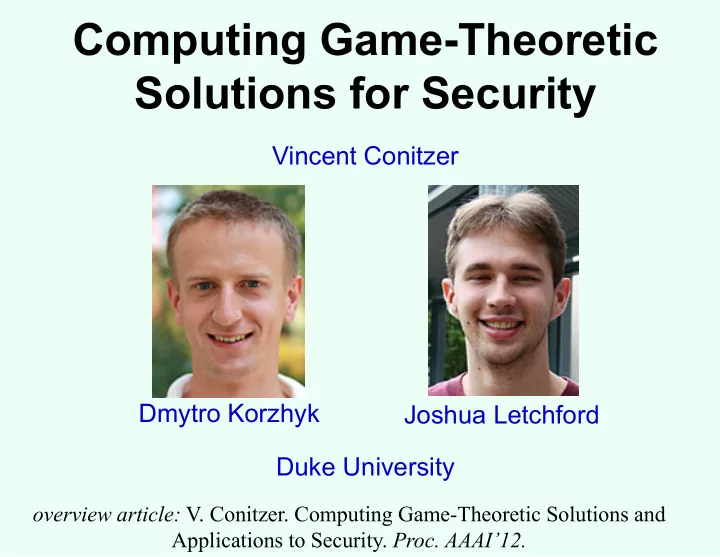
Computing Game-Theoretic Solutions for Security Vincent Conitzer Dmytro Korzhyk Dmytro Korzhyk Joshua Letchford Joshua Letchford Duke University overview article: V. Conitzer. Computing Game-Theoretic Solutions and Applications to Security.


slide-1
SLIDE 1

Computing Game-Theoretic Solutions for Security

Vincent Conitzer Dmytro Korzhyk Joshua Letchford Dmytro Korzhyk Joshua Letchford Duke University

  • verview article: V. Conitzer. Computing Game-Theoretic Solutions and

Applications to Security. Proc. AAAI’12.

slide-2
SLIDE 2

Real-world security applications

Airport sec rit

Milind Tambe’s TEAMCORE group (USC)

Airport security

  • Where should checkpoints, canine units, etc. be

deployed? deployed?

Federal Air Marshals

Whi h fli ht t FAM?

US Coast Guard

  • Which flights get a FAM?

US Coast Guard

  • Which patrol routes should be followed?
slide-3
SLIDE 3

Penalty kick example

probability .7 probability .3 action probability 1 Is this a action probability .6 “rational”

  • utcome?

If not, what action probability .4 is?

slide-4
SLIDE 4

Penalty kick

(also known as: matching pennies)

L R .5 .5

0 0

  • 1 1

L L R 5

0, 0 1, 1

  • 1 1

0 0

L R .5 5

1, 1 0, 0

R .5

slide-5
SLIDE 5

Security example

Terminal A Terminal B

action action action

slide-6
SLIDE 6

Security game y g

A B

0, 0

  • 1, 2

A

  • 1, 1

0, 0

B

slide-7
SLIDE 7

Modeling and representing games

2, 2

  • 1, 0
  • 7 -8

0 0 THIS TALK (unless specified

  • 7, -8

0, 0 normal-form games specified

  • therwise)

extensive-form games Bayesian games Bayesian games stochastic games hi l action-graph games

[L B & T h l IJCAI’03

graphical games

[Kearns, Littman, Singh UAI’01] [Leyton-Brown & Tennenholtz IJCAI’03 [Bhat & Leyton-Brown, UAI’04] [Jiang, Leyton-Brown, Bhat GEB’11]

MAIDs

[Koller & Milch. IJCAI’01/GEB’03]

slide-8
SLIDE 8

How to defend penalties

L R

Them

0, 0

  • 1, 1

L

Us

  • 1, 1

0, 0

R

Us

  • Assume opponent knows our strategy…

– hopeless?

  • … but we can use randomization
  • If we play L 60% R 40%

If we play L 60%, R 40%...

  • … opponent will play R…

t 6*( 1) 4*(0) 6

  • … we get .6*(-1) + .4*(0) = -.6
  • Better: L 50%, R 50% guarantees -.5 (optimal)
slide-9
SLIDE 9

A locally more popular sport

go for 3 go for 2

0, 0

  • 2, 2

defend the 3 go for 3 go for 2

, ,

  • 3 3

0 0

defend the 2

3, 3 0, 0

defend the 2

slide-10
SLIDE 10

Solving basketball

3 2

Them

0, 0

  • 2, 2

3

Us

  • 3, 3

0, 0

2

Us

  • If we 50% of the time defend the 3, opponent will shoot 3

– We get .5*(-3) + .5*(0) = -1.5 g ( ) ( )

  • Should defend the 3 more often: 60% of the time
  • Opponent has choice between
  • Opponent has choice between

– Go for 3: gives them .6*(0) + .4*(3) = 1.2 G f 2 i th 6*(2) 4*(0) 1 2 – Go for 2: gives them .6*(2) + .4*(0) = 1.2

  • We get -1.2 (the maximin value)
slide-11
SLIDE 11

Let’s change roles

3 2

Them

0, 0

  • 2, 2

3

Us

  • 3, 3

0, 0

2

Us

  • Suppose we know their strategy
  • If 50% of the time they go for 3, then we defend 3

y g ,

– We get .5*(0)+.5*(-2) = -1

  • Optimal for them: 40% of the time go for 3

von Neumann’s minimax theorem [1928]: maximin

Optimal for them: 40% of the time go for 3

– If we defend 3, we get .4*(0)+.6*(-2) = -1.2 If we defend 2 we get 4*( 3)+ 6*(0) = 1 2

value = minimax value (~ linear programming duality)

– If we defend 2, we get .4 (-3)+.6 (0) = -1.2

  • This is the minimax value
slide-12
SLIDE 12

Example linear program

W k d ti f maximize 3x + 2y

  • We make reproductions of

two paintings y subject to 4x + 2y ≤ 16 x + 2y ≤ 8 x + y ≤ 5

  • Painting 1 sells for $3, painting 2

sells for $2

x + y ≤ 5 x ≥ 0

sells for $2

  • Painting 1 requires 4 units of

blue, 1 green, 1 red

x 0 y ≥ 0

, g ,

  • Painting 2 requires 2 blue, 2

green, 1 red g ,

  • We have 16 units blue, 8 green,

5 red

slide-13
SLIDE 13

Solving the linear program graphically

maximize 3x + 2y subject to

8

4x + 2y ≤ 16

6

x + 2y ≤ 8 x + y ≤ 5

4

  • ptimal solution:

3 2

x + y ≤ 5 x ≥ 0

2 x=3, y=2

x 0 y ≥ 0

2 4 6 8

slide-14
SLIDE 14

Solving for minimax strategies using linear programming

  • maximize u
  • subject to
  • subject to

for any c, Σr pr uR(r, c) ≥ u Σr pr = 1 Can also convert linear programs to two-player zero-sum games, so they are equivalent g y q

slide-15
SLIDE 15

Some of the questions raised

  • Equilibrium selection?

0 0

  • 1 1

D D S

  • How should we model temporal / information

0, 0

  • 1, 1

1, -1

  • 5, -5

S

  • How should we model temporal / information

structure?

2, 2

  • 1, 0
  • 7, -8

0, 0

  • What structure should utility functions have?
  • Do our algorithms scale?
  • Do our algorithms scale?
slide-16
SLIDE 16

Observing the defender’s distribution in security

Terminal A Terminal B

  • bserve

Mo Tu We Th Fr Sa This model is not uncontroversial… [Pita, Jain, Tambe, Ordóñez, Kraus

AIJ’10; Korzhyk, Yin, Kiekintveld, C., Tambe JAIR’11; Korzhyk, C., Parr AAMAS’11]

slide-17
SLIDE 17

Commitment Commitment

1, 1 3, 0

U i N h

0, 0 2, 1

Unique Nash equilibrium

  • Suppose the game is played as follows:

von Stackelberg

– Player 1 commits to playing one of the rows, – Player 2 observes the commitment and then chooses a column Player 2 observes the commitment and then chooses a column

  • Optimal strategy for player 1: commit to Down
slide-18
SLIDE 18

Commitment as an i f extensive-form game

Player 1

  • For the case of committing to a pure strategy:

Player 1 Up Down Player 2 Player 2 Left Left Right Right

1, 1 3, 0 0, 0 2, 1

slide-19
SLIDE 19

Commitment to mixed strategies g

1

1, 1 3, 0

.49

, , 0, 0 2, 1

.51

– Sometimes also called a Stackelberg (mixed) strategy

slide-20
SLIDE 20

Commitment as an i f extensive-form game…

  • for the case of committing to a mixed strategy:

Player 1

… for the case of committing to a mixed strategy:

(1,0) (=Up) (0,1) (=Down) (.5,.5)

… …

Player 2 Left Left Right Right Left Right

1, 1 3, 0 0, 0 2, 1 .5, .5 2.5, .5

  • Economist: Just an extensive form game nothing new here
  • Economist: Just an extensive-form game, nothing new here
  • Computer scientist: Infinite-size game! Representation matters
slide-21
SLIDE 21

Computing the optimal mixed strategy to commit to

[C & Sandholm EC’06 von Stengel & Zamir GEB’10] [C. & Sandholm EC 06, von Stengel & Zamir GEB 10]

  • Separate LP for every column c*:

p y maximize Σr pr uR(r, c*) subject to

leader utility

subject to for all c, Σr pr uC(r, c*) ≥ Σr pr uC(r, c)

follower optimality

Σr pr = 1

distributional constraint

Slide 7

slide-22
SLIDE 22

applied to the previous game … applied to the previous game

1, 1 3, 0

p

0, 0 2, 1

q

maximize 1p + 0q subject to maximize 3p + 2q subject to subject to 1p + 0q ≥ 0p + 1q subject to 0p + 1q ≥ 1p + 0q p + q = 1 p ≥ 0 p + q = 1 p ≥ 0

Slide 7

p ≥ 0 q ≥ 0 p ≥ 0 q ≥ 0

slide-23
SLIDE 23

Visualization Visualization

L C R L C R U 0,1 1,0 0,0 (0,1,0) = M M 4,0 0,1 0,0 D 0,0 1,0 1,1 ( , , ) C R L R (1,0,0) = U (0,0,1) = D

slide-24
SLIDE 24

Other nice properties of commitment to mixed strategies

0, 0

  • 1, 1
  • Agrees w. Nash in zero-sum games

0, 0 1, 1

  • 1, 1

0, 0

  • Leader’s payoff at least as good as

p y g any Nash eq. or even correlated eq. (von Stengel & Zamir [GEB ‘10]; see also C

(von Stengel & Zamir [GEB 10]; see also C.

& Korzhyk [AAAI ‘11], Letchford, Korzhyk, C. [JAAMAS ’14])

  • No equilibrium selection problem

[JAAMAS 14])

0, 0

  • 1, 1

1, -1

  • 5, -5

More discussion: V. Conitzer. On Stackelberg Mixed Strategies. [Synthese, to appear.]

slide-25
SLIDE 25

Example security game

  • 3 airport terminals to defend (A, B, C)
  • Defender can place checkpoints at 2 of them

Att k tt k 1 t i l

  • Attacker can attack any 1 terminal

A B C

1 0 1 2 3

{A B} A B C

0, -1 0, -1 -2, 3 1 1 1 0 0

{A, B} {A, C} 0, -1 -1, 1

0, 0 1 1 0 1 0 0

{A, C} {B, C} -1, 1 0, -1

0, 0

{ , }

slide-26
SLIDE 26

Security resource allocation games

  • Set of targets T

[Kiekintveld, Jain, Tsai, Pita, Ordóñez, Tambe AAMAS’09] g

  • Set of security resources available to the defender (leader)
  • Set of schedules
  • Set of schedules
  • Resource  can be assigned to one of the schedules in
  • Attacker (follower) chooses one target to attack
  • Utilities: if the attacked target is defended,
  • therwise
  • s

t1 1 s1 s2 t2 t3 2

2

s3 t5 t4

slide-27
SLIDE 27

Game-theoretic properties of security resource allocation games [Korzhyk, Yin, Kiekintveld, C., Tambe JAIR’11]

For the defender:

  • For the defender:

Stackelberg strategies are also Nash strategies

– minor assumption needed – not true with multiple attacks

  • Interchangeability property for
  • Interchangeability property for

Nash equilibria (“solvable”)

1, 2 1, 0 2, 2

  • no equilibrium selection problem
  • still true with multiple attacks

1, 1 1, 0 2, 1

[Korzhyk, C., Parr IJCAI’11]

0, 1 0, 0 0, 1

slide-28
SLIDE 28

Compact LP Co pac

  • Cf. ERASER-C algorithm by Kiekintveld et al. [2009]
  • Separate LP for every possible t* attacked:

f d ili Defender utility

Marginal probability

Distributional constraints

Marginal probability

  • f t* being defended (?)

Distributional constraints Attacker optimality

Slide 11

slide-29
SLIDE 29

Counter-example to the compact LP

2 .5 .5 5

t t

1 .5

t t

.5

t t

  • LP suggests that we can cover every

target with probability 1… b t in fact e can co er at most 3

  • … but in fact we can cover at most 3

targets at a time

Slide 12

slide-30
SLIDE 30

Birkhoff-von Neumann theorem

  • Every doubly stochastic n x n matrix can be

represented as a convex combination of n x n permutation matrices

.1 .4 .5 .3 .5 .2 .6 .1 .3 1 1

= .1

1 1

+.1

1 1

+.5

1 1

+.3

  • Decomposition can be found in polynomial time O(n4.5)

1 1 1 1

Decomposition can be found in polynomial time O(n ), and the size is O(n2) [Dulmage and Halperin, 1955] C b t d d t t l d bl b t h ti

  • Can be extended to rectangular doubly substochastic

matrices

Slide 14

slide-31
SLIDE 31

Schedules of size 1 using BvN Schedules of size 1 using BvN

1 t1

.7 .1 .2

t1 t2 t3

2 t2

.7 .3

1 .7 .2 .1 2 .3 .7

t3

.1 .2 .2 .5

1 1 1 1 1 1 1 1

slide-32
SLIDE 32

Algorithms & complexity g p y

[Korzhyk, C., Parr AAAI’10]

Homogeneous R Heterogeneous Resources resources Size 1 P P (BvN theorem) dules (BvN theorem) Size ≤2, bipartite

P (BvN theorem) NP-hard (SAT)

Sche Size ≤2

P (constraint generation) NP-hard NP hard

Size ≥3

NP-hard NP-hard (3-COVER)

Slide 16

Also: security games on graphs

[Letchford, C. AAAI’13]

slide-33
SLIDE 33

Security games with multiple attacks

[Korzhyk, Yin, Kiekintveld, C., Tambe JAIR’11]

  • The attacker can choose multiple targets to attack
  • The attacker can choose multiple targets to attack
  • The utilities are added over all attacked targets
  • The utilities are added over all attacked targets
  • Stackelberg NP-hard; Nash polytime-solvable and

interchangeable [Korzhyk, C., Parr IJCAI‘11]

  • Algorithm generalizes ORIGAMI algorithm for single attack
  • Algorithm generalizes ORIGAMI algorithm for single attack

[Kiekintveld, Jain, Tsai, Pita, Ordóñez, Tambe AAMAS’09]

slide-34
SLIDE 34

Actual Security Schedules: Before vs. After

Boston, Coast Guard – “PROTECT” algorithm , g slide courtesy of Milind Tambe Before PROTECT After PROTECT Before PROTECT After PROTECT

Count Count D 1 D 2 D 3 D 4 D 5 D 6 D 7 Day 1 Day 2 Day 3 Day 4 Day 5 Day 6 Day 7 Day 1 Day 2 Day 3 Day 4 Day 5 Day 6 Day 7

Industry port partners comment: “The Coast Guard seems to be everywhere, all the time."

slide-35
SLIDE 35

Data from LAX checkpoints before and after “ARMOR” algorithm

slide courtesy of Milind Tambe

before and after ARMOR algorithm slide

140 (pre)4/17/06 to 7/31/07 120 1/1/08 to 12/31/08

not a controlled experiment!

80 100 1/1/09 to 12/31/09

experiment!

60 80 1/1/10 to 12/31/10 40 60 20 Firearm Violations Drug Related Offenses Miscellaneous Total

slide-36
SLIDE 36

Placing checkpoints in a city

[T i Yi K k K Ki ki t ld T b AAAI’10 J i K h k [Tsai, Yin, Kwak, Kempe, Kiekintveld, Tambe AAAI’10; Jain, Korzhyk, Vaněk, C., Pěchouček, Tambe AAMAS’11; Jain, C., Tambe AAMAS’13]

slide-37
SLIDE 37

In summary: CS pushing at some of the boundaries of game theory

learning in games behavioral (humans game theory playing games) CS work in game theory computation representation conceptual (e.g., equilibrium selection) representation