Computer Professional Responsibilities Ethics Professional Ethics - - PDF document

computer professional responsibilities
SMART_READER_LITE
LIVE PREVIEW

Computer Professional Responsibilities Ethics Professional Ethics - - PDF document

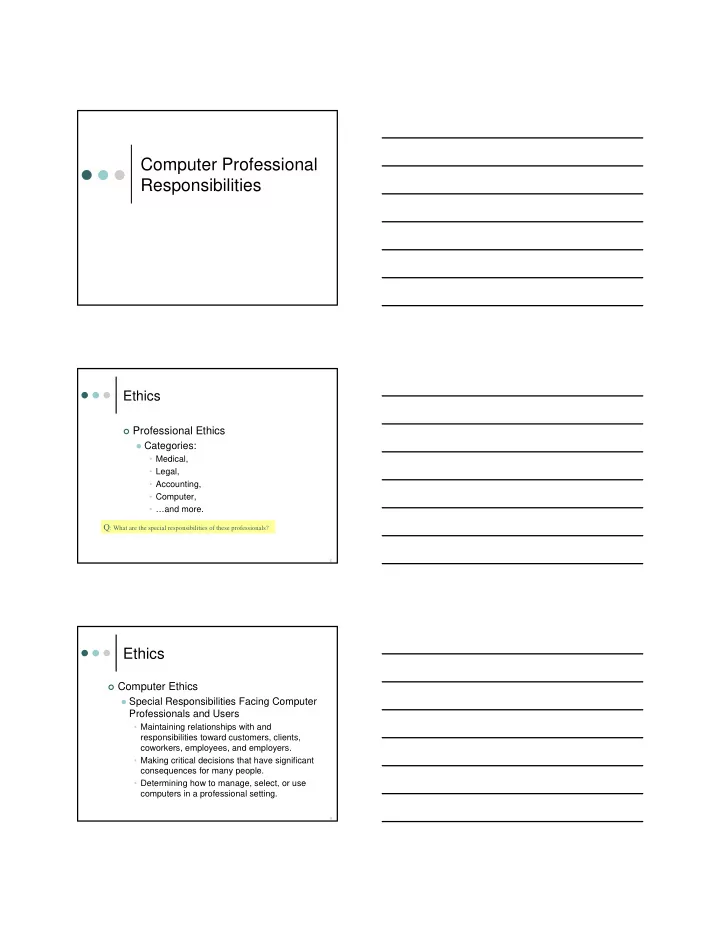
Computer Professional Responsibilities Ethics Professional Ethics Categories: Medical, Legal, Accounting, Computer, and more. Q : What are the special responsibilities of these professionals? 2 Ethics


slide-1
SLIDE 1

Computer Professional Responsibilities

2

Ethics

Professional Ethics Categories:

  • Medical,
  • Legal,
  • Accounting,
  • Computer,
  • …and more.

Q: What are the special responsibilities of these professionals?

3

Ethics

Computer Ethics Special Responsibilities Facing Computer

Professionals and Users

  • Maintaining relationships with and

responsibilities toward customers, clients, coworkers, employees, and employers.

  • Making critical decisions that have significant

consequences for many people.

  • Determining how to manage, select, or use

computers in a professional setting.

slide-2
SLIDE 2

4

Ethics

“Do the Right Thing” Behaving Ethically Includes:

  • Being honest.
  • Keeping promises.
  • Doing your job well.
  • Not stealing.

Q: What other behaviors are usually considered “doing the right thing?”

5

Ethics

Ethical Views Deontological (Moral Duty)

  • Emphasizes duty and absolute rules.
  • Rules should apply to everyone.
  • Use logic or reason to determine what is

good.

  • Treat people as an ends (not a means).

6

Ethics

Ethical Views (cont’d) Consequentialist

  • Includes Utilitarianism
  • Strive to increase “utility” (that which

satisfies a person’s needs and values) for the most people (the greater good).

  • Consider the consequences for all

affected people.

slide-3
SLIDE 3

7

Ethics

Ethical Views (cont’d) Consequentialist (cont’d)

  • Rule-Utilitarianism: Choose rules, or

guidelines for behavior, that generally increase utility.

  • Act-Utilitarianism: Analyze each action to

determine if it increases utility. Q: What are some problems with act-utilitarianism?

8

Ethics

Ethical Views (cont’d) Natural Rights

  • Derived from the nature of humanity
  • Focus is on the process by which people

interact.

  • Respect the fundamental rights of others,

including life, liberty, and property.

9

Ethics

Ethical Views (cont’d) Reaching the Right Decision

  • There is no formula to solve ethical

problems.

  • The computer professional must consider

trade-offs.

  • Ethical theories help to identify important

principles or guidelines.

slide-4
SLIDE 4

10

Ethics

Ethical Views (cont’d) Some Important Distinctions

  • Right, Wrong, and Okay: acts may be ethically
  • bligatory, ethically prohibited, or ethically

acceptable.

  • Negative rights (liberties): the right to act without

coercive interference.

  • Positive rights (claim-rights): imposing an
  • bligation on some people to provide certain

things.

  • Causing harm: some acts may cause harm to
  • thers but are not necessarily unethical.

11

Ethics

Ethical Views (cont’d) Some Important Distinctions (cont’d)

  • Goals vs. actions: the actions we take to

achieve our goals should be consistent with our ethical constraints.

  • Personal preference vs. ethics: some

issues we disapprove of because of our dislikes, rather than on ethical grounds.

  • Law vs. ethics: some acts are ethical, but

illegal; other acts are legal, but unethical.

12

Analyzing Ethical Scenarios

Brainstorming phase List risks, issues, problems, consequences. List all the stakeholders. List possible actions. Analysis phase Identify the responsibilities of the decision-maker. Identify the rights of stakeholders. Consider the impact of the action options on the

stakeholders.

Find sections in codes of ethics that apply. Categorize each

potential action or response as ethically obligatory, ethically prohibited, or ethically acceptable.

Consider the ethical merits of each option and select one.