Medical Physicists Medical Physicists Responsibilities - - PDF document

medical physicists medical physicists responsibilities
SMART_READER_LITE
LIVE PREVIEW

Medical Physicists Medical Physicists Responsibilities - - PDF document

Joel E. Gray, Ph.D. Medical Physicists Medical Physicists Responsibilities Responsibilities Evaluation and Consulting on Evaluation and Consulting on Patient Dose in Diagnostic Imaging Patient Dose in Diagnostic Imaging Provide dose


slide-1
SLIDE 1

Joel E. Gray, Ph.D. 1

Evaluation and Consulting on Evaluation and Consulting on Patient Dose in Diagnostic Imaging Patient Dose in Diagnostic Imaging

Joel E. Gray, Ph.D. Joel E. Gray, Ph.D.

Director of Technology Director of Technology Landauer, Inc. Landauer, Inc.

James M. Kofler, Ph.D. James M. Kofler, Ph.D.

Department of Diagnostic Radiology Department of Diagnostic Radiology Mayo Clinic and Foundation Mayo Clinic and Foundation

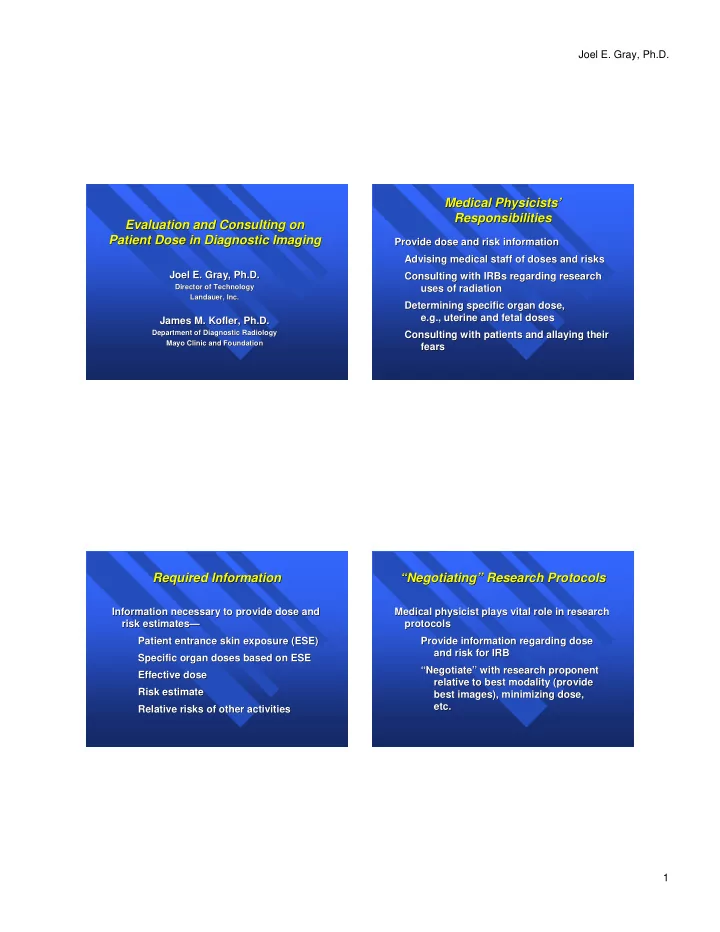
Medical Physicists Medical Physicists’ ’ Responsibilities Responsibilities

Provide dose and risk information Provide dose and risk information Advising medical staff of doses and risks Advising medical staff of doses and risks Consulting with Consulting with IRBs IRBs regarding research regarding research uses of radiation uses of radiation Determining specific organ dose, Determining specific organ dose, e.g., uterine and fetal doses e.g., uterine and fetal doses Consulting with patients and allaying their Consulting with patients and allaying their fears fears

Required Information Required Information

Information necessary to provide dose and Information necessary to provide dose and risk estimates risk estimates— — Patient entrance skin exposure (ESE) Patient entrance skin exposure (ESE) Specific organ doses based on ESE Specific organ doses based on ESE Effective dose Effective dose Risk estimate Risk estimate Relative risks of other activities Relative risks of other activities

“ “Negotiating Negotiating” ” Research Protocols Research Protocols

Medical physicist plays vital role in research Medical physicist plays vital role in research protocols protocols Provide information regarding dose Provide information regarding dose and risk for IRB and risk for IRB “ “Negotiate Negotiate” ” with research proponent with research proponent relative to best modality (provide relative to best modality (provide best images), minimizing dose, best images), minimizing dose, etc. etc.

slide-2
SLIDE 2

Joel E. Gray, Ph.D. 2

Patient ESE Patient ESE– – Simple?? Simple??

Know the kVp, mAs, SSD and calculate Know the kVp, mAs, SSD and calculate the ESE? the ESE? NO!!!!!!!!!!!!!!!!! NO!!!!!!!!!!!!!!!!! Why not?? Why not?? Variation of x Variation of x-

  • ray system output?

ray system output? Variation from one tech to another Variation from one tech to another Variation, variation, variation Variation, variation, variation How much variation? How much variation? From 10X to 130 X!!! From 10X to 130 X!!!

NEXT Survey Results NEXT Survey Results

(mR or R/min) (mR or R/min)

Exam Exam Min Min Max Max Max/Min Max/Min PA Chest PA Chest 2.4 2.4 81 81 33.8 33.8 AP L. Spine AP L. Spine 62 62 2,154 2,154 34.7 34.7 GI Exams GI Exams Rate Rate 0.7 0.7 16.2 16.2 23.1 23.1 Spot Film Spot Film 38 38 4,815 126.7 4,815 126.7 CT Head CT Head 1,600 1,600 14,000 14,000 8.8 8.8

Variation Within a Facility Variation Within a Facility

Personal experience Personal experience— — Major East Coast teaching hospital Major East Coast teaching hospital AP Lumbar spine ESE AP Lumbar spine ESE 16.4 X range in ESE!!!!! 16.4 X range in ESE!!!!! 1.10 mSv to 18.0 mSv 1.10 mSv to 18.0 mSv Mixture of CR and screen Mixture of CR and screen-

  • film

film Screen Screen-

  • film ESE ~3.00 mSv

film ESE ~3.00 mSv CR dose based on location and x CR dose based on location and x-

  • ray

ray equipment manufacturer equipment manufacturer

Variation Within a Facility Variation Within a Facility

Major East Coast teaching hospital Major East Coast teaching hospital No in No in-

  • house physicist or equipment QC

house physicist or equipment QC program program Consulting physicist visited once per year Consulting physicist visited once per year to meet regulatory requirements to meet regulatory requirements Did Did NOT NOT measure patient measure patient ESEs ESEs, only , only mR/mAs mR/mAs mR/mAs tells nothing about how the mR/mAs tells nothing about how the equipment is used nor absorbers equipment is used nor absorbers in the beam after the patient!!! in the beam after the patient!!!

slide-3
SLIDE 3

Joel E. Gray, Ph.D. 3

First Three Rules of Dose First Three Rules of Dose Determination Determination

Measure the ESE!!! Measure the ESE!!! Measure the ESE!!! Measure the ESE!!! Measure the ESE!!!* Measure the ESE!!!*

*It is morally, ethically, and *It is morally, ethically, and professionally irresponsible professionally irresponsible NOT NOT to to measure the ESE!!! measure the ESE!!!

Which ESE Do You Measure? Which ESE Do You Measure?

Ask the tech what technique they used? Ask the tech what technique they used? Which tech? Which machine? Which Which tech? Which machine? Which day? day? Measure the ESE for a standard phantom? Measure the ESE for a standard phantom? American approach American approach Determine the ESE for a group of patients? Determine the ESE for a group of patients? European approach ( European approach (Va Vañ ño

  • , et al.)

, et al.)

Effect of Patient Variation on Dose Effect of Patient Variation on Dose

Patient size variation Patient size variation— — Neonate to beached whale Neonate to beached whale 5 cm thickness to 40 cm thickness 5 cm thickness to 40 cm thickness Fetal dose estimates Fetal dose estimates— — you will know patient size, you will know patient size, i.e., these are retrospective estimates i.e., these are retrospective estimates Research protocols are prospective estimates Research protocols are prospective estimates– – you will know only the age range of patients you will know only the age range of patients AP lumbar spine range AP lumbar spine range— — 0.30 mGy to > 60.0 mGy 0.30 mGy to > 60.0 mGy Dose tables are based on Dose tables are based on “ “standard man standard man” ”

Standard (Reference) Man (Woman) Standard (Reference) Man (Woman)

Defined by ICRP 23 and 89 Defined by ICRP 23 and 89 Height, weight, skin area, chemical Height, weight, skin area, chemical composition, etc., etc., etc. composition, etc., etc., etc. Reference man Reference man– – 70 kg, 170 cm 70 kg, 170 cm Reference woman Reference woman– – 58 kg, 160 cm 58 kg, 160 cm

slide-4
SLIDE 4

Joel E. Gray, Ph.D. 4

Standard (Reference) Man (Woman) Standard (Reference) Man (Woman)

Defined by ICRP 23 and 89, Defined by ICRP 23 and 89, Height, weight, skin area, chemical Height, weight, skin area, chemical composition, etc., etc., etc. composition, etc., etc., etc. Reference man Reference man– – 70 kg, 170 cm 70 kg, 170 cm 154 lb, 5 154 lb, 5’ ’7 7” ” Reference woman Reference woman– – 58 kg, 160 cm 58 kg, 160 cm 128 lb, 5 128 lb, 5’ ’3 3” ”

Dose Estimate Error?? Dose Estimate Error??

What error in estimated dose is What error in estimated dose is acceptable in diagnostic imaging? acceptable in diagnostic imaging? < 1% (precise therapy doses) < 1% (precise therapy doses) 2% to 4% or 5% (typical therapy doses) 2% to 4% or 5% (typical therapy doses) 10% ?? 10% ?? 20% ?? 20% ?? 30% ?? (personnel dosimetry) 30% ?? (personnel dosimetry) 50% ?? 50% ?? 100% 100% not not unreasonable!! unreasonable!!

Dose Estimate Error?? Dose Estimate Error??

Depends on Depends on— — Patient size Patient size Technique (kVp, mAs, SSD, etc.) Technique (kVp, mAs, SSD, etc.) Location of sensitive tissue from beam, Location of sensitive tissue from beam, e.g., e.g., distance of fetus from distance of fetus from irradiated volume irradiated volume Room Room-

  • to

to-

  • room variation

room variation Room scatter?? Room scatter?? Tube leakage?? Tube leakage??

Dose Estimate Error?? Dose Estimate Error??

Location of sensitive tissue relative to Location of sensitive tissue relative to irradiated volume irradiated volume In direct x In direct x-

  • ray beam

ray beam Depth is important Depth is important HVL in centimeters of tissue at HVL in centimeters of tissue at 80 kVp ~3.5 cm 80 kVp ~3.5 cm Outside of irradiated volume Outside of irradiated volume Felmlee Felmlee data data

slide-5
SLIDE 5

Joel E. Gray, Ph.D. 5

Distance of Fetus From Irradiated Distance of Fetus From Irradiated Volume* and HVL in Tissue For CT Volume* and HVL in Tissue For CT

0.2969 0.2969 0.0523 0.0523 0.0136 0.0136 6 6 0.3646 0.3646 0.0642 0.0642 0.0167 0.0167 5 5 0.4498 0.4498 0.0792 0.0792 0.0206 0.0206 4 4 0.5786 0.5786 0.1019 0.1019 0.0265 0.0265 3 3 0.7380 0.7380 0.1300 0.1300 0.0338 0.0338 2 2 1.0000 1.0000 0.1762 0.1762 0.0458 0.0458 1 1 1.0000 1.0000 0.2600 0.2600 NFDR NFDR cm cm HVL in tissue ~3.5 cm

*Felmlee JP, Gray JE, Leetzow ML, Price JC. Estimated fetal radiation dose from multislice CT studies. AJR 1990; 154:185-190.

Effect of Depth in Tissue of Sensitive Organ Effect of Depth in Tissue of Sensitive Organ

1.00 1.00 1 1 0.016 0.016 1/64 1/64 28 28 0.063 0.063 1/16 1/16 14 14 0.250 0.250 1/4 1/4 7 7 Depth Depth (cm) (cm) Relative Dose

Dose Estimate Error?? Dose Estimate Error??

Taking into account all of the variables Taking into account all of the variables— — How accurately can How accurately can YOU YOU estimate the dose estimate the dose to a specific sensitive organ? to a specific sensitive organ? How accurate must the dose be for a dose How accurate must the dose be for a dose estimate estimate? ? What are the medico What are the medico-

  • legal implications

legal implications

slide-6
SLIDE 6

Joel E. Gray, Ph.D. 6

Terms and Definitions Terms and Definitions

Exposure: Exposure: Ionization per mass of air. C/kg (R) Ionization per mass of air. C/kg (R) Absorbed Dose (D): Absorbed Dose (D): Energy imparted per mass. Energy imparted per mass. Gy Gy = 100 rad = 100 rad Dose Dose Equivalent (H): Equivalent (H): Considers radiation type. Considers radiation type. H = H = w wr

rD

D, , w wr

r= 1 for x

= 1 for x-

  • rays.
  • rays. Sv

Sv = 100 rem = 100 rem Effective Dose (E): Effective Dose (E): Weights specific organ doses Weights specific organ doses for whole for whole-

  • body equivalent. E =

body equivalent. E = ∑ ∑w wt

tH

Ht

t.

. Sv Sv = 100 rem = 100 rem

Excellent Summary: Table 3-6, The Essential Physics of Medical Imaging, Bushberg, Seibert, Leidholdt, and Boone. Lippincott Williams and Wilkins (2002)

Calculating Organ Doses Calculating Organ Doses

Weighted organ doses used for calculating Weighted organ doses used for calculating Effective Dose Effective Dose Typically use tabulated Monte Carlo data Typically use tabulated Monte Carlo data Exposure Exposure-

  • to

to-

  • dose conversion factors

dose conversion factors Specific characteristics of exam and Specific characteristics of exam and equipment (HVL, field size, etc.) equipment (HVL, field size, etc.)

Conversion Factors Conversion Factors

Determined using Determined using mathematical models mathematical models Specific organ sizes, Specific organ sizes, locations, and properties locations, and properties Models everyone, Models everyone, but not any one but not any one

Calculating Organ Doses Calculating Organ Doses

Radiographic Exams Radiographic Exams First, need Monte Carlo First, need Monte Carlo conversion data conversion data Free on web! Free on web! Good news Good news… … Non Non-

  • trivial to find!

trivial to find! Bad news Bad news… … One source One source… …CDRH CDRH

(Other sources available) (Other sources available)

slide-7
SLIDE 7

Joel E. Gray, Ph.D. 7 Calculating Organ Doses Calculating Organ Doses – – Radiographic Exams Radiographic Exams Finding the Monte Carlo Data on Web Finding the Monte Carlo Data on Web Or Google “Handbook of Selected Tissue Doses” Calculating Organ Doses Calculating Organ Doses – – Radiographic Exams Radiographic Exams Exam Exam SID SID Field Size Field Size Calculating Organ Doses Calculating Organ Doses – – Radiographic Exams Radiographic Exams Male Male Organs Organs Female Female Organs Organs HVL HVL Calculating Organ Doses Calculating Organ Doses – – Radiographic Exams Radiographic Exams EXAMPLE: Measured ESE =15 mR EXAMPLE: Measured ESE =15 mR

x 0.015 R = 7.4 mrad x 0.015 R = 2.0 mrad x 0.015 R = 0.7 mrad x 0.015 R = 2.6 mrad x 0.015 R = 0.0 mrad x 0.015 R = 7.8 mrad x 0.015 R = 1.7 mrad x 0.015 R = 0.7 mrad x 0.015 R = 2.2 mrad x 0.015 R = 1.1 mrad x 0.015 R = 0.0 mrad x 0.015 R = 0.0 mrad

Organ Organ Doses Doses

slide-8
SLIDE 8

Joel E. Gray, Ph.D. 8 Relating Organ Doses to Whole Body Dose Relating Organ Doses to Whole Body Dose The effective dose is the mean absorbed The effective dose is the mean absorbed dose from a dose from a nonuniform nonuniform, partial , partial-

  • body

body irradiation that results in the same total irradiation that results in the same total radiation detriment as from a uniform radiation detriment as from a uniform whole whole-

  • body irradiation.

body irradiation.

McCollough CH and Schueler BA, Calculation of Effective Dose,

  • Med. Phys. 27 (5), May 2000

Relating Organ Doses to Whole Body Dose Relating Organ Doses to Whole Body Dose

Organ dose x weighting factor summed over all organs Organ dose x weighting factor summed over all organs

  • Dose

DoseLung

Lung x

x w wLung

Lung

Dose DoseBreast

Breast x

x w wBreast

Breast

+ + Dose DoseThyroid

Thyroid x

x w wThyroid

Thyroid

+ + = = “ “Whole Body Equiv Dose

Whole Body Equiv Dose”

Organ Organ ICRP 26 ICRP 26 ICRP 60 ICRP 60 Gonads Gonads 0.25 0.25 0.20 0.20 Red Bone Marrow Red Bone Marrow 0.12 0.12 0.12 0.12 Colon Colon

  • 0.12

0.12 Lung Lung 0.12 0.12 0.12 0.12 Stomach Stomach

  • 0.12

0.12 Bladder Bladder

  • 0.05

0.05 Breast Breast 0.15 0.15 0.05 0.05 Liver Liver

  • 0.05

0.05 Esophagus Esophagus

  • 0.05

0.05 Thyroid Thyroid 0.03 0.03 0.05 0.05 Skin Skin 0.01 0.01 0.01 0.01 Bone Surface Bone Surface 0.03 0.03 0.01 0.01 Remainder* Remainder* 0.30 0.30 0.05 0.05

*Very specific instructions for calculating the remainder dose!

2 Choices of 2 Choices of Weighting Weighting Factors Factors

Relating Organ Doses to Whole Body Dose Relating Organ Doses to Whole Body Dose

ICRP 26 (1977) ICRP 26 (1977) ICRP 60 (1990) ICRP 60 (1990)

  • Fewer organs

Fewer organs

  • More organs

More organs

  • Monte Carlo data not necessarily available

Monte Carlo data not necessarily available

E = E = ∑ ∑w wt

tH

Ht

t

Effective Dose Effective Dose H HE

E =

= ∑ ∑w wt

tH

Ht

t

Effective Dose Equivalent Effective Dose Equivalent

Relating Organ Doses to Whole Body Dose Relating Organ Doses to Whole Body Dose
slide-9
SLIDE 9

Joel E. Gray, Ph.D. 9 Example: Effective Dose Equivalent Example: Effective Dose Equivalent

Organ Dose Organ Dose EDE EDE Organ Organ ICRP 26 ICRP 26 Male (mrad) Male (mrad) H HE

E

Gonads Gonads 0.25 0.25 x x 0.0 0.0 = = 0.0 0.0 Red Bone Marrow Red Bone Marrow 0.12 0.12 x x 2.0 2.0 = = 0.24 0.24 Lung Lung 0.12 0.12 x x 7.4 7.4 = = 0.89 0.89 Thyroid Thyroid 0.03 0.03 x x 0.7 0.7 = = 0.02 0.02 Remainder (Trunk) Remainder (Trunk) 0.30 0.30 x x 2.6 2.6 = = 0.78 0.78 Sum = 1.9 mrem Sum = 1.9 mrem (0.02 mSv) (0.02 mSv)

Calculating Organ Doses Calculating Organ Doses – – Fluoroscopic Exams Fluoroscopic Exams

Calculating R Calculating R-

  • F Doses

F Doses – – Practical Practical Issues Issues

Other corrections (Tech. differences, atypical circumstances) Field size ≠ Reference Field Size

  • Some refs offer correction factors
  • Multiply by ratio of field areas

Fluoro conversion factors not available

  • Estimate with closest radiographic exam
  • Correct for field areas
  • Estimate “dwell” times over areas
  • Use reasonable assumptions
  • No need to consider nth-order details
  • Dose estimate

ALWAYS ALWAYS record all assumptions, reasoning, and refs!

Other R Other R-

  • F Dose Resources

F Dose Resources

Software Software www.fda.gov/cdrh/ohip/organdose.html XDOSE (john_le_heron@nrl.moh.govt.nz) CHILDOSE (john_le_heron@nrl.moh.govt.nz) Monte Carlo Organ Dose Conversion data Monte Carlo Organ Dose Conversion data CDRH (www.fda.gov/cdrh/ohip/organdose.html) GSF (www.gsf.de) HPA (formerly NRPB) (www.hpa.org.uk/radiation/)

slide-10
SLIDE 10

Joel E. Gray, Ph.D. 10 Calculating Organ Doses Calculating Organ Doses – – CT CT

www.hpa.org.uk/radiation/publications/ software/index.htm

Monte Carlo conversion data Monte Carlo conversion data 27 organs or regions 27 organs or regions 208 5mm sections 208 5mm sections Many scanners Many scanners & configurations & configurations Many software tools Many software tools Good news Good news… … Not free (but not $$$) Not free (but not $$$) Bad news Bad news… … One Source One Source… …NRPB NRPB

(Other sources available) (Other sources available)

Calculating Doses Calculating Doses – – CT CT

CT Dosimetry from CT Dosimetry from ImPACTscan.org ImPACTscan.org

(Other tools available) (Other tools available)

Needs NRPB datasets Needs NRPB datasets Excel Excel-

  • based

based Many features Many features

  • GUI

GUI

  • Scanner matching

Scanner matching

  • Typical values

Typical values Free Free One software tool One software tool… …

Calculating CT Doses Calculating CT Doses – – Practical Issues Practical Issues

Be careful to calculate CTDI correctly

  • GFS data normalized to air (f-factor=0.87)
  • NRPB normalized to muscle (f-factor=0.94)
  • Use TOTAL Collimation for slice thickness in MDCT
  • Does electrometer need correction for CT chamber?

Be careful to use the correct technique

  • Siemens uses Effective mAs (=mAs/pitch)

Other corrections (Technical differences, atypical circumstances)

  • Use reasonable assumptions
  • No need to consider nth-order details
  • Dose estimate

ALWAYS ALWAYS record all assumptions, reasoning, and refs!

Other CT Dose Resources Other CT Dose Resources

Software Software Monte Carlo Organ Dose Conversion data Monte Carlo Organ Dose Conversion data

GSF (www.gsf.de) HPA (formerly NRPB) (www.hpa.org.uk/radiation/) CTDosimetry (ImPACTscan.org) CTDOSE (john_le_heron@nrl.moh.govt.nz)

Website Website

ImPACTscan.org Very comprehensive CT dose and imaging resource

slide-11
SLIDE 11

Joel E. Gray, Ph.D. 11

Risk Estimate Error?? Risk Estimate Error??

What is the error for typical risk What is the error for typical risk estimates? estimates? 1:1,000, 1:10,000, 1:100,000 1:1,000, 1:10,000, 1:100,000 Always rounded to powers of 10 Always rounded to powers of 10 What is error in risk estimates of What is error in risk estimates of exposure to ionizing radiation? Better exposure to ionizing radiation? Better than a SWAG! than a SWAG! Dose and dose rate dependence Dose and dose rate dependence Age dependence, fatal breast cancer Age dependence, fatal breast cancer 15 15 – – 45 45 – –55 year old 55 year old 1/15 1/15 – – 1/50 X 1/50 X

Risk Estimate Error?? Risk Estimate Error??

Sex Sex Sensitive subpopulations Sensitive subpopulations Enhancement of one carcinogen by Enhancement of one carcinogen by another another Age at exposure and expression Age at exposure and expression Human data? Human data? Fractionation Fractionation Breast cancer, probability of fatal cancer at Breast cancer, probability of fatal cancer at 1Gy 1Gy 0.60 (0.28 0.60 (0.28 – – 1.05) or 3.75 X or 1.05) or 3.75 X or ± ± 50% 50% Based on average age!!! Based on average age!!!

Communicating Risk Estimates Communicating Risk Estimates

What is the purpose of the risk estimate? What is the purpose of the risk estimate? General information for radiology staff General information for radiology staff Estimate for research study Estimate for research study For investigators For investigators For IRB For IRB Patients Patients Lay public, news media Lay public, news media

slide-12
SLIDE 12

Joel E. Gray, Ph.D. 12

General Information for Radiology General Information for Radiology Staff Staff

Assumes that there is some understanding Assumes that there is some understanding

  • f risk
  • f risk

Assume? Assume?

Makes an Makes an

ASS ASS

Out of Out of

U U

And And

ME ME

General Information for General Information for Radiology Staff Radiology Staff

Assumes that there is some Assumes that there is some understanding of risk understanding of risk General terms General terms ESE ESE Effective dose (tends to minimize Effective dose (tends to minimize appearance of risk) appearance of risk)

General Information for General Information for Radiology Staff Radiology Staff

Radiologists are familiar with ESE Radiologists are familiar with ESE— — Chest x Chest x-

  • ray

ray 15 mR 15 mR AP lumbar spine AP lumbar spine 300 mR 300 mR Fluoro Fluoro 1 1-

  • 2 R/min

2 R/min CT Body CT Body 3,000 mR 3,000 mR Providing effective dose will be misleading to Providing effective dose will be misleading to them them— — Chest x Chest x-

  • ray

ray 2 mrad 2 mrad AP lumbar spine AP lumbar spine 20 mrad 20 mrad Fluoro Fluoro 40 40-

  • 80 mrad/min

80 mrad/min CT Body CT Body 800 mrad 800 mrad

slide-13
SLIDE 13

Joel E. Gray, Ph.D. 13

Effective Dose Effective Dose

Summation of risk to all sensitive tissues Summation of risk to all sensitive tissues Used Used ONLY ONLY when multiple organs are when multiple organs are exposed exposed NOT NOT used for mammography used for mammography Appropriately weighted to specific tissue Appropriately weighted to specific tissue Provides a Provides a single number single number for an imaging for an imaging projection or volume projection or volume Related to the risk of cancer Related to the risk of cancer mortality mortality from an from an equivalent uniform, total equivalent uniform, total-

  • body

body dose of dose of radiation radiation Tends to make the dose appear much lower Tends to make the dose appear much lower than it is to a specific tissue than it is to a specific tissue

Comparative Risks Comparative Risks

Probability of Death from Probability of Death from Radiation Induced Cancer and Other Causes Radiation Induced Cancer and Other Causes Activity Activity Risk per 10,000* Risk per 10,000* Smoking (all causes) Smoking (all causes) 30 30 CT of Kidneys or Liver CT of Kidneys or Liver 12.5 12.5 Smoking (only cancer) Smoking (only cancer) 12 12 Driving a car Driving a car 2.4 2.4 AP Lumbar Spine AP Lumbar Spine 0.06 0.06

*Per Exposure or Year *Per Exposure or Year’ ’s Activity s Activity CT risk is > 200 X that of AP lumbar spine CT risk is > 200 X that of AP lumbar spine

Research Study Research Study– – Investigators & IRB Investigators & IRB

Do Do NOT NOT speak in terms of cancer incidence speak in terms of cancer incidence

  • r deaths per 100,000
  • r deaths per 100,000

Speak in terms of Speak in terms of “ “safe safe” ” doses which are doses which are those similar to which radiation workers those similar to which radiation workers are exposed are exposed Some institutions have different review Some institutions have different review processes for low, medium, and high dose processes for low, medium, and high dose procedures procedures

Research Study Research Study— — Investigators Investigators

Present dose estimate in terms of Present dose estimate in terms of effective dose and specific organ doses effective dose and specific organ doses Discuss alternative imaging procedures Discuss alternative imaging procedures Non Non-

  • ionizing radiation?

ionizing radiation? Higher kVp? Higher kVp? Higher speed screens, CR system, etc.? Higher speed screens, CR system, etc.? Modify technique, e.g., fewer slices Modify technique, e.g., fewer slices Don Don’ ’t forget t forget– – improved imaging improved imaging techniques for better information for techniques for better information for research study research study

slide-14
SLIDE 14

Joel E. Gray, Ph.D. 14

Research Study Research Study— — IRB IRB

Most IRB members do not understand ESE, Most IRB members do not understand ESE, effective dose, specific organ dose, or effective dose, specific organ dose, or anything else related to dose and risk!! anything else related to dose and risk!! Best presentation?? Best presentation?? Single number Single number– – effective dose effective dose Never, never, never use ESE Never, never, never use ESE nor sum of ESE!!! nor sum of ESE!!! Their only concern Their only concern— — Is this dose (and risk) low, medium, or Is this dose (and risk) low, medium, or high? high?

Research Study Research Study– – IRB IRB

Is this dose (risk) low, medium, or high? Is this dose (risk) low, medium, or high? Low doses Low doses– – Naturally occurring background Naturally occurring background radiation <3 mGy*/year radiation <3 mGy*/year Maximum dose to public Maximum dose to public– – 1 mGy*/year 1 mGy*/year “ “Safe Safe” ” x x-

  • ray procedures

ray procedures AP chest AP chest— — 0.15 mGy (ESE) 0.15 mGy (ESE) AP lumbar spine AP lumbar spine— — 2 to 3 mGy (ESE) 2 to 3 mGy (ESE) Mammogram Mammogram– – 2 to 3 mGy (MGD) 2 to 3 mGy (MGD)

*Use only one unit for IRB, i.e., mGy ONLY!! Forget all *Use only one unit for IRB, i.e., mGy ONLY!! Forget all pretenses of scientific purity pretenses of scientific purity– – go for simplicity!!! go for simplicity!!!

Research Study Research Study– – IRB IRB

Is this dose (risk) low, medium, or high? Is this dose (risk) low, medium, or high? Medium doses Medium doses– – Maximum annual dose to worker Maximum annual dose to worker– – 10 mGy/year 10 mGy/year CT scan of head or body CT scan of head or body– – 10 to 30 mGy 10 to 30 mGy 2 minutes of 2 minutes of fluoro fluoro– – 20 to 40 mGy 20 to 40 mGy High Doses High Doses— — Maximum one time dose to worker Maximum one time dose to worker— — 50 mGy 50 mGy Cardiac catheterization Cardiac catheterization— — > 50 mGy > 50 mGy

Patient Patient Comunication Comunication

Patients primarily want one thing from Patients primarily want one thing from your consultation your consultation— — Is this examination safe? Is this examination safe? Your job Your job– – to communicate this in a to communicate this in a professional but warm and friendly professional but warm and friendly manner! manner!

slide-15
SLIDE 15

Joel E. Gray, Ph.D. 15

Patient Communication Patient Communication

Professional appearance!!! Professional appearance!!! Professional demeanor Professional demeanor– – Mrs. Smith, not Patty

  • Mrs. Smith, not Patty

Professional but understandable terminology Professional but understandable terminology TAKE TIME TAKE TIME— — Turn off your pager, don Turn off your pager, don’ ’t give t give the appearance of being rushed the appearance of being rushed Your job for the next XX minutes is to put Your job for the next XX minutes is to put

  • Mrs. Smith at ease, nothing more, nothing
  • Mrs. Smith at ease, nothing more, nothing

less less

Patient Communication Patient Communication

Make eye contact but Make eye contact but NOT NOT physical contact physical contact Listen!!! Listen!!! Talk about whatever Mrs. Smith wants to Talk about whatever Mrs. Smith wants to talk about! talk about! Be honest with the patient Be honest with the patient Do Do NOT NOT downplay patient downplay patient’ ’s fears s fears Patient Patient’ ’s perception IS their reality!! s perception IS their reality!! This is a professional consultation This is a professional consultation– – What What does Mrs. Smith expect when she has an does Mrs. Smith expect when she has an OB OB-

  • GYN consult?

GYN consult?

Lay Public, News Media Lay Public, News Media

Two basic rules of dealing with the Two basic rules of dealing with the media media— — KISS!!! KISS!!! Expect the unexpected! Expect the unexpected!

  • Professional appearance!!!

Professional appearance!!! Professional demeanor Professional demeanor Professional but understandable terminology Professional but understandable terminology TAKE TIME TAKE TIME— — Turn off your pager, don Turn off your pager, don’ ’t give the appearance of being t give the appearance of being rushed rushed Your job for the next XX minutes is to put the person at ease, n Your job for the next XX minutes is to put the person at ease, nothing

  • thing

more, nothing less more, nothing less Make eye contact but Make eye contact but NOT NOT physical contact physical contact Listen!!! Listen!!! Talk about what ever the person wants to talk about! Talk about what ever the person wants to talk about! This is a professional consultation This is a professional consultation– – What does the patient expect when What does the patient expect when she has an OB she has an OB-

  • GYN consult?

GYN consult?

News Media News Media

News media is always News media is always “ “on deadline

  • n deadline”

” Offer to review whatever they write or Offer to review whatever they write or develop develop You will seldom have this opportunity, You will seldom have this opportunity, but offer but offer Do Do NOT NOT be afraid to say be afraid to say “ “I don I don’ ’t know t know” ” or

  • r

“ “That question relates to medical That question relates to medical practice practice– – I can put you in contact with a I can put you in contact with a radiologist that can answer that for you radiologist that can answer that for you” ” You are You are NOT NOT a physician, regardless of the a physician, regardless of the initials after your name!!! initials after your name!!!

slide-16
SLIDE 16

Joel E. Gray, Ph.D. 16

News Media News Media

Never speculate Never speculate– – especially regarding especially regarding hypothetical questions hypothetical questions Answer only questions related to your area Answer only questions related to your area

  • f expertise
  • f expertise

The media is searching for the unusual, The media is searching for the unusual, controversial, or spectacular controversial, or spectacular– – BE CAREFUL!!! BE CAREFUL!!! Think about the question and your Think about the question and your response response– – and the way it could be quoted and the way it could be quoted

  • ut of context!
  • ut of context!

News Media News Media

And And… …last but not least last but not least… …

KISS!!! KISS!!! Expect the unexpected!!! Expect the unexpected!!! Where Do I Learn More? Where Do I Learn More? Highly recommended!! Highly recommended!!

ACR, RSNA, AAPM, etc. offer programs and ACR, RSNA, AAPM, etc. offer programs and refresher courses on dealing with the refresher courses on dealing with the media media Role play with experienced colleagues or Role play with experienced colleagues or PR PR-

  • marketing folks from your institution

marketing folks from your institution

slide-17
SLIDE 17

Joel E. Gray, Ph.D. 17

In Summary In Summary… …

Joel E. Gray, Ph.D. Joel E. Gray, Ph.D. JGray@LandauerInc.com JGray@LandauerInc.com Ph 708 Ph 708-

  • 703

703-

  • 0260

0260 James Kofler, Ph.D. James Kofler, Ph.D. JKofler@Mayo.edu JKofler@Mayo.edu Ph 507 Ph 507-

  • 284

284-

  • 5937

5937