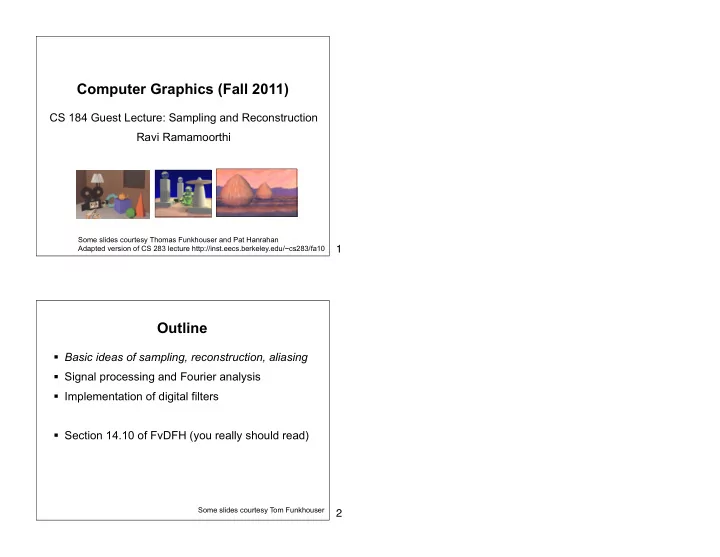
SLIDE 1 Computer Graphics (Fall 2011)
CS 184 Guest Lecture: Sampling and Reconstruction Ravi Ramamoorthi
Some slides courtesy Thomas Funkhouser and Pat Hanrahan Adapted version of CS 283 lecture http://inst.eecs.berkeley.edu/~cs283/fa10
Outline
§ Basic ideas of sampling, reconstruction, aliasing § Signal processing and Fourier analysis § Implementation of digital filters § Section 14.10 of FvDFH (you really should read)
Some slides courtesy Tom Funkhouser
1 2
SLIDE 2
Sampling and Reconstruction
§ An image is a 2D array of samples § Discrete samples from real-world continuous signal
Sampling and Reconstruction
3 4
SLIDE 3
(Spatial) Aliasing (Spatial) Aliasing
§ Jaggies probably biggest aliasing problem
5 6
SLIDE 4
Sampling and Aliasing
§ Artifacts due to undersampling or poor reconstruction § Formally, high frequencies masquerading as low § E.g. high frequency line as low freq jaggies
Image Processing pipeline
7 8
SLIDE 5
Outline
§ Basic ideas of sampling, reconstruction, aliasing § Signal processing and Fourier analysis § Implementation of digital filters § Section 14.10 of textbook
Motivation
§ Formal analysis of sampling and reconstruction § Important theory (signal-processing) for graphics § Also relevant in rendering, modeling, animation
9 10
SLIDE 6
Ideas
§ Signal (function of time generally, here of space) § Continuous: defined at all points; discrete: on a grid § High frequency: rapid variation; Low Freq: slow variation § Images are converting continuous to discrete. Do this sampling as best as possible. § Signal processing theory tells us how best to do this § Based on concept of frequency domain Fourier analysis
Sampling Theory
Analysis in the frequency (not spatial) domain § Sum of sine waves, with possibly different offsets (phase) § Each wave different frequency, amplitude
11 12
SLIDE 7
Fourier Transform
§ Tool for converting from spatial to frequency domain § Or vice versa § One of most important mathematical ideas § Computational algorithm: Fast Fourier Transform
§ One of 10 great algorithms scientific computing § Makes Fourier processing possible (images etc.) § Not discussed here, but look up if interested
Fourier Transform
§ Simple case, function sum of sines, cosines § Continuous infinite case
13 14
SLIDE 8
Fourier Transform
§ Simple case, function sum of sines, cosines § Continuous infinite case
Fourier Transform
§ Simple case, function sum of sines, cosines § Discrete case
14 15
SLIDE 9
Fourier Transform
§ Simple case, function sum of sines, cosines § Discrete case
Fourier Transform: Examples 1
Single sine curve (+constant DC term)
15 16
SLIDE 10
Fourier Transform Examples 2
§ Common examples
Fourier Transform Properties
§ Common properties
§ Linearity: § Derivatives: [integrate by parts] § 2D Fourier Transform
§ Convolution (next)
17 18
SLIDE 11
Fourier Transform Properties
§ Common properties
§ Linearity: § Derivatives: [integrate by parts] § 2D Fourier Transform
§ Convolution (next)
Fourier Transform Properties
§ Common properties
§ Linearity: § Derivatives: [integrate by parts] § 2D Fourier Transform
§ Convolution (next)
18 18
SLIDE 12
Fourier Transform Properties
§ Common properties
§ Linearity: § Derivatives: [integrate by parts] § 2D Fourier Transform
§ Convolution (next)
Sampling Theorem, Bandlimiting
§ A signal can be reconstructed from its samples, if the original signal has no frequencies above half the sampling frequency – Shannon § The minimum sampling rate for a bandlimited function is called the Nyquist rate
18 19
SLIDE 13 Sampling Theorem, Bandlimiting
§ A signal can be reconstructed from its samples, if the original signal has no frequencies above half the sampling frequency – Shannon § The minimum sampling rate for a bandlimited function is called the Nyquist rate § A signal is bandlimited if the highest frequency is
- bounded. This frequency is called the bandwidth
§ In general, when we transform, we want to filter to bandlimit before sampling, to avoid aliasing
Antialiasing
§ Sample at higher rate
§ Not always possible § Real world: lines have infinitely high frequencies, can’t sample at high enough resolution
§ Prefilter to bandlimit signal
§ Low-pass filtering (blurring) § Trade blurriness for aliasing
20 21
SLIDE 14
Ideal bandlimiting filter
§ Formal derivation is homework exercise
Outline
§ Basic ideas of sampling, reconstruction, aliasing § Signal processing and Fourier analysis
§ Convolution
§ Implementation of digital filters § Section 14.10 of FvDFH
22 23
SLIDE 15
Convolution 1 Convolution 2
24 25
SLIDE 16
Convolution 3 Convolution 4
26 27
SLIDE 17
Convolution 5 Convolution in Frequency Domain
§ Convolution (f is signal ; g is filter [or vice versa]) § Fourier analysis (frequency domain multiplication)
28 29
SLIDE 18
Convolution in Frequency Domain
§ Convolution (f is signal ; g is filter [or vice versa]) § Fourier analysis (frequency domain multiplication)
Convolution in Frequency Domain
§ Convolution (f is signal ; g is filter [or vice versa]) § Fourier analysis (frequency domain multiplication)
29 29
SLIDE 19
Practical Image Processing
§ Discrete convolution (in spatial domain) with filters for various digital signal processing operations § Easy to analyze, understand effects in frequency domain
§ E.g. blurring or bandlimiting by convolving with low pass filter
Outline
§ Basic ideas of sampling, reconstruction, aliasing § Signal processing and Fourier analysis § Implementation of digital filters § Section 14.10 of FvDFH
30 31
SLIDE 20 Discrete Convolution
§ Previously: Convolution as mult in freq domain § But need to convert digital image to and from to use that § Useful in some cases, but not for small filters § Previously seen: Sinc as ideal low-pass filter § But has infinite spatial extent, exhibits spatial ringing § In general, use frequency ideas, but consider implementation issues as well § Instead, use simple discrete convolution filters e.g. § Pixel gets sum of nearby pixels weighted by filter/mask 2
5 4 9 1
Implementing Discrete Convolution
§ Fill in each pixel new image convolving with old
§ Not really possible to implement it in place § More efficient for smaller kernels/filters f
§ Normalization
§ If you don’t want overall brightness change, entries of filter must sum to 1. You may need to normalize by dividing
§ Integer arithmetic
§ Simpler and more efficient § In general, normalization outside, round to nearest int
32 33
SLIDE 21
Outline
§ Implementation of digital filters
§ Discrete convolution in spatial domain § Basic image-processing operations § Antialiased shift and resize
Basic Image Processing
§ Blur § Sharpen § Edge Detection All implemented using convolution with different filters
34 35
SLIDE 22
Blurring
§ Used for softening appearance § Convolve with gaussian filter
§ Same as mult. by gaussian in freq. domain, so reduces high-frequency content § Greater the spatial width, smaller the Fourier width, more blurring occurs and vice versa
§ How to find blurring filter?
Blurring
36 37
SLIDE 23
Blurring Blurring
38 39
SLIDE 24
Blurring Blurring
40 41
SLIDE 25 Blurring Filter
§ In general, for symmetry f(u,v) = f(u) f(v)
§ You might want to have some fun with asymmetric filters
§ We will use a Gaussian blur
§ Blur width sigma depends on kernel size n (3,5,7,11,13,19)
Spatial Frequency
Discrete Filtering, Normalization
§ Gaussian is infinite
§ In practice, finite filter of size n (much less energy beyond 2 sigma or 3 sigma). § Must renormalize so entries add up to 1
§ Simple practical approach
§ Take smallest values as 1 to scale others, round to integers § Normalize. E.g. for n = 3, sigma = ½
42 43
SLIDE 26
Discrete Filtering, Normalization
§ Gaussian is infinite
§ In practice, finite filter of size n (much less energy beyond 2 sigma or 3 sigma). § Must renormalize so entries add up to 1
§ Simple practical approach
§ Take smallest values as 1 to scale others, round to integers § Normalize. E.g. for n = 3, sigma = ½
Discrete Filtering, Normalization
§ Gaussian is infinite
§ In practice, finite filter of size n (much less energy beyond 2 sigma or 3 sigma). § Must renormalize so entries add up to 1
§ Simple practical approach
§ Take smallest values as 1 to scale others, round to integers § Normalize. E.g. for n = 3, sigma = ½
43 43
SLIDE 27
Basic Image Processing
§ Blur § Sharpen § Edge Detection All implemented using convolution with different filters
Sharpening Filter
§ Unlike blur, want to accentuate high frequencies § Take differences with nearby pixels (rather than avg)
44 45
SLIDE 28
Blurring Blurring
46 47
SLIDE 29
Blurring Basic Image Processing
§ Blur § Sharpen § Edge Detection All implemented using convolution with different filters
48 49
SLIDE 30
Edge Detection
§ Complicated topic: subject of many PhD theses § Here, we present one approach (Sobel edge detector) § Step 1: Convolution with gradient (Sobel) filter
§ Edges occur where image gradients are large § Separately for horizontal and vertical directions
§ Step 2: Magnitude of gradient
§ Norm of horizontal and vertical gradients
§ Step 3: Thresholding
§ Threshold to detect edges
Edge Detection
50 51
SLIDE 31
Edge Detection Edge Detection
52 53
SLIDE 32
Details
§ Step 1: Convolution with gradient (Sobel) filter
§ Edges occur where image gradients are large § Separately for horizontal and vertical directions
§ Step 2: Magnitude of gradient
§ Norm of horizontal and vertical gradients
§ Step 3: Thresholding
Outline
§ Implementation of digital filters
§ Discrete convolution in spatial domain § Basic image-processing operations § Antialiased shift and resize
54 55
SLIDE 33
Antialiased Shift
Shift image based on (fractional) sx and sy
§ Check for integers, treat separately § Otherwise convolve/resample with kernel/filter h:
Antialiased Scale Magnification
Magnify image (scale s or γ > 1)
§ Interpolate between orig. samples to evaluate frac vals § Do so by convolving/resampling with kernel/filter: § Treat the two image dimensions independently (diff scales)
56 57
SLIDE 34 Antialiased Scale Minification
checkerboard.bmp 300x300: point sample checkerboard.bmp 300x300: Mitchell
Antialiased Scale Minification
Minify (reduce size of) image
§ Similar in some ways to mipmapping for texture maps § We use fat pixels of size 1/γ, with new size γ*orig size (γ is scale factor < 1). § Each fat pixel must integrate over corresponding region in original image using the filter kernel.
58 59