Computer-Aided Design for DNA Self-Assembly: Process and - - PDF document

computer aided design for dna self assembly process and
SMART_READER_LITE
LIVE PREVIEW

Computer-Aided Design for DNA Self-Assembly: Process and - - PDF document

Chris Dwyer Assistant Professor Dept. of Electrical and Computer Engineering Dept. of Computer Science Duke University Computer-Aided Design for DNA Self-Assembly: Process and Applications ICCAD 2005 Motivation log Cost ($/gate) log Length


slide-1
SLIDE 1

1

Computer-Aided Design for DNA Self-Assembly: Process and Applications

Chris Dwyer

Assistant Professor

  • Dept. of Electrical and Computer Engineering
  • Dept. of Computer Science

Duke University

ICCAD 2005

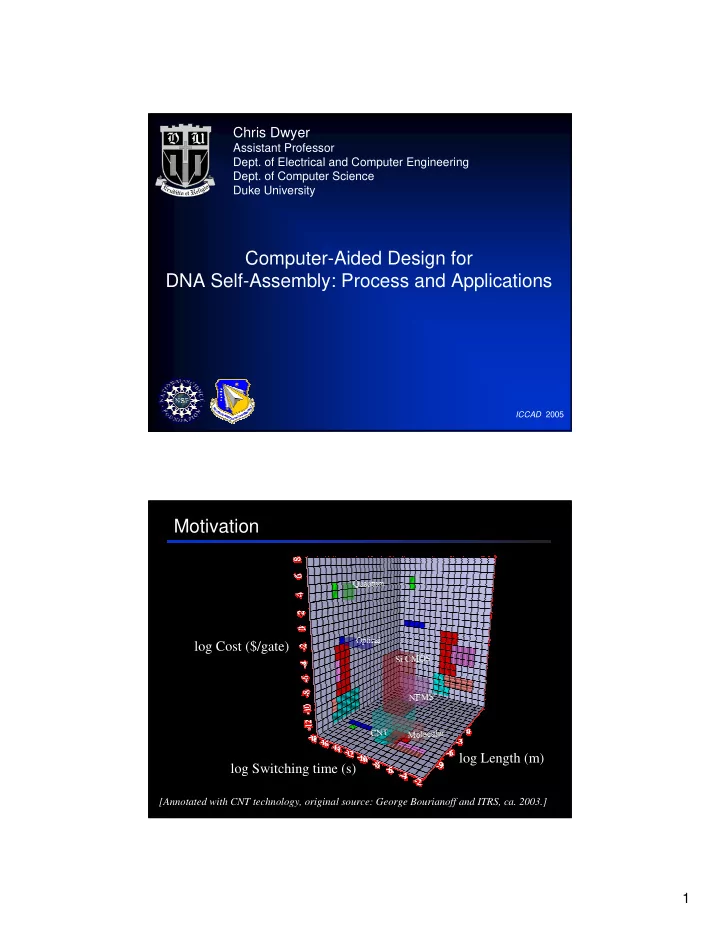
Motivation

[Annotated with CNT technology, original source: George Bourianoff and ITRS, ca. 2003.]

log Length (m) log Cost ($/gate) log Switching time (s)

slide-2
SLIDE 2

2

Outline

  • DNA Basics
  • Self-assembled Nanostructures

– DNA Scaffolds – DNA Guided Self-assembly

  • CAD Tool Support
  • Self-assembled Systems

– New Constraints – Alternative Architectures

  • Conclusions

DNA Basics

  • A DNA strand:

– A linear array of bases (A, T, G, and C) – Directional (one end is distinct from the other) – In nature, the source of genetic information

  • DNA will form a double helix:

– When the bases on each strand (aligned “head-to- toe”) are complementary: A with T, and G with C – But only under certain “natural” environmental conditions (low) temperatures (Tm: sequence dependent) and in an ionic solution.

slide-3
SLIDE 3

3

DNA Basics

  • DNA hybridization is the process that forms the

double helix

  • Sequence and temperature control the

hybridization event

∆T

DNA Basics

  • A common form of the double helix (B-form) has

some well-known geometric properties:

– 3.4 Å per base pitch along the helix – One complete turn between every 10th and 11th base

  • Flexibility:

the bonds along the sugar- phosphodiester backbone of each strand can rotate

– double stranded DNA has a ~50nm persistence length (fairly rigid) – single stranded DNA has a strongly-sequence dependent persistence length (but, it’s flexible)

slide-4
SLIDE 4

4

Outline

DNA Basics

  • Self-assembled Nanostructures

– DNA Scaffolds – DNA Guided Self-assembly

  • CAD Tool Support
  • Self-assembled Systems

– New Constraints – Alternative Architectures

  • Conclusions

Self-assembled Nanostructures

  • Self-assembly is ubiquitous in nature
  • Generally defined as spontaneously generated order
  • Thermodynamics drive the self-assembly process

– we can guide the process by the choice of materials and environmental conditions

A B ∆T A·B < 20 nm feature sizes

slide-5
SLIDE 5

5

DNA Scaffolds - Geometry

  • The geometric properties of double strands can

form specific, controlled self-assembled nanostructures:

∆T 3.4 Å

DNA Self-assembled Tiles

9 strands Cost ($) is proportional to the total number of unique strands (& quantity)

slide-6
SLIDE 6

6

DNA Scaffolds – Hierarchical Assembly

  • Self-assembly can occur in hierarchies (reduces cost):

– tiles (from single strands to tiles) – grids (from tiles to grids) – lattice (from grids or tiles to larger lattice) 30 nm

DNA Scaffolds - Functionalization

  • Tiles can be functionalized (decorated) with

nanoscale components (thus, the DNA serves as a scaffold)

  • Tiles can be functionalized before OR after

grid/lattice assembly

  • Example chemical functionalities include:

– biotin / streptavidin – DNA / nanoparticle (rods, spheres, etc.)

slide-7
SLIDE 7

7

DNA Scaffolds - Functionalization

  • Biotin / streptavidin (protein + active chemicals)
  • The DNA provides a scaffold for the protein

BELOW: AFM images of some grids functionalized with streptavidin AFM images of a 1.4 Tb/in2 ROM (barcode)

The manufacturing scale is incredible: ~1016 grids per mL!

“Letters”: ~60nm on a side (1 experiment made ~1014 of each) Trivia: The collection of books and manuscripts in the Library of Congress contains ~1014 letters.

A Brief Interlude About Yield

  • The term “yield” is well-defined in multiple fields

– Chemistry/Physics/Materials Science: extrinsically (mass) – Engineering: pass/fail (devices, circuits, systems)

  • Yield in DNA self-assembly is ambiguous

– Reason 1: Surface deposition is the major technique used to assay experimental results. Substrate-to-substrate variations change the deposition rate! – Reason 2: Partial products are common but there is no functional test (unlike with current silicon processes) – It comes down to undefined specifications
slide-8
SLIDE 8

8

DNA Scaffolds - Functionalization

  • Perhaps in the future....

Crossed carbon nanotube “FET” / SBT DNA Self-assembly

+

  • Nanotechnology,
  • vol. 13, pp. 601-604, 2002.

Outline

DNA Basics Self-assembled Nanostructures

DNA Scaffolds

  • DNA Guided Self-assembly
  • CAD Tool Support
  • Self-assembled Systems

– New Constraints – Alternative Architectures

  • Conclusions
slide-9
SLIDE 9

9

DNA Guided Self-assembly

  • Nanoparticles (rods, spheres, etc.) can be

functionalized with DNA

  • DNA hybridization stabilizes interactions

between particles if the strands are complementary

  • Sequence design and particle choice yields

controlled nanostructure formation

DNA Guided Self-assembly

  • Example: A two particle tether

∆T

slide-10
SLIDE 10

10

DNA Guided Self-assembly

  • An active component:

– ring-gate FETs (RG-FETs) (or surrounding-gate FETs)

DNA Guided Self-assembly

  • Active components for circuitry: Au – CdSe – Au

(metal, semiconductor, metal or MSM) rods

500 nm wide

slide-11
SLIDE 11

11

DNA Guided Self-assembly

  • IEEE Trans. on VLSI,
  • vol. 12, pp. 1214-1220, 2004.
  • IEEE Trans. on Nano.,

2 (2): pp. 69-74, 2003.

  • Nanotechnology,
  • vol. 13, pp. 601-604, 2002.
  • Perhaps in the future...

– The fabrication of integrated electronic systems

Self-assembled Nanostructures

  • Recap: Two Fabrication Methods

– Scaffolds – DNA Guided Assemblies

Scaffolds Nanorod assemblies

30 nm

slide-12
SLIDE 12

12

Outline

DNA Basics Self-assembled Nanostructures

DNA Scaffolds DNA Guided Self-assembly

  • CAD Tool Support
  • Self-assembled Systems

– New Constraints – Alternative Architectures

  • Conclusions
  • New technology fabric : New tool support

– Goal: apply conventional circuit design approaches to these new technologies

  • First, identify a design context:

– Tool flow – Layout tools – DNA sequence design

  • The big picture: Moving towards full system

design...

CAD Tool Support

slide-13
SLIDE 13

13

Power & Timing Estimate Device-level Description System Description Synthesis Tools Architectural Simulator (custom) Behavioral Verification Functional Verification SPICE Layout Tools (custom) Layout

Tool Flow

Assembly Order & DNA Sequences Assembler (custom) Extractor (custom) Back-annotated Circuit SPICE (custom) Timing & Power Verification Self-assembled Fabrication Layout Orders

Tool Flow

slide-14
SLIDE 14

14

CAD Tool Support – Circuit Layout

DNA scaffold layout tool DNA-rod layout tool

  • Bootstrap the automated / cell layout systems

with manual layout tools and standard cell designs

CAD Tool Support – Optimized Fabrication

  • The new aspects for the process tools:

– DNA sequence design – Assembly orders (unique per design)

Assembly Order & DNA Sequences Assembler (custom) Self-assembled Fabrication Layout Orders

slide-15
SLIDE 15

15

CAD Tool Support: Wrap-up

  • Current tool status:

Cluster-based sequence optimization Layout tools Carbon-nanotube & MSM device models for a custom SPICE kernel (semi-empirical) Assembly orders / “artwork” gen. (for large circuits)

  • Tool wish list:
  • 1. yield-aware design optimizations,
  • 2. refined (high ω) device models,
  • 3. better automated full custom support.

Outline

DNA Basics Self-assembled Nanostructures

DNA Scaffolds DNA Guided Self-assembly

CAD Tool Support

  • Self-assembled Systems

– New Constraints – Alternative Architectures

  • Conclusions
slide-16
SLIDE 16

16

Self-assembled Systems

  • There are a variety of self-assembled systems

– crossbars, micron-scale assemblies, biological systems...

  • The Systems Focus:

self-assembled computer architectures New Constraints

  • Self-assembly imposes:

– chaos / randomness at some length scale (>1-10 µm)

  • DNA hybridization imposes:

– order at some length scale (< 1-5 µm)

  • The two can work together but some fundamental

assumptions must change:

– Wire / bus interconnect

  • No large-scale interconnect networks / limited local

– Severe area / cost tradeoff

  • Large (> 1-10 µm on a side) circuit footprints are impractical

– Reliability

  • The substrate can be defective
  • The devices can be defective
slide-17
SLIDE 17

17

Alternative Architectures

  • The task: Given a device technology, design a

system

– The new constraints prevent wholesale adoption of conventional architectures / system designs

  • Two common solutions given a defect-prone

technology:

– reconfigurable resources – redundant components (e.g. TMR, n-MR, multiplexing, etc.)

Alternative Architectures

  • (Self-) Reconfigurability is key, however....
  • The large number of simple processing nodes in a

system (as many as we can assemble, ~1014 +) precludes the use of an explicit defect map

  • The goal: To stitch a sufficient number of

computational resources together to execute application code

slide-18
SLIDE 18

18

Alternative Architectures

  • Four systems: Oracles, DAMP, NANA, and

nSIMD:

– Oracles: DNA computing with a device twist that enables rapid (electrical) re-use of a DNA computation – DAMP: Decoupled Array Multi-processor, SIMD without an interconnection network- embarrassingly parallel codes – only – NANA: Nanoscale Active Network Architecture, general purpose but imbalanced due to a large communication/execution ratio- under utilized resources – nSIMD: (nano) SIMD, similar to NANA but applies a SIMD model onto a reconfigurable network topology. Utilization is high due to a depth first network traversal.

Alternative Architectures

Self-assembled Computational nodes Self-assembled Interconnect Defect model includes:

  • Rotation, position
  • Connectivity
  • Fail-stop nodes (unrealistic)
slide-19
SLIDE 19

19

Wrap-up

  • DNA Basics
  • Self-assembled Nanostructures

– DNA Scaffolds – DNA Guided Self-assembly

  • CAD Tool Support
  • Self-assembled Systems

– New Constraints – Alternative Architectures

  • Conclusions

Conclusions

Shell Arm Core

Self-assembled device theory

slide-20
SLIDE 20

20

Conclusions

Some demonstrations of self-assembled devices This technology is on its way...

30 nm

Conclusions

Self-assembled computer architectures and systems

– Oracles: Re-useable DNA computations – DAMP: Decoupled Array Multi-processor – NANA: Nanoscale Active Network Architecture – nSIMD: (nano) SIMD

slide-21
SLIDE 21

21

Acknowledgements

Vijeta Johri Vincent Mao Jaidev Patwardhan Constantin Pistol Juan Bermudez Lauren Cohen Curt Harting Josh Johnson Joe Tadduni

  • Graduate students
  • Undergraduate students

Research Sponsors

  • AFRL FA8750-05-2-0018
  • NSF CCR-0326157
  • NSF EIA-9972879
slide-22
SLIDE 22

22

Basic system criteria – a framework

(i) Linear signal transduction (ii) Non-linear signal modulation by another signal (iii) Signal amplification / restoration (iv) Signal noise immunity (v) Circuit patterning and interconnect (vi) Scale of device integration (vii) Energy consumption (viii) Application runtime performance

10X

  • DNA computing
  • Oracles
  • ASICs, FPGAs, etc.
  • Conventional serial & parallel machines
  • Decoupled array multi-processor (DAMP)

Assembly-time Run-time

Temporal spectrum of Computation

IEEE Computer,

  • vol. 38, pp. 56-64, 2005.
slide-23
SLIDE 23

23

Organization & Architecture

R0* R1* R2 R3 R4 ACC* Operation B C D S Status bits W R

  • Nanotechnology,
  • vol. 15, 1688-1694, 2004.
  • Ph.D. dissertation,
  • Univ. of North Carolina, Chapel Hill, 2003.
  • IEEE Computer,
  • vol. 38, pp. 56-64, 2005.
  • IEEE Trans. on VLSI,
  • vol. 12, pp. 1214-1220, 2004.

Question0 Answer0 log2(n) bits

. . .

Questionn-1 Answern-1

Oracles Decoupled array multiprocessor (DAMP)

  • Truth table defines binding rules
  • Each tile is implemented by a self-

assembled circuit

A A B B C Ci

i

C Co

  • S

S

Addition oracle example

1 1 1 1 1 1 1 1 1 1 1 1 1 1 1 1 1 1 1 1 A B S Ci Ci Co Co

slide-24
SLIDE 24

24

1 1 1 1 1 1 1 1 1 1 1

LSB MSB

A = 0 0 1 1 A = 0 0 1 1 B = 0 1 0 1 B = 0 1 0 1 Sum = 1 0 0 0 Sum = 1 0 0 0 S = 1 0 0 0 S = 1 0 0 0

“3 + 5 = 8”

Addition oracle example

A B S Ci Ci Co Co

  • Each tile implemented using logic circuitry

Bit from the truth table

A B S Ci Ci Co Co

Addition oracle example

slide-25
SLIDE 25

25

Organization & Architecture

R0* R1* R2 R3 R4 ACC* Operation B C D S Status bits W R

  • Nanotechnology,
  • vol. 15, 1688-1694, 2004.
  • Ph.D. dissertation,
  • Univ. of North Carolina, Chapel Hill, 2003.
  • IEEE Computer,
  • vol. 38, pp. 56-64, 2005.
  • IEEE Trans. on VLSI,
  • vol. 12, pp. 1214-1220, 2004.

Question0 Answer0 log2(n) bits

. . .

Questionn-1 Answern-1

Oracles Decoupled array multiprocessor (DAMP)

Basic system criteria

10X

Device-level simulation AND Real-device parameter extraction Interconnect & integration (SPICE, etc.) Organization / architecture & application performance (SimpleScalar, custom, etc.)

slide-26
SLIDE 26

26

  • Electrical behavior very similar to conventional MOSFETs
  • E.g., the ring-gated FET
  • 1.6x10⁻⁶
  • 1.4x10⁻⁶
  • 1.2x10⁻⁶
  • 1.0x10⁻⁶
  • 8.0x10⁻⁷
  • 6.0x10⁻⁷
  • 4.0x10⁻⁷
  • 2.0x10⁻⁷

0.0x100

  • 1
  • 0.9
  • 0.8
  • 0.7
  • 0.6
  • 0.5
  • 0.4
  • 0.3
  • 0.2
  • 0.1

Drain-to-source Current Drain-to-source Voltage Ids(Vgs= 0.00) Ids(Vgs=-0.05) Ids(Vgs=-0.10) Ids(Vgs=-0.25)

P-FET IV Curves

0.0x100 5.0x10⁻⁷ 1.0x10⁻⁶ 1.5x10⁻⁶ 2.0x10⁻⁶ 2.5x10⁻⁶ 0.1 0.2 0.3 0.4 0.5 0.6 0.7 0.8 0.9 1 Drain-to-source Current Drain-to-source Voltage Ids(Vgs=1.00) Ids(Vgs=0.90) Ids(Vgs=0.80) Ids(Vgs=0.75)

N-FET IV Curves

Case study: Silicon nanowires to DAMP

IEEE Trans. Nano, 2 (2): pp. 69-74, 2003.

Interconnect & Integration Case study: Silicon nanowires to DAMP

slide-27
SLIDE 27

27

Organization & Architecture

R0* R1* R2 R3 R4 ACC* Operation B C D S Status bits W R

Decoupled array multiprocessor (DAMP)

Case study: Silicon nanowires to DAMP

COST(R1, R2) // Save last ∆X, copy F into acc ADDI(∆fi) // Accumulate the next interval STORE(R2) // Save it LOAD(Mi-1) // Load the correction factor for this interval COST(R0, R1) // Save the correction, load the specific Ti value ADDI(-∆Xi) // Subtract the current interval's end value (T) WAITNLT // any processor that didn't end the integration at T... SETB // all processors that DID end at T, set the B bit... RESUME // all-aboard WAITB

Application Performance (DES) Case study: Silicon nanowires to DAMP

slide-28
SLIDE 28

28

1 2 3 4 5 6 7 8 9 10 DAMP IBM BlueGene/L NEC Earth Simulator SETI@Home Intel Pentium 4 Log search time (sec)

Application Performance (DES) Case study: Silicon nanowires to DAMP

2 4 6 8 10 DAMP IBM BlueGene/L NEC Earth Simulator SETI@Home Intel Pentium 4 Log scale Energy/op (fJ)

Application Performance (DES) Case study: Silicon nanowires to DAMP

slide-29
SLIDE 29

29

Electrolyte gated carbon nanotubes

  • S. Rosenblatt, Y. Yaish, J. Park, J. Gore, and
  • P. L. McEuen, 2002.

Electrolyte gated carbon nanotubes

  • CMOS vs. CNT ring oscillators (per inverter)

2.9 1.6 ~550 18nm‡ 59.0 3.49 29.67 0.1µm* 0.17 0.179 524 CNT-20nm 27.5 1.67 30.4 45nm* 47.0 2.69 28.7 65nm* 74.5 2.66 17.82 0.13µm* 305 8.87 14.53 0.18µm†

  • Trans. Energy (aJ)

Power (uW) fmax (GHz) Technology

† – Verified against MOSIS reference device T3AZ, Dec. 2003. ‡ – ITRS 2003 prediction.

* – Berkeley predictive technology models, Y. Cao et al., 2000-2002.