SLIDE 1 1
CS/EE 6710
Introduction to Layout Inverter Layout Example Layout Design Rules
Composite Layout
Drawing the mask layers that will be used by the fabrication folks to make the devices
Very different from schematics
In schematics you’re describing the LOGICAL connections In layout, you’re describing the PHYSICAL placement of everything!
Use colored regions to define the different layers that are patterned onto the silicon
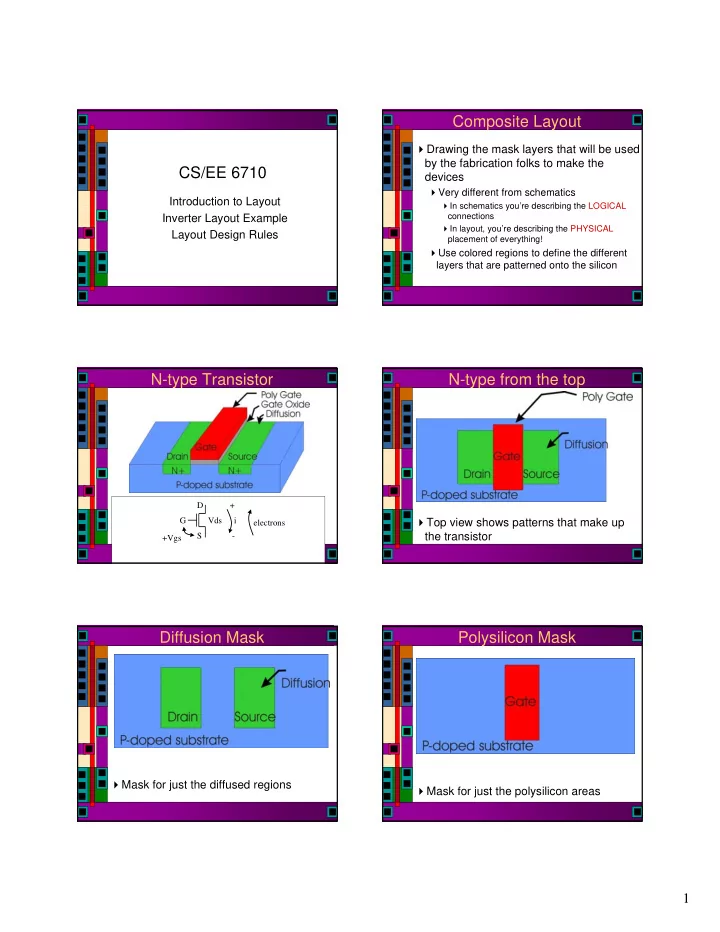
N-type Transistor
+
electrons Vds +Vgs S G D
N-type from the top
Top view shows patterns that make up the transistor
Diffusion Mask
Mask for just the diffused regions
Polysilicon Mask
Mask for just the polysilicon areas
SLIDE 2
2
Combine the two masks
You get an N-type transistor
There are other steps in the process…
P-type transistor
Same type of masks as the N-type
But, you have to get the substrate right and you have to dope the diffusion differently
General CMOS cross section
Note that the general substrate is P-type The N-substrate for the P-transistor is in a “well” There are lots of other layers
Thick SiO2 oxide (“field oxide) Thin SiO2 oxide (gate oxide Metal for interconnect
Cutaway Photo A Cutaway View
CMOS structure with both transistor types, and top-view structure
Top View from that Section
Note the different mask layers that correspond to the different transistor layers
In particular, note the N-well and P-select layers
SLIDE 3
3
This is an Inverter
In Out Gnd Vdd
Layout in Cadence
Each color corresponds to a mask layer Draw rectangles to describe mask regions A LOT of things to keep in mind
connectivity, functionality, design rules
What are the layers? How do the Layers Interact? Photo of Interconnect Back to the Inverter
Let’s walk through drawing this inverter You can draw layers in whatever order makes sense to you…
SLIDE 4
4
Layout Basics
Where poly crosses active = transistor
For N-type, nactive over the substrate (p substrate) For P-type, pactive inside an Nwell
There’s really only one “active” mask
nselect and pselect layers define active types Our setup has separate nactive and pactive colors to help keep things straight.
Layout Basics
Diffusion, Poly, and metal all conduct
But resistances are very different
Diffusion is worst, poly isn’t too bad, metal is by far the best
Contact cuts are needed to connect between layers
Make sure to use the right type of contact! Cc for poly-metal1, active-metal1 Via1 for metal1-metal2 Via2 for metal2-metal3
First Layout the Power Rails
Power rail pitch is important
Allows cells to connect by abutment
Also add the N-well for the P-type transistor
Now add Diffusion
Note the M1 contacts in the diffusion Diffusion by itself will be N-type Diffusion in an N-well will be P-type
Or will it? The well just defines the substrate type
Add the Select Regions
Nselect defines N-type diffusion Pselect defines P-type diffusion
Now add the Poly Gates
Remember: crossing diffusion with Poly makes a transistor
The type of the diffusion, and the type of well, define what kind of transistor
SLIDE 5 5
Note the Metal1 Connections
Overlapping boxes of the same type of material make a connection Overlaps of different types of material need a contact cut of some sort
Connect the Gates
Connect gates together to form the inverter Note contact cuts and metal overlaps
Layout Subtlety
We currently think of transistors as three- terminal devices
Gate, Source, Drain
They’re really four-terminal devices
There’s also a connection to the substrate
It’s important to tie the substrate to a specific voltage
GND for the P-substrate VDD for the N-well
Reasons later… Has to do with “latch up”
Well (or Substrate) Contacts
Connect P-substrate to GND (VSS) with a little stub of P-type diffusion (remember Pselect) Connect the N-well to VDD with a little stub of N-type diffusion
I.e. inside the N-well, but with N-select
Layout Design Rules
Define the allowed geometry of the different layers
Guidelines for making safe process masks Rules about the allowed sizes and shapes of a particular layer Rules about how different layers interact
Dimensions listed in one of two ways
Absolute dimensions (I.e. microns) Scalable dimensions in abstract units
Usually called “lambda” Design in lambda units, then scale lambda for a particular process
Intra-Layer Rules (Lambda)
12 18 Well Active 3 3 Polysilicon 3 2 Different Potential Same Potential Metal1 3 3 2 Contact
Select 2
6 2 Hole Metal2 3 3 Metal3 4 5 2
Lambda = 0.50 => 1.0u process Lambda = 0.30 => 0.6u process
SLIDE 6 6
Intra-Layer Rules (Native)
5 5 Well Active 0.8 0.8 Polysilicon 0.6 0.6 Different Potential Same Potential Metal1 0.6 0.6 0.5 Contact
Select 1
5 0.5 Hole Metal2 0.7 0.7 Metal3 0.7 0.8 1
Dimensions are directly in microns Some things scale uniformly, others don’t Native rules are generally more dense
Transistor Layout
0.3 0.6 0.9 0.6 0.9 0.6 0.6
Measurements are in microns based on scalable rules and a lambda
0.3
Select Poly Active
Vias and Contacts
0.3 0.6 0.3 Via Metal to Poly Contact Metal to Active Contact 0.3 0.9 0.9
Look at Inverter Layout Again
Lots and lots of design rules to consider!
Use Design Rule Checking (DRC) to see if everything is OK
Layout Design Rules
On the class web page Modified version of the MOSIS SCMOS
Modified to show both Lambda and Micron dimensions All our design will be done in microns
Because of the NCSU tech files
But, even though we’re using microns, we’re using the SCMOS Lambda rules…
Print them out in color if possible!
SCMOS Nwell
SLIDE 7
7
SCMOS Active (diffusion) SCMOS Poly SCMOS Select SCMOS Contacts SCMOS Contact to Poly SCMOS Contact to Active
SLIDE 8
8
SCMOS Metal1 SCMOS Via SCMOS Metal2 SCMOS Via2 SCMOS Metal3