
SLIDE 1
Component Firmware http://outflux.net/slides/2014/lss/firmware.pdf - - PowerPoint PPT Presentation
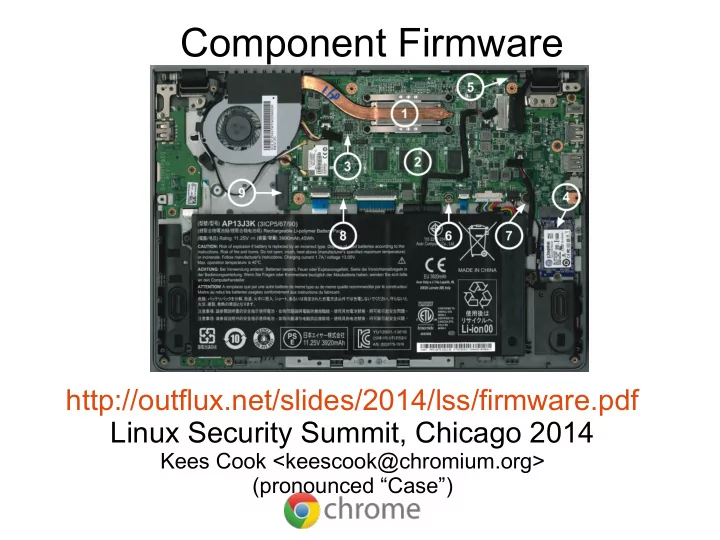
Component Firmware http://outflux.net/slides/2014/lss/firmware.pdf Linux Security Summit, Chicago 2014 Kees Cook <keescook@chromium.org> (pronounced Case) Overview Wait, which firmware? Threats Update methods
Component Firmware Linux Security Summit 2014 Aug 18, 2014 2/20
Component Firmware Linux Security Summit 2014 Aug 18, 2014 3/20
– Though consider ME, SMM, TrustZone
– Network – Storage – Input – CPU – Other weird stuff
Component Firmware Linux Security Summit 2014 Aug 18, 2014
– Example: network card
http://esec-lab.sogeti.com/dotclear/public/publications/11-recon-nicreverse_slides.pdf
Component Firmware Linux Security Summit 2014 Aug 18, 2014
– Example: Bluetooth keyboard, drives
– Example: SuperIO and TPM are on LPC
https://online.tugraz.at/tug_online/voe_main2.getvolltext?pCurrPk=59565 http://spritesmods.com/?art=hddhack
Component Firmware Linux Security Summit 2014 Aug 18, 2014
Component Firmware Linux Security Summit 2014 Aug 18, 2014
– Cannot be replaced with malicious code
– Cannot be replaced with bug-fixed code without
Component Firmware Linux Security Summit 2014 Aug 18, 2014
– Cannot be replaced with malicious code
– Cannot be replaced with bug-fixed code without
Component Firmware Linux Security Summit 2014 Aug 18, 2014
– Secure firmware updates
– System owner has no access to change firmware – Uncommon for component vendors to implement
Component Firmware Linux Security Summit 2014 Aug 18, 2014
– Secure firmware updates – Key chain defined by system owner
– Very unlikely for component vendors to implement
Component Firmware Linux Security Summit 2014 Aug 18, 2014
– Secure firmware updates
– Only as secure as boot firmware – Updates must be applied during initial system boot – Boot firmware may need to re-flip bit across power
Component Firmware Linux Security Summit 2014 Aug 18, 2014
– Updates possible
– Only as secure as the kernel – Need kernel API to verify firmware origin
Component Firmware Linux Security Summit 2014 Aug 18, 2014
– Updates possible
– Crosses the line between userspace and ring0 – May not be limited to root user (e.g. 3G modem
Component Firmware Linux Security Summit 2014 Aug 18, 2014
Component Firmware Linux Security Summit 2014 Aug 18, 2014
/* * @kernel_fw_from_file: * Load firmware from userspace (not called for built-in firmware). * @file contains the file structure pointing to the file containing * the firmware to load. This argument will be NULL if the firmware * was loaded via the uevent-triggered blob-based interface exposed * by CONFIG_FW_LOADER_USER_HELPER. * @buf pointer to buffer containing firmware contents. * @size length of the firmware contents. * Return 0 if permission is granted. */
Component Firmware Linux Security Summit 2014 Aug 18, 2014
Component Firmware Linux Security Summit 2014 Aug 18, 2014
Component Firmware Linux Security Summit 2014 Aug 18, 2014
Component Firmware Linux Security Summit 2014 Aug 18, 2014 19/20
Component Firmware Linux Security Summit 2014 Aug 18, 2014