Complex Content in Museums Lindsay Newton Missouri History Museum - - PowerPoint PPT Presentation

complex content in museums
SMART_READER_LITE
LIVE PREVIEW

Complex Content in Museums Lindsay Newton Missouri History Museum - - PowerPoint PPT Presentation

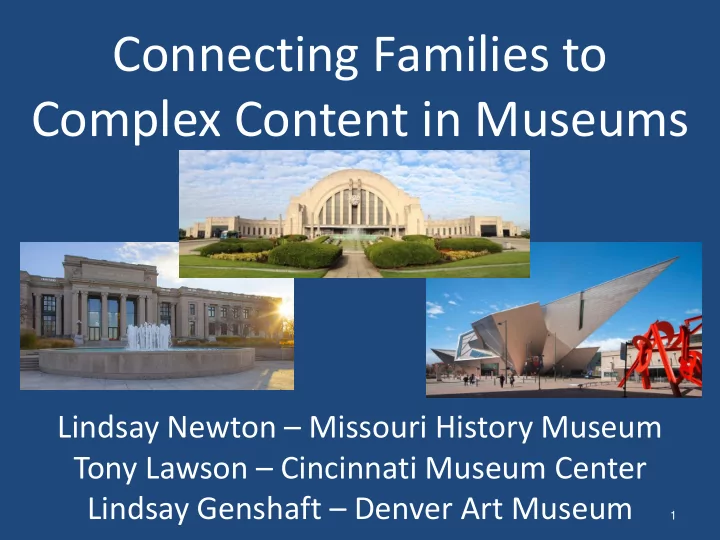
Connecting Families to Complex Content in Museums Lindsay Newton Missouri History Museum Tony Lawson Cincinnati Museum Center Lindsay Genshaft Denver Art Museum 1 How would you define complex? 2 Complex: Not easy to


slide-1
SLIDE 1

Connecting Families to Complex Content in Museums

Lindsay Newton – Missouri History Museum Tony Lawson – Cincinnati Museum Center Lindsay Genshaft – Denver Art Museum

1
slide-2
SLIDE 2

How would you define “complex”?

2

slide-3
SLIDE 3

“Complex”:

  • Not easy to analyze or understand
  • Complicated
  • Intricate

3

slide-4
SLIDE 4

So how would you define “complex content” in museums?

4

slide-5
SLIDE 5

5

Exhibits, programs, or instructional materials that:

  • Deal with race, prejudice, bias,

religion, immigration

  • Push people to critically think and

problem solve

  • Ask for people to voice their
  • pinions and be heard
slide-6
SLIDE 6

Case Study: ​ Connecting Families to Complex Science Content at Cincinnati Museum Center

6

slide-7
SLIDE 7

“I haven’t had a science class since high school.”

7

“My kids are too young to learn science.”

slide-8
SLIDE 8

Exhibit Engagement

8

Learning Through Play Family Guides

  • Play
  • Learn
  • Discover
  • Explore
slide-9
SLIDE 9

Exhibit Engagement

9

Children’s Museum: The Woods Science Museum: The Cave

slide-10
SLIDE 10

Facilitated Science Programs

10

Science Process Skills

  • Classification
  • Communication
  • Prediction
  • Inference
  • Measurement
  • Observation
slide-11
SLIDE 11

Live Animal Programs

11

Children’s Museum: Animals Up Close Science Museum: Bat Flight

slide-12
SLIDE 12

“I didn’t know the kids were learning science while they were playing.”

12

“My daughter has developed a serious interest in science!”

slide-13
SLIDE 13

Case Study: ​ Using facilitated programs at the Denver Art Museum to tackle complex content​

13

slide-14
SLIDE 14

“…many parents question whether art museum visits are age-appropriate for young children.”

  • IMLS Report

14

“I feel like we

need “Art museum for dumb parents”

  • r something

like that.”

slide-15
SLIDE 15

Miró, Magic, and the Night

15

slide-16
SLIDE 16

A Promise to Keep Create-n-Take

16

slide-17
SLIDE 17

Foxy and Shmoxy: Art Detectives

17

slide-18
SLIDE 18

Case Study: ​ Connecting Families with Complex Content at the Missouri History Museum

18

slide-19
SLIDE 19

“A museum is not a good place for young children to go.” “History is boring.” “Kids don’t have the ability to understand history.”

19

slide-20
SLIDE 20

Family Programs

  • Over 250 programs

per year

  • Serving families with

kids ages 2-10

  • Highlighting local

culture, holidays, and exhibits

20

slide-21
SLIDE 21

History Clubhouse

  • For kids ages 2-10

with their families

  • r caregivers
  • 100% hands-on
  • FREE

21

  • Learn about St. Louis history in a way

that is interactive and fun

slide-22
SLIDE 22

Paint for Peace Mural

22

slide-23
SLIDE 23

Paint for Peace Mural

23

slide-24
SLIDE 24

P.E.A.C.E. Out for Kids

Painting Everything Always Calms Everybody

24

slide-25
SLIDE 25

Children’s Library and Storytelling

25

slide-26
SLIDE 26

Strategies

For Connecting Families to Complex Content

26

  • Apply to any kind of museum experience
  • Humans want to make sense of the world
  • Combine strategies
  • Use good judgement
  • Be prepared to dive deep
slide-27
SLIDE 27

Ground Your Program in a Guiding Question

27

  • What is the at the heart of what you’re exploring?
  • Boil it down to the essence for clarity
slide-28
SLIDE 28

Use Real/Authentic Artifacts and Objects

28

  • Provide unique

experiences

  • Encourage close

looking, questions, and new conclusions or

  • pinions
  • “See it, try it”
slide-29
SLIDE 29

29

Recreate Experiences to Support Full Immersion

  • Allows kids to imagine

places and times they have not experienced

  • Fosters empathy
slide-30
SLIDE 30

Model Process of Exploring and Empowering Kids to Have a Conversation

30

  • Supports perspective taking and perspective

getting

  • Consider different methods of prompting

questions

slide-31
SLIDE 31

Encourage Playing and Learning Together

31

  • Supports:
  • Discovery
  • Problem solving
  • Creative thinking
slide-32
SLIDE 32

Parents as First Teachers

32

  • Parents as first

teachers

  • Provide

suggestions for parents

  • Suggestions

should vary for different types of learners

slide-33
SLIDE 33

Imbed Humor

33

  • Consider multi levels of humor
  • Laughter as comfort
slide-34
SLIDE 34

Use Art Making

34

  • Expression through

creating

  • Ideal to encourage

reflection

  • Memorable
slide-35
SLIDE 35

Use Storytelling in Its Variety of Forms

35

  • Children’s books
  • Performances
  • First-hand stories
  • Family story sharing
slide-36
SLIDE 36

Incorporate Movement and Music

36

  • Kinesthetic learners
  • Channels energy to

make connections

slide-37
SLIDE 37

Use a Familiar Context

37

  • Comfort
  • Connect previous

knowledge to new ideas

slide-38
SLIDE 38

Visitors in Role (Being Part of a Story)

38

  • Supports empathy
  • Promotes critical thinking
slide-39
SLIDE 39

Youth Activism & Engagement Workshop

39

Focus on Relevant Topics

  • Provides new context to real world issues
  • Encourages thinking in new ways
slide-40
SLIDE 40

Be Open to Improvisation

40

  • Supports visitor-centric experience
  • Promotes inclusion
slide-41
SLIDE 41

Group Work

Incorporate strategies into specific scenarios.

41

slide-42
SLIDE 42

Share Session

42

slide-43
SLIDE 43

Connecting Families to Complex Content in Museums

Lindsay Newton – Missouri History Museum Tony Lawson – Cincinnati Museum Center Lindsay Genshaft – Denver Art Museum

43