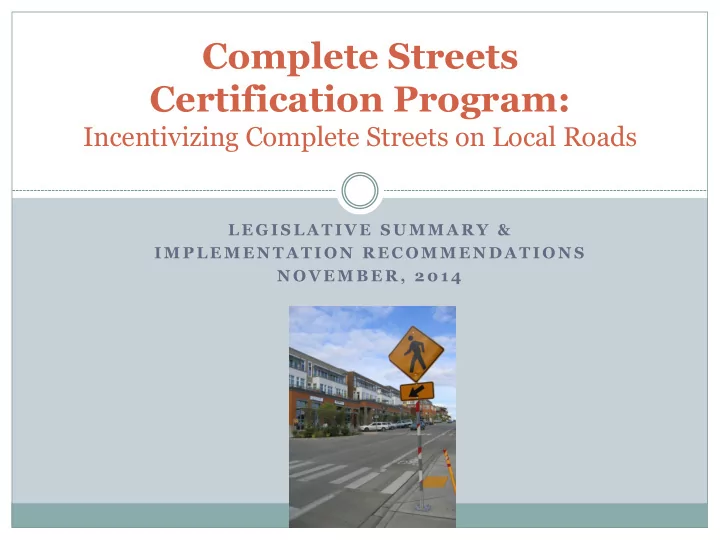
SLIDE 1 Complete Streets Certification Program:
Incentivizing Complete Streets on Local Roads
L E G I S L A T I V E S U M M A R Y & I M P L E M E N T A T I O N R E C O M M E N D A T I O N S N O V E M B E R , 2 0 1 4
SLIDE 2 Presentation Outline
- 1. Why the Complete Streets
Certification Program?
- 2. Supporters
- 3. Summary of Legislation
- 4. Implementation
Recommendations
- 5. Community Illustrations
SLIDE 3
Presenters
Maddie Ribble, Massachusetts Public
Health Association
Wendy Landman, WalkBoston Michelle Ciccolo, Town of Hudson Julie Kelly, City of Fall River
SLIDE 4 Why the Complete Streets Certification Program?
- 1. Incorporate Complete Streets into Local
Roadways with an Incentive Approach. 77% of Massachusetts roadways are locally-controlled, and state policies on complete streets do not directly apply to them. This program will provide an incentive for municipalities to incorporate complete streets into these roadways, including an incentive to allocate Chapter 90 funds toward projects that advance complete streets.
SLIDE 5 Why the Complete Streets Certification Program?
- 2. Small Awards Can Make a Big Impact.
Relatively small awards to municipalities can make a significant impact on planning, design, and infrastructure. Planning and design support are critical to
- communities. For infrastructure, awards could add
incrementally to Chapter 90 funds going toward a project in order to better incorporate complete streets,
- r could specifically support improvements like ramps,
curb cuts, crosswalks, or bike lane striping that are relatively inexpensive.
SLIDE 6 Why the Complete Streets Certification Program?
- 3. Municipal Leaders Want To Advance
Complete Streets. Many municipal leaders see complete streets as an important contributor to quality of life in their communities, encouraging residents and visitors to shop locally, helping to attract and retain workplaces and employees, and increasing real estate values. However, all communities are hampered by limited resources to move this priority forward.
SLIDE 7 Why the Complete Streets Certification Program?
- 4. Tool to Advance Existing MassDOT Goals.
The program will help MassDOT achieve stated goals related to mode shift, greenhouse gas reduction, and healthy transportation.
- 5. Continue National Leadership.
The Program will continue MassDOT’s and Massachusetts’ national leadership in supporting healthy and active transportation.
SLIDE 8
Supported By State and Local Advocates
SLIDE 9 John Musante, Town Manager Town of Amherst Mary Pat Flynn, Chairman County Commissioners Barnstable County Margot Fleischman, Chair On behalf of the Board of Selectmen Town of Bedford Judith Booman, Chairman Board of Selectmen Town of Berlin Michael Cahill, Mayor City of Beverly Martin J. Walsh, Mayor City of Boston Bill Carpenter, Mayor City of Brockton Ken Goldstein, Chair On behalf of the Board of Selectman Town of Brookline David Maher, Mayor City of Cambridge Paul Cohen, Town Manager Town of Chelmsford Ann Vandal, Acting Town Manager Town of Dracut Carlo DeMaria, Mayor City of Everett William Flanagan, Mayor City of Fall River Lisa Wong, Mayor City of Fitchburg Mark Hawke, Mayor City of Gardner Alex Morse, Mayor City of Holyoke Philip Lemnios, Town Manager Town of Hull Fred P. Lucy, III, Chair Board of Selectman Town of Hudson Daniel Rivera, Mayor City of Lawrence
Supported By Municipal Leaders - 1
SLIDE 10 Dean Mazzarella, Mayor City of Leominster Deborah M. Mauger, Chairman On behalf of the Board of Selectmen Town of Lexington Keith Bergman Town Administrator Town of Littleton Kevin Murphy, City Manager City of Lowell Gary Christenson, Mayor City of Malden Robert Dolan, Mayor City of Melrose Ira Singer, Town Administrator Town of Middleton Richard Alcombright, Mayor City of North Adams David Narkewicz, Mayor City of Northampton John Lebeaux Town Administrator Town of Princeton Thomas Koch, Mayor City of Quincy Daniel Rizzo, Mayor City of Revere Kimberley Driscoll, Mayor City of Salem Joseph Curtatone, Mayor City of Somerville Domenic Sarno, Mayor City of Springfield Jodi Ross, Town Manager Town of Westford Susan Kay, Mayor Town of Weymouth Morris Bergman City Councilor Anthony Economou City Councilor City of Worcester
Supported By Municipal Leaders - 2
SLIDE 11
Summary of Legislation
SLIDE 12
Authority: 2014 Transportation Bond Bill
Chapter 79 of the Acts of 2014
Section 2A, line item 6121-1318 – $50 million
funding authorization
Section 9 – Creation of “Complete Streets
Certification Program” as Mass General Laws, Chapter 90I
SLIDE 13
Funding Authorization
6121-1318 For the complete streets certification program established pursuant to chapter 90I of the General Laws to be disbursed in the form of grants to certified cities and towns for infrastructure and planning; provided, that not less than 33 per cent of the grants awarded shall be issued to cities and towns with a median household income below the average of the commonwealth $50,000,000
SLIDE 14
Chapter 90I – Complete Streets Program
“The department shall establish a complete streets certification program to encourage municipalities to regularly and routinely include complete streets design elements and infrastructure on locally-funded roads.” “Complete streets” defined as streets that provide accommodations for users of all transportation modes including, but not limited to, walking, cycling, public transportation, automobiles and freight.
SLIDE 15 Requirements for a Community to be Certified
Local Policy. Adopt a complete streets policy – may be a by-law,
- rdinance or administrative policy.
Baseline Inventory. Coordinate with MassDOT to confirm
baseline inventory of pedestrian and bicycle accommodations in
- rder to identify priority projects.
Procedures to Incorporate into Routine Road Work.
Develop procedures to follow when conducting municipal road repairs, upgrades or expansion projects in order to incorporate complete streets elements.
Review Process for Private Development. Establish a review
process for private development proposals in order to incorporate complete streets.
Mode Share Goal. Set a 5-year municipal mode shift goal. Initial application and annual progress reports.
SLIDE 16 Advisory Committee
12 Persons to be appointed by Governor 3 from different RPAs; 2 from Gateway Communities 1 each from
Metropolitan Area Planning Council Department of Public Health Mass Municipal Association MassBike WalkBoston LivableStreets Mass Association of Chamber of Commerce Executives
MassDOT has signaled intent to use existing bodies
to serve this purpose
SLIDE 17
Other
Legislative body of municipality must take vote to accept
provisions of the program.
MassDOT shall adopt rules, regulations or guidelines for
the administration and enforcement of this section including, but not limited to establishing applicant selection criteria, funding priority, application forms and procedures, grant distribution and other requirements.
MassDOT must file a legislative report annually by April
1st.
SLIDE 18
Implementation Recommendations
SLIDE 19
Programmatic Recommendations
The five criteria outlined in the legislation are broad Guidance on how municipalities can meet each
criteria should recognize the myriad community types in the state and provide the ability for all 351 cities and towns to be eligible for this program
SLIDE 20 Programmatic Recommendations
Criterion 1: The Complete Streets Policy
Resolution, policy, by-law or ordinance adopted by the local
legislative body
Expresses the municipality’s commitment to implementation
while also providing for clear and accountable exceptions
The final guidelines should be flexible enough to allow cities
and towns already doing good work but without a policy to easily become eligible
e.g. Cambridge’s Vehicle Trip Reduction and Parking Demand
Management ordinances, when taken together, could meet the necessary requirements
SLIDE 21 Programmatic Recommendations
Criterion 2: Coordination with MassDOT
Intended to coordinate efforts ongoing at the state level to
identify all bicycle and pedestrian facilities in all municipalities
Cities and towns have the local knowledge of what is already in
place and what missing connections are important to address
This coordination should include at least one in-person
meeting and continued correspondence to ensure all parties are working toward the same goals and not at cross purposes
SLIDE 22 Programmatic Recommendations
Criterion 3: Incorporation of Policy in Routine Road
Work
Critical for the continued success of this program Municipalities should identify all appropriate times for
Complete Streets to be considered part of a project including but not limited to:
Full reconstruction New construction Resurfacing Striping Utility work Routine maintenance work
SLIDE 23 Programmatic Recommendations
Criterion 4: Review Process for Private Development
Important to not create new gaps in the network if large
private developments come into a municipality
Existing regulations (e.g. site plan review or subdivision
regulations) may provide the necessary opportunity to ensure private developments align with the Complete Streets policy and include the necessary infrastructure elements
SLIDE 24 Programmatic Recommendations
Criterion 5: Municipal Mode Share Goal
Meant to complement MassDOT’s mode shift goal, but never
intended to capture all trips taken by every resident
Municipalities could identify key intersections or corridors at
which they will implement Complete Streets and collect data before and after the intervention
Measurable data and statistics are important, but collecting
that data should not be so onerous that smaller municipalities cannot meet this criterion
SLIDE 25 Programmatic Recommendations
Funding Structure and Uses
The goal of this program was always to have funding be made
available for both planning work and actual construction
Even if fully funded, the program would not have enough
money available to implement Complete Streets fully
The funding is meant to leverage local spending and
supplement it when possible
33% of the funding must be awarded to municipalities with a
median household income below the Commonwealth’s average, but that should not be considered the upper limit for funding directed to those municipalities
SLIDE 26 Community Illustrations
New Crosswalk in front of Cottell Height on Pleasant Street, Fall River
SLIDE 27
Municipalities Are Ready
Littleton, Plymouth, Everett, Salem and many others have
passed Complete Streets policies.
Holyoke is on track for its City Council to vote on a Complete
Streets ordinance.
Worcester’s DPW is working to draft a policy. Fitchburg’s DPW has adopted a Complete Streets Resolution
Administrative policy.
Springfield and Fall River have completed
Complete Streets plans, but need funding for design and implementation.
SLIDE 28
Municipalities Are Ready
Springfield is putting the finishing touches on a city-wide
Complete Streets/Walking and Bicycling Plan but needs funding for design and implementation.
Lawrence recently completed the Spicket River Greenway and
will begin work on an urban rail trail.
New Bedford has been working to update its street network to
accommodate bicyclists and pedestrians, including updated crossings and restriping, but it has limited funding available for this work.
Quincy has undertaken numerous planning efforts and
exercises but does not have the funding available to begin implementing its vision.
SLIDE 29 New Crosswalks on Alden Street, Fall River Tucker Street/Stafford Road, Fall River
SLIDE 30 New Crosswalks on Pleasant Street/ Quarry Street, Fall River
SLIDE 31 Resources
National Complete Streets Coalition
www.smartgrowthamerica.org/complete-streets Policy Atlas: www.smartgrowthamerica.org/complete-
streets/changing-policy/complete-streets-atlas
American Planning Association
www.planning.org/research/streets/
US Department of Transportation
www.fhwa.dot.gov/environment/bicycle_pedestrian/guidance
/design_guidance/design_nonmotor/highway/index.cfm
Metropolitan Area Planning Council
www.mapc.org/sites/default/files/MAPC%20Complete%20Str
eets%20summary.pdf
SLIDE 32 Thank you!
Maddie Ribble, Massachusetts Public Health Association
mribble@mphaweb.org, 857-263-7072, x111
Nick Downing, Metropolitan Area Planning Council
ndowning@mapc.org, 617-451-2770, x711
Wendy Landman, WalkBoston
wlandman@walkboston.org, 617-367-9285
Michelle Ciccolo, Town of Hudson
mciccolo@townofhudson.org, 978-562-2989
Julianne Kelly, Mass in Motion, City of Fall River
jkelly@fallriverma.org, 508-324-2405