Comparison of two facility-based interventions to promote exclusive - - PowerPoint PPT Presentation

comparison of two facility based interventions to promote
SMART_READER_LITE
LIVE PREVIEW

Comparison of two facility-based interventions to promote exclusive - - PowerPoint PPT Presentation

Comparison of two facility-based interventions to promote exclusive breastfeeding: a cluster randomized controlled trial M Yotebieng, JL Chalachala, B Lapika, F Behets, M Labbok Luyundu Maternity Hospital Kinshasa, DRC 1 Introduction In


slide-1
SLIDE 1

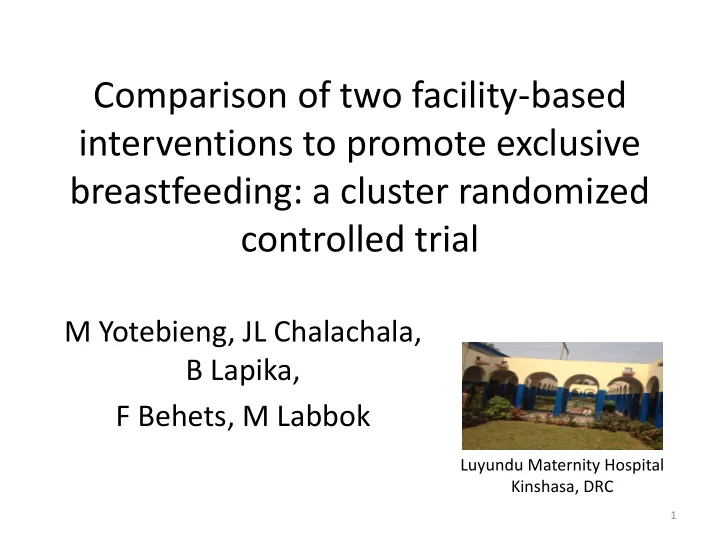
Comparison of two facility-based interventions to promote exclusive breastfeeding: a cluster randomized controlled trial

M Yotebieng, JL Chalachala, B Lapika, F Behets, M Labbok

1

Luyundu Maternity Hospital Kinshasa, DRC
slide-2
SLIDE 2

Introduction

  • In the Democratic Republic of Congo (DRC) rates of exclusive

breastfeeding (EBF) are low

  • UNICEF attempted to implement the Baby-Friendly Hospital

Initiative (BFHI) in DRC to address low EBF rates in early 2000s, but successful implementation was challenging

– Difficult to implement 10th Step (fostering the establishment of breastfeeding support groups and referring mothers to them upon discharge from the hospital or clinic) – Difficult to organize external evaluations required for accreditation

  • Study rationale

– Need to find an easier alternative to implementation of the 10th Step – Need to evaluate BFHI implementation without accreditation

2

slide-3
SLIDE 3

Objectives

  • To examine the effect of implementation of

BFHI Steps 1-9 with or without an alternative to the 10th step on EBF rates

3

A mother and her 1-day old baby at Lukunga Hospital

slide-4
SLIDE 4

Methods: Site, design & eligibility criteria

  • Cluster randomized controlled trial

– Cluster = health facility – Health facilities matched on location, management type, # of deliveries, work load, % of mothers returning for 1 wk postpartum visit before randomization

  • Eligibility criteria

– Single, healthy birth – Delivery in study health facility – Intention to attend well-child clinics at same health facility

4

slide-5
SLIDE 5

Methods: Study Groups

Control BFHI 1-9 BFHI 1-9 +

  • Standard of care: Group counseling on child health including

BF, before vaccination

  • ANC and maternity ward staff trained on

BFHI Steps 1-9 using WHO/UNICEF course

  • Well-child clinic

staff trained on BFHI

  • Provision of BF

flyer

5

Weighing & immunization session at Luyundu Hospital

slide-6
SLIDE 6

Methods: Interventions – BF flyer

6

slide-7
SLIDE 7

Methods: Data collection & analysis

  • Face-to-face interviews
  • Comparison of baseline

characteristics

– Categorical variables: Pearson chi-square test – Non-normally distributed continuous variables: Wilcoxon rank sum test

  • Comparison of EBF rates

– Generalized estimated equations accounting for cluster

7

Interview time points after delivery Interview location/ Health visit 2-3 d Postpartum ward 1 wk Maternity clinic 6 wk Well-child clinic 10 wk Well-child clinic 14 wk Well-child clinic 18 wk Well-child clinic 24 wk Well-child clinic

slide-8
SLIDE 8

Results: Flow diagram

44 health facilities (HFs) screened 19 HFs eligible 6 HFs randomized 2 HFs in control 304 mother-infant pairs enrolled 2 HFs in BFHI Steps 1-9 368 mother-infant pairs enrolled 2 HFs in BFHI Steps 1-9 + 308 mother-infant pairs enrolled

8

slide-9
SLIDE 9

Results: Baseline characteristics*

9

Control (N=310) BFHI 1-9 (N=373) BFHI 1-9 + (N=308) Age (y), median 28 26* 26* Education (y), median 11 9* 10 Primipara (%) 27 21 26 Previous child death (%) 22 21 15* Married/Has live-in boyfriend (%) 88 89 84 Owns house she lives in (%) 48 36* 45 Electricity in house (%) 92 95 95 Piped water source (%) 81 87* 94* Flushable toilet (%) 27 49* 51* Attended ≥ 4 ANC visits (%) 71 47* 42*

* = Significantly different from the control group

slide-10
SLIDE 10

Results: % EBF (24 h recall)

87 68 51 34 14 93 93 90 76 45 98 96 81 47 16

10 20 30 40 50 60 70 80 90 100

2-3 d 1 wk 6 wk 14 wk 24 wk Control BFHI Steps 1-9 BFHI Steps 1-9 +

10

slide-11
SLIDE 11

Results: % EBF (24 h recall)*

34 14 76 45 47 16

10 20 30 40 50 60 70 80 90 100

14 wk 24 wk Control BFHI Steps 1-9 BFHI Steps 1-9 + AOR: 2.1 (1.8, 2.5) AOR: 1.3 (1.1, 1.6) AOR: 3.1 (2.3, 4.3)

*Adjusted for: maternal age & education, previous child death, ownership of residence, type of toilet, and # of antenatal clinics attended

11

AOR: 1.2 (0.7, 1.9)

slide-12
SLIDE 12

Conclusions

  • Provision of WHO/UNICEF BFHI

Steps 1-9 training increased EBF rates at 14 and 24 wk

  • The distribution of flyers

postpartum with messages addressing suboptimal BF practices seemed to lessen the effect of the BFHI training

  • In this context, the distribution of

the study flyers was not an effective alternative to the 10th Step

12

Mother-infant pair at follow-up visit at Kitenda Hospital

slide-13
SLIDE 13

Acknowledgments

  • Participants
  • Research Team
  • Health Facilities: Esengo, Kinkenda,

Kitega, Libikisi, Lukunga, Luyindu

  • Dave Kleckner
  • Kathyrn Salisbury
  • Kengne Villeneuve
  • Ruphine Mboda
  • Technical Advisory Group
  • Kathryn Dewey
  • Edye Kuyper
  • Bineti Vitta
  • Kinshasa School of Public Health,

University of Kinshasa, DRC

  • Centre for the Coordination of Social

Science Research and Documentation in Africa South of the Sahara (CERDAS), DRC

  • Salvation Army, DRC
  • Bureau Diocésain des Œuvres

Médicales de Kinshasa (BDOM) , DRC

  • National Program for Nutrition

(PRONANUT), DRC

13

Funding: the Bill & Melinda Gates Foundation to FHI 360, through the Alive & Thrive Small Grants Program managed by UC Davis