Comparison of ENDF/B-VIII.0 and ENDF/B-VII.1 in Criticality and - - PDF document

comparison of endf b viii 0 and endf b vii 1 in
SMART_READER_LITE
LIVE PREVIEW

Comparison of ENDF/B-VIII.0 and ENDF/B-VII.1 in Criticality and - - PDF document

Transactions of the Korean Nuclear Society Virtual Spring Meeting July 9-10, 2020 Comparison of ENDF/B-VIII.0 and ENDF/B-VII.1 in Criticality and Depletion using PWR Pin Cell by STREAM Kyeongwon Kim a , Sooyoung Choi a , Kiho Kim b , Wonkyeong


slide-1
SLIDE 1

Comparison of ENDF/B-VIII.0 and ENDF/B-VII.1 in Criticality and Depletion using PWR Pin Cell by STREAM

Kyeongwon Kima, Sooyoung Choia, Kiho Kimb, Wonkyeong Kima, Deokjung Leea* Department of Nuclear Engineering, Ulsan National Institute of Science and Technology 50 UNIST-gil, Ulsan 44919, Republic of Korea Korea Institute of Nuclear Safety, 62 Gwahak-ro, Yuseong-gu, Daejeon 34142, Korea

*Corresponding author: deokjung@unist.ac.kr

  • 1. Introduction

This paper presents the criticality and depletion comparison of nuclear data library ENDF/B-VIII.0 and ENDF/B-VII.1 using pressurized light water reactor (PWR) pin cell by STREAM. In this study, several different temperatures of fuel and coolant are used The new version of ENDF/B library, ENDF/B-VIII.0 was released in 2018 [1-2]. ENDF/B is a raw evaluated nuclear data library containing the neutron cross section. Generally, the neutron cross section data is processed by a nuclear data processing code for a neutron transport analysis code. Then, the output of nuclear data processing code is processed again into the data and the format required for the library of a neutron transport analysis code. In this study, NJOY2016 is used to process nuclear data ,and NTOS (NJOY to STREAM) is used to process the output of NJOY into library of STREAM [3]. STREAM has been developing by Computational Reactor Physics and Experiment laboratory (CORE) in Ulsan National Institute Science and Technology (UNIST) [4-5].

  • 2. Methods and Results

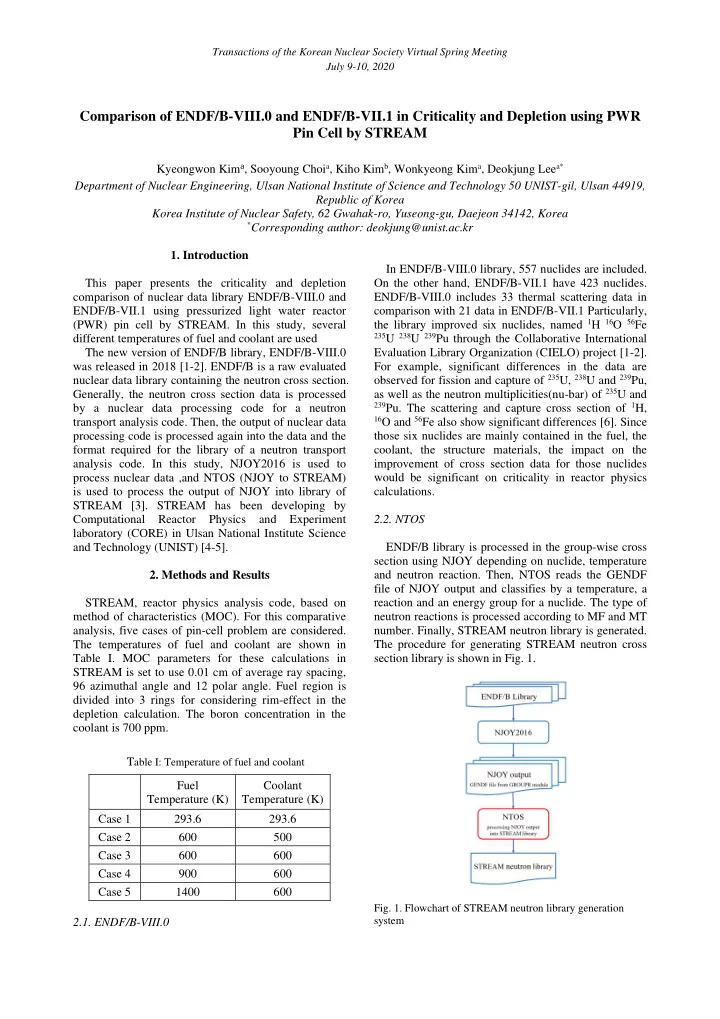
STREAM, reactor physics analysis code, based on method of characteristics (MOC). For this comparative analysis, five cases of pin-cell problem are considered. The temperatures of fuel and coolant are shown in Table I. MOC parameters for these calculations in STREAM is set to use 0.01 cm of average ray spacing, 96 azimuthal angle and 12 polar angle. Fuel region is divided into 3 rings for considering rim-effect in the depletion calculation. The boron concentration in the coolant is 700 ppm. Table I: Temperature of fuel and coolant Fuel Temperature (K) Coolant Temperature (K) Case 1 293.6 293.6 Case 2 600 500 Case 3 600 600 Case 4 900 600 Case 5 1400 600 2.1. ENDF/B-VIII.0 In ENDF/B-VIII.0 library, 557 nuclides are included. On the other hand, ENDF/B-VII.1 have 423 nuclides. ENDF/B-VIII.0 includes 33 thermal scattering data in comparison with 21 data in ENDF/B-VII.1 Particularly, the library improved six nuclides, named 1H 16O 56Fe

235U 238U 239Pu through the Collaborative International

Evaluation Library Organization (CIELO) project [1-2]. For example, significant differences in the data are

  • bserved for fission and capture of 235U, 238U and 239Pu,

as well as the neutron multiplicities(nu-bar) of 235U and

  • 239Pu. The scattering and capture cross section of 1H,

16O and 56Fe also show significant differences [6]. Since

those six nuclides are mainly contained in the fuel, the coolant, the structure materials, the impact on the improvement of cross section data for those nuclides would be significant on criticality in reactor physics calculations. 2.2. NTOS ENDF/B library is processed in the group-wise cross section using NJOY depending on nuclide, temperature and neutron reaction. Then, NTOS reads the GENDF file of NJOY output and classifies by a temperature, a reaction and an energy group for a nuclide. The type of neutron reactions is processed according to MF and MT

  • number. Finally, STREAM neutron library is generated.

The procedure for generating STREAM neutron cross section library is shown in Fig. 1.

  • Fig. 1. Flowchart of STREAM neutron library generation

system Transactions of the Korean Nuclear Society Virtual Spring Meeting July 9-10, 2020

slide-2
SLIDE 2

2.3. PWR Pin cell The typical PWR pin cell is used to compare the effective multiplication factor (keff). The pin cell has 3.1 wt%-enriched uranium oxide fuel and pitch of 1.26 cm. The configuration of pin cell is shown in Fig. 1.

  • Fig. 2. Configuration of PWR pin cell

2.4. Results The keff of pin cell using ENDF/B-VIII.0 and ENDF/B-VII.1 are compared on Case 1 to 5. The results of BOC, MOC and EOC are shown in Table II-

  • VI. The 

and k  are calculated by eq. (1) and (2).

5 8.0 7.1 8.0 7.1

( ) 10 k k k k  −  = 

(1)

5 8.0 7.1

( ) 10 k k k  = − 

(2) Where k8.0 and k7.1 are the keff of pin cell using ENDF/B-VIII.0 and ENDF/B-VII.1 respectively. Table II: keff difference of Case1 problem Burnup

[MWd/kg]

ENDF/B

  • VIII.0

ENDF/B

  • VII.1

△ρ [pcm] △k keff keff BOC 0.0 1.27189 1.27312

  • 76
  • 123

MOC 30.0 0.91509 0.91894

  • 458
  • 385

EOC 60.0 0.73532 0.74013

  • 884
  • 481

Table III: keff difference of Case2 problem Burnup

[MWd/kg]

ENDF/B

  • VIII.0

ENDF/B

  • VII.1

△ρ [pcm] △k keff keff BOC 0.0 1.25464 1.25504

  • 25
  • 40

MOC 30.0 0.93047 0.93346

  • 344
  • 299

EOC 60.0 0.77714 0.78208

  • 813
  • 494

Table IV: keff difference of Case3 problem Burnup

[MWd/kg]

ENDF/B

  • VIII.0

ENDF/B

  • VII.1

△ρ [pcm] △k keff keff BOC 0.0 1.23600 1.23634

  • 22
  • 34

MOC 30.0 0.93325 0.93579

  • 291
  • 254

EOC 60.0 0.80895 0.81341

  • 678
  • 446

Table V: keff difference of Case4 problem Burnup

[MWd/kg]

ENDF/B

  • VIII.0

ENDF/B

  • VII.1

△ρ [pcm] △k keff keff BOC 0.0 1.22335 1.22361

  • 17
  • 26

MOC 30.0 0.92990 0.93237

  • 285
  • 247

EOC 60.0 0.81280 0.81708

  • 644
  • 428

Table VI: keff difference of Case5 problem Burnup

[MWd/kg]

ENDF/B

  • VIII.0

ENDF/B

  • VII.1

△ρ [pcm] △k keff keff BOC 0.0 1.20560 1.20574

  • 10
  • 14

MOC 30.0 0.92476 0.92714

  • 278
  • 238

EOC 60.0 0.81736 0.82140

  • 602
  • 404

All cases, the reactivity difference ( 

) depending

  • n depletion is shown in Fig. 3. At the beginning of the

cycle (BOC), the difference of reactivity within  80 pcm and the maximum value is -76 pcm. In case of the middle of the cycle (MOC), the difference is increased from -76 pcm to -458 pcm and -884 pcm for the end of the cycle (EOC). The burnup 0.0 MWd/kg, 30.0 MWd/kg and 60.0 MWd/kg are considered for BOC, MOC and EOC respectively. At room temperature (293.6K), difference is maximum, however, with increasing the fuel temperature to 1400K and coolant temperature to 600K, difference is decreased from -76 pcm to -10 pcm at

  • BOC. In case of MOC and EOC, it goes from -458 pcm

to -278 pcm and -884 pcm to -602 pcm respectively. Similar trends of difference are founded in keff difference and it shown in Fig. 4.

  • Fig. 3. Difference of △ρ using ENDF/B-VIII.0 and ENDF/B-

VII.1 for Case 1-5 Transactions of the Korean Nuclear Society Virtual Spring Meeting July 9-10, 2020

slide-3
SLIDE 3
  • Fig. 4. Difference of △keff using ENDF/B-VIII.0 and

ENDF/B-VII.1 for Case 1-5

  • 3. Conclusions

This paper analyzes the difference of keff for PWR pin cell using ENDF/B-VIII.0 and ENDF/B-VII.1 by

  • STREAM. The difference of 

and k  increase as depletion and decrease with increasing temperature. But in this analysis, only the cross section and point wise library is generated using ENDF/B-VIII.0. The depletion, decay and yield library used in this study is made using ENDF/B-VII.1. Future work will be generation of depletion, decay and yield library using ENDF/B-VIII.0 and comparison

  • f the reaction rates with nuclide, reaction and
  • temperature. Furthermore, it will be analyzed which

nuclides made the difference in keff. Acknowledgement This work was supported by the National Research Foundation of Korea (NRF) grant funded by the Korea government (MSIT). (No. NRF- 2019M2D2A1A03058371). REFERENCES

[1] D. A. Brown, et al., ENDF/B-VIII0: The 8th Major Release

  • f the Nuclear Reaction Data Library with CIELO-project

Cross Section, New Standards and Thermal Scattering Data, Nuclear Data Sheets, Vol. 148, pp. 1-142, 2018 [2] M.B. Chadwick, et al., CIELO Collaboration Summary Results: International Evaluations of Neutron Reactions on Uranium, Plutonium, Iron, Oxygen and Hydrogen, Nuclear Data sheets, Vol. 148, pp. 189-213, 2018 [3] Kiho Kim, Neutron XS Library Generation of ENDF/B- VIII.0 for MOC code STREAM and Monte Carlo code MCS, Master’s Thesis [4] Sooyoung Choi, et. al., Recent Development Status of Neutron Transport Code STREAM, Korean Nuclear Society, May 23-24, 2019, Jeju, Korea [5] Jiwon Choe, et al., Verification and validation of STREAM/RAST-K for PWR analysis, Nuclear Engineering and Technology, Vol. 51, pp. 356-368, 2019 [6] Friederike Bostelmann, et al., Impact of the ENDF/B- VIII.0 Library

  • n

Advanced Reactor Simulations, Transactions of the American Nuclear Society, Vol. 121, November 17-21, 2019, Washington, D. C., USA Transactions of the Korean Nuclear Society Virtual Spring Meeting July 9-10, 2020