SLIDE 1 1
Comparing proofs of security for lattice-based encryption Daniel J. Bernstein Primary objective of this paper: Make a complete plan for thorough security reviews
Much harder: Do the reviews! Complete plan is framework to evaluate which pieces are done, and to coordinate further efforts. KEMs vary in what’s needed.
2
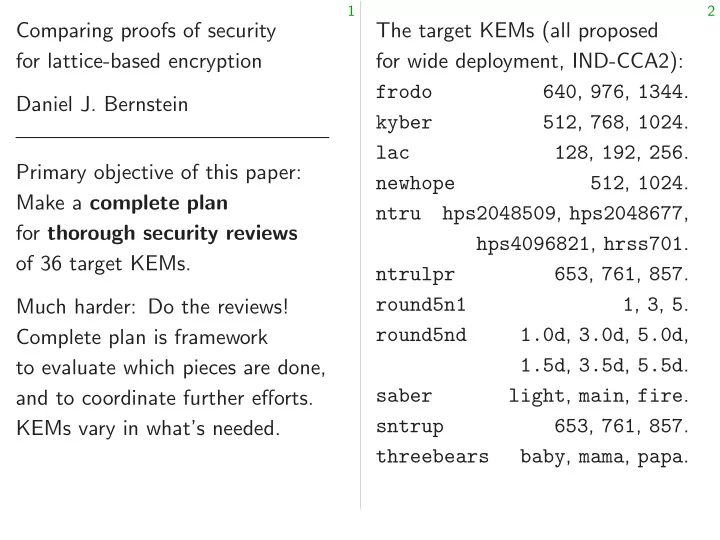
The target KEMs (all proposed for wide deployment, IND-CCA2): frodo 640, 976, 1344. kyber 512, 768, 1024. lac 128, 192, 256. newhope 512, 1024. ntru hps2048509, hps2048677, hps4096821, hrss701. ntrulpr 653, 761, 857. round5n1 1, 3, 5. round5nd 1.0d, 3.0d, 5.0d, 1.5d, 3.5d, 5.5d. saber light, main, fire. sntrup 653, 761, 857. threebears baby, mama, papa.
SLIDE 2 1
Comparing proofs of security lattice-based encryption
ry objective of this paper: a complete plan thorough security reviews target KEMs. harder: Do the reviews! Complete plan is framework evaluate which pieces are done, coordinate further efforts. vary in what’s needed.
2
The target KEMs (all proposed for wide deployment, IND-CCA2): frodo 640, 976, 1344. kyber 512, 768, 1024. lac 128, 192, 256. newhope 512, 1024. ntru hps2048509, hps2048677, hps4096821, hrss701. ntrulpr 653, 761, 857. round5n1 1, 3, 5. round5nd 1.0d, 3.0d, 5.0d, 1.5d, 3.5d, 5.5d. saber light, main, fire. sntrup 653, 761, 857. threebears baby, mama, papa. One catego frodo kyber lac newhope ntru ntrulpr round5n1 round5nd saber sntrup threebears
SLIDE 3 1
encryption Bernstein tive of this paper: complete plan security reviews KEMs. Do the reviews! is framework which pieces are done, te further efforts. what’s needed.
2
The target KEMs (all proposed for wide deployment, IND-CCA2): frodo 640, 976, 1344. kyber 512, 768, 1024. lac 128, 192, 256. newhope 512, 1024. ntru hps2048509, hps2048677, hps4096821, hrss701. ntrulpr 653, 761, 857. round5n1 1, 3, 5. round5nd 1.0d, 3.0d, 5.0d, 1.5d, 3.5d, 5.5d. saber light, main, fire. sntrup 653, 761, 857. threebears baby, mama, papa. One categorization frodo kyber lac newhope ntru Quotient ntrulpr round5n1 round5nd saber sntrup Quotient threebears
SLIDE 4
1
security encryption paper: reviews reviews! rk re done, efforts. ded.
2
The target KEMs (all proposed for wide deployment, IND-CCA2): frodo 640, 976, 1344. kyber 512, 768, 1024. lac 128, 192, 256. newhope 512, 1024. ntru hps2048509, hps2048677, hps4096821, hrss701. ntrulpr 653, 761, 857. round5n1 1, 3, 5. round5nd 1.0d, 3.0d, 5.0d, 1.5d, 3.5d, 5.5d. saber light, main, fire. sntrup 653, 761, 857. threebears baby, mama, papa. One categorization of the KEMs: frodo Product NTRU. kyber Product NTRU. lac Product NTRU. newhope Product NTRU. ntru Quotient NTRU. ntrulpr Product NTRU. round5n1 Product NTRU. round5nd Product NTRU. saber Product NTRU. sntrup Quotient NTRU. threebears Product NTRU.
SLIDE 5
2
The target KEMs (all proposed for wide deployment, IND-CCA2): frodo 640, 976, 1344. kyber 512, 768, 1024. lac 128, 192, 256. newhope 512, 1024. ntru hps2048509, hps2048677, hps4096821, hrss701. ntrulpr 653, 761, 857. round5n1 1, 3, 5. round5nd 1.0d, 3.0d, 5.0d, 1.5d, 3.5d, 5.5d. saber light, main, fire. sntrup 653, 761, 857. threebears baby, mama, papa.
3
One categorization of the KEMs: frodo Product NTRU. kyber Product NTRU. lac Product NTRU. newhope Product NTRU. ntru Quotient NTRU. ntrulpr Product NTRU. round5n1 Product NTRU. round5nd Product NTRU. saber Product NTRU. sntrup Quotient NTRU. threebears Product NTRU.
SLIDE 6
2
rget KEMs (all proposed e deployment, IND-CCA2): 640, 976, 1344. 512, 768, 1024. 128, 192, 256. newhope 512, 1024. hps2048509, hps2048677, hps4096821, hrss701. ntrulpr 653, 761, 857. round5n1 1, 3, 5. round5nd 1.0d, 3.0d, 5.0d, 1.5d, 3.5d, 5.5d. light, main, fire. 653, 761, 857. threebears baby, mama, papa.
3
One categorization of the KEMs: frodo Product NTRU. kyber Product NTRU. lac Product NTRU. newhope Product NTRU. ntru Quotient NTRU. ntrulpr Product NTRU. round5n1 Product NTRU. round5nd Product NTRU. saber Product NTRU. sntrup Quotient NTRU. threebears Product NTRU. An oversimplified Plan: Verify make sure
SLIDE 7
2
KEMs (all proposed yment, IND-CCA2): 640, 976, 1344. 512, 768, 1024. 128, 192, 256. 512, 1024. hps2048509, hps2048677, hps4096821, hrss701. 653, 761, 857. 1, 3, 5. 1.0d, 3.0d, 5.0d, 1.5d, 3.5d, 5.5d. light, main, fire. 653, 761, 857. baby, mama, papa.
3
One categorization of the KEMs: frodo Product NTRU. kyber Product NTRU. lac Product NTRU. newhope Product NTRU. ntru Quotient NTRU. ntrulpr Product NTRU. round5n1 Product NTRU. round5nd Product NTRU. saber Product NTRU. sntrup Quotient NTRU. threebears Product NTRU. An oversimplified plan Plan: Verify the securit make sure there are
SLIDE 8 2
IND-CCA2): , 1344. , 1024. 192, 256. , 1024. hps2048677, hrss701. 761, 857. 1, 3, 5. , 5.0d, , 5.5d. , fire. 761, 857. , papa.
3
One categorization of the KEMs: frodo Product NTRU. kyber Product NTRU. lac Product NTRU. newhope Product NTRU. ntru Quotient NTRU. ntrulpr Product NTRU. round5n1 Product NTRU. round5nd Product NTRU. saber Product NTRU. sntrup Quotient NTRU. threebears Product NTRU. An oversimplified plan Plan: Verify the security pro make sure there are no mistak
SLIDE 9
3
One categorization of the KEMs: frodo Product NTRU. kyber Product NTRU. lac Product NTRU. newhope Product NTRU. ntru Quotient NTRU. ntrulpr Product NTRU. round5n1 Product NTRU. round5nd Product NTRU. saber Product NTRU. sntrup Quotient NTRU. threebears Product NTRU.
4
An oversimplified plan Plan: Verify the security proofs— make sure there are no mistakes.
SLIDE 10
3
One categorization of the KEMs: frodo Product NTRU. kyber Product NTRU. lac Product NTRU. newhope Product NTRU. ntru Quotient NTRU. ntrulpr Product NTRU. round5n1 Product NTRU. round5nd Product NTRU. saber Product NTRU. sntrup Quotient NTRU. threebears Product NTRU.
4
An oversimplified plan Plan: Verify the security proofs— make sure there are no mistakes. Why verification is important: e.g., Asiacrypt 2004 Rogaway “OCB2” was standardized in 2009, completely broken in 2018. The attack exploited proof error.
SLIDE 11
3
One categorization of the KEMs: frodo Product NTRU. kyber Product NTRU. lac Product NTRU. newhope Product NTRU. ntru Quotient NTRU. ntrulpr Product NTRU. round5n1 Product NTRU. round5nd Product NTRU. saber Product NTRU. sntrup Quotient NTRU. threebears Product NTRU.
4
An oversimplified plan Plan: Verify the security proofs— make sure there are no mistakes. Why verification is important: e.g., Asiacrypt 2004 Rogaway “OCB2” was standardized in 2009, completely broken in 2018. The attack exploited proof error. I did some sanity checks (tiny part of full verification!) and found unproven theorems claimed by frodo, round5n1, round5nd, saber; also wrong hypotheses for newhope theorem.
SLIDE 12
3
categorization of the KEMs: Product NTRU. Product NTRU. Product NTRU. newhope Product NTRU. Quotient NTRU. ntrulpr Product NTRU. round5n1 Product NTRU. round5nd Product NTRU. Product NTRU. Quotient NTRU. threebears Product NTRU.
4
An oversimplified plan Plan: Verify the security proofs— make sure there are no mistakes. Why verification is important: e.g., Asiacrypt 2004 Rogaway “OCB2” was standardized in 2009, completely broken in 2018. The attack exploited proof error. I did some sanity checks (tiny part of full verification!) and found unproven theorems claimed by frodo, round5n1, round5nd, saber; also wrong hypotheses for newhope theorem. Strategy explain all to a thoroughly that completely
SLIDE 13
3
rization of the KEMs: Product NTRU. Product NTRU. Product NTRU. Product NTRU. Quotient NTRU. Product NTRU. Product NTRU. Product NTRU. Product NTRU. Quotient NTRU. Product NTRU.
4
An oversimplified plan Plan: Verify the security proofs— make sure there are no mistakes. Why verification is important: e.g., Asiacrypt 2004 Rogaway “OCB2” was standardized in 2009, completely broken in 2018. The attack exploited proof error. I did some sanity checks (tiny part of full verification!) and found unproven theorems claimed by frodo, round5n1, round5nd, saber; also wrong hypotheses for newhope theorem. Strategy to eliminate explain all of the ta to a thoroughly audited that completely verifies
SLIDE 14
3
KEMs: duct NTRU. duct NTRU. duct NTRU. duct NTRU. Quotient NTRU. duct NTRU. duct NTRU. duct NTRU. duct NTRU. Quotient NTRU. duct NTRU.
4
An oversimplified plan Plan: Verify the security proofs— make sure there are no mistakes. Why verification is important: e.g., Asiacrypt 2004 Rogaway “OCB2” was standardized in 2009, completely broken in 2018. The attack exploited proof error. I did some sanity checks (tiny part of full verification!) and found unproven theorems claimed by frodo, round5n1, round5nd, saber; also wrong hypotheses for newhope theorem. Strategy to eliminate proof erro explain all of the target proofs to a thoroughly audited program that completely verifies proofs.
SLIDE 15
4
An oversimplified plan Plan: Verify the security proofs— make sure there are no mistakes. Why verification is important: e.g., Asiacrypt 2004 Rogaway “OCB2” was standardized in 2009, completely broken in 2018. The attack exploited proof error. I did some sanity checks (tiny part of full verification!) and found unproven theorems claimed by frodo, round5n1, round5nd, saber; also wrong hypotheses for newhope theorem.
5
Strategy to eliminate proof errors: explain all of the target proofs to a thoroughly audited program that completely verifies proofs.
SLIDE 16 4
An oversimplified plan Plan: Verify the security proofs— make sure there are no mistakes. Why verification is important: e.g., Asiacrypt 2004 Rogaway “OCB2” was standardized in 2009, completely broken in 2018. The attack exploited proof error. I did some sanity checks (tiny part of full verification!) and found unproven theorems claimed by frodo, round5n1, round5nd, saber; also wrong hypotheses for newhope theorem.
5
Strategy to eliminate proof errors: explain all of the target proofs to a thoroughly audited program that completely verifies proofs. My assessment of this strategy:
- Status today: ≈0% completed.
SLIDE 17 4
An oversimplified plan Plan: Verify the security proofs— make sure there are no mistakes. Why verification is important: e.g., Asiacrypt 2004 Rogaway “OCB2” was standardized in 2009, completely broken in 2018. The attack exploited proof error. I did some sanity checks (tiny part of full verification!) and found unproven theorems claimed by frodo, round5n1, round5nd, saber; also wrong hypotheses for newhope theorem.
5
Strategy to eliminate proof errors: explain all of the target proofs to a thoroughly audited program that completely verifies proofs. My assessment of this strategy:
- Status today: ≈0% completed.
- Progress is painful and slow.
Will we even reach 1% before post-quantum standardization?
SLIDE 18 4
An oversimplified plan Plan: Verify the security proofs— make sure there are no mistakes. Why verification is important: e.g., Asiacrypt 2004 Rogaway “OCB2” was standardized in 2009, completely broken in 2018. The attack exploited proof error. I did some sanity checks (tiny part of full verification!) and found unproven theorems claimed by frodo, round5n1, round5nd, saber; also wrong hypotheses for newhope theorem.
5
Strategy to eliminate proof errors: explain all of the target proofs to a thoroughly audited program that completely verifies proofs. My assessment of this strategy:
- Status today: ≈0% completed.
- Progress is painful and slow.
Will we even reach 1% before post-quantum standardization?
- Easier-to-use proof tools
could make strategy work.
SLIDE 19 4
An oversimplified plan Plan: Verify the security proofs— make sure there are no mistakes. Why verification is important: e.g., Asiacrypt 2004 Rogaway “OCB2” was standardized in 2009, completely broken in 2018. The attack exploited proof error. I did some sanity checks (tiny part of full verification!) and found unproven theorems claimed by frodo, round5n1, round5nd, saber; also wrong hypotheses for newhope theorem.
5
Strategy to eliminate proof errors: explain all of the target proofs to a thoroughly audited program that completely verifies proofs. My assessment of this strategy:
- Status today: ≈0% completed.
- Progress is painful and slow.
Will we even reach 1% before post-quantum standardization?
- Easier-to-use proof tools
could make strategy work. Backup strategies: Clean up
- proofs. Check proofs by hand.
Track bug categories, as in code.
SLIDE 20 4
Verify the security proofs— sure there are no mistakes. verification is important: Asiacrypt 2004 Rogaway “OCB2” was standardized in completely broken in 2018. attack exploited proof error. some sanity checks part of full verification!) found unproven theorems claimed by frodo, round5n1, round5nd, saber; also wrong
- theses for newhope theorem.
5
Strategy to eliminate proof errors: explain all of the target proofs to a thoroughly audited program that completely verifies proofs. My assessment of this strategy:
- Status today: ≈0% completed.
- Progress is painful and slow.
Will we even reach 1% before post-quantum standardization?
- Easier-to-use proof tools
could make strategy work. Backup strategies: Clean up
- proofs. Check proofs by hand.
Track bug categories, as in code. Why call What “securit is not actually
SLIDE 21 4
security proofs— are no mistakes. is important: 2004 Rogaway standardized in completely broken in 2018. exploited proof error. y checks full verification!) roven theorems , round5n1, ; also wrong newhope theorem.
5
Strategy to eliminate proof errors: explain all of the target proofs to a thoroughly audited program that completely verifies proofs. My assessment of this strategy:
- Status today: ≈0% completed.
- Progress is painful and slow.
Will we even reach 1% before post-quantum standardization?
- Easier-to-use proof tools
could make strategy work. Backup strategies: Clean up
- proofs. Check proofs by hand.
Track bug categories, as in code. Why call this “oversimplified”? What “security pro is not actually securit
SLIDE 22 4
roofs— mistakes. rtant: way in 2018.
verification!) rems round5n1, wrong theorem.
5
Strategy to eliminate proof errors: explain all of the target proofs to a thoroughly audited program that completely verifies proofs. My assessment of this strategy:
- Status today: ≈0% completed.
- Progress is painful and slow.
Will we even reach 1% before post-quantum standardization?
- Easier-to-use proof tools
could make strategy work. Backup strategies: Clean up
- proofs. Check proofs by hand.
Track bug categories, as in code. Why call this “oversimplified”? What “security proofs” prove is not actually security.
SLIDE 23 5
Strategy to eliminate proof errors: explain all of the target proofs to a thoroughly audited program that completely verifies proofs. My assessment of this strategy:
- Status today: ≈0% completed.
- Progress is painful and slow.
Will we even reach 1% before post-quantum standardization?
- Easier-to-use proof tools
could make strategy work. Backup strategies: Clean up
- proofs. Check proofs by hand.
Track bug categories, as in code.
6
Why call this “oversimplified”? What “security proofs” prove is not actually security.
SLIDE 24 5
Strategy to eliminate proof errors: explain all of the target proofs to a thoroughly audited program that completely verifies proofs. My assessment of this strategy:
- Status today: ≈0% completed.
- Progress is painful and slow.
Will we even reach 1% before post-quantum standardization?
- Easier-to-use proof tools
could make strategy work. Backup strategies: Clean up
- proofs. Check proofs by hand.
Track bug categories, as in code.
6
Why call this “oversimplified”? What “security proofs” prove is not actually security. Even with correct proofs, there are still risks of attacks. We all rely on cryptanalysis for analyzing remaining risks.
SLIDE 25 5
Strategy to eliminate proof errors: explain all of the target proofs to a thoroughly audited program that completely verifies proofs. My assessment of this strategy:
- Status today: ≈0% completed.
- Progress is painful and slow.
Will we even reach 1% before post-quantum standardization?
- Easier-to-use proof tools
could make strategy work. Backup strategies: Clean up
- proofs. Check proofs by hand.
Track bug categories, as in code.
6
Why call this “oversimplified”? What “security proofs” prove is not actually security. Even with correct proofs, there are still risks of attacks. We all rely on cryptanalysis for analyzing remaining risks. Revised plan:
- 1. Verify the “security proofs”.
- 2. Verify the cryptanalysis
- f the risks left by the proofs.
Again clean up; check by hand; track failure categories.
SLIDE 26 5
Strategy to eliminate proof errors: all of the target proofs thoroughly audited program completely verifies proofs. assessment of this strategy: Status today: ≈0% completed. Progress is painful and slow. we even reach 1% before
- st-quantum standardization?
Easier-to-use proof tools could make strategy work. Backup strategies: Clean up
- fs. Check proofs by hand.
bug categories, as in code.
6
Why call this “oversimplified”? What “security proofs” prove is not actually security. Even with correct proofs, there are still risks of attacks. We all rely on cryptanalysis for analyzing remaining risks. Revised plan:
- 1. Verify the “security proofs”.
- 2. Verify the cryptanalysis
- f the risks left by the proofs.
Again clean up; check by hand; track failure categories. Are attack-cost How tho
How tho claimed that work Do the cryptanalytic match the Long histo NSA overstated L(1=2) optimalit for facto TLS Triple-DES-CBC without
SLIDE 27 5
eliminate proof errors: target proofs audited program verifies proofs.
≈0% completed. painful and slow. reach 1% before standardization? roof tools strategy work. strategies: Clean up roofs by hand. categories, as in code.
6
Why call this “oversimplified”? What “security proofs” prove is not actually security. Even with correct proofs, there are still risks of attacks. We all rely on cryptanalysis for analyzing remaining risks. Revised plan:
- 1. Verify the “security proofs”.
- 2. Verify the cryptanalysis
- f the risks left by the proofs.
Again clean up; check by hand; track failure categories. Are attack-cost analyses How thorough is explo
- f space of optimizations?
How thorough is the claimed barriers to that work for simila Do the cryptanalytic match the proof risks? Long history of failures: NSA overstated DES L(1=2) optimality for factorization was TLS Triple-DES-CBC without Triple-DES
SLIDE 28 5
roofs rogram roofs. strategy: completed. slow. efore rdization? rk. up hand. code.
6
Why call this “oversimplified”? What “security proofs” prove is not actually security. Even with correct proofs, there are still risks of attacks. We all rely on cryptanalysis for analyzing remaining risks. Revised plan:
- 1. Verify the “security proofs”.
- 2. Verify the cryptanalysis
- f the risks left by the proofs.
Again clean up; check by hand; track failure categories. Are attack-cost analyses correct? How thorough is exploration
- f space of optimizations?
How thorough is the study of claimed barriers to speedups that work for similar problems? Do the cryptanalytic targets match the proof risks? etc. Long history of failures: e.g., NSA overstated DES attack L(1=2) optimality conjecture for factorization was wrong; TLS Triple-DES-CBC was brok without Triple-DES attack; etc.
SLIDE 29 6
Why call this “oversimplified”? What “security proofs” prove is not actually security. Even with correct proofs, there are still risks of attacks. We all rely on cryptanalysis for analyzing remaining risks. Revised plan:
- 1. Verify the “security proofs”.
- 2. Verify the cryptanalysis
- f the risks left by the proofs.
Again clean up; check by hand; track failure categories.
7
Are attack-cost analyses correct? How thorough is exploration
- f space of optimizations?
How thorough is the study of claimed barriers to speedups that work for similar problems? Do the cryptanalytic targets match the proof risks? etc. Long history of failures: e.g., NSA overstated DES attack cost; L(1=2) optimality conjecture for factorization was wrong; TLS Triple-DES-CBC was broken without Triple-DES attack; etc.
SLIDE 30 6
call this “oversimplified”? “security proofs” prove actually security. with correct proofs, are still risks of attacks. rely on cryptanalysis analyzing remaining risks. Revised plan: erify the “security proofs”. erify the cryptanalysis risks left by the proofs. clean up; check by hand; failure categories.
7
Are attack-cost analyses correct? How thorough is exploration
- f space of optimizations?
How thorough is the study of claimed barriers to speedups that work for similar problems? Do the cryptanalytic targets match the proof risks? etc. Long history of failures: e.g., NSA overstated DES attack cost; L(1=2) optimality conjecture for factorization was wrong; TLS Triple-DES-CBC was broken without Triple-DES attack; etc. Why bother Plan without Verify crypta
SLIDE 31 6
“oversimplified”? proofs” prove security. rrect proofs, risks of attacks. cryptanalysis remaining risks. “security proofs”. cryptanalysis by the proofs. check by hand; categories.
7
Are attack-cost analyses correct? How thorough is exploration
- f space of optimizations?
How thorough is the study of claimed barriers to speedups that work for similar problems? Do the cryptanalytic targets match the proof risks? etc. Long history of failures: e.g., NSA overstated DES attack cost; L(1=2) optimality conjecture for factorization was wrong; TLS Triple-DES-CBC was broken without Triple-DES attack; etc. Why bother with p Plan without proofs Verify cryptanalysis
SLIDE 32 6
“oversimplified”? rove attacks. cryptanalysis risks.
hand;
7
Are attack-cost analyses correct? How thorough is exploration
- f space of optimizations?
How thorough is the study of claimed barriers to speedups that work for similar problems? Do the cryptanalytic targets match the proof risks? etc. Long history of failures: e.g., NSA overstated DES attack cost; L(1=2) optimality conjecture for factorization was wrong; TLS Triple-DES-CBC was broken without Triple-DES attack; etc. Why bother with proofs? Plan without proofs is simpler: Verify cryptanalysis of the KEMs.
SLIDE 33 7
Are attack-cost analyses correct? How thorough is exploration
- f space of optimizations?
How thorough is the study of claimed barriers to speedups that work for similar problems? Do the cryptanalytic targets match the proof risks? etc. Long history of failures: e.g., NSA overstated DES attack cost; L(1=2) optimality conjecture for factorization was wrong; TLS Triple-DES-CBC was broken without Triple-DES attack; etc.
8
Why bother with proofs? Plan without proofs is simpler: Verify cryptanalysis of the KEMs.
SLIDE 34 7
Are attack-cost analyses correct? How thorough is exploration
- f space of optimizations?
How thorough is the study of claimed barriers to speedups that work for similar problems? Do the cryptanalytic targets match the proof risks? etc. Long history of failures: e.g., NSA overstated DES attack cost; L(1=2) optimality conjecture for factorization was wrong; TLS Triple-DES-CBC was broken without Triple-DES attack; etc.
8
Why bother with proofs? Plan without proofs is simpler: Verify cryptanalysis of the KEMs. But sometimes the proofs reduce cost of cryptanalysis.
SLIDE 35 7
Are attack-cost analyses correct? How thorough is exploration
- f space of optimizations?
How thorough is the study of claimed barriers to speedups that work for similar problems? Do the cryptanalytic targets match the proof risks? etc. Long history of failures: e.g., NSA overstated DES attack cost; L(1=2) optimality conjecture for factorization was wrong; TLS Triple-DES-CBC was broken without Triple-DES attack; etc.
8
Why bother with proofs? Plan without proofs is simpler: Verify cryptanalysis of the KEMs. But sometimes the proofs reduce cost of cryptanalysis. Sometimes this outweighs cost to verify proofs: reduces cost of thorough security review. Hopefully less chance of disaster.
SLIDE 36 7
Are attack-cost analyses correct? How thorough is exploration
- f space of optimizations?
How thorough is the study of claimed barriers to speedups that work for similar problems? Do the cryptanalytic targets match the proof risks? etc. Long history of failures: e.g., NSA overstated DES attack cost; L(1=2) optimality conjecture for factorization was wrong; TLS Triple-DES-CBC was broken without Triple-DES attack; etc.
8
Why bother with proofs? Plan without proofs is simpler: Verify cryptanalysis of the KEMs. But sometimes the proofs reduce cost of cryptanalysis. Sometimes this outweighs cost to verify proofs: reduces cost of thorough security review. Hopefully less chance of disaster. This paper’s verification plan skips proofs that clearly fail to reduce cost of cryptanalysis: e.g., frodo seed “reduction”.
SLIDE 37 7
attack-cost analyses correct? thorough is exploration space of optimizations? thorough is the study of claimed barriers to speedups
the cryptanalytic targets the proof risks? etc. history of failures: e.g.,
- verstated DES attack cost;
2) optimality conjecture factorization was wrong; riple-DES-CBC was broken without Triple-DES attack; etc.
8
Why bother with proofs? Plan without proofs is simpler: Verify cryptanalysis of the KEMs. But sometimes the proofs reduce cost of cryptanalysis. Sometimes this outweighs cost to verify proofs: reduces cost of thorough security review. Hopefully less chance of disaster. This paper’s verification plan skips proofs that clearly fail to reduce cost of cryptanalysis: e.g., frodo seed “reduction”. Risks not A “securit security against all assuming for underlying
SLIDE 38 7
analyses correct? exploration
the study of to speedups imilar problems? cryptanalytic targets risks? etc. failures: e.g., DES attack cost;
was wrong; riple-DES-CBC was broken riple-DES attack; etc.
8
Why bother with proofs? Plan without proofs is simpler: Verify cryptanalysis of the KEMs. But sometimes the proofs reduce cost of cryptanalysis. Sometimes this outweighs cost to verify proofs: reduces cost of thorough security review. Hopefully less chance of disaster. This paper’s verification plan skips proofs that clearly fail to reduce cost of cryptanalysis: e.g., frodo seed “reduction”. Risks not ruled out A “security proof” security level – for against all attacks assuming security for underlying problem
SLIDE 39 7
correct? ration
eedups roblems? rgets etc. e.g., attack cost; conjecture wrong; broken attack; etc.
8
Why bother with proofs? Plan without proofs is simpler: Verify cryptanalysis of the KEMs. But sometimes the proofs reduce cost of cryptanalysis. Sometimes this outweighs cost to verify proofs: reduces cost of thorough security review. Hopefully less chance of disaster. This paper’s verification plan skips proofs that clearly fail to reduce cost of cryptanalysis: e.g., frodo seed “reduction”. Risks not ruled out by proofs A “security proof” guarantees security level – for system X against all attacks of type T assuming security level –′ for underlying problem P.
SLIDE 40
8
Why bother with proofs? Plan without proofs is simpler: Verify cryptanalysis of the KEMs. But sometimes the proofs reduce cost of cryptanalysis. Sometimes this outweighs cost to verify proofs: reduces cost of thorough security review. Hopefully less chance of disaster. This paper’s verification plan skips proofs that clearly fail to reduce cost of cryptanalysis: e.g., frodo seed “reduction”.
9
Risks not ruled out by proofs A “security proof” guarantees security level – for system X against all attacks of type T assuming security level –′ for underlying problem P.
SLIDE 41
8
Why bother with proofs? Plan without proofs is simpler: Verify cryptanalysis of the KEMs. But sometimes the proofs reduce cost of cryptanalysis. Sometimes this outweighs cost to verify proofs: reduces cost of thorough security review. Hopefully less chance of disaster. This paper’s verification plan skips proofs that clearly fail to reduce cost of cryptanalysis: e.g., frodo seed “reduction”.
9
Risks not ruled out by proofs A “security proof” guarantees security level – for system X against all attacks of type T assuming security level –′ for underlying problem P. Risk #1: P does not reach security level –′.
SLIDE 42
8
Why bother with proofs? Plan without proofs is simpler: Verify cryptanalysis of the KEMs. But sometimes the proofs reduce cost of cryptanalysis. Sometimes this outweighs cost to verify proofs: reduces cost of thorough security review. Hopefully less chance of disaster. This paper’s verification plan skips proofs that clearly fail to reduce cost of cryptanalysis: e.g., frodo seed “reduction”.
9
Risks not ruled out by proofs A “security proof” guarantees security level – for system X against all attacks of type T assuming security level –′ for underlying problem P. Risk #1: P does not reach security level –′. Risk #2 (looseness): – is below claimed security level of X.
SLIDE 43
8
Why bother with proofs? Plan without proofs is simpler: Verify cryptanalysis of the KEMs. But sometimes the proofs reduce cost of cryptanalysis. Sometimes this outweighs cost to verify proofs: reduces cost of thorough security review. Hopefully less chance of disaster. This paper’s verification plan skips proofs that clearly fail to reduce cost of cryptanalysis: e.g., frodo seed “reduction”.
9
Risks not ruled out by proofs A “security proof” guarantees security level – for system X against all attacks of type T assuming security level –′ for underlying problem P. Risk #1: P does not reach security level –′. Risk #2 (looseness): – is below claimed security level of X. Risk #3: There are faster attacks outside type T.
SLIDE 44
8
Why bother with proofs? Plan without proofs is simpler: Verify cryptanalysis of the KEMs. But sometimes the proofs reduce cost of cryptanalysis. Sometimes this outweighs cost to verify proofs: reduces cost of thorough security review. Hopefully less chance of disaster. This paper’s verification plan skips proofs that clearly fail to reduce cost of cryptanalysis: e.g., frodo seed “reduction”.
9
Risks not ruled out by proofs A “security proof” guarantees security level – for system X against all attacks of type T assuming security level –′ for underlying problem P. Risk #1: P does not reach security level –′. Risk #2 (looseness): – is below claimed security level of X. Risk #3: There are faster attacks outside type T. Risk #4: Proof is incorrect.
SLIDE 45 8
without proofs is simpler: cryptanalysis of the KEMs. sometimes the proofs cost of cryptanalysis. Sometimes this outweighs verify proofs: reduces
- f thorough security review.
efully less chance of disaster. paper’s verification plan roofs that clearly fail reduce cost of cryptanalysis: frodo seed “reduction”.
9
Risks not ruled out by proofs A “security proof” guarantees security level – for system X against all attacks of type T assuming security level –′ for underlying problem P. Risk #1: P does not reach security level –′. Risk #2 (looseness): – is below claimed security level of X. Risk #3: There are faster attacks outside type T. Risk #4: Proof is incorrect. Targets fo Attack O security
SLIDE 46 8
with proofs?
nalysis of the KEMs. the proofs cryptanalysis.
roofs: reduces security review. hance of disaster. verification plan that clearly fail
“reduction”.
9
Risks not ruled out by proofs A “security proof” guarantees security level – for system X against all attacks of type T assuming security level –′ for underlying problem P. Risk #1: P does not reach security level –′. Risk #2 (looseness): – is below claimed security level of X. Risk #3: There are faster attacks outside type T. Risk #4: Proof is incorrect. Targets for lattice Attack OW-Passive security of the 36 co
SLIDE 47
8
simpler: KEMs. cryptanalysis. reduces review. disaster. plan fail cryptanalysis: “reduction”.
9
Risks not ruled out by proofs A “security proof” guarantees security level – for system X against all attacks of type T assuming security level –′ for underlying problem P. Risk #1: P does not reach security level –′. Risk #2 (looseness): – is below claimed security level of X. Risk #3: There are faster attacks outside type T. Risk #4: Proof is incorrect. Targets for lattice cryptanalysis Attack OW-Passive (“OW-CP security of the 36 core PKEs.
SLIDE 48
9
Risks not ruled out by proofs A “security proof” guarantees security level – for system X against all attacks of type T assuming security level –′ for underlying problem P. Risk #1: P does not reach security level –′. Risk #2 (looseness): – is below claimed security level of X. Risk #3: There are faster attacks outside type T. Risk #4: Proof is incorrect.
10
Targets for lattice cryptanalysis Attack OW-Passive (“OW-CPA”) security of the 36 core PKEs.
SLIDE 49
9
Risks not ruled out by proofs A “security proof” guarantees security level – for system X against all attacks of type T assuming security level –′ for underlying problem P. Risk #1: P does not reach security level –′. Risk #2 (looseness): – is below claimed security level of X. Risk #3: There are faster attacks outside type T. Risk #4: Proof is incorrect.
10
Targets for lattice cryptanalysis Attack OW-Passive (“OW-CPA”) security of the 36 core PKEs. For some targets: Attack IND-CPA security of core PKEs.
SLIDE 50
9
Risks not ruled out by proofs A “security proof” guarantees security level – for system X against all attacks of type T assuming security level –′ for underlying problem P. Risk #1: P does not reach security level –′. Risk #2 (looseness): – is below claimed security level of X. Risk #3: There are faster attacks outside type T. Risk #4: Proof is incorrect.
10
Targets for lattice cryptanalysis Attack OW-Passive (“OW-CPA”) security of the 36 core PKEs. For some targets: Attack IND-CPA security of core PKEs. For some targets: Attack pseudorandom multipliers.
SLIDE 51
9
Risks not ruled out by proofs A “security proof” guarantees security level – for system X against all attacks of type T assuming security level –′ for underlying problem P. Risk #1: P does not reach security level –′. Risk #2 (looseness): – is below claimed security level of X. Risk #3: There are faster attacks outside type T. Risk #4: Proof is incorrect.
10
Targets for lattice cryptanalysis Attack OW-Passive (“OW-CPA”) security of the 36 core PKEs. For some targets: Attack IND-CPA security of core PKEs. For some targets: Attack pseudorandom multipliers. For some targets: KEM proofs are loose. Find faster attacks.
SLIDE 52
9
Risks not ruled out by proofs A “security proof” guarantees security level – for system X against all attacks of type T assuming security level –′ for underlying problem P. Risk #1: P does not reach security level –′. Risk #2 (looseness): – is below claimed security level of X. Risk #3: There are faster attacks outside type T. Risk #4: Proof is incorrect.
10
Targets for lattice cryptanalysis Attack OW-Passive (“OW-CPA”) security of the 36 core PKEs. For some targets: Attack IND-CPA security of core PKEs. For some targets: Attack pseudorandom multipliers. For some targets: KEM proofs are loose. Find faster attacks. Also, some KEM “proofs” rely on unproven conjectures.
SLIDE 53
9
Risks not ruled out by proofs A “security proof” guarantees security level – for system X against all attacks of type T assuming security level –′ for underlying problem P. Risk #1: P does not reach security level –′. Risk #2 (looseness): – is below claimed security level of X. Risk #3: There are faster attacks outside type T. Risk #4: Proof is incorrect.
10
Targets for lattice cryptanalysis Attack OW-Passive (“OW-CPA”) security of the 36 core PKEs. For some targets: Attack IND-CPA security of core PKEs. For some targets: Attack pseudorandom multipliers. For some targets: KEM proofs are loose. Find faster attacks. Also, some KEM “proofs” rely on unproven conjectures. For all targets: KEM proofs allow non-ROM attacks.
SLIDE 54 9
not ruled out by proofs “security proof” guarantees y level – for system X against all attacks of type T assuming security level –′ underlying problem P. #1: P does not reach y level –′. #2 (looseness): – is below claimed security level of X. #3: There are faster attacks outside type T. #4: Proof is incorrect.
10
Targets for lattice cryptanalysis Attack OW-Passive (“OW-CPA”) security of the 36 core PKEs. For some targets: Attack IND-CPA security of core PKEs. For some targets: Attack pseudorandom multipliers. For some targets: KEM proofs are loose. Find faster attacks. Also, some KEM “proofs” rely on unproven conjectures. For all targets: KEM proofs allow non-ROM attacks. The core Key gene
- Table 8.6:
- Table 8.7:
- Table 8.8:
SLIDE 55 9
- ut by proofs
- f” guarantees
for system X ttacks of type T y level –′ roblem P. es not reach eness): – is below level of X. are faster type T. is incorrect.
10
Targets for lattice cryptanalysis Attack OW-Passive (“OW-CPA”) security of the 36 core PKEs. For some targets: Attack IND-CPA security of core PKEs. For some targets: Attack pseudorandom multipliers. For some targets: KEM proofs are loose. Find faster attacks. Also, some KEM “proofs” rely on unproven conjectures. For all targets: KEM proofs allow non-ROM attacks. The core PKEs (“P Key generation:
- Table 8.6: Public
- Table 8.7: Short
- Table 8.8: Public
SLIDE 56 9
rantees X T reach below . rrect.
10
Targets for lattice cryptanalysis Attack OW-Passive (“OW-CPA”) security of the 36 core PKEs. For some targets: Attack IND-CPA security of core PKEs. For some targets: Attack pseudorandom multipliers. For some targets: KEM proofs are loose. Find faster attacks. Also, some KEM “proofs” rely on unproven conjectures. For all targets: KEM proofs allow non-ROM attacks. The core PKEs (“P”) Key generation:
- Table 8.6: Public multiplier
- Table 8.7: Short secret a.
- Table 8.8: Public A ≈ aG.
SLIDE 57 10
Targets for lattice cryptanalysis Attack OW-Passive (“OW-CPA”) security of the 36 core PKEs. For some targets: Attack IND-CPA security of core PKEs. For some targets: Attack pseudorandom multipliers. For some targets: KEM proofs are loose. Find faster attacks. Also, some KEM “proofs” rely on unproven conjectures. For all targets: KEM proofs allow non-ROM attacks.
11
The core PKEs (“P”) Key generation:
- Table 8.6: Public multiplier G.
- Table 8.7: Short secret a.
- Table 8.8: Public A ≈ aG.
SLIDE 58 10
Targets for lattice cryptanalysis Attack OW-Passive (“OW-CPA”) security of the 36 core PKEs. For some targets: Attack IND-CPA security of core PKEs. For some targets: Attack pseudorandom multipliers. For some targets: KEM proofs are loose. Find faster attacks. Also, some KEM “proofs” rely on unproven conjectures. For all targets: KEM proofs allow non-ROM attacks.
11
The core PKEs (“P”) Key generation:
- Table 8.6: Public multiplier G.
- Table 8.7: Short secret a.
- Table 8.8: Public A ≈ aG.
Encryption: Short secret b; public ciphertext B ≈ Gb (or B ≈ Gb=3 or B ≈ 3Gb).
SLIDE 59 10
Targets for lattice cryptanalysis Attack OW-Passive (“OW-CPA”) security of the 36 core PKEs. For some targets: Attack IND-CPA security of core PKEs. For some targets: Attack pseudorandom multipliers. For some targets: KEM proofs are loose. Find faster attacks. Also, some KEM “proofs” rely on unproven conjectures. For all targets: KEM proofs allow non-ROM attacks.
11
The core PKEs (“P”) Key generation:
- Table 8.6: Public multiplier G.
- Table 8.7: Short secret a.
- Table 8.8: Public A ≈ aG.
Encryption: Short secret b; public ciphertext B ≈ Gb (or B ≈ Gb=3 or B ≈ 3Gb). That’s it for Quotient NTRU.
SLIDE 60 10
Targets for lattice cryptanalysis Attack OW-Passive (“OW-CPA”) security of the 36 core PKEs. For some targets: Attack IND-CPA security of core PKEs. For some targets: Attack pseudorandom multipliers. For some targets: KEM proofs are loose. Find faster attacks. Also, some KEM “proofs” rely on unproven conjectures. For all targets: KEM proofs allow non-ROM attacks.
11
The core PKEs (“P”) Key generation:
- Table 8.6: Public multiplier G.
- Table 8.7: Short secret a.
- Table 8.8: Public A ≈ aG.
Encryption: Short secret b; public ciphertext B ≈ Gb (or B ≈ Gb=3 or B ≈ 3Gb). That’s it for Quotient NTRU. More for Product NTRU:
- Table 8.9: Public C ≈ Ab + M.
- Table 8.10: Secret M.
SLIDE 61 10
rgets for lattice cryptanalysis OW-Passive (“OW-CPA”) y of the 36 core PKEs. some targets: Attack IND-CPA security of core PKEs. some targets: Attack random multipliers. some targets: KEM proofs
some KEM “proofs” unproven conjectures. targets: KEM proofs non-ROM attacks.
11
The core PKEs (“P”) Key generation:
- Table 8.6: Public multiplier G.
- Table 8.7: Short secret a.
- Table 8.8: Public A ≈ aG.
Encryption: Short secret b; public ciphertext B ≈ Gb (or B ≈ Gb=3 or B ≈ 3Gb). That’s it for Quotient NTRU. More for Product NTRU:
- Table 8.9: Public C ≈ Ab + M.
- Table 8.10: Secret M.
OW-Pass Quotient asks for 2003 Nao
SLIDE 62 10
lattice cryptanalysis assive (“OW-CPA”) 36 core PKEs. rgets: Attack security of core PKEs. rgets: Attack ultipliers. rgets: KEM proofs faster attacks. “proofs” conjectures. KEM proofs attacks.
11
The core PKEs (“P”) Key generation:
- Table 8.6: Public multiplier G.
- Table 8.7: Short secret a.
- Table 8.8: Public A ≈ aG.
Encryption: Short secret b; public ciphertext B ≈ Gb (or B ≈ Gb=3 or B ≈ 3Gb). That’s it for Quotient NTRU. More for Product NTRU:
- Table 8.9: Public C ≈ Ab + M.
- Table 8.10: Secret M.
OW-Passive vs. IND-CP Quotient NTRU (ntru asks for OW-Passive 2003 Naor: this is
SLIDE 63 10
cryptanalysis W-CPA”) PKEs. PKEs. roofs attacks. conjectures.
11
The core PKEs (“P”) Key generation:
- Table 8.6: Public multiplier G.
- Table 8.7: Short secret a.
- Table 8.8: Public A ≈ aG.
Encryption: Short secret b; public ciphertext B ≈ Gb (or B ≈ Gb=3 or B ≈ 3Gb). That’s it for Quotient NTRU. More for Product NTRU:
- Table 8.9: Public C ≈ Ab + M.
- Table 8.10: Secret M.
OW-Passive vs. IND-CPA (“dist”) Quotient NTRU (ntru, sntrup asks for OW-Passive cryptanalysis. 2003 Naor: this is “falsifiable”.
SLIDE 64 11
The core PKEs (“P”) Key generation:
- Table 8.6: Public multiplier G.
- Table 8.7: Short secret a.
- Table 8.8: Public A ≈ aG.
Encryption: Short secret b; public ciphertext B ≈ Gb (or B ≈ Gb=3 or B ≈ 3Gb). That’s it for Quotient NTRU. More for Product NTRU:
- Table 8.9: Public C ≈ Ab + M.
- Table 8.10: Secret M.
12
OW-Passive vs. IND-CPA (“dist”) Quotient NTRU (ntru, sntrup) asks for OW-Passive cryptanalysis. 2003 Naor: this is “falsifiable”.
SLIDE 65 11
The core PKEs (“P”) Key generation:
- Table 8.6: Public multiplier G.
- Table 8.7: Short secret a.
- Table 8.8: Public A ≈ aG.
Encryption: Short secret b; public ciphertext B ≈ Gb (or B ≈ Gb=3 or B ≈ 3Gb). That’s it for Quotient NTRU. More for Product NTRU:
- Table 8.9: Public C ≈ Ab + M.
- Table 8.10: Secret M.
12
OW-Passive vs. IND-CPA (“dist”) Quotient NTRU (ntru, sntrup) asks for OW-Passive cryptanalysis. 2003 Naor: this is “falsifiable”. Product NTRU (ntrulpr and systems not named after NTRU) asks for IND-CPA cryptanalysis. Lower security than OW-Passive? Only “somewhat falsifiable”.
SLIDE 66 11
The core PKEs (“P”) Key generation:
- Table 8.6: Public multiplier G.
- Table 8.7: Short secret a.
- Table 8.8: Public A ≈ aG.
Encryption: Short secret b; public ciphertext B ≈ Gb (or B ≈ Gb=3 or B ≈ 3Gb). That’s it for Quotient NTRU. More for Product NTRU:
- Table 8.9: Public C ≈ Ab + M.
- Table 8.10: Secret M.
12
OW-Passive vs. IND-CPA (“dist”) Quotient NTRU (ntru, sntrup) asks for OW-Passive cryptanalysis. 2003 Naor: this is “falsifiable”. Product NTRU (ntrulpr and systems not named after NTRU) asks for IND-CPA cryptanalysis. Lower security than OW-Passive? Only “somewhat falsifiable”. Compare 2006 Goldreich: “What concerns us about” DDH is that “DDH is less simple than DH” making it “harder to evaluate.”
SLIDE 67
11
re PKEs (“P”) generation: able 8.6: Public multiplier G. able 8.7: Short secret a. able 8.8: Public A ≈ aG. Encryption: Short secret b; ciphertext B ≈ Gb ≈ Gb=3 or B ≈ 3Gb). it for Quotient NTRU. for Product NTRU: able 8.9: Public C ≈ Ab + M. able 8.10: Secret M.
12
OW-Passive vs. IND-CPA (“dist”) Quotient NTRU (ntru, sntrup) asks for OW-Passive cryptanalysis. 2003 Naor: this is “falsifiable”. Product NTRU (ntrulpr and systems not named after NTRU) asks for IND-CPA cryptanalysis. Lower security than OW-Passive? Only “somewhat falsifiable”. Compare 2006 Goldreich: “What concerns us about” DDH is that “DDH is less simple than DH” making it “harder to evaluate.” Pseudorandom Product into PKE pseudorandomly
SLIDE 68
11
(“P”) Public multiplier G. rt secret a. Public A ≈ aG. rt secret b; B ≈ Gb r B ≈ 3Gb). Quotient NTRU. duct NTRU: Public C ≈ Ab + M. Secret M.
12
OW-Passive vs. IND-CPA (“dist”) Quotient NTRU (ntru, sntrup) asks for OW-Passive cryptanalysis. 2003 Naor: this is “falsifiable”. Product NTRU (ntrulpr and systems not named after NTRU) asks for IND-CPA cryptanalysis. Lower security than OW-Passive? Only “somewhat falsifiable”. Compare 2006 Goldreich: “What concerns us about” DDH is that “DDH is less simple than DH” making it “harder to evaluate.” Pseudorandom mul Product NTRU: convert into PKE that builds pseudorandomly from
SLIDE 69
11
multiplier G. a. G. ; ). NTRU. Ab + M.
12
OW-Passive vs. IND-CPA (“dist”) Quotient NTRU (ntru, sntrup) asks for OW-Passive cryptanalysis. 2003 Naor: this is “falsifiable”. Product NTRU (ntrulpr and systems not named after NTRU) asks for IND-CPA cryptanalysis. Lower security than OW-Passive? Only “somewhat falsifiable”. Compare 2006 Goldreich: “What concerns us about” DDH is that “DDH is less simple than DH” making it “harder to evaluate.” Pseudorandom multipliers (“ROM2”) Product NTRU: convert core into PKE that builds multiplier pseudorandomly from public
SLIDE 70
12
OW-Passive vs. IND-CPA (“dist”) Quotient NTRU (ntru, sntrup) asks for OW-Passive cryptanalysis. 2003 Naor: this is “falsifiable”. Product NTRU (ntrulpr and systems not named after NTRU) asks for IND-CPA cryptanalysis. Lower security than OW-Passive? Only “somewhat falsifiable”. Compare 2006 Goldreich: “What concerns us about” DDH is that “DDH is less simple than DH” making it “harder to evaluate.”
13
Pseudorandom multipliers (“ROM2”) Product NTRU: convert core PKE into PKE that builds multiplier G pseudorandomly from public seed.
SLIDE 71
12
OW-Passive vs. IND-CPA (“dist”) Quotient NTRU (ntru, sntrup) asks for OW-Passive cryptanalysis. 2003 Naor: this is “falsifiable”. Product NTRU (ntrulpr and systems not named after NTRU) asks for IND-CPA cryptanalysis. Lower security than OW-Passive? Only “somewhat falsifiable”. Compare 2006 Goldreich: “What concerns us about” DDH is that “DDH is less simple than DH” making it “harder to evaluate.”
13
Pseudorandom multipliers (“ROM2”) Product NTRU: convert core PKE into PKE that builds multiplier G pseudorandomly from public seed. saber, round5n1, round5nd claim that this provably preserves security assuming PRG/PRF.
SLIDE 72
12
OW-Passive vs. IND-CPA (“dist”) Quotient NTRU (ntru, sntrup) asks for OW-Passive cryptanalysis. 2003 Naor: this is “falsifiable”. Product NTRU (ntrulpr and systems not named after NTRU) asks for IND-CPA cryptanalysis. Lower security than OW-Passive? Only “somewhat falsifiable”. Compare 2006 Goldreich: “What concerns us about” DDH is that “DDH is less simple than DH” making it “harder to evaluate.”
13
Pseudorandom multipliers (“ROM2”) Product NTRU: convert core PKE into PKE that builds multiplier G pseudorandomly from public seed. saber, round5n1, round5nd claim that this provably preserves security assuming PRG/PRF. I dispute this. Need non-ROM cryptanalysis for all these PKEs. Proofs cover only ROM attacks. Must modify theorem statements.
SLIDE 73
12
OW-Passive vs. IND-CPA (“dist”) Quotient NTRU (ntru, sntrup) asks for OW-Passive cryptanalysis. 2003 Naor: this is “falsifiable”. Product NTRU (ntrulpr and systems not named after NTRU) asks for IND-CPA cryptanalysis. Lower security than OW-Passive? Only “somewhat falsifiable”. Compare 2006 Goldreich: “What concerns us about” DDH is that “DDH is less simple than DH” making it “harder to evaluate.”
13
Pseudorandom multipliers (“ROM2”) Product NTRU: convert core PKE into PKE that builds multiplier G pseudorandomly from public seed. saber, round5n1, round5nd claim that this provably preserves security assuming PRG/PRF. I dispute this. Need non-ROM cryptanalysis for all these PKEs. Proofs cover only ROM attacks. Must modify theorem statements. frodo seed “reduction”: Useless. Still need non-ROM cryptanalysis.
SLIDE 74 12
assive vs. IND-CPA (“dist”) Quotient NTRU (ntru, sntrup) r OW-Passive cryptanalysis. Naor: this is “falsifiable”. duct NTRU (ntrulpr and systems not named after NTRU) r IND-CPA cryptanalysis. security than OW-Passive? “somewhat falsifiable”. Compare 2006 Goldreich: “What concerns us about” DDH is that is less simple than DH” making it “harder to evaluate.”
13
Pseudorandom multipliers (“ROM2”) Product NTRU: convert core PKE into PKE that builds multiplier G pseudorandomly from public seed. saber, round5n1, round5nd claim that this provably preserves security assuming PRG/PRF. I dispute this. Need non-ROM cryptanalysis for all these PKEs. Proofs cover only ROM attacks. Must modify theorem statements. frodo seed “reduction”: Useless. Still need non-ROM cryptanalysis. More hashin Want the to provid The proofs even assuming
The proofs ROM IND-CCA2 Issue for and for Quotient
SLIDE 75 12
IND-CPA (“dist”) (ntru, sntrup) assive cryptanalysis. is “falsifiable”. (ntrulpr and named after NTRU) A cryptanalysis. than OW-Passive? “somewhat falsifiable”. Goldreich: “What
simple than DH” rder to evaluate.”
13
Pseudorandom multipliers (“ROM2”) Product NTRU: convert core PKE into PKE that builds multiplier G pseudorandomly from public seed. saber, round5n1, round5nd claim that this provably preserves security assuming PRG/PRF. I dispute this. Need non-ROM cryptanalysis for all these PKEs. Proofs cover only ROM attacks. Must modify theorem statements. frodo seed “reduction”: Useless. Still need non-ROM cryptanalysis. More hashing (“ROM”) Want the target KEMs to provide IND-CCA2 The proofs don’t give even assuming securit
The proofs are limited ROM IND-CCA2 attacks. Issue for Product NTRU and for Quotient NTRU.
SLIDE 76 12
(“dist”) sntrup) cryptanalysis. “falsifiable”. and NTRU) cryptanalysis. assive? falsifiable”. “What is that DH” evaluate.”
13
Pseudorandom multipliers (“ROM2”) Product NTRU: convert core PKE into PKE that builds multiplier G pseudorandomly from public seed. saber, round5n1, round5nd claim that this provably preserves security assuming PRG/PRF. I dispute this. Need non-ROM cryptanalysis for all these PKEs. Proofs cover only ROM attacks. Must modify theorem statements. frodo seed “reduction”: Useless. Still need non-ROM cryptanalysis. More hashing (“ROM”) Want the target KEMs to provide IND-CCA2 securit The proofs don’t give this, even assuming security
The proofs are limited to ROM IND-CCA2 attacks. Issue for Product NTRU and for Quotient NTRU.
SLIDE 77 13
Pseudorandom multipliers (“ROM2”) Product NTRU: convert core PKE into PKE that builds multiplier G pseudorandomly from public seed. saber, round5n1, round5nd claim that this provably preserves security assuming PRG/PRF. I dispute this. Need non-ROM cryptanalysis for all these PKEs. Proofs cover only ROM attacks. Must modify theorem statements. frodo seed “reduction”: Useless. Still need non-ROM cryptanalysis.
14
More hashing (“ROM”) Want the target KEMs to provide IND-CCA2 security. The proofs don’t give this, even assuming security
The proofs are limited to ROM IND-CCA2 attacks. Issue for Product NTRU and for Quotient NTRU.
SLIDE 78 13
Pseudorandom multipliers (“ROM2”) Product NTRU: convert core PKE into PKE that builds multiplier G pseudorandomly from public seed. saber, round5n1, round5nd claim that this provably preserves security assuming PRG/PRF. I dispute this. Need non-ROM cryptanalysis for all these PKEs. Proofs cover only ROM attacks. Must modify theorem statements. frodo seed “reduction”: Useless. Still need non-ROM cryptanalysis.
14
More hashing (“ROM”) Want the target KEMs to provide IND-CCA2 security. The proofs don’t give this, even assuming security
The proofs are limited to ROM IND-CCA2 attacks. Issue for Product NTRU and for Quotient NTRU. For all target KEMs, need non- ROM IND-CCA2 cryptanalysis.
SLIDE 79 13
Pseudorandom multipliers (“ROM2”) duct NTRU: convert core PKE PKE that builds multiplier G randomly from public seed. , round5n1, round5nd that this provably preserves y assuming PRG/PRF. dispute this. Need non-ROM cryptanalysis for all these PKEs. cover only ROM attacks. modify theorem statements. seed “reduction”: Useless. need non-ROM cryptanalysis.
14
More hashing (“ROM”) Want the target KEMs to provide IND-CCA2 security. The proofs don’t give this, even assuming security
The proofs are limited to ROM IND-CCA2 attacks. Issue for Product NTRU and for Quotient NTRU. For all target KEMs, need non- ROM IND-CCA2 cryptanalysis. Decryption 2017 Hofheinz–H¨ proofs do CCA2 attacks even if the Q: numb ‹: failure
SLIDE 80 13
ultipliers (“ROM2”) convert core PKE builds multiplier G from public seed. , round5nd rovably preserves assuming PRG/PRF. Need non-ROM all these PKEs.
theorem statements. “reduction”: Useless. non-ROM cryptanalysis.
14
More hashing (“ROM”) Want the target KEMs to provide IND-CCA2 security. The proofs don’t give this, even assuming security
The proofs are limited to ROM IND-CCA2 attacks. Issue for Product NTRU and for Quotient NTRU. For all target KEMs, need non- ROM IND-CCA2 cryptanalysis. Decryption failures 2017 Hofheinz–H¨
proofs do not rule CCA2 attacks with even if the PKEs a Q: number of hash ‹: failure probabilit
SLIDE 81 13
(“ROM2”) core PKE multiplier G public seed. round5nd reserves PRG/PRF. non-ROM PKEs. attacks. statements. Useless. cryptanalysis.
14
More hashing (“ROM”) Want the target KEMs to provide IND-CCA2 security. The proofs don’t give this, even assuming security
The proofs are limited to ROM IND-CCA2 attacks. Issue for Product NTRU and for Quotient NTRU. For all target KEMs, need non- ROM IND-CCA2 cryptanalysis. Decryption failures (“fail”/“c 2017 Hofheinz–H¨
proofs do not rule out ROM CCA2 attacks with probabilit even if the PKEs are secure. Q: number of hash calls. ‹: failure probability.
SLIDE 82 14
More hashing (“ROM”) Want the target KEMs to provide IND-CCA2 security. The proofs don’t give this, even assuming security
The proofs are limited to ROM IND-CCA2 attacks. Issue for Product NTRU and for Quotient NTRU. For all target KEMs, need non- ROM IND-CCA2 cryptanalysis.
15
Decryption failures (“fail”/“conj”) 2017 Hofheinz–H¨
proofs do not rule out ROM IND- CCA2 attacks with probability Q‹, even if the PKEs are secure. Q: number of hash calls. ‹: failure probability.
SLIDE 83 14
More hashing (“ROM”) Want the target KEMs to provide IND-CCA2 security. The proofs don’t give this, even assuming security
The proofs are limited to ROM IND-CCA2 attacks. Issue for Product NTRU and for Quotient NTRU. For all target KEMs, need non- ROM IND-CCA2 cryptanalysis.
15
Decryption failures (“fail”/“conj”) 2017 Hofheinz–H¨
proofs do not rule out ROM IND- CCA2 attacks with probability Q‹, even if the PKEs are secure. Q: number of hash calls. ‹: failure probability. ‹ = 0 proven for 10 KEMs: ntru, ntrulpr, sntrup. (Also, simpler ROM IND-CCA2 proof.)
SLIDE 84 14
More hashing (“ROM”) Want the target KEMs to provide IND-CCA2 security. The proofs don’t give this, even assuming security
The proofs are limited to ROM IND-CCA2 attacks. Issue for Product NTRU and for Quotient NTRU. For all target KEMs, need non- ROM IND-CCA2 cryptanalysis.
15
Decryption failures (“fail”/“conj”) 2017 Hofheinz–H¨
proofs do not rule out ROM IND- CCA2 attacks with probability Q‹, even if the PKEs are secure. Q: number of hash calls. ‹: failure probability. ‹ = 0 proven for 10 KEMs: ntru, ntrulpr, sntrup. (Also, simpler ROM IND-CCA2 proof.) frodo640, kyber512 prove ‹ ≤ 2−128 with security goal 2128. frodo976 proves ‹ ≤ 2−192.
SLIDE 85 14
hashing (“ROM”) the target KEMs rovide IND-CCA2 security. roofs don’t give this, assuming security underlying PKEs. roofs are limited to IND-CCA2 attacks. for Product NTRU r Quotient NTRU. target KEMs, need non- IND-CCA2 cryptanalysis.
15
Decryption failures (“fail”/“conj”) 2017 Hofheinz–H¨
proofs do not rule out ROM IND- CCA2 attacks with probability Q‹, even if the PKEs are secure. Q: number of hash calls. ‹: failure probability. ‹ = 0 proven for 10 KEMs: ntru, ntrulpr, sntrup. (Also, simpler ROM IND-CCA2 proof.) frodo640, kyber512 prove ‹ ≤ 2−128 with security goal 2128. frodo976 proves ‹ ≤ 2−192. The other Security without So need
SLIDE 86 14
(“ROM”) KEMs IND-CCA2 security. ’t give this, security underlying PKEs. limited to attacks. duct NTRU Quotient NTRU. KEMs, need non- cryptanalysis.
15
Decryption failures (“fail”/“conj”) 2017 Hofheinz–H¨
proofs do not rule out ROM IND- CCA2 attacks with probability Q‹, even if the PKEs are secure. Q: number of hash calls. ‹: failure probability. ‹ = 0 proven for 10 KEMs: ntru, ntrulpr, sntrup. (Also, simpler ROM IND-CCA2 proof.) frodo640, kyber512 prove ‹ ≤ 2−128 with security goal 2128. frodo976 proves ‹ ≤ 2−192. The other 23 KEMs: Security goal 2k without proof that So need CCA cryptanalysis.
SLIDE 87 14
security. this, non- cryptanalysis.
15
Decryption failures (“fail”/“conj”) 2017 Hofheinz–H¨
proofs do not rule out ROM IND- CCA2 attacks with probability Q‹, even if the PKEs are secure. Q: number of hash calls. ‹: failure probability. ‹ = 0 proven for 10 KEMs: ntru, ntrulpr, sntrup. (Also, simpler ROM IND-CCA2 proof.) frodo640, kyber512 prove ‹ ≤ 2−128 with security goal 2128. frodo976 proves ‹ ≤ 2−192. The other 23 KEMs: Security goal 2k without proof that ‹ ≤ 2−k. So need CCA cryptanalysis.
SLIDE 88 15
Decryption failures (“fail”/“conj”) 2017 Hofheinz–H¨
proofs do not rule out ROM IND- CCA2 attacks with probability Q‹, even if the PKEs are secure. Q: number of hash calls. ‹: failure probability. ‹ = 0 proven for 10 KEMs: ntru, ntrulpr, sntrup. (Also, simpler ROM IND-CCA2 proof.) frodo640, kyber512 prove ‹ ≤ 2−128 with security goal 2128. frodo976 proves ‹ ≤ 2−192.
16
The other 23 KEMs: Security goal 2k without proof that ‹ ≤ 2−k. So need CCA cryptanalysis.
SLIDE 89 15
Decryption failures (“fail”/“conj”) 2017 Hofheinz–H¨
proofs do not rule out ROM IND- CCA2 attacks with probability Q‹, even if the PKEs are secure. Q: number of hash calls. ‹: failure probability. ‹ = 0 proven for 10 KEMs: ntru, ntrulpr, sntrup. (Also, simpler ROM IND-CCA2 proof.) frodo640, kyber512 prove ‹ ≤ 2−128 with security goal 2128. frodo976 proves ‹ ≤ 2−192.
16
The other 23 KEMs: Security goal 2k without proof that ‹ ≤ 2−k. So need CCA cryptanalysis. Main issues in these 23 KEMs:
that ‹ is small enough.
SLIDE 90 15
Decryption failures (“fail”/“conj”) 2017 Hofheinz–H¨
proofs do not rule out ROM IND- CCA2 attacks with probability Q‹, even if the PKEs are secure. Q: number of hash calls. ‹: failure probability. ‹ = 0 proven for 10 KEMs: ntru, ntrulpr, sntrup. (Also, simpler ROM IND-CCA2 proof.) frodo640, kyber512 prove ‹ ≤ 2−128 with security goal 2128. frodo976 proves ‹ ≤ 2−192.
16
The other 23 KEMs: Security goal 2k without proof that ‹ ≤ 2−k. So need CCA cryptanalysis. Main issues in these 23 KEMs:
that ‹ is small enough.
- 15 KEMs conjecture ‹ ≤ · · ·
without claiming proof.
SLIDE 91 15
Decryption failures (“fail”/“conj”) 2017 Hofheinz–H¨
proofs do not rule out ROM IND- CCA2 attacks with probability Q‹, even if the PKEs are secure. Q: number of hash calls. ‹: failure probability. ‹ = 0 proven for 10 KEMs: ntru, ntrulpr, sntrup. (Also, simpler ROM IND-CCA2 proof.) frodo640, kyber512 prove ‹ ≤ 2−128 with security goal 2128. frodo976 proves ‹ ≤ 2−192.
16
The other 23 KEMs: Security goal 2k without proof that ‹ ≤ 2−k. So need CCA cryptanalysis. Main issues in these 23 KEMs:
that ‹ is small enough.
- 15 KEMs conjecture ‹ ≤ · · ·
without claiming proof.
- 5 KEMs have proofs but do not
clearly use correct ‹ definition. (LEDA uses wrong definition.)
SLIDE 92 15
Decryption failures (“fail”/“conj”) Hofheinz–H¨
do not rule out ROM IND- attacks with probability Q‹, if the PKEs are secure. number of hash calls. failure probability. proven for 10 KEMs: ntrulpr, sntrup. (Also, simpler ROM IND-CCA2 proof.) frodo640, kyber512 prove
128 with security goal 2128.
frodo976 proves ‹ ≤ 2−192.
16
The other 23 KEMs: Security goal 2k without proof that ‹ ≤ 2−k. So need CCA cryptanalysis. Main issues in these 23 KEMs:
that ‹ is small enough.
- 15 KEMs conjecture ‹ ≤ · · ·
without claiming proof.
- 5 KEMs have proofs but do not
clearly use correct ‹ definition. (LEDA uses wrong definition.) What ab Consider for each
SLIDE 93 15
failures (“fail”/“conj”) Hofheinz–H¨
rule out ROM IND- with probability Q‹, PKEs are secure. hash calls. robability. 10 KEMs:
IND-CCA2 proof.) kyber512 prove security goal 2128. roves ‹ ≤ 2−192.
16
The other 23 KEMs: Security goal 2k without proof that ‹ ≤ 2−k. So need CCA cryptanalysis. Main issues in these 23 KEMs:
that ‹ is small enough.
- 15 KEMs conjecture ‹ ≤ · · ·
without claiming proof.
- 5 KEMs have proofs but do not
clearly use correct ‹ definition. (LEDA uses wrong definition.) What about quantum Consider quantum for each cryptanalytic
SLIDE 94 15
”/“conj”)
ROM IND- robability Q‹, secure. KEMs: (Also, roof.) rove goal 2128.
192.
16
The other 23 KEMs: Security goal 2k without proof that ‹ ≤ 2−k. So need CCA cryptanalysis. Main issues in these 23 KEMs:
that ‹ is small enough.
- 15 KEMs conjecture ‹ ≤ · · ·
without claiming proof.
- 5 KEMs have proofs but do not
clearly use correct ‹ definition. (LEDA uses wrong definition.) What about quantum attacks? Consider quantum computers for each cryptanalytic target.
SLIDE 95 16
The other 23 KEMs: Security goal 2k without proof that ‹ ≤ 2−k. So need CCA cryptanalysis. Main issues in these 23 KEMs:
that ‹ is small enough.
- 15 KEMs conjecture ‹ ≤ · · ·
without claiming proof.
- 5 KEMs have proofs but do not
clearly use correct ‹ definition. (LEDA uses wrong definition.)
17
What about quantum attacks? Consider quantum computers for each cryptanalytic target.
SLIDE 96 16
The other 23 KEMs: Security goal 2k without proof that ‹ ≤ 2−k. So need CCA cryptanalysis. Main issues in these 23 KEMs:
that ‹ is small enough.
- 15 KEMs conjecture ‹ ≤ · · ·
without claiming proof.
- 5 KEMs have proofs but do not
clearly use correct ‹ definition. (LEDA uses wrong definition.)
17
What about quantum attacks? Consider quantum computers for each cryptanalytic target. When hashing is involved, analyze three types of attacks: (1) ROM attacks. (2) Non-ROM QROM attacks. (3) Non-QROM attacks.
SLIDE 97 16
The other 23 KEMs: Security goal 2k without proof that ‹ ≤ 2−k. So need CCA cryptanalysis. Main issues in these 23 KEMs:
that ‹ is small enough.
- 15 KEMs conjecture ‹ ≤ · · ·
without claiming proof.
- 5 KEMs have proofs but do not
clearly use correct ‹ definition. (LEDA uses wrong definition.)
17
What about quantum attacks? Consider quantum computers for each cryptanalytic target. When hashing is involved, analyze three types of attacks: (1) ROM attacks. (2) Non-ROM QROM attacks. (3) Non-QROM attacks. Sometimes proofs eliminate #1. Ongoing efforts to extend proofs to similarly eliminate #2. Most QROM proofs are loose, but see 2019 Bindel–Hamburg– H¨ ulsing–Persichetti.
SLIDE 98 16
Security goal 2k without proof that ‹ ≤ 2−k. need CCA cryptanalysis. issues in these 23 KEMs: KEMs do not claim ‹ is small enough. KEMs conjecture ‹ ≤ · · · without claiming proof. KEMs have proofs but do not rly use correct ‹ definition. A uses wrong definition.)
17
What about quantum attacks? Consider quantum computers for each cryptanalytic target. When hashing is involved, analyze three types of attacks: (1) ROM attacks. (2) Non-ROM QROM attacks. (3) Non-QROM attacks. Sometimes proofs eliminate #1. Ongoing efforts to extend proofs to similarly eliminate #2. Most QROM proofs are loose, but see 2019 Bindel–Hamburg– H¨ ulsing–Persichetti. What ab Each KEM
SLIDE 99 16
KEMs: that ‹ ≤ 2−k. cryptanalysis. these 23 KEMs: not claim enough. conjecture ‹ ≤ · · · claiming proof. proofs but do not rrect ‹ definition. wrong definition.)
17
What about quantum attacks? Consider quantum computers for each cryptanalytic target. When hashing is involved, analyze three types of attacks: (1) ROM attacks. (2) Non-ROM QROM attacks. (3) Non-QROM attacks. Sometimes proofs eliminate #1. Ongoing efforts to extend proofs to similarly eliminate #2. Most QROM proofs are loose, but see 2019 Bindel–Hamburg– H¨ ulsing–Persichetti. What about multi-user Each KEM has quantitative
SLIDE 100 16
k.
cryptanalysis. KEMs: · · · do not definition. definition.)
17
What about quantum attacks? Consider quantum computers for each cryptanalytic target. When hashing is involved, analyze three types of attacks: (1) ROM attacks. (2) Non-ROM QROM attacks. (3) Non-QROM attacks. Sometimes proofs eliminate #1. Ongoing efforts to extend proofs to similarly eliminate #2. Most QROM proofs are loose, but see 2019 Bindel–Hamburg– H¨ ulsing–Persichetti. What about multi-user attacks? Each KEM has quantitative
- f single-user security level –
SLIDE 101 17
What about quantum attacks? Consider quantum computers for each cryptanalytic target. When hashing is involved, analyze three types of attacks: (1) ROM attacks. (2) Non-ROM QROM attacks. (3) Non-QROM attacks. Sometimes proofs eliminate #1. Ongoing efforts to extend proofs to similarly eliminate #2. Most QROM proofs are loose, but see 2019 Bindel–Hamburg– H¨ ulsing–Persichetti.
18
What about multi-user attacks? Each KEM has quantitative claim
- f single-user security level –.
SLIDE 102 17
What about quantum attacks? Consider quantum computers for each cryptanalytic target. When hashing is involved, analyze three types of attacks: (1) ROM attacks. (2) Non-ROM QROM attacks. (3) Non-QROM attacks. Sometimes proofs eliminate #1. Ongoing efforts to extend proofs to similarly eliminate #2. Most QROM proofs are loose, but see 2019 Bindel–Hamburg– H¨ ulsing–Persichetti.
18
What about multi-user attacks? Each KEM has quantitative claim
- f single-user security level –.
This claim implies quantitative claim –′ of U-user security. –′ vs. –: looseness factor U.
SLIDE 103 17
What about quantum attacks? Consider quantum computers for each cryptanalytic target. When hashing is involved, analyze three types of attacks: (1) ROM attacks. (2) Non-ROM QROM attacks. (3) Non-QROM attacks. Sometimes proofs eliminate #1. Ongoing efforts to extend proofs to similarly eliminate #2. Most QROM proofs are loose, but see 2019 Bindel–Hamburg– H¨ ulsing–Persichetti.
18
What about multi-user attacks? Each KEM has quantitative claim
- f single-user security level –.
This claim implies quantitative claim –′ of U-user security. –′ vs. –: looseness factor U. The only risks of this U-user security claim being broken come from the single-user security claim – being broken.
SLIDE 104 17
What about quantum attacks? Consider quantum computers for each cryptanalytic target. When hashing is involved, analyze three types of attacks: (1) ROM attacks. (2) Non-ROM QROM attacks. (3) Non-QROM attacks. Sometimes proofs eliminate #1. Ongoing efforts to extend proofs to similarly eliminate #2. Most QROM proofs are loose, but see 2019 Bindel–Hamburg– H¨ ulsing–Persichetti.
18
What about multi-user attacks? Each KEM has quantitative claim
- f single-user security level –.
This claim implies quantitative claim –′ of U-user security. –′ vs. –: looseness factor U. The only risks of this U-user security claim being broken come from the single-user security claim – being broken. As far as I can tell, none of the target KEMs claim higher U-user security.