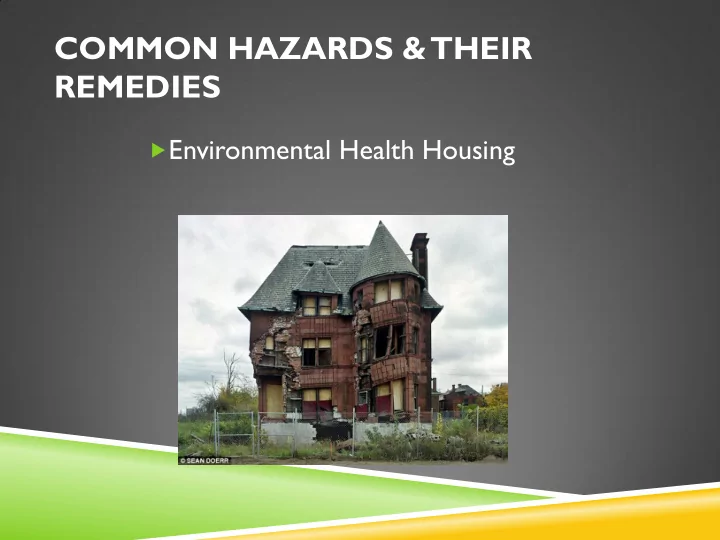
SLIDE 1
COMMON HAZARDS & THEIR REMEDIES
Environmental Health Housing
SLIDE 2
WHO WE ARE.
Environmental Health Housing consists of : Housing Reactive Team – Enquiries are
investigated primarily relating to properties that are rented or owned.
Housing Licensing Team – Enquiries and
licensing relating to Houses in Multiple Occupation (HMO).
SLIDE 3 WHAT WE DO
We respond to service requests and
enquiries from landlords, tenants, owner
- ccupiers and other members of the public
including neighbours and other agencies such as social services, Building Control etc.
We deal with an average of 1500-1900
service enquiries a year.
SLIDE 4 GENERAL COMPLAINTS HOUSING REACTIVE TEAM DEAL WITH
Drainage – private drains, private pumping stations, drainage cross
connections etc.
Statutory Nuisance issues such as odours arising from domestic
properties and water ingress by party walls, dog faeces, pigeon faeces, rodent and insect infestations
Overcrowding Immigration Inspections / Accommodation Certificates Empty property nuisances / open to trespass Possible hazards at the property, for example, defective heating
provision, damp and mould growth, falls and trip hazards etc.
SLIDE 5
HOUSING ACT 2004
We primarily use the Housing Act 2004 as our legislation
when inspecting properties.
We determine defects and identify hazards which are
assessed under the Housing Health and Safety Rating System , or HHSRS
There are 29 hazards that we can investigate and assess. This includes damp and mould, falls, structural collapse,
excess cold, electrical safety, carbon monoxide, lighting, pests and refuse, personal hygiene sanitation, fire, noise.
SLIDE 6
COMMON HHSRS HAZARDS OR DEFECTS
Damp and mould growth Lack of heating and/or hot water. Falls or trips Excess cold
SLIDE 7
CONDENSATION MOULD
SLIDE 8
CONDENSATION – LIKELY CAUSES
When undertaking management visits, check:
Are there clothes upon the radiators. Are tumble
driers lacking proper ventilation.
Can the windows be opened? i.e. are they painted
shut, broken, missing keys to any locks.
If mould is present would a mechanical vent or
trickle vents to windows help?
Use a suitable mould inhibitor to destroy and
remove the mould.
SLIDE 9
CONDENSATION
Is the heating system working correctly and
serviced annually
Does the tenant know how to use the heating
system? i.e. provide instructions and leave a copy of the manual with the tenant.
Are the tenants using a Calor gas heater in addition
to the existing heating ?
Should you wish to receive further guidance,
please do not hesitate to contact this office. Copies can also be emailed as a pdf file.
SLIDE 10
EXCESS COLD
SLIDE 11 EXCESS COLD – LIKELY CAUSES
Excess cold will usually score highly under the HHSRS. It is recommended
that whilst undertaking your management, you check:
Is there a lack of sufficient heating provision to the property? This can also
potentially cause condensation issues.
Is insulation installed in the property (walls / roof / draught proofing)? Are there gaps to the entrance doors? Are the seals and glazing to the windows sufficient or defective? Could double glazed units be installed to the property? If they are eligible, could the tenants be referred to NEST to potentially
assist with boiler / heating system upgrades.
A simple fix, does the letterbox to the property have both internal and
external covers?
SLIDE 12
FALLS AND TRIPS
SLIDE 13 FALLS AND TRIPS.
Falls, again, can score highly under the HHSRS. Whilst undertaking your
management inspection, check if any occupants could potentially injure themselves through falls or trips at the property:
Does the staircase have a full handrail with gaps more than 100mm? Is the staircase open on one side, missing any spindrels, or has horizontal
guards with open gaps?
Are the front and rear gardens raised and have a wall and / or steps? If so, seek to install guarding. If you decide not to install solid boards,
any spacing or gaps between the guarding / spindrels must meet building regulation standards (be 900mm internally high, 1100mm externally high and have open gaps less than 100mm).
Are there carpet grippers, threshold strips to the floor coverings? Is the carpet ( if installed ) fraying or loose. Are there loose or damaged
floor tiles, paving tiles, low level walls.
SLIDE 14 WHAT WE DO IF WE RECEIVE AN ENQUIRY
Initially we will make a visit to the property and assess for hazards. Generally, we informally write to the landlord asking for repair works to
be completed within approx. 28 days. However, this will depend on the severity of the hazard identified and landlord previous compliance.
We welcome correspondence from the landlord and aim to work
together on timescales and any concerns raised.
Revisits are then undertaken to check compliance. If the works are not completed and the landlord is not engaging with us
then we do have the power to serve a legal notice. There is currently a charge of £385 for these notices.
SLIDE 15 During regular management checks at the property, check for any repair
works that might be required to minimise any potential hazards or defects.
e.g. signs of dampness, condensation mould growth, overcrowding ,
heating issues etc.
A landlord has a legal right to enter their rented property to inspect it
- r carry out repair works, providing at least 24 hour’s notice is given,
although in an emergency access may be required sooner. We advise to provide the tenants with more than 24 hours notice.
SLIDE 16 ANY QUESTIONS?
Contact us For help and advice
Telephone – 01633 656656 Email – env.health@newport.gov.uk or
hmo@newport.gov.uk