SLIDE 1
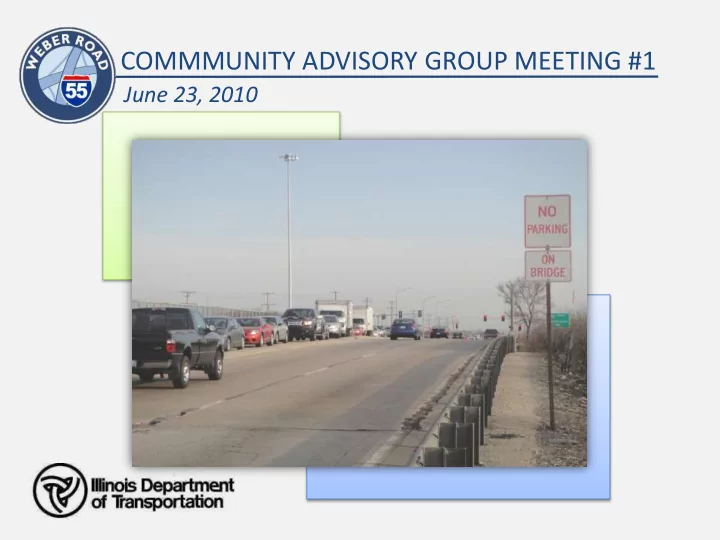
COMMMUNITY ADVISORY GROUP MEETING #1
June 23, 2010
SLIDE 2
INTRODUCTIONS
Illinois Department of Transportation Clark Dietz, Inc. Huff & Huff, Inc. Planning Communities, LLC. Community Advisory Group (CAG) members
SLIDE 3
MEETING OUTLINE
Agenda
Review the public involvement process Discuss the initial findings Define the transportation problem Establish the next steps in the process
CAG Notebooks
Meeting materials Reference materials
SLIDE 4
PUBLIC INVOLVEMENT PROCESS
Context Sensitive Solutions (CSS) review Ground rules Role of the Community
Advisory Group (CAG)
Meeting timetable
SLIDE 5 WHAT IS CONTEXT SENSITIVE SOLUTIONS?
Context Sensitive Solutions (CSS) is an interdisciplinary approach that seeks effective, multimodal transportation solutions by working with stakeholders to develop a cost- effective transportation facility which will fit into and reflect the project’s surroundings – its “context”. An IDOT CSS project:
Considers project’s context Fosters communication and collaboration Environmentally sensitive Exercises design flexibility
SLIDE 6
WHY USE CONTEXT SENSITIVE SOLUTIONS?
Open and transparent process Find solutions to transportation
and community issues
Add lasting value to community,
environment and transportation system
Create working relationships
SLIDE 7 THE CSS PROCESS
Identify Context Define Problem Evaluation Criteria Define and Evaluate Alternatives Identify Stakeholders
Considerations
Stakeholder Considerations / Community Assets Environmental Considerations / Compatibility with the Environment Engineering Considerations / Transportation Needs
Preferred Alternative
SLIDE 8 IDENTIFYING CONTEXT
Economics Environment Aesthetics Right-of-Way Constraints Land Use Social & Cultural Mobility Safety & Health
VISIBLE LOCAL INVISIBLE REGIONAL
SLIDE 9
IDENTIFYING CONTEXT
SLIDE 10 REGIONAL CONTEXT
I-55 at Weber Rd
SLIDE 11 LOCAL CONTEXT
Rodeo Dr./119th St Normantown Rd. Windham Pkwy. Romeo Rd./135th St
Warehouse and Distribution Businesses Farmland Residential Parks/Open lands Civic Colleges
SLIDE 12
STAKEHOLDER INVOLVEMENT PLAN (SIP)
Inventory of stakeholders Responsibilities of participants Description of opportunities for
stakeholder participation
Schedule of public involvement
activities
Will be available on the study website
SLIDE 13
PUBLIC INVOLVEMENT PROCESS
Context Sensitive Solutions (CSS) review Ground rules Role of the Community
Advisory Group (CAG)
Meeting timetable
SLIDE 14
PUBLIC INVOLVEMENT PROCESS
Context Sensitive Solutions (CSS) review Ground rules Role of the Community
Advisory Group (CAG)
Meeting timetable
SLIDE 15 THE COMMUNITY ADVISORY GROUP
General Public
Responsibilities include:
Providing input
Attending meetings
Collaborating with the Project Study Group Could consist of:
Community leaders
Interested stakeholders Assists with:
Defining context
Establishing purpose and need
Developing alternatives Community Advisory Group (CAG)
Interest Groups Local Businesses
SLIDE 16 TECHNICAL ADVISORY GROUPS
Technical Advisory Group (TAG) Could consist of parties interested in:
Transportation & engineering
Environment & land Use Responsibilities include:
Provide input
Attend TAG meetings
Collaborate with the Project Study Group Assists with:
Evaluation of alternatives
Specific issues
SLIDE 17 PROJECT STUDY GROUP
Clark Dietz, Inc. & Sub-Consultants
SLIDE 18 PROJECT STUDY GROUP
Project Study Group (PSG) Technical Advisory Group (TAG) Community Advisory Group (CAG)
Clark Dietz, Inc. & Sub-Consultants
SLIDE 19
PUBLIC INVOLVEMENT PROCESS
Context Sensitive Solutions (CSS) review Ground rules Role of the Community
Advisory Group (CAG)
Meeting timetable
SLIDE 20
MEETING TIMETABLE
SLIDE 21
INITIAL FINDINGS
Regional growth Future growth Traffic Crashes Context Survey results
SLIDE 22
What are the transportation problems at the I-55 at Weber Road interchange?
PROBLEM STATEMENT WORKSHOP
SLIDE 23 CONSIDERATIONS
Economics Environment Aesthetics Right-of-Way Constraints Land Use Social & Cultural Mobility Safety & Health
VISIBLE LOCAL INVISIBLE REGIONAL
SLIDE 24
THANK YOU!
Community Advisory Group Meeting #2 August 2010