SLIDE 1 GERDA Collaboration Meeting, LNGS, March 2010 1
- A. Gangapshev
- M. Heisel
- A. Klimenko
- S. Schönert
- A. Smolnikov
- G. Zuzel
GERDA Collaboration Meeting, LNGS, 1-3 March 2010
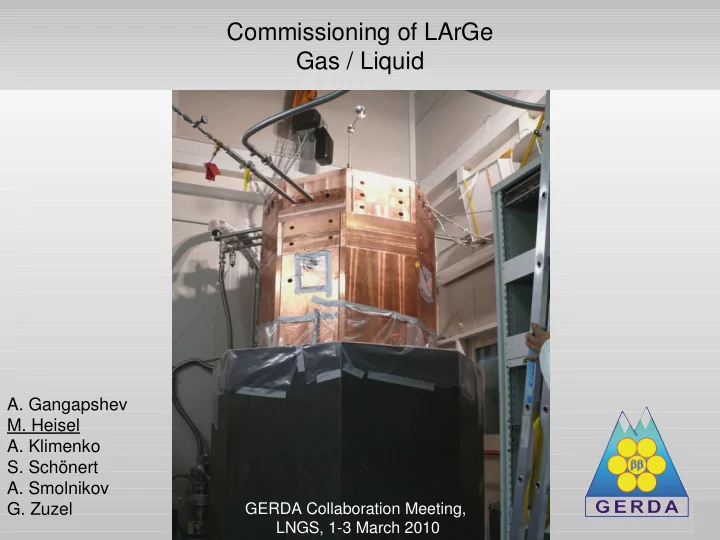
Commissioning of LArGe Gas / Liquid
SLIDE 2 GERDA Collaboration Meeting, LNGS, March 2010 2
Lock: Can house up to 3 strings (9 detectors) Cryostat with LAr: Volume: 1000 liter Shield: Cu 15cm, Pb 10cm, Steel 23cm, PE 20cm reflector foil & wavelength shifter 9 PMTs: For the detec- tion of Ar-scintillation
128 nm ~450 nm
PMT VM2000 + WLS Ar scintillation
Reminder: The LArGe Setup
- peration of naked HPGe-crystals in LAr using Ar-scintillation light as
veto & for background diagnostics:
SLIDE 3 GERDA Collaboration Meeting, LNGS, March 2010 3
History Overview Since Last Meeting
first scintillation light in GAr presented light degradation discovered
1st LAr filling of cryostat light quenched
investigations & cryostat modifications
2nd LAr filling light is stable!
SLIDE 4 GERDA Collaboration Meeting, LNGS, March 2010 4
Light Degradation Measurements in GAr
- ctober `09: after last meeting
GAr at room temperature
100 200 300 400 500 600 700 800 1 2 3 4 5 6 time [h] light yield [a.u.]
GAr at room temperature Gd-148 source
SLIDE 5 GERDA Collaboration Meeting, LNGS, March 2010 5
100 200 300 400 500 600 700 800 1 2 3 4 5 6 time [h] light yield [a.u.]
Light Degradation Measurements in GAr
- ctober `09: prior to 1st filling with LAr
GAr at room temperature cold GAr at -73°C to -90°C Gd-148 source
SLIDE 6 GERDA Collaboration Meeting, LNGS, March 2010 6
1st LAr Filling
- light yield lower by factor ~60
- 0.03 pe/keV - measured with Th-228 & Am-241
- 1.8 pe/keV - in Mini-LArGe
- slow component strongly quenched
- triplet-lifetime: τtrip = 66 ns
(lit. τtrip = 1.1 to 1.7 µs)
- mass spectrometer measurements:
- N2: 7 ppm
- O2: <4 ppm
- no other trace contaminations found due to the limited sensitivity of the
mass spectrometer
SLIDE 7 GERDA Collaboration Meeting, LNGS, March 2010 7
Triplet Lifetime (Slow Component) as an Indicator for Impurities
(example from GAr) clean argon contaminated argon time amplitude pulse shape average
SLIDE 8
GERDA Collaboration Meeting, LNGS, March 2010 8
873 ns
What is the Origin of the Contamination? Mini-LArGe Investigations…
LAr
112 ns
LAr in LArGe is contaminated, instrumental reasons excluded
775 ns
charcoal & PTFE filter are clean
733 ns
stable for 3 days Araldit is no problem
74 ns
activated charcoal did not remove contamination
configuration triplet lifetime conclusion
SLIDE 9 GERDA Collaboration Meeting, LNGS, March 2010 9
Modifications on LArGe Cryostat
jan-feb `10:
- cryostat with GAr again
- support compensator to allow for pumping the cryostat
- degass from air residues by
- heating up cryostat (15°C 40°C)
- & perform flushing-pumping cycles
SLIDE 10
GERDA Collaboration Meeting, LNGS, March 2010 10
After Modifications: N2 and O2 constant vs. time
time level of contaminents [a.u.]
Ar6.0 reference background
SLIDE 11
GERDA Collaboration Meeting, LNGS, March 2010 11
Light Degradation Measurements in GAr (2)
0.5 1 1.5 2 2.5 3 3.5 4 2 4 6 8 10 time [h] triplett lifetime [ns] light yield [a.u.]
GAr before 1st filling GAr before 2nd filling
february `10: triplet lifetime in GAr is much more stable than before 1st filling
SLIDE 12
GERDA Collaboration Meeting, LNGS, March 2010 12
2nd Filling: Average Pulse Shape in LAr
3 PMTs, 2-fold trigger, no source
SLIDE 13
GERDA Collaboration Meeting, LNGS, March 2010 13
2nd Filling: Triplett Lifetime Stability in LAr
200 400 600 800 1000 1200 1400 2 4 6 8 10
time [days] triplet lifetime [ns]
feb-mar `10: triplet lifetime in LAr is stable since 8 days
SLIDE 14 GERDA Collaboration Meeting, LNGS, March 2010 14
Conclusions & Outlook
- LArGe is filled with LAr & the scintillation light is stable since 8 days
- the triplet lifetime is
- GAr: 3.5 µs @ 950 mbar
(ref. 3.2 µs @ 1100 mbar)
(lit. 1.1 to 1.7 µs)
Mini-LArGe result: ~790 ns (@LNGS with Ar5.0), 1.2 µs (@MPIK with Ar5.4)
- active cooling with LN runs very smooth
good control over pressure & stable LAr filling level
- now we can start to study spectral properties of scintillation light in LArGe
(light yield, resolution…)
- eventually (april?): mount lock and enter BEGe‘s