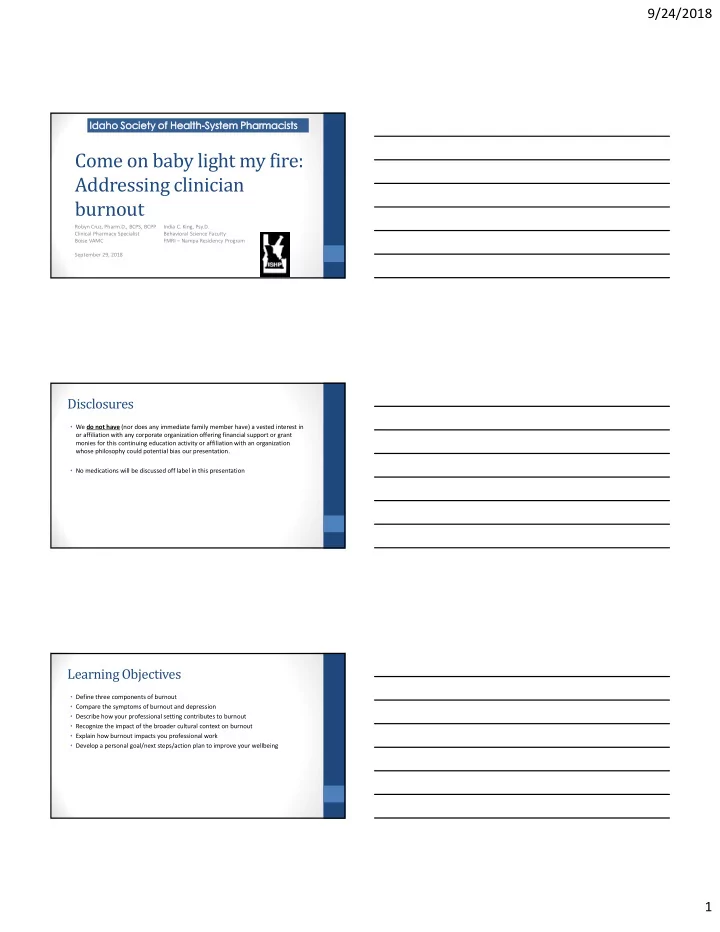
Come on baby light my fire: Addressing clinician burnout Robyn - - PDF document

come on baby light my fire addressing clinician burnout
SMART_READER_LITE
LIVE PREVIEW

Come on baby light my fire: Addressing clinician burnout Robyn - - PDF document

9/24/2018 Come on baby light my fire: Addressing clinician burnout Robyn Cruz, Pharm.D., BCPS, BCPP India C. King, Psy.D. Clinical Pharmacy Specialist Behavioral Science Faculty Boise VAMC FMRI Nampa Residency Program September 29,


slide-1
SLIDE 1

9/24/2018 1

Come on baby light my fire: Addressing clinician burnout

Robyn Cruz, Pharm.D., BCPS, BCPP India C. King, Psy.D. Clinical Pharmacy Specialist Behavioral Science Faculty Boise VAMC FMRI – Nampa Residency Program September 29, 2018

Disclosures

  • We do not have (nor does any immediate family member have) a vested interest in
  • r affiliation with any corporate organization offering financial support or grant

monies for this continuing education activity or affiliation with an organization whose philosophy could potential bias our presentation.

  • No medications will be discussed off label in this presentation

Learning Objectives

  • Define three components of burnout
  • Compare the symptoms of burnout and depression
  • Describe how your professional setting contributes to burnout
  • Recognize the impact of the broader cultural context on burnout
  • Explain how burnout impacts you professional work
  • Develop a personal goal/next steps/action plan to improve your wellbeing
slide-2
SLIDE 2

9/24/2018 2

Components of Burnout

  • 1. Exhaustion

Physical Emotional

  • 2. Depersonalization

Cynicism Detachment

  • 3. Ineffectiveness

Lack of accomplishment More work, decreased productivity

Depression

Major Depressive Disorder

  • For 2 weeks, must have 5 of these symptoms
  • Depressed mood
  • Loss of interest or pleasure
  • Weight changes
  • Sleep disturbances
  • Psychomotor agitations or retardation
  • Fatigue
  • Feelings of worthlessness or inappropriate guilt
  • Recurrent thoughts of death
  • Significant distress or impairment in social, occupation, or other domains of functioning

American Psychiatric Association. Washington, DC: American Psychiatric Association; 2013.

Clinical Depression Burnout

Exhaustion Depersonalization Ineffectiveness Depressed mood Anhedonia Sleep disturbances Psychomotor changes Fatigue Worthlessness/guilt Thoughts

  • f death

Bianchi R et al. Clinical Psychology Review. 2015; 36: 28-41.

slide-3
SLIDE 3

9/24/2018 3

External Pressures

National Academy of Medicine. Factors Affecting Clinician Well-Being and Resilience

Work-related pressures

  • Organizational Factors
  • Learning/practice environment

Contextual pressures

  • Socio-cultural factors
  • Regulatory, business, & payer

environment

Activity: Context and Burnout

As a group discuss the following questions:

  • 1. What are the pressures in your work setting that could contribute to

burnout?

  • 2. What are larger (outside of you work setting) pressures that could

contribute to burnout?

  • 3. Are there any of the above pressures that you could positively impact?

Activity: Consequences of Burnout

Prompt: Imagine that you were completely burned out…… What would folks see? What would you do? What would you not do? How would your colleagues know? 2 min personal reflection 8 min paired discussion

slide-4
SLIDE 4

9/24/2018 4

Burnout & Health Care Providers

Well known for healthcare practitioners in general

  • Reduced patient satisfaction, increased medical errors
  • Main factors: quality of care, electronic health record

Less copious amounts of data available specifically for pharmacy since the 1990s

  • Most are specific to one job area (faculty, hospital, etc.)
  • Not unique to only US pharmacists
  • Community pharmacists likely experience lower job satisfaction -> increased

burnout

  • 2016 US pharmacist salary survey (N=3085):
  • 73% satisfied with jobs
  • 64% reported increased job stress from previous year

Bridgeman PJ, et al. Am J. Health-Syst Pharm. 2018; 75:147-52 Jones GM, et al. Hosp Pharm. 2017 Dec;52(11):742-751

Burnout & Pharmacists

Compared to US physician survey

  • Pharmacists had less

depersonalization (10% vs. 29%)

  • Pharmacists had more

ineffectiveness (24% vs. 12%)

  • Different job expectations?
  • Less autonomy, limited in

job responsibilities and scope

El-Ibiary SY, et al. Am J Pharm Ed. 2017; 81 (4) Article 75.

Compared to demographic norm

  • Same risk for mental health and

substance use disorders

  • Exhaustion scores higher
  • Depersonalization lower
  • Ineffectiveness similar

Potential contributors:

  • Workload
  • Tight regulations in profession
  • Continual focus on

compliance

  • Lack of control in the

workplace

  • Excessive documentation
  • Depersonalization of work
  • Incongruencies between skills

and day-to-day tasks

  • Feeling underappreciated by
  • thers
  • Greater amount of

distributive functions

  • Lack of time
  • Keeping up with

professional developments

  • Paperwork
  • interruptions

Bridgeman PJ, et al. Am J. Health-Syst Pharm. 2018; 75:147-52 El-Ibiary SY, et al. Am J Pharm Ed. 2017; 81 (4) Article 75. Jones GM, et al. Hosp Pharm. 2017 Dec;52(11):742-751

slide-5
SLIDE 5

9/24/2018 5

Burnout & Pharmacists

Less favorable scores associated with:

  • No hobby
  • No mentor
  • Total years worked (exhaustion, depersonalization)
  • Having children ages 1-12
  • Greater time spent at work

More favorable scores associated with:

  • Total years worked (effectiveness)
  • Having children >12 years (lower exhaustion)

El-Ibiary SY, et al. Am J Pharm Ed. 2017; 81 (4) Article 75.

Burnout Prevention

We can recognize and prevent burnout ASHP in addition to ACGME are actively working towards preventing burnout

  • Ex. cap on duty hours for residents

Awareness of upcoming generational differences, susceptibility to burnout related to criticism and challenges

  • Mentoring is valuable!

Bridgeman PJ, et al. Am J. Health-Syst Pharm. 2018; 75:147-52

Resources (break time)

slide-6
SLIDE 6

9/24/2018 6

Enhancing Wellness

Balance = ongoing active process Your true North will change depending on:

  • Life stage
  • Personal responsibilities
  • Professional career stage
  • Others?

Activity: Balance Self-Assessment

1. Select components of your life that are important to you and label each point 2. With the outermost area point equaling 100% where you want to be and the innermost point being 0% of where you want to be mark your current state in each area 5 min personal reflection

Activity: Areas of Improvement

Review your self-assessment consider: What you are doing well Areas that you could improve 2 min personal reflection 8 min paired discussion

slide-7
SLIDE 7

9/24/2018 7

Activity: Individual Goal Setting

Select one area that you would like to improve. Consider: What can you start doing? What can you stop doing? Write a SMART goal for yourself that targets your selected area for improvement. 5 min personal reflection

Activity: Committed Action

Share your goal with you group 10 min group discussion

Q&A

slide-8
SLIDE 8

9/24/2018 8

Assessment Questions

  • 1. Which is not a component of burnout?
  • A. emotional exhaustion
  • B. depersonalization
  • C. avoidance
  • D. Ineffectiveness
  • 2. The following overlaps between both depression and burnout:
  • A. Thoughts of death
  • B. Depressed mood
  • C. Psychomotor changes
  • D. Exhaustion
  • 3. The professional setting (pharmacy) can contribute to burnout by:
  • A. Loose regulations
  • B. Interruptions
  • C. Excessive professional development
  • D. Appreciation of unique skill set

Assessment Questions

  • 4. Select all components that can contribute to burnout:
  • A. Patient expectations
  • B. Media portrayal
  • C. Scope of practice
  • D. Colleague interactions
  • 5. Identify a factor that negatively contributes to burnout:
  • A. Not having a mentor or not having a hobby
  • B. Working less than 40 hours per week
  • C. Having adult children
  • D. None of the above
  • 6. Choose the method that can increase the chance of follow through of an action plan/goal:
  • A. Keeping my goal top secret
  • B. Verbalizing my goal
  • C. Neither A or B
  • D. Both A and B

References

Bridgeman PJ, Bridgeman MB, Barone J. Burnout syndrome among healthcare professionals. Am J. Health-Syst Pharm. 2018; 75:147-52. El-Ibiary SY, Yam L, Lee KC. Assessment of burnout and associated risk factors among pharmacy practice faculty in the United States. Am J Pharm Ed. 2017; 81 (4) Article 75. Jones GM, Roe NA, Louden L, Tubbs CR. Hosp Pharm. 2017 Dec;52(11):742-751 National Academy of Medicine. Factors Affecting Clinician Well-Being and Resilience. https://nam.edu/clinicianwellbeing/resources/a-journey-to-construct-an-all-encompassing- conceptual-model-of-factors-affecting-clinician-well-being-and-resilience/ Accessed August 14, 2018. Bianchi R, Schonfeld IS, Laurent E. Burnout-depression overlap: a review. Clinical Psychology

  • Review. 2015; 36: 28-41.

Dyrbye LN, Shanafelt TD, Linshy CA et al. Burnout among health care professionals: a call to explore and address this under recognized and threat to safe, high-quality health care. [website] Accessed August 14, 2018. American Psychiatric Association. Diagnostic and Statistical Manual of Mental Disorders. 5th

  • ed. Washington, DC: American Psychiatric Association; 2013.