Combinatorial Ski Rental and Online Bipartite Matching Hanrui Zhang - - PowerPoint PPT Presentation

combinatorial ski rental and online bipartite matching
SMART_READER_LITE
LIVE PREVIEW

Combinatorial Ski Rental and Online Bipartite Matching Hanrui Zhang - - PowerPoint PPT Presentation

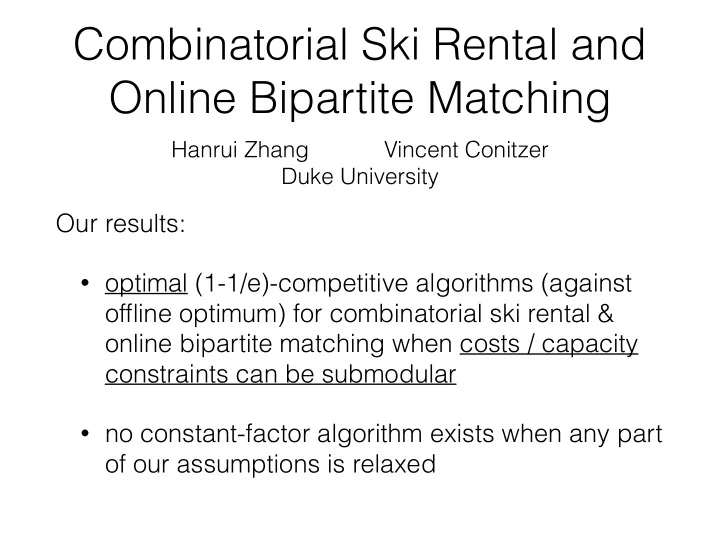
Combinatorial Ski Rental and Online Bipartite Matching Hanrui Zhang Vincent Conitzer Duke University Our results: optimal (1-1/e)-competitive algorithms (against offline optimum) for combinatorial ski rental & online


slide-1
SLIDE 1

Combinatorial Ski Rental and Online Bipartite Matching

Hanrui Zhang Vincent Conitzer Duke University

Our results:

  • optimal (1-1/e)-competitive algorithms (against
  • ffline optimum) for combinatorial ski rental &
  • nline bipartite matching when costs / capacity

constraints can be submodular

  • no constant-factor algorithm exists when any part
  • f our assumptions is relaxed
slide-2
SLIDE 2

cost of purchasing: $30 $30 $50 cost of renting: 1st task requires: rent Excel at cost $10, cost so far: $10 product(s) purchased: 2nd task requires: rent both at cost $15, cost so far: $25 product(s) purchased: 3rd task requires: buy Excel at cost $30, cost so far: $55 product(s) purchased: 4th task requires: rent Powerpoint at cost $10, cost so far: $65 product(s) purchased: 5th task requires: buy Powerpoint at (marginal) cost $20, cost so far: $85 product(s) purchased: both products purchased future cost = 0 time "upgrading" is allowed: pay $20 for Powerpoint when Excel is already purchased $30 $30 $50

  • a business analyst’s job involves 2 software

products: Excel and Powerpoint

  • tasks arrive over time, each of which may

require either / both of the 2 products

  • in order to finish all tasks, analyst may "rent" or

"buy" any combination of the products; purchased products cannot be returned

  • discounts are available when renting or

buying both products

Combinatorial ski rental

slide-3
SLIDE 3
  • n offline vertices, one online vertex at each

time t

  • λt(i): fraction of online vertex arriving at time t

matched to offline vertex i

  • maximize:

Σ1 ≤ t ≤ T Σ1 ≤ i ≤ n λt(i)

  • s.t. (offline capacity constraints) for every set
  • f items S:

Σ1 ≤ t ≤ T Σi ∈ S λt(i) ≤ f(S)

  • s.t. (online supply constraints) for every set of

items S, time t: Σi ∈ S λt(i) ≤ gt(S)

Primal LP for ski rental

  • n products available for purchasing / renting
  • f(S): cost of purchasing S
  • gt(S): cost of renting S at time t
  • x(S) ≥ 0: probability of purchasing S
  • yt(S) ≥ 0: probability of renting S at time t
  • minimize:

ΣS x(S) f(S) + Σ1 ≤ t ≤ T ΣS’ yt(S’) gt(S’)

  • s.t. for all item i, time t:

ΣS: i ∈ S x(S) + yt(S) ≥ 1

Dual LP for online matching

take-home message: online primal-dual analysis can go fully combinatorial

total (fractional) number of online vertices matched total load of all

  • ffline vertices

in S cannot exceed f(S) fraction of online vertex at time t matched to

  • ffline vertices in S

cannot exceed gt(S)

slide-4
SLIDE 4
  • minimize: ΣS x(S) f(S) + Σ1 ≤ t ≤ T ΣS' yt(S') gt(S')
  • s.t. for all i, t: ΣS: i ∈ S x(S) + yt(S) ≥ 1

primal:

  • minimize: F(xt(1), …, xt(n)) + Σ1 ≤ t ≤ T Gt(yt(1), … yt(n))

dual:

  • maximize: Σ1 ≤ t ≤ T Σ1 ≤ i ≤ n λt(i)
  • s.t. for all S: Σ1 ≤ t ≤ T Σi ∈ S λt(i) ≤ f(S)
  • s.t. for all S, t: Σi ∈ S λt(i) ≤ gt(S)

Sketch of algorithm

  • in constraints: only marginal probabilities matter
  • re-parametrize by marginal probabilities
  • consider convex envelope = Lovasz extension

new problem: global objective & constraints

  • lemma: under certain conditions, local constraints

satisfied imply global constraints satisfied & small ratio between primal / dual objectives

  • problem boils down to local task: setting λt(i)

(which determine xt(i)) to satisfy these certain conditions at each time t

  • relatively easy when xt(i) are all different, highly

nontrivial (and combinatorial) otherwise; latter (hard) case is not "zero-measure"

no constant-factor algorithm if:

  • cost of purchasing is allowed to be XOS,
  • cost of renting is allowed to be supermodular, or
  • upgrading is not allowed (i.e., price of

purchasing S given S' is f(S) rather than f(S | S')) in words: all our assumptions are necessary symmetrization tecinque: prepare future clauses, choose realization by demanding right copy of item

Overview of lower bounds