Combating antibiotic resistance October 8, 2007 Causes of death, - - PDF document

combating antibiotic resistance
SMART_READER_LITE
LIVE PREVIEW

Combating antibiotic resistance October 8, 2007 Causes of death, - - PDF document

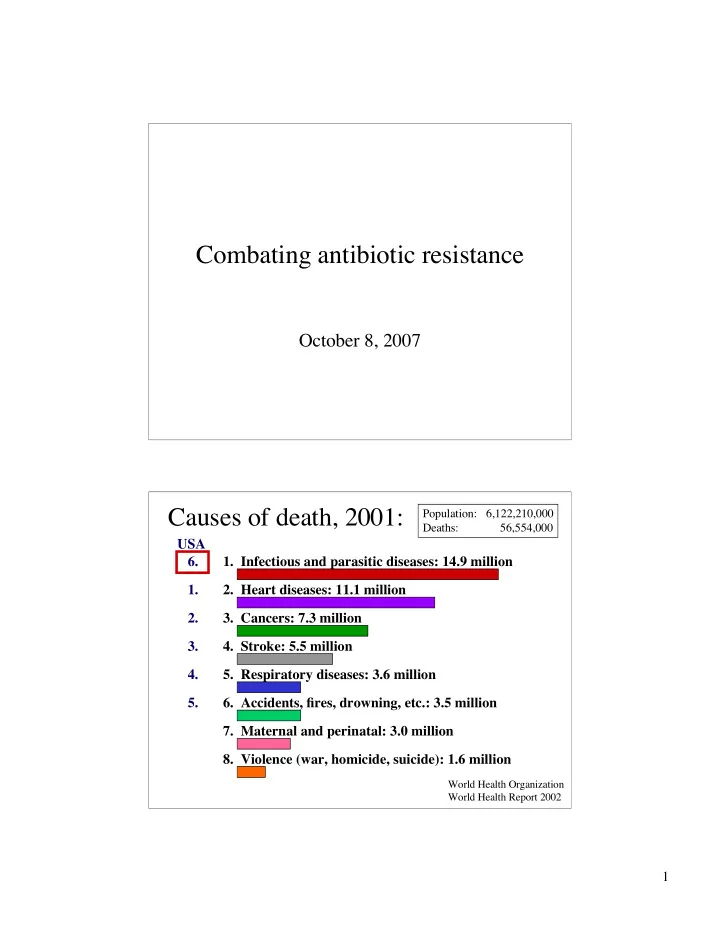
Combating antibiotic resistance October 8, 2007 Causes of death, 2001: Population: 6,122,210,000 Deaths: 56,554,000 USA 6. 1. Infectious and parasitic diseases: 14.9 million 1. 2. Heart diseases: 11.1 million 2. 3.


slide-1
SLIDE 1

1

Combating antibiotic resistance

October 8, 2007

Causes of death, 2001:

  • 1. Infectious and parasitic diseases: 14.9 million
  • 2. Heart diseases: 11.1 million
  • 3. Cancers: 7.3 million
  • 4. Stroke: 5.5 million
  • 5. Respiratory diseases: 3.6 million
  • 6. Accidents, fires, drowning, etc.: 3.5 million
  • 7. Maternal and perinatal: 3.0 million
  • 8. Violence (war, homicide, suicide): 1.6 million

World Health Organization World Health Report 2002

Population: 6,122,210,000 Deaths: 56,554,000

USA 6. 1. 2. 3. 4. 5.

slide-2
SLIDE 2

2

Deaths from infectious diseases in the US: 1900-1994

1900-1937: public health clean water, good sewers 1937-1953: vaccines, antibiotics 1953-1980: antibiotics, antivirals 1980-1994: still more drugs, but...

1918 flu epidemic

Deaths from infectious diseases in the US: 1900-1996

1980-1994

slide-3
SLIDE 3

3

2000 1990 1940 1950 1960 1930 1970 1980

linezolid vancomycin nalidixic acid norfloxacin erythromycin tetracycline streptomycin penicillin G methicillin sulfonamides expanded-spectrum cephalosporins Augmentin

Resistance to Antibiotics Is Inevitable and Develops Rapidly

slide-4
SLIDE 4

4

Penicillin

β-lactams

1928: Mold found by Alexander Fleming (who also found lysozyme by sneezing on a plate) 1940: Penicillin purified by Florey & Chain

Bacterial cell surface structure

slide-5
SLIDE 5

5

Cell wall molecular structure Transpeptidase reaction and penicillin inhibition

slide-6
SLIDE 6

6

Antibiotic targets: mostly cell wall and ribosome

(resistance mechanisms) (resistance mechanisms)

Modes of antibiotic resistance

  • Destroy or covalently modify the drug
  • Change the target so the drug no longer binds
  • Actively export the drug from the cytoplasm by a specific or

non-specific efflux pump (MDR = multi-drug resistant)

  • Prevent drug uptake by altering membrane permeability (rare)

Selective pressures caused by human misuse:

– Physician overprescription – Agricultural use as a growth enhancer – Domestic misuse (compare the “hygiene hypothesis”)

slide-7
SLIDE 7

7

Penicillin resistance

  • Alteration in the transpeptidase (PBP)

– Usually generates cross-resistance to all β-lactams – Mechanism found in MRSA (mecA gene acquired laterally from unknown source)

  • Expression of β-lactamases

– At least 255 different kinds – Derived from transpeptidases!!! – Rate of hydrolytic deacylation increased from 1 per hour to 1500 per second – Can be partially overcome by coadministration of clavulanic acid (augmentin)

Nosocomial infections

  • >10 per 1000 patient-days in the hospital
  • Most common in intensive care units, acute care surgical

and orthopedic units

  • Increasing in frequency and severity

– Populations are more immunocompromised – Antibiotic resistance is becoming more prevalent

  • Frequently opportunistic Gram-positives from normal flora

(Staphylococcus, Enterococcus, Streptococcus)

  • MRSA (methicillin-resistant Staphylococcus aureus) are
  • ften resistant to all antibiotics except vancomycin
  • MRSA increasingly found in community-acquired

infections as well as hospital-acquired infections

slide-8
SLIDE 8

8

PENICILLIN RESISTANCE IN STAPHYLOCOCCUS AUREUS

Currently – 90% Resistant worldwide 83% Outpatient isolates resistant 84% Inpatient isolates resistant (Moellering, MGH) 1967 73% Resistant (Finland, BCH) 1951 32% Resistant (Finland, BCH) 1947 All from hospitalized patients (outpatient isolates susceptible) <1% Resistant (Finland, BCH) 1940-1946 Virtually all strains susceptible to penicillin (worldwide) 1940

Murray BA, Moellering RC Jr. Med Clin N Am. 1978;62(5):899-923.

METHICILLIN-RESISTANT S. AUREUS Methicillin resists most β-lactamases

1959 First clinical use of methicillin 1961 First description of MRSA 1967 First report of nosocomial infection in the US (2 cases) 1968 Increase in MRSA in the UK 1968-1979 Rise and subsequent wane of prevalence of MRSA (especially nosocomial infections) in Europe, Australia, and elsewhere (except US) 1975-1980 First reports of problems with MRSA in the US; most

  • ccurred in large tertiary care hospitals (especially

burn units and ICUs) 1980-1991 MRSA increase in prevalence in US nursing homes; community-acquired MRSA infections in the US 2003-2004 Community-acquired clones of MRSA cause outbreaks of necrotizing fasciitis in Los Angeles

  • Jevons. BMJ 1961;1:124

Westh H et al. Clin Infect Dis. 1992;14:1186-1194. Chambers HF. Clin Microbiol Rev. 1997;10:781-791. Bradley SF. Am J Med. 1999;106(5A):2S-10S. Miller LG et al. NEJM 2005; 352: 1445-1453.

slide-9
SLIDE 9

9

Pandemic MRSA around the world

Oliveira et a., 2002, Lancet Inf Dis. 2: 180

Vancomycin

20-50% of a typical hospital antibiotic budget is spent on vancomycin

slide-10
SLIDE 10

10

Vancomycin resistance in enterococci

  • 12 species cause bacteremia, mostly E. faecalis and E.

faecium

  • Vancomycin resistance described in 1986; currently

25% of clinical isolates are resistant (VRE)

  • High mortality rate (10-50%)
  • US: Reservoirs are hospital staff and patients (farm

animals in Europe due to use of avoparcin)

  • Genotypic classification of resistance:

– vanA - inducible, cross resistance to teicoplanin, >1000 µg/ml – vanB - inducible, teicoplanin-sensitive, >1000 µg/ml – vanC, vanD - constitutive, teicoplanin-sensitive, 30-100 µg/ml

  • orf1 - transposase
  • orf2 - resolvase
  • vanR - response regulator (transcriptional activator)
  • vanS - histidine protein kinase (sensor)
  • vanH - D-specific α-keto acid reductase (makes D-lactate)
  • vanA - D-Ala-D-lactate peptide ligase
  • vanX - D-Ala-D-Ala dipeptidase
  • vanY - D-D carboxypeptidase

vanA: Organization of transposon Tn1546

slide-11
SLIDE 11

11

Induction of resistance genes by vancomycin via two-component response regulator Change of cell wall peptide from D-Ala-D-Ala to D-Ala-D-lactate removes one hydrogen bond...enough!

HO C COOH H CH3 lactate

slide-12
SLIDE 12

12

Synercid for treating VRE (E. faecium only)

Quinupristin Dalfopristin

Bind 50S ribosomal subunit Bacteriostatic alone Bacteriocidal together Advertised as a “new class” BUT...

Comparison of % resistance among Enterococcus faecium from food animals, food and humans (1997, Denmark). Antibiotic Chick Cattle Beef Pigs Pork Humans Gentamicin 3 Chloramphenicol 6 8 4 5 Vancomycin 9 20 Erythromycin 71 20 36 87 26 8 Penicillin 2 13 47

  • Virginiamycin

59 13 3 37 10 29

Mechanisms of genetic exchange and spread of resistance determinants

Known cross-species routes of exchange VRE can transfer Tn1546 to MRSA in vitro (samples immediately autoclaved)

slide-13
SLIDE 13

13

Well, has transfer occurred?

  • June 2002: 40 yo woman in Michigan

– Hypertension, diabetes, peripheral vascular disease, chronic renal failure – Recurrent foot ulcers due to diabetic neuropathy; right foot amputated – Treated with vancomycin, gentamicin, ampicillin-sulbactam, piperacillin-tazobactam, levofloxacin, clindamycin, cefazolin, trimethoprim-sulfamethoxyzole, tobramycin and metronicazole prior to amputation – Cultured MRSA in April 2002, VRE in June 2002 – VRSA appeared in June 2002: Tn1546 transferred from VRE on a conjugative plasmid (pLW1043)

Chang et al., 2003, NEJM 348: 1342 Weigel et al., 2003, Science 302: 1569

Growth curves for a vancomycin- dependent isolate of VRE

1992 46 yo woman Infected with S. aureus, Pseudomonas aeruginosa, Enterobacter spp. Two 6-10 week courses of vancomycin (plus others) Urine samples plated as sterile but chains of Gram- positive cocci observed in the microscope What happened? (Hint: loss of gene)

slide-14
SLIDE 14

14

Isn’t there a fitness cost?

Clinical Laboratory Clinical isolates of rifampicin-resistant Mycobacterium tuberculosis have little

  • r no fitness defect;

laboratory isolates always do

Gagneux et al., 2006, Science 312: 1944

Also: bacteria under antibiotic stress 1) increase genetic transformability 2) increase error-prone replication mechanisms

What can we do? New targets, new drugs…

N N O CO2H N HN F N N O CO2H H N N F S

Ciprofloxacin A-692345 Inhibits DNA Topoisomerase Point mutations in GyrA give resistance Inhibits protein synthesis

(S. pneumoniae, H. influenzae)

Dandliker, et. al. AAC (2003), 47, 3831.

slide-15
SLIDE 15

15

Inhibiting pathogenesis as a novel therapeutic strategy

Phenotypic screen in Vibrio cholerae identified “virstatin” (4-[N-(1,8-naphthalimide)]-n-butyric acid) NO effect on growth, inhibits expression of cholera toxin and TCP Directly inhibits ToxT transcription factor Selective pressures???

Hung et al., 2005, Science 310: 670

Papers for Wednesday:

  • Mwangi et al., 2007, “Tracking the in vivo

evolution of multidrug resistance in Staphylococcus aureus by whole-genome sequencing.” Proc. Natl. Acad. Sci. USA 104: 9451-9456

  • D’Costa et al., 2006, “Sampling the antibiotic

resistome.” Science, 311: 374-377.