SLIDE 1
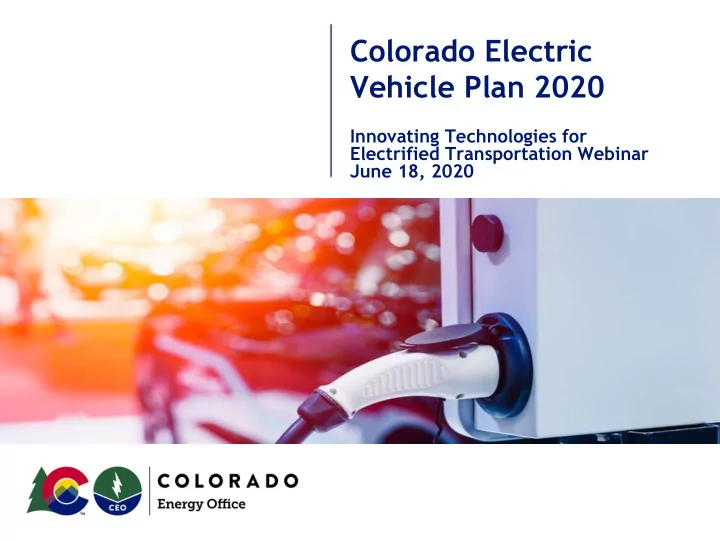
Colorado Electric Vehicle Plan 2020
Innovating Technologies for Electrified Transportation Webinar June 18, 2020
SLIDE 2 The 2018 EV Plan and Progress
Colorado’s first electric vehicle (EV) plan which set forth goals, actions and strategies to develop EV fast-charging corridors across the state and establishing a target of 940,000 EVs by 2030. Significant achievements include:
- Award of a contract to ChargePoint for the build-out of EV fast-
charging stations at 33 sites along Colorado’s major transportation corridors;
- State investment to install 351 EV chargers across Colorado;
SLIDE 3 The 2018 EV Plan and Progress
- Adoption of a zero emission vehicle (ZEV) standard in August 2019
with the support of the auto manufacturing industry;
- Dedication of all remaining state Volkswagen diesel settlement funds
to ZEV charging infrastructure and zero emission buses, shuttles and trucks including first round grant awards totaling $13.9 million to six transit agencies for 23 battery electric buses and supporting infrastructure—with a second round of awards to be announced in spring 2020; and
- More than doubling the number of EVs registered in Colorado from
11,238 in August 2017 to over 24,000 in June 2019
SLIDE 4
EV Plan 2020: Vision
Large scale transition of Colorado’s transportation system to zero emission vehicles, with a long term goal of 100% of light-duty vehicles being electric and 100% of medium- and heavy-duty vehicles being zero emissions
SLIDE 5
Five Goals
1) Increase the number of light-duty electric vehicles (EVs) to 940,000 by 2030; 2) Develop plans for transitioning medium-duty (MDV), heavy-duty (HDV) and transit vehicles to zero emission vehicles (ZEVS); 3) Develop an EV infrastructure goal by undertaking a gap analysis to identify the type and number of charging stations needed across the state to meet 2030 light-duty vehicle (LDV), MDV and HDV goals; 4) State government agencies meet directives and goals related to EVs from the updated Greening Government Executive order; and 5) Develop a roadmap to full electrification of the light-duty vehicle fleet in Colorado.
SLIDE 6
A Note on Timing
Unless otherwise noted, all actions/strategies are to be completed by January 2022 - however, dates may be impacted and modified due to the 2020 COVID-19 Pandemic
SLIDE 7
EV Actions in Support of Goals
Four areas that work together comprehensively: 1) Policy, Planning and Guidance Actions – In response to CEO analysis (Navigant) analysis showing that policy support needed to electrify the transportation sector 2) Programming and Funding - providing funding and programming to address market gaps 3) Supporting Emerging EV Technology and Innovation – connecting with Colorado research collaboratives to support transportation electrification innovation, emerging technology and data gaps 4) Engaging People – communicating and educating all Coloradans on how they can access the benefits of EVs
SLIDE 8 Policy, Planning Guidance Actions
Electrification of the Transportation Sector ▪ Light Duty Sector
- Roadmap to 100% electrification (CEO, CDOT, CDPHE, RAQC)
- Action on outcome of CDOT’s Emerging Mobility Impact Study
▪ Medium/Heavy-Duty Sector
- Electrification strategy by July 2021 including investigation of a
Clean Truck Rule (CEO, CDOT, CDPHE, RAQC)
- Development of strategies in support of adoption of zero emission
school buses (RAQC)
SLIDE 9 Policy, Planning Guidance Actions
▪ Transit Sector
- Investigate the adoption of a Clean Transit Rule (CEO, CDOT,
CDPHE)
- Explore equity and rural-focused transit options and provide
recommendations for action in next EV Plan (CEO, CDOT, CDPHE, CEVC)
- Development of a state-approved master purchasing contract
for zero emission vans, cutaways and large buses and third party financing options (CDOT and CEO)
- Expansion of transit electrification planning to attain ZEV goals
(CDOT)
SLIDE 10 Policy, Planning Guidance Actions
▪ E-bike Sector
- E-bike considerations into mobility planning and support of e-
bike incentives for low income individuals (CDOT, CEO) ▪ Supporting Consumer Choice
- Gap analysis to identify types, locations and number of charging
stations need to meet 2030 LDV, MDV and HDV goals (CEO)
- State agency support of ZEV HOV/express lane incentives
- Support of Direct Sales EV legislation (CEO)
- Work with the legislature for removal of Home Owner
Association barriers to EV charging (CEO)
SLIDE 11 Policy, Planning Guidance Actions
▪ Near-term State Government Lead by Example Planning
- Annual charging station need identification and EV take home
policy development (CEO, DPA)
- Exploration of alternative vehicle procurement strategies (DPA,
CEO) ▪ EV Building Code and Parking Guidance
- Develop an Advanced Building Code Adoption Toolkit (CEO)
- Develop guidance on Charging Station Parking Enforcement
(CEO, CEVC)
SLIDE 12 Policy, Planning Guidance Actions
▪ Near-term Electric Utility Engagement
- Survey municipal utilities and rural co-ops on rates to develop
new rates that encourage EV adoption (CEO, CEVC)
- Convene an EV rates workshop for all Colorado utilities to
discuss and develop best practices (CEO)
- Work with regulated utilities and market stakeholders to
ensure their Transportation Electrification Plans (TEPs) meet requirements and make it attractive to own EVs and EVSE (CEO)
- Encourage unregulated utilities to submit TEPs and invest in
transportation electrification (CEO)
SLIDE 13 Programming and Funding Actions
▪ Community-Based EV Charging
- 15% of Charge Ahead Colorado Program (CAC) awards to multi-
family housing and workplaces(CEO, RAQC)
- Identification of new funding sources for CAC (CEO, RAQC)
- Launch of community-based DC Fast-Charging Plaza Grant
Program (CEO, RAQC, CDOT)
SLIDE 14 Programming and Funding Actions
▪ Corridor-Based ZEV Charging
- Continue and monitor DC Fast-Charging Corridors Program,
adding stations if needed at high-volume locations (CEO)
- Continue participation in REV West to enable EV travel across
Arizona, Colorado, Idaho, Montana, Nevada, New Mexico, Utah and Wyoming (CEO, CDOT)
- Work with Colorado Tourism Office to electrify scenic byways,
state parks, ski areas, national parks and monuments (CEO)
SLIDE 15 Programming and Funding Actions
▪ Medium- & Heavy-Duty Electric Vehicles
- CDOT’s Division of Transit and Rail will continue to utilize
remaining VW settlement funds to support purchase of zero emission vehicles
- CDOT will incorporate EV Plan transit goals into program
planning by Jan. 2021
- RAQC will fund medium- & heavy-duty ZEVs for 20-25 fleets
statewide through ALT Fuels Colorado Program
SLIDE 16 Supporting Emerging EV Technology/Innovation Actions
▪ Research in Support of EVs and Associated Technologies and Systems
- Engage Colorado Energy Research Collaboratory to identify
funding and industry partnerships and share information to inform current EV research, potential end-users and business development (CEO, CSU)
- Engage with University of Colorado and other research
universities on graduate student-led Capstone projects (CEO)
SLIDE 17 Supporting Emerging EV Technology/Innovation Actions
▪ Support of Development of EV Charging Standard and Hydrogen as an EV Fuel
- Development of EV Charging Standards (CDLE)
- Develop a hydrogen roadmap for Colorado (CEO, CDLE, CDOT,
RAQC)
- Introduction of legislation to stimulate fuel cell electric vehicle
fueling infrastructure projects (CDLE)
SLIDE 18 Supporting Emerging EV Technology/Innovation Actions
▪ Development of Public EV Data Resources
- Develop and host an EV Registration tracking dashboard (CEO)
- Develop a Performance Data Warehouse to monitor
performance of electric transit vehicles (CDOT)
SLIDE 19 Engaging People Actions
▪ EV Equity
- Conduct an EV Equity Study by which to evaluate and prioritize
programming and outreach and incorporate recommendations into transit and MD/HDV electrification planning (CEO, CDOT, RAQC, CDPHE)
- CEO’s interventions in PUC proceedings will ensure plans
increase access for low-income customers (CEO)
SLIDE 20 Engaging People Actions
▪ EV Education & Outreach
- Conduct EV market research study and use to inform the
development of dealership engagement strategy and a public- focused website (CEO, CDOT)
- Explore collaborations with non-profits (CEO, CDPHE, CDOT,
RAQC)
- ReCharge Colorado coaches with conduct EV Workshops, Ride
and Drives and Group Buys
SLIDE 21 Engaging People Actions
▪ EV Community Readiness
- Provide grants in support of local EV Readiness Planning (CEO,
CDOT, DOLA)
SLIDE 22
Colorado Energy Office 1600 Broadway, Suite 1960 Denver, Colorado 80202 @COenergyoffice