Collusive Bidding: Lessons from the FCC Spectrum Auctions Peter - - PDF document

collusive bidding lessons from the fcc spectrum auctions
SMART_READER_LITE
LIVE PREVIEW

Collusive Bidding: Lessons from the FCC Spectrum Auctions Peter - - PDF document

Collusive Bidding: Lessons from the FCC Spectrum Auctions Peter Cramton University of Maryland cramton@umd.edu; www.cramton.umd.edu Jesse Schwartz jesse.schwartz@vanderbilt.edu Vanderbilt University What was for sale in the DEF Block PCS


slide-1
SLIDE 1

Collusive Bidding: Lessons from the FCC Spectrum Auctions

Peter Cramton University of Maryland

cramton@umd.edu; www.cramton.umd.edu

Jesse Schwartz

jesse.schwartz@vanderbilt.edu

Vanderbilt University

2

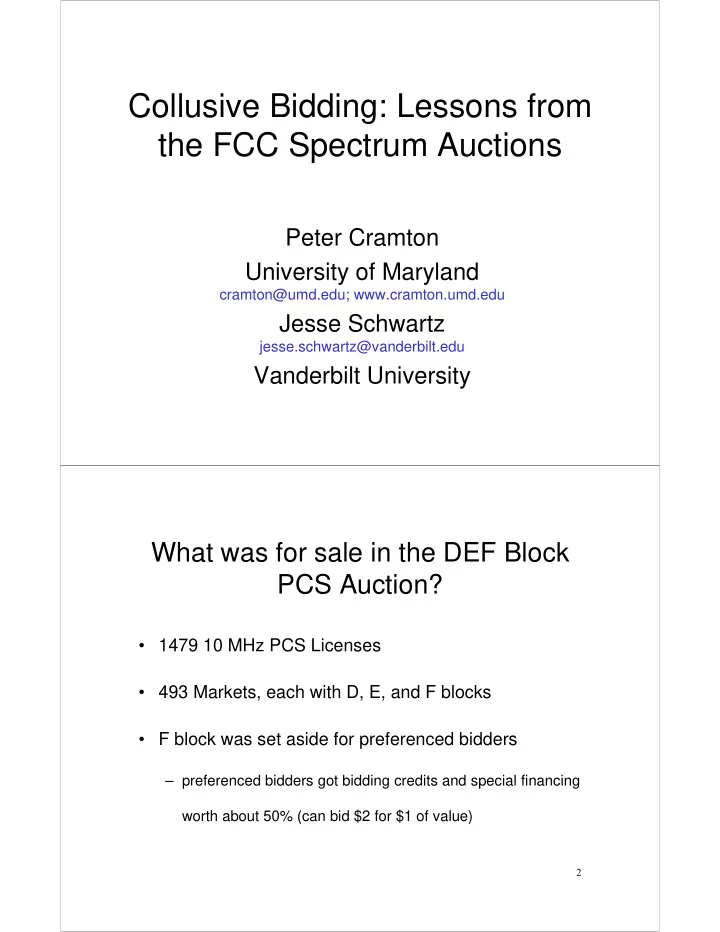
What was for sale in the DEF Block PCS Auction?

  • 1479 10 MHz PCS Licenses
  • 493 Markets, each with D, E, and F blocks
  • F block was set aside for preferenced bidders

– preferenced bidders got bidding credits and special financing worth about 50% (can bid $2 for $1 of value)

slide-2
SLIDE 2

3

How were the licenses sold?

  • Simultaneous ascending auction
  • Bids submitted privately
  • After each round, all bids are shown with

– bidder numbers – market numbers and block

  • Stopping rule: auction ends when no new bids on any

license

4

The Dark Side of a Simultaneous Ascending Auction

  • “Negotiation” with other bidders

– Auction ends when all agree how licenses should be split up – Can only communicate with bids

  • Use retaliation to coordinate on a split

(coordinated demand reduction)

  • Use code bids to make retaliation clear
slide-3
SLIDE 3

5

Example of Code Bidding

Marshalltown, IA Rochester, MN Waterloo, IA 283 E 378 D 452 E Round McLeod USWest McLeod USWest AT&T McLeod USWest 24 56,000 287,000 … … … 46 568,000 52 689,000 55 723,000 58 795,000 59 875,000 313,378 60 345,000 62 963,000 64 62,378 1,059,000 65 69,000 68 371,000

6

Example of Retaliation

Canton, OH Harrisburg, PA 65 F 181 F Round NextWave NorthCoast OPCSE NextWave NorthCoast 56 358,000 1,217,000 57 409,011 78 460,000 82 511,011 125 562,000 136 618,011 158 680,000 159 748,011 160 861,000 161 1,339,011 162 1,473,000 163 947,011

slide-4
SLIDE 4

7

Market Design Issue: How much information to reveal?

  • Displaying entire bid allows code bidding
  • Displaying bidder identities facilitates retaliation
  • Concealing bidder identities has costs

– bidder may care which markets competitor wins – transparency of auction is sacrificed – savvy bidders may still find ways to retaliate

8

Preview of Results

  • Code bidding & retaliation used to win in 20

markets

  • Prices were not significantly lower in these

markets

  • Bid signaling appears effective at achieving

lower prices

– Signalers won 40% of spectrum – Signalers paid 36% less per pop on D&E blocks – Signalers paid 18% less per pop on F block

slide-5
SLIDE 5

9

Why study DEF Block Broadband PCS Auction?

  • Ripe for bid signaling to be effective

– Many small licenses – Weak competition – No reserve prices

  • Mercury was fined $650,000 for making 13 code bids

(fine dropped later due to insufficient notice)

  • USWest and Western Wireless fined $2.4 million for

voice mail on bidding strategy

10

Bouts of Retaliation in the BTA DEF Auction With Code Bids Without Code Bids Blocks D and E F D and E F Total Successful 5 7 3 4 19 Unsuccessful 3 8 4 3 18 Total 8 15 7 7 37 The Main Retaliating Bidders Bouts Initiated With Code Bids Without Code Bids Total 21Century 3 3 AT&T 1 3 4 Mercury 7 1 8 NorthCoast 5 5 OPCSE 7 1 8 USWest 3 1 4

slide-6
SLIDE 6

11

Was bid signaling effective?

  • Were prices surprisingly low in markets with bid

signaling?

  • Did signaling bidders pay significantly lower prices?
  • We estimate prices with model similar to the

benchmark model of Ausubel-Cramton-McAfee- McMillan “Synergies” paper (JEMS, 97)

12

Price Regressions for D & E Blocks

Log of DE Price ($/pop) OLS 2SLS Variable (4) (5) 0.345

  • 0.089

Log of net C price ($/pop) (4.16) (0.71)

  • 0.054

0.022 Log of AB price ($/pop) (0.72) (0.37) 0.377 0.211 Cumulative number of bidders

  • n DE blocks in first 5 rnds

(9.45) (3.86) 0.091 0.012 Log of population density (2.25) (0.31) 1.557 0.687 Ten-year population growth, 1990-1999 (3.52) (1.70) 0.453 0.086 Microwave links per hundred million people (2.49) (0.52) 0.049 0.123 Log of 1994 population (0.97) (2.77)

  • 0.922
  • 1.079

Fraction of households with annual income > $35k (1.51) (2.36)

  • 2.021
  • 0.895

Constant (4.13) (1.69) 0.658 Predicted value of the log of F-block net price ($/pop) (3.66) Sample Size 473 473 R2 0.323 0.630 Goldfeld-Quandt F-Statistic 1.310 0.469 p-value of Goldfeld-Quandt 0.051 0.999

slide-7
SLIDE 7

13

Signaling Bidders Paid Less

Per Capita Price Differences Between Signaling and Nonsignaling Bidders D and E Blocks Means Not Controlling for Market Characteristics Means Controlling for Market Characteristics OLS OLS OLS 2SLS Bidder Type (1) (2) (3) (4) Signaling $2.45 $3.05 $3.06 $2.38 Nonsignaling $5.47 $4.42 $4.41 $5.59 Price Difference 76% 37% 36% 80% F Block Means Not Controlling for Market Characteristics Means Controlling for Market Characteristics OLS OLS 2SLS Bidder Type (1) (3) (4) Signaling $1.67 $1.23 $1.46 Nonsignaling $1.65 $1.47 $1.77 Price Difference

  • 1%

18% 19%

14

Further Evidence of Retaliation: Bidders avoid AT&T

Do Bidders Avoid AT&T more than Small Bidders? AT&T Five Small Bidders1 Test Statistic for Comparison of Means Other Block is 25% More Expensive Number of Bids on Other Block 140 16 Number of Bids on Less Expensive Block 307 71 Percent Bid on Other Block 31.3% 18.4% 2.75 Other Block is 50% More Expensive Number of Bids on Other Block 73 7 Number of Bids on Less Expensive Block 203 41 Percent Bid on Other Block 26.5% 14.6% 2.07

Notes:

1The five smaller bidders are ACCPCS, Comcast, Rivgam, PAccess, Touch, each of whom won

between 9 and 14 licenses. AT&T won 223 licenses.

slide-8
SLIDE 8

15

Conclusions

  • Lots of signaling

(90+ code bids, 55+ retaliations)

  • Strong incentives for coordinated demand

reduction when competition is weak

  • Revenue effects may be large

– signaling bidders won 40% of spectrum – signaling bidders paid 36% less on DE and 18% on F

16

Recommendations

  • If weak competition, make it harder for

bidders to split up licenses

– Eligibility ratio = (total eligibility)/(total spectrum available) – Eligibility ratio < 2 suggests weak comp.

  • Use higher reserve prices
  • Use an anonymous auction
  • Auction large geographic areas
  • Use package bidding