
SLIDE 1
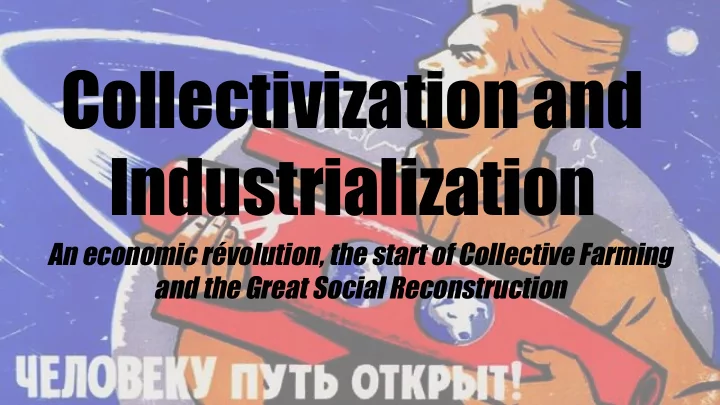
Collectivization and Industrialization
An economic révolution, the start of Collective Farming and the Great Social Reconstruction
Collectivization and Industrialization An economic rvolution, the - - PowerPoint PPT Presentation
Collectivization and Industrialization An economic rvolution, the start of Collective Farming and the Great Social Reconstruction Economic Aims An economical revolution Agricultural and industrial methods were to be changed
An economic révolution, the start of Collective Farming and the Great Social Reconstruction
Economic Aims
○ Agricultural and industrial methods were to be changed
agrarian to industrial
○ Stalin: resolution to reality
○ Collectivization ○ Industrialization
○ Selfish, manipulative, careful ○ Wanted this event to propulse him as a revolutionary hero (like Lenin) In 1934, Russia was 100 years behind Europe in terms of industrialization and technology. Stalin wanted to fix that in 5 years through his Economic Plan.
What is Collectivization
industry, LAND needed to be used
○ Forced 25 million peasant households into 240 000 collective farms
○ No more Orthodox churches, no more village commune ○ Millions died and millions fled into industrial cities
○ KOLKHOZY (Collective Farms) ○ SOVKHOZY (State Farms)
Collective Farming: Kolkhozy
Kolektivnoe Khozyaistvo
COLLECTIVE FARMING
Collective Farms (Kolkhozy)
State Farming: Sovkhozy
Sovetskoye Khozyaistvo
SOVIET FARMING
State Farms (Sovkhozy)
Almost no difference between the two different types of farming as both of them had one ultimate goal: to eliminate private ownership altogether and to benefit the state.
○ SURPLUS OF FOOD THAT COULD BE SOLD ABROAD ○ DECREASE NUMBER OF RURAL LABOURERS AND INCREASE NUMBER OF FACTORY WORKERS
Stalin Talking About Collectivization in Pravda
Stalin, in an article entitled ‘Year of the Great Breakthrough’, Pravda, 7th November 1929 “From small, backward, individual farming to large-scale, advanced, collective
that the peasants are joining the collective farms not in separate groups, but in whole villages, whole regions, whole districts, and even whole provinces… We are becoming a country of metal, an automobilised country; a tractorised country. And when we have put the USSR on an automobile, and the muzhik [peasant] on a tractor, let the esteemed capitalists, who boast their ‘civilisation’, try to overtake us.”
“Day of harvest and collectivization” celebration of kolkhozes
“Against the kulaks let’s rise as a collective harvesting front”. All peasants increase your sowing, use technology, strengthen your property and establishment.
“In our kolkhoz there is no room for kulaks or popes” “Work hard all year long and bread will come your way”
Statue: Worker and Kolkhoz Woman
{Rabotnik i Kolkhoznitsa} A statue created in 1937 by Vera Mukhina, was awarded the Stalin Prize in 1941 and became the symbol of the film production company: Mosfilm, in 1947.
Kulaks
peasants)
○ NOT TRUE ○ It was forced
revolution
○ According to Stalin they were the ones to monopolize the best land and to employ the cheapest peasants ○ Hoarded farm produce and kept food prices high ○ Made themselves “rich” at the expense of workers and poor peasants
○ They were peasants who worked hard and proved to be more efficient
class
○ Millions of people suddenly found themselves labelled as Kulaks because Stalin needed their land and resources
○ Tsarist times ○ Notion of Kulak was very powerful ○ Provided grounds for coercion of peasantry altogether
Stalin while visiting Siberia in January, 1928
Talking to the administrators “You have a bumper harvest… Your grain surpluses this year are bigger than ever
kulak farms: their barns and sheds are crammed with grain… You say that the kulaks are unwilling to deliver grain, that they are waiting for prices to rise, and prefer to engage in unbridled speculation. That is true. But the kulaks… are demanding to increase in prices to three times those fixed by the government… But there is no guarantee that the kulaks will not again sabotage the grain procurements next year. More, it may be said with certainty that so long as there are kulaks, so long will there be sabotage of grain procurements.”
Anti-Kulak Propaganda
“The kulaks are the most violent, most rude and most beastly
landowners, tsars, popes and capitalists. Go! Kulaks must leave the kolkhozes!” “The kulaks are our worst
for the in our Soviet! Let’s improve the Village Council, the organizer and administrator of the kolkhoz construction!”
Dekulakization
○ They could finally rat out their neighbors for being wealthier ○ Land and property was to be taken from the better-off peasants
○ Modelled gangs that persecuted the peasants during the Civil War
○ Served as warning ○ Set fear into people
“Most party officers thought that dekulakization was valued as an administrative measure, speeding up collectivization.”
Served as warning for peasants to not resist to the state. Showed consequences.
Resistance from the People
up to the government
○ Stalin wanted to bring communist economy back entirely and people were against ○ Peasants were tied like serfs to nobility over centuries ○ Lenin previous Decree on Land heightened this attachment
○ Peasants burned their own stock ○ Slaughtered their own livestock ○ Tied themselves to barns when police attempted to drag them away from their land
Between December 1929 and March 1930, half the peasant farms in USSR were collectivized. Peasants resisted. “Civil war” broke out in the countryside.
mass disturbances increased from 172 (first half of 1929) to 229 (second half of 1929)
Women
In Okhochaya (Ukrainian village) an eyewitness described a vicious scene where women broke into barns where requisition squads left the grain seized from the peasants:
“...they were screaming, wailing and demanding their cows and seed back. Men stood off to the side, silent … The terrified granary man (guard) ran away: the women tore off the bolts and together with the men began dragging
○ The women were the organizers of households ○ First to suffer harsh losses ○ So they were the first to take action
“My wife does not want to socialise our cow”
○ Court records proved that
COLLECTIVIZATION
By the end of 1930s all peasantry was collectivized
Collectivization Statistics
collectives
year by 50%
(more than in collective farms)
21% by January of 1930
Nikolai Bukharin Bukharin was against collectivization. Stalin’s decision to proceed with his method drove the two men apart and Bukharin was then expelled of the Politburo in 1929.
After Bukharin’s expulsion from the Politburo...
Stalin decided to proceed with war against the kulaks, and the following month he made a speech where he argued: "Now we have the opportunity to carry out a resolute offensive against the kulaks, break their resistance, eliminate them as a class and replace their production with the production of kolkhozes and sovkhozes… Now dekulakization is being undertaken by the masses of the poor and middling peasant masses themselves, who are realising total collectivization. Now dekulakization in the areas of total collectivisation is not just a simple administrative measure. Now dekulakization is an integral part of the creation and development of collective farms. When the head is cut off, no one wastes tears on the hair."
According to Simon Sebag Montefiore, the author of Stalin: The Court of the Red Tsar (2003), the kulaks were divided into three categories: Thousands of kulaks were executed and an estimated 5 million were deported to Siberia or Central Asia. Approximately 25% of these died by the time they reached their destination.
January 1930: Politburo approves liquidation of kulaks as a class (Vyacheslav Molotov was put in charge of the operation)
1. To be eliminated 2. To be imprisoned in camps 3. 150 000 households to be deported Molotov oversaw death squads, railway carriages, concentration camps. 5-7 million people fit into the 3 categories.
Historical Perspectives: Why Stalin called a sudden end to Collectivization in 1930
Beginning of 1930: 55% farmland collectivized but in March Stalin announced that collectivization was voluntary and in Dizzy With Success (Pravda) he accused party officials of excessive force.
Most historians interpreted this as cynical ploy to encourage peasants to cooperate so that success
compromised by upheavals. Others, such as Lynne Viola, argue that collectivization did get out of control: that Stalin was trying to reassert central gov’s control over local activists in order to end the chaotic conditions in countryside.
Reinstallation of Forced Collectivization
○
○ Peasants had to deliver a set amount of produce at prices set by the state ○ Allowed to retain surplus grain ○ Had to pay the Motor Tractor Stations from which they rented tractors
Upheaval and Starvation
cooperate
slaughtered their own livestock
○ No crops or animals left
could not make the livestock come back to life
the land themselves but their inability and ignorance only contributed to the chaos
As ironic as it is, even as starvation set in the grain that was being produced was exported as “surplus” to
industry demanded. By 1932 the situation was catastrophic.
The 1932-1933 Famine
million)
Disruption caused by collectivization + peasant resistance = falling grain output = FAMINE
production amongst peasants)
○ Migration into industrialized areas increased dramatically ○ System of internal passports had to be created to control the flow
suffered the most
1930s
Official Silence
○ More than political significance ○ Protected Stalin as a great planner ○ Prevented introduction of measures to get rid of distress
FAMINE DID NOT OFFICIALLY EXIST = STATE COULD NOT PUBLICLY TAKE STEPS TO RELIEVE IT
the famine of 1921)
Isaac Deutscher: Former Trotskyist
“The first purely man-made famine in history” went unacknowledged in order to avoid discredditing Stalin
Strong rumour that Stalin’s second wife Nadezhda Alliluyeva committed suicide because she found out about her husband’s sins and mistreatment of the nation
○ Alliluyeva and Stalin had a morbid relationship ○ She convinced him to let her study at the University of Moscow in 1929, strong character ○ Big mistake on Stalin’s part ○ By communicating with university folks Alliluyeva’s eyes were opened to the real situation within the country ○ Before that she was only given information through political speeches and what was published in the newspaper ○ Now she knew how much the nation suffered ○ Her death was covered up ○ Rumours: apendicitis, health problems He was terrible towards his own wife: brought mistresses home to his Dacha, had affairs, called his own wife a fool, disrespected her
Nadezhda Alliluyeva about Stalin
His Cruelty Confirmed
LYNNE VIOLA confirmed the horrific character of Stalin’s treatment of peasantry
exile as slave labourers, a quarter of them dying of hunger
historian to chart Stalin’s brutalities)
sympathisers who claimed that Stalin was creating a paradise on Earth
Were Stalin’s Collectivization aims achieved?
YES
1. Party had control over peasants and
collectivization as a new form of “serfdom”. 2. State controlled grain supplies. 1928: state
40%. 3. State was able to feed industrial workers (only after 1935). More could be exported abroad in order to purchase machinery for
a year 1931-1932. Famine: 2 million tonnes
4. Collectivization = increase in urban
NO
1. Grain production and agricultural productivity only increased marginally a. 1913: produced 0.5 tonnes of grain/head b. 1937: produced 0.57 tonnes grain/head 2. Collectives remained inefficient in long
grain from Canada and USA. 3. Livestock levels fell massively. Did not fully recover till 1950s. Early 1930s: peasants had slaughtered 65% of their sheep and 46% of their cattle.
Debate: Did the policies benefit the Soviet Union and its people or were they introduced by Stalin primarily to consolidate his political holds on the USSR?
Alec Nove: Argued that Stalin’s collectivization and industrialization policies were bad economics. Caused misery on peasants without bringing the industrial growth that the nation needed. Living standards of factory workers in 1953 were barely higher than in 1928. Farm workers living standards were lower than in 1913. Dmitri Volkogonov: Real purpose of Stalin’s policies was incidentally economic: Soviet leader’s aim was to remove all opposition by making his economic policies a test of loyalty. To question his plans was to challenge his authority.
David Hoffman: Argues that Stalin’s use of coercion in seeking economic and social change proved both inhumane and ineffective. Terry Martin: Pointed out paradox in Stalin’s attempt to modernize USSR. Stalin’s methods did not take the country Soviet Union forward but returned it to neotraditionalist ways. His programmes of collectivization and industrialization became heavily dependent on blat: just the same way that Tsarist capitalism had been. Robert Service: Economy was disrupted. Ukraine, South Russia and Kazakhstan were starving. The Gulag heaved with prisoners … Yet the USSR under Stalin was going decisively in the direction of industrialization. The gamble was paying
Stalin’s views on Rapid industrialization
➢ Leon Trotsky, Gregory Zinoviev, Lev Kamenev and
been in favour of the rapid industrialisation of the Soviet Union. ○ Stalin disagreed with this view. He accused them
declared that it was vitally important to : "preserve the alliance between the workers and the peasants." However that changed:
Why?
1. When Stalin accepted the need for collectivisation he also had to reconsider industrialization. His goals of collectivisation, he learned, would require 250,000 tractors. In 1927 they had only 7,000. As well as tractors, there was also a need to develop the oil fields to provide the necessary petrol to drive the
to be built to supply the farms with electricity. 1. 2. Kotkin: “In the arguments during the power struggles of the nineteen-twenties, he had used his support for the nep to isolate its left-wing critics, notably Trotsky, but
became a critic, too. He believed that another European war was coming, and that, in order to survive it, backward Russia would have to industrialize.” (How Stalin Became a Stalinist)
Political Motives:
➢ James William Crowl has argued there were political reasons for the introduction of the Five Year Plan: ○ "Stalin With the defeat of Trotsky and the Left Wing in 1927, Stalin apparently began to look for a way to
Right Wing led by Bukharin, Rykov and Tomsky. It was not by accident that the economy provided him with the issues he needed to destroy his erstwhile allies”
Stalin’s Rapid Industrialization of Russia:
➢ Stalin’s industrialization was planned as a series of five-year programs for industrial expansion. A five-year plan became the “law” of the life of Soviet society. ○ The transition to centralized directive planning led to the revival of certain characteristics of the war communism era. ○ It entailed the elevation of the role of the Gosplan—the state planning authority—that had been in existence since the early 1920s. Gosplan was directly subordinated to the government and charged with drawing up the five-year-plans in accordance with the leadership’s political
whole of Soviet industry. ➢ Finally, the doctrine of “socialist industrialization” put great emphasis on a massive expansion of heavy industry, particularly the means of production, as a necessary first step on the way to the technological restructuring of the entire economy. Only after a massive surge in heavy industrial capacity had been achieved would it be possible to embark on a more balanced economic strategy.
The first Five Year Plan that was introduced in 1928, concentrated on the development of iron and steel, machine-tools, electric power and transport. Stalin set the workers high targets.
Kotkin on the Goals of the Five Year Plans:
“The five-year plans laying out the targets for the Soviet economy were full of exaggerations and fantasies, but the Soviets really did build a steel industry and an auto industry; they constructed canals and railroads; they mined nickel in the Arctic and gold in the Far East and coal in the Donbass.” (How Stalin Became a Stalinist, Keith Gessen)
“No comrades... the pace must not be slackened! On the contrary, we must quicken it as much as is within our powers and possibilities. (...) Either we do it or they crush us.” – Stalin 1931
Sergo Ordzhonikidze and Yuri Pyatakov
➢ In 1932 Ordzhonikidze became Commissar for Heavy Industry. Yuri Pyatakov, was appointed his deputy. The two men had the important task of making the Five Year Plan a success. ➢ Robert Conquest argues that Ordzhonikidze relied heavily on his deputy for the skill and knowledge needed to create and implement the five year plans. ➢ This may be because while Ordzhonikidze and Stalin go back to before the Revolution, Pyatakov was actually expelled from the party in 1928 for being a “trotskyite”. ○ He was later reinstated and Stalin assured Ordzhonikidze that Pyatakov would not be assassinated. Regardless, Pyatakov would have been a controversial choice. ➢ Also, positions in the politburo were generally given based less on qualification and more on other factors.
The beginning of the First Five Year Plan:
➢ The first Five-Year Plan did not get off to a successful start in all sectors: For example, the production of pig iron and steel increased by only 600,000 to 800,000 tons in 1929, barely surpassing the 1913-14 level. ➢ Only 3,300 tractors were produced in 1929. The output of food processing and light industry rose slowly, but in the crucial area of transportation, the railways worked especially poorly. ○ "In June, 1930, Stalin announced sharp increases in the goals - for pig iron, from 10 million to 17 million tons by the last year of the plan; for tractors, from 55,000 to 170,000; for other agricultural machinery and trucks, an increase of more than 100 per cent."
Unskilled workers and poor machinery:
“And when we have put the USSR on an automobile, and the muzhik [peasant] on a tractor” – Stalin, in an article entitled ‘Year of the Great Breakthrough’, Pravda, 7th November 1929 At the beginning the quality of work was poor, the were inefficient. This is because they were creating the industry from nothing. Meaning, the workers were illiterate peasants (muzhik) and their machines were not of a high quality.
The First Five Year Plan End (1932)
“The five-year plan in four years!” (Kind of)
➢ At the end of 1932, it was officially announced that the overall objectives of the First Five-Year Plan had been achieved ahead of time. ○ Even now, after seven decades, it is difficult to judge to what extent the triumphant declaration corresponded to reality. ○ The newspapers were allowed to report only “outstanding achievements” of the USSR’s advance toward socialism. Local state agencies were prohibited from publishing any economic data apart from the official figures issued by the Gosplan. ■ According to these, the output of machinery and electric equipment expanded by 157 percent over the 1929 level.
The First Five Year Plan End (1932) cont.
➢ Whatever the veracity of the Soviet statistics, in the industrial field the overall achievements of the plan were impressive: ○ Two new important industrial centers were established, one in the Urals (Magnitogorsk) and the other in southern Siberia (Kuznetsk). ○ Entirely new branches of industry were developed, such as aviation, plastics, and synthetic rubber. The plan constituted an important milestone in the process of the socioeconomic transformation of Russia.
Non-Soviet Marxists, from the Mensheviks to Herbert Marcuse:
➢ Accept that industrialization is needed, BUT:
○ Much of the appeal of the literature inspired by Trotsky came from its identification of an alien stratum (or class) of bureaucrats that exploited the Soviet workers. ○ Here the essentially manipulative and exploitative nature of Stalinist industrialization has been challenged as excessively repressive, unnecessary, and fundamentally anti-Marxist.
The Second Five Year Plan
➢ The Second Five-Year Plan—from January 1933 to December 1937—also gave priority to heavy industry. ○ One of the weaknesses revealed during the First Five-Year Plan was that of the Soviet infrastructure, especially roads, railways, and canals. ➢ Consequently, the second plan also provided for reconstruction and double tracking of the principal lines, starting with the Trans-Siberian Railway. ➢ The widening of old canals and the construction of new ones (like the Moscow-Volga canal) was another vital task assigned to the new plan. ➢ By 1933 the altered international position of the USSR resulting from Hitler’s seizure of power was reflected in a rapid expansion of armament production. The armed forces were gradually reshaped into an increasingly professional, modern fighting machine, comparable to those of other great powers. Between 1933 and 1936, the size of the Red Army tripled, from 562,000 to 1.5 million, exceeding the size of the imperial army in 1913.
*Stalin justified his policies with the fear of war, so this is important.
The Second Five Year Plan (cont.)
➢ As with the First Five-Year Plan, the second was also officially declared completed nine months ahead of time, in 1937. Again, however, not all of its goals were achieved. ➢ Among the items that surpassed their estimated targets were steel and the automotive industry, created practically from scratch. Tanks and armored cars were given priority over civilian vehicles. The most striking failure was consumer goods production. ➢ The first two five-year plans increased the industrial capacity of the USSR dramatically in all major fields—steel, coal, and electric power—and created new manufacturing sectors indispensable to any great power—automobiles, aviation, chemicals, and plastics. Consequently, the first two five-year plans laid the foundation of the industrial might of the Soviet Union, especially in the military field.
The Third Five Year Plan 1938-1942
➢ The Third Five Year Plan was, much like the second, was focused heavily on military production. This reflected the international climate, as the world prepared for the second world war. ➢ To give Russian time to advance their industrialization, and restrengthening of the military Stalin made the “brilliant” (Kotkin) strategic move of signing the Nazi-Soviet non-aggression pact in 1939. ○ This delayed the war in Russia by two years. Giving them adequate time to prepare for Hitler’s inevitable breaking of the pact, in 1941. ➢ The third five year plan was disrupted by the Nazi invasion
the Germans.
Disagreement
Since both ideology and reality compelled the choice for industrialism the disagreement came from the methods.
How did Stalin find the resources to industrialize?
1. The revenues from light industry and, in particular, from agriculture were to be used to finance the expansion of the industrial branches of the economy. 2. Hard currency earnings from the state monopoly on foreign trade, including the export of grain, timber, gold, furs, and other goods, were to be used to buy state-of-the-art equipment for the newly constructed industrial enterprises. 3. The surviving Nepmen were to be subjected to heavy taxes. The crippling taxation of private enterprise together with the mounting administrative pressure would stifle private initiative in both industry and commerce by 1933. . . . Additional savings were to be gained by reducing the output of consumer goods and by restricting food consumption of both the urban and rural populations. This was to be achieved by raising retail prices, using goods rationing, and similar measures. Capital was forcibly squeezed out of the reluctant population, mainly the peasantry, through an arbitrary price system.
British Embassy report (21st June 1932) “A record of over-staffing, overplanning and complete incompetence at the centre; of human misery, starvation, death and disease among the peasantry... the only creatures who have any life at all in the districts visited are boars, pigs and other swine. Men, women, and children, horses and
shall at least succeed on paper.”
Method (Carrot):
➢ One of the most controversial aspects of the Five Year Plan was Stalin's decision to move away from the principle of equal pay. Under the rule of Lenin, for example, the leaders of the Bolshevik Party could not receive more than the wages of a skilled labourer. ➢ With the modernization of industry, Stalin argued that it was necessary to pay higher wages to certain workers in order to encourage increased output: ○ His left-wing opponents claimed that this inequality was a betrayal of socialism and would create a new class system in the Soviet Union. Stalin had his way and during the 1930s, the gap between the wages of the labourers and the skilled workers increased.
Stakhanovism
➢ Shock brigades were formed with the best workers on the highest rates. ○ 'Socialist competition' between factories and work brigades was encouraged to raise output, with league tables, medals and rewards for productivity ➢ Stakhanovism (after the 'model' coalminer Aleksei Stakhanov who broke all records in 1935 by mining 102 tons of coal in less than six hours).
Propaganda and Popular Support:
➢ Ultimately, the most crucial resource of Stalin’s industrialization was the abundance and inexhaustibility of cheap labor. ○ It was provided by millions of trained workers, by millions of peasants driven to towns by the collectivization, by millions of labor camp inmates, and by 1.5 million of the former unemployed (unemployment disappeared in 1930). ➢ Many were driven by enthusiasm, prepared to sweat at construction sites around the clock virtually for free. ○ Young people, in particular, were deeply motivated by the idea that it was possible to build a better and fairer society relatively quickly, within their lifetime, by mounting a huge exhausting effort and accepting hardships and self-sacrifice.
A joke reflecting the Russian mentality:
A Frenchman, a Brit, and a Russian are admiring a painting of Adam and Eve in the garden of Eden. The Frenchman says, "they must be French, they're naked and they're eating fruit." The Englishman says, "clearly, they're English; observe how politely the man is offering the woman the fruit." The Russian notes, "they are Russian, of course. They have nothing to wear, nothing to eat, and they think they are in paradise."
Methods to increase productivity (Stick):
➢ Every factory had large display boards erected that showed the output of
criticized and humiliated. ➢ Some workers could not cope with this pressure and absenteeism increased. This led to even more repressive measures being introduced. ➢ Records were kept of workers' lateness, absenteeism and bad workmanship. If the worker's record was poor, he was accused of trying to sabotage the Five Year Plan and if found guilty could be shot or sent to work as forced labour on the Baltic Sea Canal or the Siberian Railway.
THE GULAGS, LABOUR CAMPS AND WORKING CONDITIONS
Some of this work was done by Gulag slave labor; the rest was done by poorly paid workers living in tents and makeshift dormitories.
By the exercise of ruthless dictatorial power, Stalin succeeded in diverting a huge percentage
and defense purposes.
Bukharin and The Right
➢ Bukharin wrote an article, Notes of an Economist: ○ He criticised what he called the Five Year Plan as "super-industrialisation". According to Bukharin, this policy was "Trotskyist and anti-Leninist". ○ He argued that only a "balanced, steady relationship between the interests of industry and agriculture would secure healthy economic development". Stalin disagreed with Bukharin. He believed that fast industrial progress would provide military security. Stalin felt so strongly about this that he was willing to crush anyone who stood in the way of the policy.
Contradictions (Ideology?):
Stalin originally called Leon Trotsky, Gregory Zinoviev, Lev Kamenev anti-Lenin, because industrialism would destroy “the alliance between the workers and the peasants.” Stalin’s harsh (cruel) policies, which destroyed said alliance, and his decision to abolish equal pay was inherently anti-marxist and anti-leninist. As a part of collectivisation Stalin made it imperative to abolish the “kulaks” as they were richer than the others, thus oppressive to the lower
increase productivity, Stalin introduced higher pay for more productive workers. Creating socio-economic division, and a new class.
Societal Effects
Industrial expansion and often forcible relocation involved a massive shift of sometimes unwilling citizens, mostly from the countryside to the cities. Between 1926 and 1939 the overall percentage of urban dwellers nearly doubled, from 18 to 33
people moved from the countryside to the cities. History had rarely seen migrations on such a scale. Most of the migrants left the countryside during the first five-year plan as a result of the collectivization and the policy of “liquidation of the kulak as a class.” The dramatic increase in the number of city dwellers represented in itself a major aspect of the Stalin revolution, leading to rapid urbanization of Soviet society.
Societal effects cont.:
➢ As a result, living standards of blue- and white-collar workers plummeted two- or threefold. ➢ Consumer goods production all but ceased, and every available resource was pressed into the program of rapid industrial expansion in capital-intensive heavy industry, such as steel, coal, and machinery.
Magnitogorsk, a new industrial city in the 1930s
Traditional Perspective:
➢ The first three Five-Year Plans succeeded in developing heavy industry to the point where it was ultimately responsible for the survival of the Soviet Union during the Second World War. ➢ It managed to do this without having to resort to any sort of dependence on outside investment; success was achieved by exploitation of the Soviet population. ○ Peasants were obliged to subsidise industrial growth through the sacrifice of their profits in agriculture, while peasants and workers alike had to give up any hopes of acquiring consumer goods as heavy industry took priority over light industry. In other words, Stalin’s economic policy was ruthless but arrived at an effective industrial outcome.
Eugene Lyons (Assignment in Utopia):
➢ “ Was the first Five Year Plan a "success"? For whom and for what? ○ Certainly not for the socialist dream, which had been emptied of human meaning in the process, reduced to a mechanical formula of the state as a super-trust and the population as its helpless serfs. ○ Certainly not for the individual worker, whose trade union had been absorbed by the state-employer, who was terrorized by medieval decrees, who had lost even the illusion of a share in regulating his own life. Certainly not for the revolutionary movement of the world, which was splintered, harassed by the growing strength of fascism, weaker and less hopeful than at the launching of the Plan. Certainly not for the human spirit, mired and outraged by sadistic cruelties on a scale new in modern history, shamed by meekness and sycophancy and systematized hypocrisy. ➢ If industrialization were an end in itself, unrelated to larger human ends, the U.S.S.R. had an astounding amount of physical property to show for its sacrifices.
”
Soviet commentators: view the industrial revolution carried out by the
Stalinist party/state as an enormous achievement (dostizheniye) essential both to the economic and social modernization.
SOVIET PERSPECTIVE: GORBACHEV
"when the feeling of the threat of imperialist aggression was growing rapidly the Party strengthened its conviction that it was necessary not just to cover but to literally race across, in the shortest possible historical span, the distance from the sledgehammer and the peasant's wooden plow to a developed industry, without which the entire cause of the Revolution would have inevitably perished." – GORBACHEV
Russell J Tarr
PEOPLE VERSUS PROGRESS
Key question: Could the USSR have closed the economical gap with the West without Stalin’s methods?