SLIDE 1
UNIVERSITA’ DEGLI STUDI DI PARMA AI*IA 2015 Conference - Ferrara, 23/9/2015 M. Amoretti, S. Cagnoni
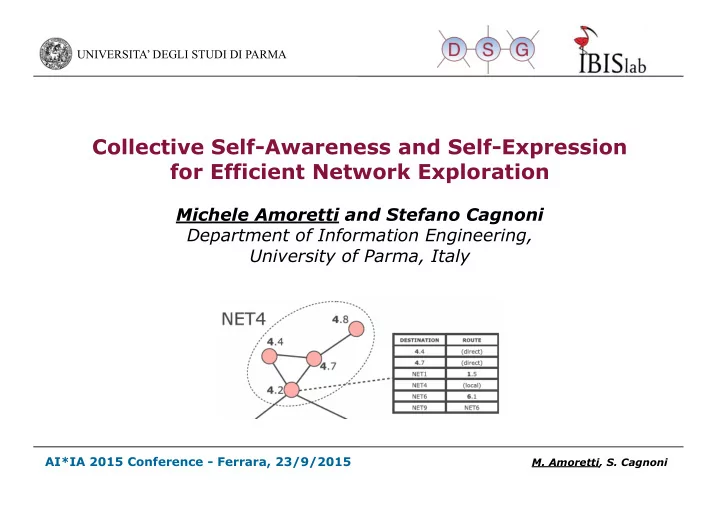
Collective Self-Awareness and Self-Expression for Efficient Network Exploration
Michele Amoretti and Stefano Cagnoni Department of Information Engineering, University of Parma, Italy
SLIDE 2 UNIVERSITA’ DEGLI STUDI DI PARMA AI*IA 2015 Conference - Ferrara, 23/9/2015 M. Amoretti, S. Cagnoni
Problem Statement
Message broadcasting and topology discovery are classical problems for distributed systems, both of which are related to the concept of network exploration. Decentralized approaches are usually adopted, assuming that network nodes are provided with traditional routing tables.
- Yu, D., Hua, Q.-S., Wang, Y., Yu, J., Lau, F.C.M.: Efficient distributed multiple-
message broadcasting in unstructured wireless networks. In: IEEE INFOCOM, Turin, Italy (2013)
- La, C.-A., Varga, L.-O., Heusse, M., Duda, A.: Energy-efficient multi-hop broadcasting
in low power and lossy networks. In: 17th ACM Int’.l Conference on Modeling, Analysis and Simulation of Wireless and Mobile Systems (MSWiM 2014), Montreal, Canada (2014)
- Khazaei, H., Misic, J., Misic, V.B.: Mobile software agents for wireless network
mapping and dynamic routing. In: IEEE Int’.l Conference on Distributed Computing Systems (ICDCS) Workshops, Genoa, Italy (2010)
SLIDE 3 UNIVERSITA’ DEGLI STUDI DI PARMA AI*IA 2015 Conference - Ferrara, 23/9/2015 M. Amoretti, S. Cagnoni
Proposed Approach
We propose a novel network exploration approach based on collective self-awareness and self-expression, resulting from the simultaneous application of two strategies, namely hierarchy and recursion (HR). HR-based network exploration implies the adoption of unusual routing tables. With respect to traditional approaches, the one we propose may provide distributed systems with improved efficiency and scalability.
- Amoretti, M., Cagnoni, S.: Toward Collective Self-Awareness and Self-Expression in
Distributed Systems. IEEE Computer 48(7), 29–36 (2015)
SLIDE 4 UNIVERSITA’ DEGLI STUDI DI PARMA AI*IA 2015 Conference - Ferrara, 23/9/2015 M. Amoretti, S. Cagnoni
Self-Aware and Self-Expressive Computing
Self-awareness produces behavioral models of the node. Self-expression encompasses goal revision and self-adaptive behavior deriving from reasoning about such models.
- Faniyi, F., Lewis, P.R., Bahsoon, R.,
Yao, X.: Architecting self-aware software systems. In: IEEE/IFIP WICSA 2014, pp. 91–94 Physical Environment Other Nodes Node
Learnt Models Meta-Self- Awareness Internal Sensors External Sensors External Actuators Internal Actuators Goals
Self-Awareness
Stimulus Interaction Time Goal
Self-Expression
SLIDE 5
UNIVERSITA’ DEGLI STUDI DI PARMA AI*IA 2015 Conference - Ferrara, 23/9/2015 M. Amoretti, S. Cagnoni
Collective Self-Awareness and Self-Expression
What about self-awareness and self-expression of a distributed system as a whole? Can actual global self-awareness be achieved only by providing the distributed system with a centralized omniscient monitor? Luckily, the answer is no. In our view, self-expression for ensembles is the assertion of collective self-adaptive behavior, based on collective self- awareness. By means of HR, global self-awareness is available at every node and enables global self-expression.
SLIDE 6 UNIVERSITA’ DEGLI STUDI DI PARMA AI*IA 2015 Conference - Ferrara, 23/9/2015 M. Amoretti, S. Cagnoni
Hierarchy and Recursion (HR)
Hierarchy is the categorization of a group of nodes according to their capability or status. Recursion is the repeated use of a single, flexible functional unit for different capabilities over different scopes of a distributed system. A possible implementation of this principle is recursive networking, developed to describe multi-layer virtual networks that embed networks as nodes inside other networks.
- Touch, J., Baldine, I., Dutta, R., Ford, B., Finn, G.,
Jordan, S., Massey, D., Matta, A., Papadopoulos, C., Reiher, P., Rouskas, G.: A dynamic recursive unified internet design (DRUID). Computer Networks 55(4), 919–935 (2011)
NET1 NET4 NET6 NET9
1.2 1.5 4.2 4.4 4.7 4.8 6.1 6.7 6.4 6.2 9.3 9.6 9.8
DESTINATION ROUTE
4.4 (direct) 4.7 (direct) NET1 1.5 NET4 (local) NET6 6.1 NET9 NET6
SLIDE 7 UNIVERSITA’ DEGLI STUDI DI PARMA AI*IA 2015 Conference - Ferrara, 23/9/2015 M. Amoretti, S. Cagnoni
HR-based Network Exploration
Our HR-based network exploration approach takes subnetworks into account and exploits collective self-awareness. Importantly, the size of the routing table is O(S), where S is the number of subnetworks.
- The neighbor to whom the probe is forwarded belongs to the
same subnetwork of the sender.
- If all neighbors of the same subnetwork have been already
visited, the probe is forwarded to one neighbor from another subnetwork, excluding the previous hop.
- If there is only one neighbor belonging to other subnetworks and
it is the previous hop, then the neighbor that grants access to the longest route is chosen.
SLIDE 8
UNIVERSITA’ DEGLI STUDI DI PARMA AI*IA 2015 Conference - Ferrara, 23/9/2015 M. Amoretti, S. Cagnoni
Performance Evaluation
HR-based network exploration compared to Classical Flooding (CF) and Random Walk (RW), considering BA topology (scale-free) and ER topology (purely random).
SLIDE 9
UNIVERSITA’ DEGLI STUDI DI PARMA AI*IA 2015 Conference - Ferrara, 23/9/2015 M. Amoretti, S. Cagnoni
Conclusion and Future Work
HR-based collective self-awareness and self-expression make it possible to design efficient and scalable network exploration strategies, with limited extra cost in terms of design complexity. Other than network exploration, message routing and distributed computing, also distributed sensing, mapping and geo- localization systems may benefit from collective self-awareness and self-expression. It will be particularly important to find novel strategies for the efficient maintenance of HR-enabling information.