Cohomologically Complete Complexes Amnon Yekutieli Department of - - PowerPoint PPT Presentation

cohomologically complete complexes
SMART_READER_LITE
LIVE PREVIEW

Cohomologically Complete Complexes Amnon Yekutieli Department of - - PowerPoint PPT Presentation

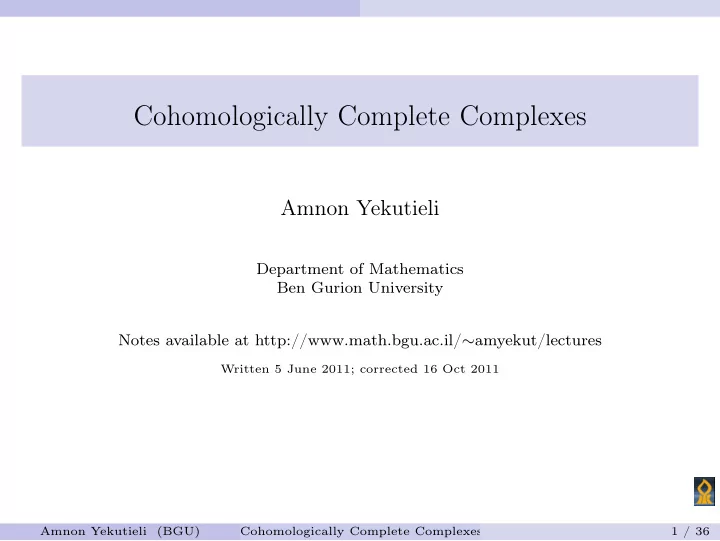
Cohomologically Complete Complexes Amnon Yekutieli Department of Mathematics Ben Gurion University Notes available at http://www.math.bgu.ac.il/ amyekut/lectures Written 5 June 2011; corrected 16 Oct 2011 Amnon Yekutieli (BGU)


slide-1
SLIDE 1

Cohomologically Complete Complexes

Amnon Yekutieli

Department of Mathematics Ben Gurion University Notes available at http://www.math.bgu.ac.il/∼amyekut/lectures

Written 5 June 2011; corrected 16 Oct 2011 Amnon Yekutieli (BGU) Cohomologically Complete Complexes 1 / 36

slide-2
SLIDE 2

Outline

Outline Here is an outline of the lecture:

  • 1. The Completion and Torsion Functors
  • 2. Adically Projective Modules
  • 3. Derived Completion and Torsion Functors
  • 4. MGM Equivalence and GM Duality
  • 5. Derived Localization
  • 6. Cohomologically Complete Nakayama
  • 7. Cohomologically Cofinite Complexes
  • 8. Completion via Derived Double Centralizer

The work discussed here is joint with Marco Porta and Liran Shaul (the paper [PSY]).

Amnon Yekutieli (BGU) Cohomologically Complete Complexes 2 / 36

slide-3
SLIDE 3

Outline

Outline Here is an outline of the lecture:

  • 1. The Completion and Torsion Functors
  • 2. Adically Projective Modules
  • 3. Derived Completion and Torsion Functors
  • 4. MGM Equivalence and GM Duality
  • 5. Derived Localization
  • 6. Cohomologically Complete Nakayama
  • 7. Cohomologically Cofinite Complexes
  • 8. Completion via Derived Double Centralizer

The work discussed here is joint with Marco Porta and Liran Shaul (the paper [PSY]).

Amnon Yekutieli (BGU) Cohomologically Complete Complexes 2 / 36

slide-4
SLIDE 4

Outline

Outline Here is an outline of the lecture:

  • 1. The Completion and Torsion Functors
  • 2. Adically Projective Modules
  • 3. Derived Completion and Torsion Functors
  • 4. MGM Equivalence and GM Duality
  • 5. Derived Localization
  • 6. Cohomologically Complete Nakayama
  • 7. Cohomologically Cofinite Complexes
  • 8. Completion via Derived Double Centralizer

The work discussed here is joint with Marco Porta and Liran Shaul (the paper [PSY]).

Amnon Yekutieli (BGU) Cohomologically Complete Complexes 2 / 36

slide-5
SLIDE 5

Outline

Outline Here is an outline of the lecture:

  • 1. The Completion and Torsion Functors
  • 2. Adically Projective Modules
  • 3. Derived Completion and Torsion Functors
  • 4. MGM Equivalence and GM Duality
  • 5. Derived Localization
  • 6. Cohomologically Complete Nakayama
  • 7. Cohomologically Cofinite Complexes
  • 8. Completion via Derived Double Centralizer

The work discussed here is joint with Marco Porta and Liran Shaul (the paper [PSY]).

Amnon Yekutieli (BGU) Cohomologically Complete Complexes 2 / 36

slide-6
SLIDE 6

Outline

Outline Here is an outline of the lecture:

  • 1. The Completion and Torsion Functors
  • 2. Adically Projective Modules
  • 3. Derived Completion and Torsion Functors
  • 4. MGM Equivalence and GM Duality
  • 5. Derived Localization
  • 6. Cohomologically Complete Nakayama
  • 7. Cohomologically Cofinite Complexes
  • 8. Completion via Derived Double Centralizer

The work discussed here is joint with Marco Porta and Liran Shaul (the paper [PSY]).

Amnon Yekutieli (BGU) Cohomologically Complete Complexes 2 / 36

slide-7
SLIDE 7

Outline

Outline Here is an outline of the lecture:

  • 1. The Completion and Torsion Functors
  • 2. Adically Projective Modules
  • 3. Derived Completion and Torsion Functors
  • 4. MGM Equivalence and GM Duality
  • 5. Derived Localization
  • 6. Cohomologically Complete Nakayama
  • 7. Cohomologically Cofinite Complexes
  • 8. Completion via Derived Double Centralizer

The work discussed here is joint with Marco Porta and Liran Shaul (the paper [PSY]).

Amnon Yekutieli (BGU) Cohomologically Complete Complexes 2 / 36

slide-8
SLIDE 8

Outline

Outline Here is an outline of the lecture:

  • 1. The Completion and Torsion Functors
  • 2. Adically Projective Modules
  • 3. Derived Completion and Torsion Functors
  • 4. MGM Equivalence and GM Duality
  • 5. Derived Localization
  • 6. Cohomologically Complete Nakayama
  • 7. Cohomologically Cofinite Complexes
  • 8. Completion via Derived Double Centralizer

The work discussed here is joint with Marco Porta and Liran Shaul (the paper [PSY]).

Amnon Yekutieli (BGU) Cohomologically Complete Complexes 2 / 36

slide-9
SLIDE 9

Outline

Outline Here is an outline of the lecture:

  • 1. The Completion and Torsion Functors
  • 2. Adically Projective Modules
  • 3. Derived Completion and Torsion Functors
  • 4. MGM Equivalence and GM Duality
  • 5. Derived Localization
  • 6. Cohomologically Complete Nakayama
  • 7. Cohomologically Cofinite Complexes
  • 8. Completion via Derived Double Centralizer

The work discussed here is joint with Marco Porta and Liran Shaul (the paper [PSY]).

Amnon Yekutieli (BGU) Cohomologically Complete Complexes 2 / 36

slide-10
SLIDE 10

Outline

Outline Here is an outline of the lecture:

  • 1. The Completion and Torsion Functors
  • 2. Adically Projective Modules
  • 3. Derived Completion and Torsion Functors
  • 4. MGM Equivalence and GM Duality
  • 5. Derived Localization
  • 6. Cohomologically Complete Nakayama
  • 7. Cohomologically Cofinite Complexes
  • 8. Completion via Derived Double Centralizer

The work discussed here is joint with Marco Porta and Liran Shaul (the paper [PSY]).

Amnon Yekutieli (BGU) Cohomologically Complete Complexes 2 / 36

slide-11
SLIDE 11

Outline

Outline Here is an outline of the lecture:

  • 1. The Completion and Torsion Functors
  • 2. Adically Projective Modules
  • 3. Derived Completion and Torsion Functors
  • 4. MGM Equivalence and GM Duality
  • 5. Derived Localization
  • 6. Cohomologically Complete Nakayama
  • 7. Cohomologically Cofinite Complexes
  • 8. Completion via Derived Double Centralizer

The work discussed here is joint with Marco Porta and Liran Shaul (the paper [PSY]).

Amnon Yekutieli (BGU) Cohomologically Complete Complexes 2 / 36

slide-12
SLIDE 12

Outline

Outline Here is an outline of the lecture:

  • 1. The Completion and Torsion Functors
  • 2. Adically Projective Modules
  • 3. Derived Completion and Torsion Functors
  • 4. MGM Equivalence and GM Duality
  • 5. Derived Localization
  • 6. Cohomologically Complete Nakayama
  • 7. Cohomologically Cofinite Complexes
  • 8. Completion via Derived Double Centralizer

The work discussed here is joint with Marco Porta and Liran Shaul (the paper [PSY]).

Amnon Yekutieli (BGU) Cohomologically Complete Complexes 2 / 36

slide-13
SLIDE 13
  • 1. The Completion and Torsion Functors
  • 1. The Completion and Torsion Functors

Let A be a commutative ring, with ideal a. For an A-module M, its a-adic completion is the A-module ΛaM = M := lim

←i M/aiM.

This is an additive functor Λa : Mod A → Mod A, where Mod A is the category of A-modules.

Amnon Yekutieli (BGU) Cohomologically Complete Complexes 3 / 36

slide-14
SLIDE 14
  • 1. The Completion and Torsion Functors
  • 1. The Completion and Torsion Functors

Let A be a commutative ring, with ideal a. For an A-module M, its a-adic completion is the A-module ΛaM = M := lim

←i M/aiM.

This is an additive functor Λa : Mod A → Mod A, where Mod A is the category of A-modules.

Amnon Yekutieli (BGU) Cohomologically Complete Complexes 3 / 36

slide-15
SLIDE 15
  • 1. The Completion and Torsion Functors
  • 1. The Completion and Torsion Functors

Let A be a commutative ring, with ideal a. For an A-module M, its a-adic completion is the A-module ΛaM = M := lim

←i M/aiM.

This is an additive functor Λa : Mod A → Mod A, where Mod A is the category of A-modules.

Amnon Yekutieli (BGU) Cohomologically Complete Complexes 3 / 36

slide-16
SLIDE 16
  • 1. The Completion and Torsion Functors
  • 1. The Completion and Torsion Functors

Let A be a commutative ring, with ideal a. For an A-module M, its a-adic completion is the A-module ΛaM = M := lim

←i M/aiM.

This is an additive functor Λa : Mod A → Mod A, where Mod A is the category of A-modules.

Amnon Yekutieli (BGU) Cohomologically Complete Complexes 3 / 36

slide-17
SLIDE 17
  • 1. The Completion and Torsion Functors

The surjections M → M/aiM induce a natural transformation τM : M → ΛaM. The module M is said to be a-adically complete if τM is an isomorphism. Some texts would say that “M is a-adically separated and complete”.

Amnon Yekutieli (BGU) Cohomologically Complete Complexes 4 / 36

slide-18
SLIDE 18
  • 1. The Completion and Torsion Functors

The surjections M → M/aiM induce a natural transformation τM : M → ΛaM. The module M is said to be a-adically complete if τM is an isomorphism. Some texts would say that “M is a-adically separated and complete”.

Amnon Yekutieli (BGU) Cohomologically Complete Complexes 4 / 36

slide-19
SLIDE 19
  • 1. The Completion and Torsion Functors

The surjections M → M/aiM induce a natural transformation τM : M → ΛaM. The module M is said to be a-adically complete if τM is an isomorphism. Some texts would say that “M is a-adically separated and complete”.

Amnon Yekutieli (BGU) Cohomologically Complete Complexes 4 / 36

slide-20
SLIDE 20
  • 1. The Completion and Torsion Functors

The a-torsion submodule of M is the submodule ΓaM := {m ∈ M | aim = 0 for some i ≥ 1}. This is an additive functor Γa : Mod A → Mod A. The inclusion σM : ΓaM → M is a natural transformation. The module M is said to be a-torsion if σM is an isomorphism. The torsion functor Γa is idempotent, in the following sense: for any module M, the module ΓaM is a-torsion.

Amnon Yekutieli (BGU) Cohomologically Complete Complexes 5 / 36

slide-21
SLIDE 21
  • 1. The Completion and Torsion Functors

The a-torsion submodule of M is the submodule ΓaM := {m ∈ M | aim = 0 for some i ≥ 1}. This is an additive functor Γa : Mod A → Mod A. The inclusion σM : ΓaM → M is a natural transformation. The module M is said to be a-torsion if σM is an isomorphism. The torsion functor Γa is idempotent, in the following sense: for any module M, the module ΓaM is a-torsion.

Amnon Yekutieli (BGU) Cohomologically Complete Complexes 5 / 36

slide-22
SLIDE 22
  • 1. The Completion and Torsion Functors

The a-torsion submodule of M is the submodule ΓaM := {m ∈ M | aim = 0 for some i ≥ 1}. This is an additive functor Γa : Mod A → Mod A. The inclusion σM : ΓaM → M is a natural transformation. The module M is said to be a-torsion if σM is an isomorphism. The torsion functor Γa is idempotent, in the following sense: for any module M, the module ΓaM is a-torsion.

Amnon Yekutieli (BGU) Cohomologically Complete Complexes 5 / 36

slide-23
SLIDE 23
  • 1. The Completion and Torsion Functors

The a-torsion submodule of M is the submodule ΓaM := {m ∈ M | aim = 0 for some i ≥ 1}. This is an additive functor Γa : Mod A → Mod A. The inclusion σM : ΓaM → M is a natural transformation. The module M is said to be a-torsion if σM is an isomorphism. The torsion functor Γa is idempotent, in the following sense: for any module M, the module ΓaM is a-torsion.

Amnon Yekutieli (BGU) Cohomologically Complete Complexes 5 / 36

slide-24
SLIDE 24
  • 1. The Completion and Torsion Functors

The a-torsion submodule of M is the submodule ΓaM := {m ∈ M | aim = 0 for some i ≥ 1}. This is an additive functor Γa : Mod A → Mod A. The inclusion σM : ΓaM → M is a natural transformation. The module M is said to be a-torsion if σM is an isomorphism. The torsion functor Γa is idempotent, in the following sense: for any module M, the module ΓaM is a-torsion.

Amnon Yekutieli (BGU) Cohomologically Complete Complexes 5 / 36

slide-25
SLIDE 25
  • 1. The Completion and Torsion Functors

This is not true, in general, for the completion functor Λa. Indeed, there is an example of a module M whose a-adic completion ΛaM is not a-adically complete. See [Ye, Example 1.8]. The ring A is this example is A = K[t1, t2, . . .], the polynomial ring in countably many variables over a field K, and a is the ideal generated by the variables. Fortunately we have: Theorem 1.1. If the ideal a is finitely generated, then for any A-module M, the a-adic completion ΛaM is a-adically complete. See [St], or [Ye, Corollary 3.6].

Amnon Yekutieli (BGU) Cohomologically Complete Complexes 6 / 36

slide-26
SLIDE 26
  • 1. The Completion and Torsion Functors

This is not true, in general, for the completion functor Λa. Indeed, there is an example of a module M whose a-adic completion ΛaM is not a-adically complete. See [Ye, Example 1.8]. The ring A is this example is A = K[t1, t2, . . .], the polynomial ring in countably many variables over a field K, and a is the ideal generated by the variables. Fortunately we have: Theorem 1.1. If the ideal a is finitely generated, then for any A-module M, the a-adic completion ΛaM is a-adically complete. See [St], or [Ye, Corollary 3.6].

Amnon Yekutieli (BGU) Cohomologically Complete Complexes 6 / 36

slide-27
SLIDE 27
  • 1. The Completion and Torsion Functors

This is not true, in general, for the completion functor Λa. Indeed, there is an example of a module M whose a-adic completion ΛaM is not a-adically complete. See [Ye, Example 1.8]. The ring A is this example is A = K[t1, t2, . . .], the polynomial ring in countably many variables over a field K, and a is the ideal generated by the variables. Fortunately we have: Theorem 1.1. If the ideal a is finitely generated, then for any A-module M, the a-adic completion ΛaM is a-adically complete. See [St], or [Ye, Corollary 3.6].

Amnon Yekutieli (BGU) Cohomologically Complete Complexes 6 / 36

slide-28
SLIDE 28
  • 1. The Completion and Torsion Functors

This is not true, in general, for the completion functor Λa. Indeed, there is an example of a module M whose a-adic completion ΛaM is not a-adically complete. See [Ye, Example 1.8]. The ring A is this example is A = K[t1, t2, . . .], the polynomial ring in countably many variables over a field K, and a is the ideal generated by the variables. Fortunately we have: Theorem 1.1. If the ideal a is finitely generated, then for any A-module M, the a-adic completion ΛaM is a-adically complete. See [St], or [Ye, Corollary 3.6].

Amnon Yekutieli (BGU) Cohomologically Complete Complexes 6 / 36

slide-29
SLIDE 29
  • 1. The Completion and Torsion Functors

This is not true, in general, for the completion functor Λa. Indeed, there is an example of a module M whose a-adic completion ΛaM is not a-adically complete. See [Ye, Example 1.8]. The ring A is this example is A = K[t1, t2, . . .], the polynomial ring in countably many variables over a field K, and a is the ideal generated by the variables. Fortunately we have: Theorem 1.1. If the ideal a is finitely generated, then for any A-module M, the a-adic completion ΛaM is a-adically complete. See [St], or [Ye, Corollary 3.6].

Amnon Yekutieli (BGU) Cohomologically Complete Complexes 6 / 36

slide-30
SLIDE 30
  • 2. Adically Projective Modules
  • 2. Adically Projective Modules

From now on we shall assume that A is noetherian, so in particular Theorem 1.1 holds: the a-adic completion functor Λa is idempotent. Definition 2.1. An A module P is called a-adically free if P ∼ = ΛaQ for some free A-module Q. Note that an a-adically free module P is usually not free. Theorem 2.2. Let P be an a-adically free A-module. Then P is flat. See [St], or [Ye, Theorem 3.4].

Amnon Yekutieli (BGU) Cohomologically Complete Complexes 7 / 36

slide-31
SLIDE 31
  • 2. Adically Projective Modules
  • 2. Adically Projective Modules

From now on we shall assume that A is noetherian, so in particular Theorem 1.1 holds: the a-adic completion functor Λa is idempotent. Definition 2.1. An A module P is called a-adically free if P ∼ = ΛaQ for some free A-module Q. Note that an a-adically free module P is usually not free. Theorem 2.2. Let P be an a-adically free A-module. Then P is flat. See [St], or [Ye, Theorem 3.4].

Amnon Yekutieli (BGU) Cohomologically Complete Complexes 7 / 36

slide-32
SLIDE 32
  • 2. Adically Projective Modules
  • 2. Adically Projective Modules

From now on we shall assume that A is noetherian, so in particular Theorem 1.1 holds: the a-adic completion functor Λa is idempotent. Definition 2.1. An A module P is called a-adically free if P ∼ = ΛaQ for some free A-module Q. Note that an a-adically free module P is usually not free. Theorem 2.2. Let P be an a-adically free A-module. Then P is flat. See [St], or [Ye, Theorem 3.4].

Amnon Yekutieli (BGU) Cohomologically Complete Complexes 7 / 36

slide-33
SLIDE 33
  • 2. Adically Projective Modules
  • 2. Adically Projective Modules

From now on we shall assume that A is noetherian, so in particular Theorem 1.1 holds: the a-adic completion functor Λa is idempotent. Definition 2.1. An A module P is called a-adically free if P ∼ = ΛaQ for some free A-module Q. Note that an a-adically free module P is usually not free. Theorem 2.2. Let P be an a-adically free A-module. Then P is flat. See [St], or [Ye, Theorem 3.4].

Amnon Yekutieli (BGU) Cohomologically Complete Complexes 7 / 36

slide-34
SLIDE 34
  • 2. Adically Projective Modules
  • 2. Adically Projective Modules

From now on we shall assume that A is noetherian, so in particular Theorem 1.1 holds: the a-adic completion functor Λa is idempotent. Definition 2.1. An A module P is called a-adically free if P ∼ = ΛaQ for some free A-module Q. Note that an a-adically free module P is usually not free. Theorem 2.2. Let P be an a-adically free A-module. Then P is flat. See [St], or [Ye, Theorem 3.4].

Amnon Yekutieli (BGU) Cohomologically Complete Complexes 7 / 36

slide-35
SLIDE 35
  • 2. Adically Projective Modules
  • 2. Adically Projective Modules

From now on we shall assume that A is noetherian, so in particular Theorem 1.1 holds: the a-adic completion functor Λa is idempotent. Definition 2.1. An A module P is called a-adically free if P ∼ = ΛaQ for some free A-module Q. Note that an a-adically free module P is usually not free. Theorem 2.2. Let P be an a-adically free A-module. Then P is flat. See [St], or [Ye, Theorem 3.4].

Amnon Yekutieli (BGU) Cohomologically Complete Complexes 7 / 36

slide-36
SLIDE 36
  • 2. Adically Projective Modules

Let me say a few words on the structure of a-adically free A-modules. Take a set Z, and consider the set Ffin(Z, A) of functions φ : Z → A with finite support. It is a free A-module with basis the set {δz}z∈Z of delta functions. Of course any free A-module looks like this. The completion Λa Ffin(Z, A) is canonically isomorphic to the A-module Fdec(Z, A) of a-adically decaying functions φ : Z → A, where A := ΛaA. Theorem 2.2 is proved in [Ye] by showing that the functor M → Fdec(Z, M) is exact on the category Modf A of finitely generated

  • A-modules, and that for any such M the canonical homomorphism

M ⊗

A Fdec(Z,

A) → Fdec(Z, M) is bijective.

Amnon Yekutieli (BGU) Cohomologically Complete Complexes 8 / 36

slide-37
SLIDE 37
  • 2. Adically Projective Modules

Let me say a few words on the structure of a-adically free A-modules. Take a set Z, and consider the set Ffin(Z, A) of functions φ : Z → A with finite support. It is a free A-module with basis the set {δz}z∈Z of delta functions. Of course any free A-module looks like this. The completion Λa Ffin(Z, A) is canonically isomorphic to the A-module Fdec(Z, A) of a-adically decaying functions φ : Z → A, where A := ΛaA. Theorem 2.2 is proved in [Ye] by showing that the functor M → Fdec(Z, M) is exact on the category Modf A of finitely generated

  • A-modules, and that for any such M the canonical homomorphism

M ⊗

A Fdec(Z,

A) → Fdec(Z, M) is bijective.

Amnon Yekutieli (BGU) Cohomologically Complete Complexes 8 / 36

slide-38
SLIDE 38
  • 2. Adically Projective Modules

Let me say a few words on the structure of a-adically free A-modules. Take a set Z, and consider the set Ffin(Z, A) of functions φ : Z → A with finite support. It is a free A-module with basis the set {δz}z∈Z of delta functions. Of course any free A-module looks like this. The completion Λa Ffin(Z, A) is canonically isomorphic to the A-module Fdec(Z, A) of a-adically decaying functions φ : Z → A, where A := ΛaA. Theorem 2.2 is proved in [Ye] by showing that the functor M → Fdec(Z, M) is exact on the category Modf A of finitely generated

  • A-modules, and that for any such M the canonical homomorphism

M ⊗

A Fdec(Z,

A) → Fdec(Z, M) is bijective.

Amnon Yekutieli (BGU) Cohomologically Complete Complexes 8 / 36

slide-39
SLIDE 39
  • 2. Adically Projective Modules

Let me say a few words on the structure of a-adically free A-modules. Take a set Z, and consider the set Ffin(Z, A) of functions φ : Z → A with finite support. It is a free A-module with basis the set {δz}z∈Z of delta functions. Of course any free A-module looks like this. The completion Λa Ffin(Z, A) is canonically isomorphic to the A-module Fdec(Z, A) of a-adically decaying functions φ : Z → A, where A := ΛaA. Theorem 2.2 is proved in [Ye] by showing that the functor M → Fdec(Z, M) is exact on the category Modf A of finitely generated

  • A-modules, and that for any such M the canonical homomorphism

M ⊗

A Fdec(Z,

A) → Fdec(Z, M) is bijective.

Amnon Yekutieli (BGU) Cohomologically Complete Complexes 8 / 36

slide-40
SLIDE 40
  • 2. Adically Projective Modules

Let me say a few words on the structure of a-adically free A-modules. Take a set Z, and consider the set Ffin(Z, A) of functions φ : Z → A with finite support. It is a free A-module with basis the set {δz}z∈Z of delta functions. Of course any free A-module looks like this. The completion Λa Ffin(Z, A) is canonically isomorphic to the A-module Fdec(Z, A) of a-adically decaying functions φ : Z → A, where A := ΛaA. Theorem 2.2 is proved in [Ye] by showing that the functor M → Fdec(Z, M) is exact on the category Modf A of finitely generated

  • A-modules, and that for any such M the canonical homomorphism

M ⊗

A Fdec(Z,

A) → Fdec(Z, M) is bijective.

Amnon Yekutieli (BGU) Cohomologically Complete Complexes 8 / 36

slide-41
SLIDE 41
  • 2. Adically Projective Modules

Definition 2.3. An A module P is called a-adically projective if it is a-adically complete, and any diagram P

  • M

φ

N

where M and N are a-adically complete and φ is surjective, extends to a diagram P

  • M

φ

N

Amnon Yekutieli (BGU) Cohomologically Complete Complexes 9 / 36

slide-42
SLIDE 42
  • 2. Adically Projective Modules

Definition 2.3. An A module P is called a-adically projective if it is a-adically complete, and any diagram P

  • M

φ

N

where M and N are a-adically complete and φ is surjective, extends to a diagram P

  • M

φ

N

Amnon Yekutieli (BGU) Cohomologically Complete Complexes 9 / 36

slide-43
SLIDE 43
  • 2. Adically Projective Modules

Here are some results from [Ye], which show that the concept of a-adically projective module is useful. Proposition 2.4.

  • 1. Let M be an a-adically complete module. Then M is a quotient of

an a-adically free module P.

  • 2. A module P is a-adically projective iff it is a direct summand of an

a-adically free module.

  • 3. An a-adically projective module P is flat.
  • 4. If Q is a projective A-module, then its completion P := ΛaQ is

a-adically projective.

Amnon Yekutieli (BGU) Cohomologically Complete Complexes 10 / 36

slide-44
SLIDE 44
  • 2. Adically Projective Modules

Here are some results from [Ye], which show that the concept of a-adically projective module is useful. Proposition 2.4.

  • 1. Let M be an a-adically complete module. Then M is a quotient of

an a-adically free module P.

  • 2. A module P is a-adically projective iff it is a direct summand of an

a-adically free module.

  • 3. An a-adically projective module P is flat.
  • 4. If Q is a projective A-module, then its completion P := ΛaQ is

a-adically projective.

Amnon Yekutieli (BGU) Cohomologically Complete Complexes 10 / 36

slide-45
SLIDE 45
  • 2. Adically Projective Modules

Here are some results from [Ye], which show that the concept of a-adically projective module is useful. Proposition 2.4.

  • 1. Let M be an a-adically complete module. Then M is a quotient of

an a-adically free module P.

  • 2. A module P is a-adically projective iff it is a direct summand of an

a-adically free module.

  • 3. An a-adically projective module P is flat.
  • 4. If Q is a projective A-module, then its completion P := ΛaQ is

a-adically projective.

Amnon Yekutieli (BGU) Cohomologically Complete Complexes 10 / 36

slide-46
SLIDE 46
  • 2. Adically Projective Modules

Here are some results from [Ye], which show that the concept of a-adically projective module is useful. Proposition 2.4.

  • 1. Let M be an a-adically complete module. Then M is a quotient of

an a-adically free module P.

  • 2. A module P is a-adically projective iff it is a direct summand of an

a-adically free module.

  • 3. An a-adically projective module P is flat.
  • 4. If Q is a projective A-module, then its completion P := ΛaQ is

a-adically projective.

Amnon Yekutieli (BGU) Cohomologically Complete Complexes 10 / 36

slide-47
SLIDE 47
  • 2. Adically Projective Modules

Here are some results from [Ye], which show that the concept of a-adically projective module is useful. Proposition 2.4.

  • 1. Let M be an a-adically complete module. Then M is a quotient of

an a-adically free module P.

  • 2. A module P is a-adically projective iff it is a direct summand of an

a-adically free module.

  • 3. An a-adically projective module P is flat.
  • 4. If Q is a projective A-module, then its completion P := ΛaQ is

a-adically projective.

Amnon Yekutieli (BGU) Cohomologically Complete Complexes 10 / 36

slide-48
SLIDE 48
  • 2. Adically Projective Modules

Here are some results from [Ye], which show that the concept of a-adically projective module is useful. Proposition 2.4.

  • 1. Let M be an a-adically complete module. Then M is a quotient of

an a-adically free module P.

  • 2. A module P is a-adically projective iff it is a direct summand of an

a-adically free module.

  • 3. An a-adically projective module P is flat.
  • 4. If Q is a projective A-module, then its completion P := ΛaQ is

a-adically projective.

Amnon Yekutieli (BGU) Cohomologically Complete Complexes 10 / 36

slide-49
SLIDE 49
  • 2. Adically Projective Modules

When A is a local ring, more can be said. Theorem 2.5. ([Ye, Corollary 4.5]) Assume A is a complete local ring, with maximal ideal m. The following conditions are equivalent for an A-module M: (i) M is flat and m-adically complete. (ii) M is m-adically free.

Amnon Yekutieli (BGU) Cohomologically Complete Complexes 11 / 36

slide-50
SLIDE 50
  • 2. Adically Projective Modules

When A is a local ring, more can be said. Theorem 2.5. ([Ye, Corollary 4.5]) Assume A is a complete local ring, with maximal ideal m. The following conditions are equivalent for an A-module M: (i) M is flat and m-adically complete. (ii) M is m-adically free.

Amnon Yekutieli (BGU) Cohomologically Complete Complexes 11 / 36

slide-51
SLIDE 51
  • 2. Adically Projective Modules

When A is a local ring, more can be said. Theorem 2.5. ([Ye, Corollary 4.5]) Assume A is a complete local ring, with maximal ideal m. The following conditions are equivalent for an A-module M: (i) M is flat and m-adically complete. (ii) M is m-adically free.

Amnon Yekutieli (BGU) Cohomologically Complete Complexes 11 / 36

slide-52
SLIDE 52
  • 2. Adically Projective Modules

When A is a local ring, more can be said. Theorem 2.5. ([Ye, Corollary 4.5]) Assume A is a complete local ring, with maximal ideal m. The following conditions are equivalent for an A-module M: (i) M is flat and m-adically complete. (ii) M is m-adically free.

Amnon Yekutieli (BGU) Cohomologically Complete Complexes 11 / 36

slide-53
SLIDE 53
  • 2. Adically Projective Modules

When A is a local ring, more can be said. Theorem 2.5. ([Ye, Corollary 4.5]) Assume A is a complete local ring, with maximal ideal m. The following conditions are equivalent for an A-module M: (i) M is flat and m-adically complete. (ii) M is m-adically free.

Amnon Yekutieli (BGU) Cohomologically Complete Complexes 11 / 36

slide-54
SLIDE 54
  • 2. Adically Projective Modules

When A is a local ring, more can be said. Theorem 2.5. ([Ye, Corollary 4.5]) Assume A is a complete local ring, with maximal ideal m. The following conditions are equivalent for an A-module M: (i) M is flat and m-adically complete. (ii) M is m-adically free.

Amnon Yekutieli (BGU) Cohomologically Complete Complexes 11 / 36

slide-55
SLIDE 55
  • 3. Derived Completion and Torsion Functors
  • 3. Derived Completion and Torsion Functors

Let us denote by D(Mod A) the derived category of (unbounded) complexes of A-modules. We shall require the notions of K-flat resolution and K-injective resolution. A complex of A-modules P is called K-flat if for any acyclic complex N, the complex P ⊗A N is acyclic. A K-flat resolution of a complex M is a quasi-isomorphism P → M, with P a K-flat complex. Such resolutions always exist. Example 3.1. Suppose M is a bounded above complex. Let P → M be a flat resolution (in the usual sense, i.e. P is a bounded above complex of flat modules). Then P → M is a K-flat resolution.

Amnon Yekutieli (BGU) Cohomologically Complete Complexes 12 / 36

slide-56
SLIDE 56
  • 3. Derived Completion and Torsion Functors
  • 3. Derived Completion and Torsion Functors

Let us denote by D(Mod A) the derived category of (unbounded) complexes of A-modules. We shall require the notions of K-flat resolution and K-injective resolution. A complex of A-modules P is called K-flat if for any acyclic complex N, the complex P ⊗A N is acyclic. A K-flat resolution of a complex M is a quasi-isomorphism P → M, with P a K-flat complex. Such resolutions always exist. Example 3.1. Suppose M is a bounded above complex. Let P → M be a flat resolution (in the usual sense, i.e. P is a bounded above complex of flat modules). Then P → M is a K-flat resolution.

Amnon Yekutieli (BGU) Cohomologically Complete Complexes 12 / 36

slide-57
SLIDE 57
  • 3. Derived Completion and Torsion Functors
  • 3. Derived Completion and Torsion Functors

Let us denote by D(Mod A) the derived category of (unbounded) complexes of A-modules. We shall require the notions of K-flat resolution and K-injective resolution. A complex of A-modules P is called K-flat if for any acyclic complex N, the complex P ⊗A N is acyclic. A K-flat resolution of a complex M is a quasi-isomorphism P → M, with P a K-flat complex. Such resolutions always exist. Example 3.1. Suppose M is a bounded above complex. Let P → M be a flat resolution (in the usual sense, i.e. P is a bounded above complex of flat modules). Then P → M is a K-flat resolution.

Amnon Yekutieli (BGU) Cohomologically Complete Complexes 12 / 36

slide-58
SLIDE 58
  • 3. Derived Completion and Torsion Functors
  • 3. Derived Completion and Torsion Functors

Let us denote by D(Mod A) the derived category of (unbounded) complexes of A-modules. We shall require the notions of K-flat resolution and K-injective resolution. A complex of A-modules P is called K-flat if for any acyclic complex N, the complex P ⊗A N is acyclic. A K-flat resolution of a complex M is a quasi-isomorphism P → M, with P a K-flat complex. Such resolutions always exist. Example 3.1. Suppose M is a bounded above complex. Let P → M be a flat resolution (in the usual sense, i.e. P is a bounded above complex of flat modules). Then P → M is a K-flat resolution.

Amnon Yekutieli (BGU) Cohomologically Complete Complexes 12 / 36

slide-59
SLIDE 59
  • 3. Derived Completion and Torsion Functors
  • 3. Derived Completion and Torsion Functors

Let us denote by D(Mod A) the derived category of (unbounded) complexes of A-modules. We shall require the notions of K-flat resolution and K-injective resolution. A complex of A-modules P is called K-flat if for any acyclic complex N, the complex P ⊗A N is acyclic. A K-flat resolution of a complex M is a quasi-isomorphism P → M, with P a K-flat complex. Such resolutions always exist. Example 3.1. Suppose M is a bounded above complex. Let P → M be a flat resolution (in the usual sense, i.e. P is a bounded above complex of flat modules). Then P → M is a K-flat resolution.

Amnon Yekutieli (BGU) Cohomologically Complete Complexes 12 / 36

slide-60
SLIDE 60
  • 3. Derived Completion and Torsion Functors
  • 3. Derived Completion and Torsion Functors

Let us denote by D(Mod A) the derived category of (unbounded) complexes of A-modules. We shall require the notions of K-flat resolution and K-injective resolution. A complex of A-modules P is called K-flat if for any acyclic complex N, the complex P ⊗A N is acyclic. A K-flat resolution of a complex M is a quasi-isomorphism P → M, with P a K-flat complex. Such resolutions always exist. Example 3.1. Suppose M is a bounded above complex. Let P → M be a flat resolution (in the usual sense, i.e. P is a bounded above complex of flat modules). Then P → M is a K-flat resolution.

Amnon Yekutieli (BGU) Cohomologically Complete Complexes 12 / 36

slide-61
SLIDE 61
  • 3. Derived Completion and Torsion Functors
  • 3. Derived Completion and Torsion Functors

Let us denote by D(Mod A) the derived category of (unbounded) complexes of A-modules. We shall require the notions of K-flat resolution and K-injective resolution. A complex of A-modules P is called K-flat if for any acyclic complex N, the complex P ⊗A N is acyclic. A K-flat resolution of a complex M is a quasi-isomorphism P → M, with P a K-flat complex. Such resolutions always exist. Example 3.1. Suppose M is a bounded above complex. Let P → M be a flat resolution (in the usual sense, i.e. P is a bounded above complex of flat modules). Then P → M is a K-flat resolution.

Amnon Yekutieli (BGU) Cohomologically Complete Complexes 12 / 36

slide-62
SLIDE 62
  • 3. Derived Completion and Torsion Functors
  • 3. Derived Completion and Torsion Functors

Let us denote by D(Mod A) the derived category of (unbounded) complexes of A-modules. We shall require the notions of K-flat resolution and K-injective resolution. A complex of A-modules P is called K-flat if for any acyclic complex N, the complex P ⊗A N is acyclic. A K-flat resolution of a complex M is a quasi-isomorphism P → M, with P a K-flat complex. Such resolutions always exist. Example 3.1. Suppose M is a bounded above complex. Let P → M be a flat resolution (in the usual sense, i.e. P is a bounded above complex of flat modules). Then P → M is a K-flat resolution.

Amnon Yekutieli (BGU) Cohomologically Complete Complexes 12 / 36

slide-63
SLIDE 63
  • 3. Derived Completion and Torsion Functors

A complex I is called K-injective if for any acyclic complex N, the complex HomA(N, I) is acyclic. A K-injective resolution of a complex M is a quasi-isomorphism M → I, with I a K-injective complex. Such resolutions always exist. Example 3.2. Suppose M is a bounded below complex. Let M → I be an injective resolution (in the usual sense, i.e. I is a bounded below complex of injective modules). Then M → I is a K-injective resolution.

Amnon Yekutieli (BGU) Cohomologically Complete Complexes 13 / 36

slide-64
SLIDE 64
  • 3. Derived Completion and Torsion Functors

A complex I is called K-injective if for any acyclic complex N, the complex HomA(N, I) is acyclic. A K-injective resolution of a complex M is a quasi-isomorphism M → I, with I a K-injective complex. Such resolutions always exist. Example 3.2. Suppose M is a bounded below complex. Let M → I be an injective resolution (in the usual sense, i.e. I is a bounded below complex of injective modules). Then M → I is a K-injective resolution.

Amnon Yekutieli (BGU) Cohomologically Complete Complexes 13 / 36

slide-65
SLIDE 65
  • 3. Derived Completion and Torsion Functors

A complex I is called K-injective if for any acyclic complex N, the complex HomA(N, I) is acyclic. A K-injective resolution of a complex M is a quasi-isomorphism M → I, with I a K-injective complex. Such resolutions always exist. Example 3.2. Suppose M is a bounded below complex. Let M → I be an injective resolution (in the usual sense, i.e. I is a bounded below complex of injective modules). Then M → I is a K-injective resolution.

Amnon Yekutieli (BGU) Cohomologically Complete Complexes 13 / 36

slide-66
SLIDE 66
  • 3. Derived Completion and Torsion Functors

A complex I is called K-injective if for any acyclic complex N, the complex HomA(N, I) is acyclic. A K-injective resolution of a complex M is a quasi-isomorphism M → I, with I a K-injective complex. Such resolutions always exist. Example 3.2. Suppose M is a bounded below complex. Let M → I be an injective resolution (in the usual sense, i.e. I is a bounded below complex of injective modules). Then M → I is a K-injective resolution.

Amnon Yekutieli (BGU) Cohomologically Complete Complexes 13 / 36

slide-67
SLIDE 67
  • 3. Derived Completion and Torsion Functors

A complex I is called K-injective if for any acyclic complex N, the complex HomA(N, I) is acyclic. A K-injective resolution of a complex M is a quasi-isomorphism M → I, with I a K-injective complex. Such resolutions always exist. Example 3.2. Suppose M is a bounded below complex. Let M → I be an injective resolution (in the usual sense, i.e. I is a bounded below complex of injective modules). Then M → I is a K-injective resolution.

Amnon Yekutieli (BGU) Cohomologically Complete Complexes 13 / 36

slide-68
SLIDE 68
  • 3. Derived Completion and Torsion Functors

The additive functors Λa, Γa : Mod A → Mod A have derived functors LΛa, RΓa : D(Mod A) → D(Mod A). The left derived functor LΛa is constructed like this: given a complex M of A-modules, we choose a K-flat resolution P → M, and we let LΛaM := ΛaP. The right derived functor RΓa is constructed like this: RΓaM := ΓaI, where M → I is a K-injective resolution.

Amnon Yekutieli (BGU) Cohomologically Complete Complexes 14 / 36

slide-69
SLIDE 69
  • 3. Derived Completion and Torsion Functors

The additive functors Λa, Γa : Mod A → Mod A have derived functors LΛa, RΓa : D(Mod A) → D(Mod A). The left derived functor LΛa is constructed like this: given a complex M of A-modules, we choose a K-flat resolution P → M, and we let LΛaM := ΛaP. The right derived functor RΓa is constructed like this: RΓaM := ΓaI, where M → I is a K-injective resolution.

Amnon Yekutieli (BGU) Cohomologically Complete Complexes 14 / 36

slide-70
SLIDE 70
  • 3. Derived Completion and Torsion Functors

The additive functors Λa, Γa : Mod A → Mod A have derived functors LΛa, RΓa : D(Mod A) → D(Mod A). The left derived functor LΛa is constructed like this: given a complex M of A-modules, we choose a K-flat resolution P → M, and we let LΛaM := ΛaP. The right derived functor RΓa is constructed like this: RΓaM := ΓaI, where M → I is a K-injective resolution.

Amnon Yekutieli (BGU) Cohomologically Complete Complexes 14 / 36

slide-71
SLIDE 71
  • 3. Derived Completion and Torsion Functors

There are natural transformations τ L

M : M → LΛaM

and σR

M : RΓaM → M.

Definition 3.3. A complex M ∈ D(Mod A) is called a cohomologically a-torsion complex if the morphism σR

M is an isomorphism.

Cohomologically a-torsion complexes are not hard to identify, because

  • f the next result.

Theorem 3.4. [PSY, Corollary 5.4] A complex M ∈ D(Mod A) is cohomologically a-torsion iff for every i the A-module HiM is a-torsion.

Amnon Yekutieli (BGU) Cohomologically Complete Complexes 15 / 36

slide-72
SLIDE 72
  • 3. Derived Completion and Torsion Functors

There are natural transformations τ L

M : M → LΛaM

and σR

M : RΓaM → M.

Definition 3.3. A complex M ∈ D(Mod A) is called a cohomologically a-torsion complex if the morphism σR

M is an isomorphism.

Cohomologically a-torsion complexes are not hard to identify, because

  • f the next result.

Theorem 3.4. [PSY, Corollary 5.4] A complex M ∈ D(Mod A) is cohomologically a-torsion iff for every i the A-module HiM is a-torsion.

Amnon Yekutieli (BGU) Cohomologically Complete Complexes 15 / 36

slide-73
SLIDE 73
  • 3. Derived Completion and Torsion Functors

There are natural transformations τ L

M : M → LΛaM

and σR

M : RΓaM → M.

Definition 3.3. A complex M ∈ D(Mod A) is called a cohomologically a-torsion complex if the morphism σR

M is an isomorphism.

Cohomologically a-torsion complexes are not hard to identify, because

  • f the next result.

Theorem 3.4. [PSY, Corollary 5.4] A complex M ∈ D(Mod A) is cohomologically a-torsion iff for every i the A-module HiM is a-torsion.

Amnon Yekutieli (BGU) Cohomologically Complete Complexes 15 / 36

slide-74
SLIDE 74
  • 3. Derived Completion and Torsion Functors

There are natural transformations τ L

M : M → LΛaM

and σR

M : RΓaM → M.

Definition 3.3. A complex M ∈ D(Mod A) is called a cohomologically a-torsion complex if the morphism σR

M is an isomorphism.

Cohomologically a-torsion complexes are not hard to identify, because

  • f the next result.

Theorem 3.4. [PSY, Corollary 5.4] A complex M ∈ D(Mod A) is cohomologically a-torsion iff for every i the A-module HiM is a-torsion.

Amnon Yekutieli (BGU) Cohomologically Complete Complexes 15 / 36

slide-75
SLIDE 75
  • 3. Derived Completion and Torsion Functors

There are natural transformations τ L

M : M → LΛaM

and σR

M : RΓaM → M.

Definition 3.3. A complex M ∈ D(Mod A) is called a cohomologically a-torsion complex if the morphism σR

M is an isomorphism.

Cohomologically a-torsion complexes are not hard to identify, because

  • f the next result.

Theorem 3.4. [PSY, Corollary 5.4] A complex M ∈ D(Mod A) is cohomologically a-torsion iff for every i the A-module HiM is a-torsion.

Amnon Yekutieli (BGU) Cohomologically Complete Complexes 15 / 36

slide-76
SLIDE 76
  • 3. Derived Completion and Torsion Functors

Definition 3.5. A complex M ∈ D(Mod A) is called a cohomologically a-adically complete complex if the morphism τ L

M : M → LΛaM

is an isomorphism. We first saw the notion of cohomologically complete complex in the paper [KS] of Kashiwara and Schapira. They considered the ring A := K[t] and the ideal a := (t); we refer to this as the principal case. The definition above is different from the one in [KS]; but we will prove later that they are equivalent (in Section 5).

Amnon Yekutieli (BGU) Cohomologically Complete Complexes 16 / 36

slide-77
SLIDE 77
  • 3. Derived Completion and Torsion Functors

Definition 3.5. A complex M ∈ D(Mod A) is called a cohomologically a-adically complete complex if the morphism τ L

M : M → LΛaM

is an isomorphism. We first saw the notion of cohomologically complete complex in the paper [KS] of Kashiwara and Schapira. They considered the ring A := K[t] and the ideal a := (t); we refer to this as the principal case. The definition above is different from the one in [KS]; but we will prove later that they are equivalent (in Section 5).

Amnon Yekutieli (BGU) Cohomologically Complete Complexes 16 / 36

slide-78
SLIDE 78
  • 3. Derived Completion and Torsion Functors

Definition 3.5. A complex M ∈ D(Mod A) is called a cohomologically a-adically complete complex if the morphism τ L

M : M → LΛaM

is an isomorphism. We first saw the notion of cohomologically complete complex in the paper [KS] of Kashiwara and Schapira. They considered the ring A := K[t] and the ideal a := (t); we refer to this as the principal case. The definition above is different from the one in [KS]; but we will prove later that they are equivalent (in Section 5).

Amnon Yekutieli (BGU) Cohomologically Complete Complexes 16 / 36

slide-79
SLIDE 79
  • 3. Derived Completion and Torsion Functors

Definition 3.5. A complex M ∈ D(Mod A) is called a cohomologically a-adically complete complex if the morphism τ L

M : M → LΛaM

is an isomorphism. We first saw the notion of cohomologically complete complex in the paper [KS] of Kashiwara and Schapira. They considered the ring A := K[t] and the ideal a := (t); we refer to this as the principal case. The definition above is different from the one in [KS]; but we will prove later that they are equivalent (in Section 5).

Amnon Yekutieli (BGU) Cohomologically Complete Complexes 16 / 36

slide-80
SLIDE 80
  • 3. Derived Completion and Torsion Functors

Cohomologically complete complexes are somewhat mysterious, as the next example shows. Example 3.6. [PSY, Example 2.27] Let A := K[[t]] and a := (t). There is a complex P =

  • · · · → 0 → P −1 → P 0 → 0 → · · ·
  • with these properties:

◮ P −1 and P 0 are a-adically projective modules. ◮ The complex P is cohomologically a-adically complete. ◮ H−1P = 0, but the A-module H0P is not a-adically complete.

Amnon Yekutieli (BGU) Cohomologically Complete Complexes 17 / 36

slide-81
SLIDE 81
  • 3. Derived Completion and Torsion Functors

Cohomologically complete complexes are somewhat mysterious, as the next example shows. Example 3.6. [PSY, Example 2.27] Let A := K[[t]] and a := (t). There is a complex P =

  • · · · → 0 → P −1 → P 0 → 0 → · · ·
  • with these properties:

◮ P −1 and P 0 are a-adically projective modules. ◮ The complex P is cohomologically a-adically complete. ◮ H−1P = 0, but the A-module H0P is not a-adically complete.

Amnon Yekutieli (BGU) Cohomologically Complete Complexes 17 / 36

slide-82
SLIDE 82
  • 3. Derived Completion and Torsion Functors

Cohomologically complete complexes are somewhat mysterious, as the next example shows. Example 3.6. [PSY, Example 2.27] Let A := K[[t]] and a := (t). There is a complex P =

  • · · · → 0 → P −1 → P 0 → 0 → · · ·
  • with these properties:

◮ P −1 and P 0 are a-adically projective modules. ◮ The complex P is cohomologically a-adically complete. ◮ H−1P = 0, but the A-module H0P is not a-adically complete.

Amnon Yekutieli (BGU) Cohomologically Complete Complexes 17 / 36

slide-83
SLIDE 83
  • 3. Derived Completion and Torsion Functors

Cohomologically complete complexes are somewhat mysterious, as the next example shows. Example 3.6. [PSY, Example 2.27] Let A := K[[t]] and a := (t). There is a complex P =

  • · · · → 0 → P −1 → P 0 → 0 → · · ·
  • with these properties:

◮ P −1 and P 0 are a-adically projective modules. ◮ The complex P is cohomologically a-adically complete. ◮ H−1P = 0, but the A-module H0P is not a-adically complete.

Amnon Yekutieli (BGU) Cohomologically Complete Complexes 17 / 36

slide-84
SLIDE 84
  • 3. Derived Completion and Torsion Functors

Cohomologically complete complexes are somewhat mysterious, as the next example shows. Example 3.6. [PSY, Example 2.27] Let A := K[[t]] and a := (t). There is a complex P =

  • · · · → 0 → P −1 → P 0 → 0 → · · ·
  • with these properties:

◮ P −1 and P 0 are a-adically projective modules. ◮ The complex P is cohomologically a-adically complete. ◮ H−1P = 0, but the A-module H0P is not a-adically complete.

Amnon Yekutieli (BGU) Cohomologically Complete Complexes 17 / 36

slide-85
SLIDE 85
  • 3. Derived Completion and Torsion Functors

Cohomologically complete complexes are somewhat mysterious, as the next example shows. Example 3.6. [PSY, Example 2.27] Let A := K[[t]] and a := (t). There is a complex P =

  • · · · → 0 → P −1 → P 0 → 0 → · · ·
  • with these properties:

◮ P −1 and P 0 are a-adically projective modules. ◮ The complex P is cohomologically a-adically complete. ◮ H−1P = 0, but the A-module H0P is not a-adically complete.

Amnon Yekutieli (BGU) Cohomologically Complete Complexes 17 / 36

slide-86
SLIDE 86
  • 3. Derived Completion and Torsion Functors

We do have this partial characterization: Theorem 3.7. [PSY, Theorem 2.24] A bounded above complex M is cohomologically a-adically complete iff it is isomorphic, in D(Mod A), to a bounded above complex P of a-adically projective complexes. Let us denote by D−

f (Mod A) the category of bounded above complexes

with finitely generated cohomologies. Corollary 3.8. Assume that A is a-adically complete. Then D−

f (Mod A) ⊂ D(Mod A)a-com.

  • Proof. Let M ∈ D−

f (Mod A). There there is a resolution P → M,

where P is a bounded above complex of finitely generated projective A-modules. Since A is complete, each P i is an a-adically projective module.

  • Amnon Yekutieli

(BGU) Cohomologically Complete Complexes 18 / 36

slide-87
SLIDE 87
  • 3. Derived Completion and Torsion Functors

We do have this partial characterization: Theorem 3.7. [PSY, Theorem 2.24] A bounded above complex M is cohomologically a-adically complete iff it is isomorphic, in D(Mod A), to a bounded above complex P of a-adically projective complexes. Let us denote by D−

f (Mod A) the category of bounded above complexes

with finitely generated cohomologies. Corollary 3.8. Assume that A is a-adically complete. Then D−

f (Mod A) ⊂ D(Mod A)a-com.

  • Proof. Let M ∈ D−

f (Mod A). There there is a resolution P → M,

where P is a bounded above complex of finitely generated projective A-modules. Since A is complete, each P i is an a-adically projective module.

  • Amnon Yekutieli

(BGU) Cohomologically Complete Complexes 18 / 36

slide-88
SLIDE 88
  • 3. Derived Completion and Torsion Functors

We do have this partial characterization: Theorem 3.7. [PSY, Theorem 2.24] A bounded above complex M is cohomologically a-adically complete iff it is isomorphic, in D(Mod A), to a bounded above complex P of a-adically projective complexes. Let us denote by D−

f (Mod A) the category of bounded above complexes

with finitely generated cohomologies. Corollary 3.8. Assume that A is a-adically complete. Then D−

f (Mod A) ⊂ D(Mod A)a-com.

  • Proof. Let M ∈ D−

f (Mod A). There there is a resolution P → M,

where P is a bounded above complex of finitely generated projective A-modules. Since A is complete, each P i is an a-adically projective module.

  • Amnon Yekutieli

(BGU) Cohomologically Complete Complexes 18 / 36

slide-89
SLIDE 89
  • 3. Derived Completion and Torsion Functors

We do have this partial characterization: Theorem 3.7. [PSY, Theorem 2.24] A bounded above complex M is cohomologically a-adically complete iff it is isomorphic, in D(Mod A), to a bounded above complex P of a-adically projective complexes. Let us denote by D−

f (Mod A) the category of bounded above complexes

with finitely generated cohomologies. Corollary 3.8. Assume that A is a-adically complete. Then D−

f (Mod A) ⊂ D(Mod A)a-com.

  • Proof. Let M ∈ D−

f (Mod A). There there is a resolution P → M,

where P is a bounded above complex of finitely generated projective A-modules. Since A is complete, each P i is an a-adically projective module.

  • Amnon Yekutieli

(BGU) Cohomologically Complete Complexes 18 / 36

slide-90
SLIDE 90
  • 3. Derived Completion and Torsion Functors

We do have this partial characterization: Theorem 3.7. [PSY, Theorem 2.24] A bounded above complex M is cohomologically a-adically complete iff it is isomorphic, in D(Mod A), to a bounded above complex P of a-adically projective complexes. Let us denote by D−

f (Mod A) the category of bounded above complexes

with finitely generated cohomologies. Corollary 3.8. Assume that A is a-adically complete. Then D−

f (Mod A) ⊂ D(Mod A)a-com.

  • Proof. Let M ∈ D−

f (Mod A). There there is a resolution P → M,

where P is a bounded above complex of finitely generated projective A-modules. Since A is complete, each P i is an a-adically projective module.

  • Amnon Yekutieli

(BGU) Cohomologically Complete Complexes 18 / 36

slide-91
SLIDE 91
  • 3. Derived Completion and Torsion Functors

We do have this partial characterization: Theorem 3.7. [PSY, Theorem 2.24] A bounded above complex M is cohomologically a-adically complete iff it is isomorphic, in D(Mod A), to a bounded above complex P of a-adically projective complexes. Let us denote by D−

f (Mod A) the category of bounded above complexes

with finitely generated cohomologies. Corollary 3.8. Assume that A is a-adically complete. Then D−

f (Mod A) ⊂ D(Mod A)a-com.

  • Proof. Let M ∈ D−

f (Mod A). There there is a resolution P → M,

where P is a bounded above complex of finitely generated projective A-modules. Since A is complete, each P i is an a-adically projective module.

  • Amnon Yekutieli

(BGU) Cohomologically Complete Complexes 18 / 36

slide-92
SLIDE 92
  • 3. Derived Completion and Torsion Functors

We do have this partial characterization: Theorem 3.7. [PSY, Theorem 2.24] A bounded above complex M is cohomologically a-adically complete iff it is isomorphic, in D(Mod A), to a bounded above complex P of a-adically projective complexes. Let us denote by D−

f (Mod A) the category of bounded above complexes

with finitely generated cohomologies. Corollary 3.8. Assume that A is a-adically complete. Then D−

f (Mod A) ⊂ D(Mod A)a-com.

  • Proof. Let M ∈ D−

f (Mod A). There there is a resolution P → M,

where P is a bounded above complex of finitely generated projective A-modules. Since A is complete, each P i is an a-adically projective module.

  • Amnon Yekutieli

(BGU) Cohomologically Complete Complexes 18 / 36

slide-93
SLIDE 93
  • 3. Derived Completion and Torsion Functors

We do have this partial characterization: Theorem 3.7. [PSY, Theorem 2.24] A bounded above complex M is cohomologically a-adically complete iff it is isomorphic, in D(Mod A), to a bounded above complex P of a-adically projective complexes. Let us denote by D−

f (Mod A) the category of bounded above complexes

with finitely generated cohomologies. Corollary 3.8. Assume that A is a-adically complete. Then D−

f (Mod A) ⊂ D(Mod A)a-com.

  • Proof. Let M ∈ D−

f (Mod A). There there is a resolution P → M,

where P is a bounded above complex of finitely generated projective A-modules. Since A is complete, each P i is an a-adically projective module.

  • Amnon Yekutieli

(BGU) Cohomologically Complete Complexes 18 / 36

slide-94
SLIDE 94
  • 4. MGM Equivalence and GM Duality
  • 4. MGM Equivalence and GM Duality

Most of the results in this section were already proved by Alonso, Jeremias and Lipman in the paper [AJL1]; and some results even go back to Matlis [Ma], and Greenlees and May [GM]. The proofs given in [PSY] are somewhat different. For convenience I will indicate the references in [PSY]. Let us denote by D(Mod A)a-com full subcategory of D(Mod A) consisting of cohomologically a-adically complete complexes. Likewise let D(Mod A)a-tor be the category of cohomologically a-torsion complexes. These are triangulated subcategories.

Amnon Yekutieli (BGU) Cohomologically Complete Complexes 19 / 36

slide-95
SLIDE 95
  • 4. MGM Equivalence and GM Duality
  • 4. MGM Equivalence and GM Duality

Most of the results in this section were already proved by Alonso, Jeremias and Lipman in the paper [AJL1]; and some results even go back to Matlis [Ma], and Greenlees and May [GM]. The proofs given in [PSY] are somewhat different. For convenience I will indicate the references in [PSY]. Let us denote by D(Mod A)a-com full subcategory of D(Mod A) consisting of cohomologically a-adically complete complexes. Likewise let D(Mod A)a-tor be the category of cohomologically a-torsion complexes. These are triangulated subcategories.

Amnon Yekutieli (BGU) Cohomologically Complete Complexes 19 / 36

slide-96
SLIDE 96
  • 4. MGM Equivalence and GM Duality
  • 4. MGM Equivalence and GM Duality

Most of the results in this section were already proved by Alonso, Jeremias and Lipman in the paper [AJL1]; and some results even go back to Matlis [Ma], and Greenlees and May [GM]. The proofs given in [PSY] are somewhat different. For convenience I will indicate the references in [PSY]. Let us denote by D(Mod A)a-com full subcategory of D(Mod A) consisting of cohomologically a-adically complete complexes. Likewise let D(Mod A)a-tor be the category of cohomologically a-torsion complexes. These are triangulated subcategories.

Amnon Yekutieli (BGU) Cohomologically Complete Complexes 19 / 36

slide-97
SLIDE 97
  • 4. MGM Equivalence and GM Duality
  • 4. MGM Equivalence and GM Duality

Most of the results in this section were already proved by Alonso, Jeremias and Lipman in the paper [AJL1]; and some results even go back to Matlis [Ma], and Greenlees and May [GM]. The proofs given in [PSY] are somewhat different. For convenience I will indicate the references in [PSY]. Let us denote by D(Mod A)a-com full subcategory of D(Mod A) consisting of cohomologically a-adically complete complexes. Likewise let D(Mod A)a-tor be the category of cohomologically a-torsion complexes. These are triangulated subcategories.

Amnon Yekutieli (BGU) Cohomologically Complete Complexes 19 / 36

slide-98
SLIDE 98
  • 4. MGM Equivalence and GM Duality
  • 4. MGM Equivalence and GM Duality

Most of the results in this section were already proved by Alonso, Jeremias and Lipman in the paper [AJL1]; and some results even go back to Matlis [Ma], and Greenlees and May [GM]. The proofs given in [PSY] are somewhat different. For convenience I will indicate the references in [PSY]. Let us denote by D(Mod A)a-com full subcategory of D(Mod A) consisting of cohomologically a-adically complete complexes. Likewise let D(Mod A)a-tor be the category of cohomologically a-torsion complexes. These are triangulated subcategories.

Amnon Yekutieli (BGU) Cohomologically Complete Complexes 19 / 36

slide-99
SLIDE 99
  • 4. MGM Equivalence and GM Duality
  • 4. MGM Equivalence and GM Duality

Most of the results in this section were already proved by Alonso, Jeremias and Lipman in the paper [AJL1]; and some results even go back to Matlis [Ma], and Greenlees and May [GM]. The proofs given in [PSY] are somewhat different. For convenience I will indicate the references in [PSY]. Let us denote by D(Mod A)a-com full subcategory of D(Mod A) consisting of cohomologically a-adically complete complexes. Likewise let D(Mod A)a-tor be the category of cohomologically a-torsion complexes. These are triangulated subcategories.

Amnon Yekutieli (BGU) Cohomologically Complete Complexes 19 / 36

slide-100
SLIDE 100
  • 4. MGM Equivalence and GM Duality

Theorem 4.1. [PSY, Theorems 5.1 and 7.1] Assume that the ideal a can be generated by n elements. Then the functors RΓa and LΛa have cohomological dimensions ≤ n. Theorem 4.2. (MGM Equivalence) [PSY, Theorem 7.3]

  • 1. For any M ∈ D(Mod A) one has

RΓaM ∈ D(Mod A)a-tor and LΛaM ∈ D(Mod A)a-com .

  • 2. The functor

RΓa : D(Mod A)a-com → D(Mod A)a-tor is an equivalence, with quasi-inverse LΛa.

Amnon Yekutieli (BGU) Cohomologically Complete Complexes 20 / 36

slide-101
SLIDE 101
  • 4. MGM Equivalence and GM Duality

Theorem 4.1. [PSY, Theorems 5.1 and 7.1] Assume that the ideal a can be generated by n elements. Then the functors RΓa and LΛa have cohomological dimensions ≤ n. Theorem 4.2. (MGM Equivalence) [PSY, Theorem 7.3]

  • 1. For any M ∈ D(Mod A) one has

RΓaM ∈ D(Mod A)a-tor and LΛaM ∈ D(Mod A)a-com .

  • 2. The functor

RΓa : D(Mod A)a-com → D(Mod A)a-tor is an equivalence, with quasi-inverse LΛa.

Amnon Yekutieli (BGU) Cohomologically Complete Complexes 20 / 36

slide-102
SLIDE 102
  • 4. MGM Equivalence and GM Duality

Theorem 4.1. [PSY, Theorems 5.1 and 7.1] Assume that the ideal a can be generated by n elements. Then the functors RΓa and LΛa have cohomological dimensions ≤ n. Theorem 4.2. (MGM Equivalence) [PSY, Theorem 7.3]

  • 1. For any M ∈ D(Mod A) one has

RΓaM ∈ D(Mod A)a-tor and LΛaM ∈ D(Mod A)a-com .

  • 2. The functor

RΓa : D(Mod A)a-com → D(Mod A)a-tor is an equivalence, with quasi-inverse LΛa.

Amnon Yekutieli (BGU) Cohomologically Complete Complexes 20 / 36

slide-103
SLIDE 103
  • 4. MGM Equivalence and GM Duality

Theorem 4.1. [PSY, Theorems 5.1 and 7.1] Assume that the ideal a can be generated by n elements. Then the functors RΓa and LΛa have cohomological dimensions ≤ n. Theorem 4.2. (MGM Equivalence) [PSY, Theorem 7.3]

  • 1. For any M ∈ D(Mod A) one has

RΓaM ∈ D(Mod A)a-tor and LΛaM ∈ D(Mod A)a-com .

  • 2. The functor

RΓa : D(Mod A)a-com → D(Mod A)a-tor is an equivalence, with quasi-inverse LΛa.

Amnon Yekutieli (BGU) Cohomologically Complete Complexes 20 / 36

slide-104
SLIDE 104
  • 4. MGM Equivalence and GM Duality

Theorem 4.1. [PSY, Theorems 5.1 and 7.1] Assume that the ideal a can be generated by n elements. Then the functors RΓa and LΛa have cohomological dimensions ≤ n. Theorem 4.2. (MGM Equivalence) [PSY, Theorem 7.3]

  • 1. For any M ∈ D(Mod A) one has

RΓaM ∈ D(Mod A)a-tor and LΛaM ∈ D(Mod A)a-com .

  • 2. The functor

RΓa : D(Mod A)a-com → D(Mod A)a-tor is an equivalence, with quasi-inverse LΛa.

Amnon Yekutieli (BGU) Cohomologically Complete Complexes 20 / 36

slide-105
SLIDE 105
  • 4. MGM Equivalence and GM Duality

Theorem 4.1. [PSY, Theorems 5.1 and 7.1] Assume that the ideal a can be generated by n elements. Then the functors RΓa and LΛa have cohomological dimensions ≤ n. Theorem 4.2. (MGM Equivalence) [PSY, Theorem 7.3]

  • 1. For any M ∈ D(Mod A) one has

RΓaM ∈ D(Mod A)a-tor and LΛaM ∈ D(Mod A)a-com .

  • 2. The functor

RΓa : D(Mod A)a-com → D(Mod A)a-tor is an equivalence, with quasi-inverse LΛa.

Amnon Yekutieli (BGU) Cohomologically Complete Complexes 20 / 36

slide-106
SLIDE 106
  • 4. MGM Equivalence and GM Duality

Theorem 4.3. (GM Duality) [PSY, Theorem 7.7] There is an isomorphism RHomA(RΓaM, N) ∼ = RHomA(M, LΛaN), functorial in M, N ∈ D(Mod A). Taking M := A in the theorem we obtain: Corollary 4.4. For any N ∈ D(Mod A) we have LΛaN ∼ = RHomA(RΓaA, N). The last formula allows us to compute LΛaN in some cases.

Amnon Yekutieli (BGU) Cohomologically Complete Complexes 21 / 36

slide-107
SLIDE 107
  • 4. MGM Equivalence and GM Duality

Theorem 4.3. (GM Duality) [PSY, Theorem 7.7] There is an isomorphism RHomA(RΓaM, N) ∼ = RHomA(M, LΛaN), functorial in M, N ∈ D(Mod A). Taking M := A in the theorem we obtain: Corollary 4.4. For any N ∈ D(Mod A) we have LΛaN ∼ = RHomA(RΓaA, N). The last formula allows us to compute LΛaN in some cases.

Amnon Yekutieli (BGU) Cohomologically Complete Complexes 21 / 36

slide-108
SLIDE 108
  • 4. MGM Equivalence and GM Duality

Theorem 4.3. (GM Duality) [PSY, Theorem 7.7] There is an isomorphism RHomA(RΓaM, N) ∼ = RHomA(M, LΛaN), functorial in M, N ∈ D(Mod A). Taking M := A in the theorem we obtain: Corollary 4.4. For any N ∈ D(Mod A) we have LΛaN ∼ = RHomA(RΓaA, N). The last formula allows us to compute LΛaN in some cases.

Amnon Yekutieli (BGU) Cohomologically Complete Complexes 21 / 36

slide-109
SLIDE 109
  • 4. MGM Equivalence and GM Duality

Theorem 4.3. (GM Duality) [PSY, Theorem 7.7] There is an isomorphism RHomA(RΓaM, N) ∼ = RHomA(M, LΛaN), functorial in M, N ∈ D(Mod A). Taking M := A in the theorem we obtain: Corollary 4.4. For any N ∈ D(Mod A) we have LΛaN ∼ = RHomA(RΓaA, N). The last formula allows us to compute LΛaN in some cases.

Amnon Yekutieli (BGU) Cohomologically Complete Complexes 21 / 36

slide-110
SLIDE 110
  • 4. MGM Equivalence and GM Duality

Theorem 4.3. (GM Duality) [PSY, Theorem 7.7] There is an isomorphism RHomA(RΓaM, N) ∼ = RHomA(M, LΛaN), functorial in M, N ∈ D(Mod A). Taking M := A in the theorem we obtain: Corollary 4.4. For any N ∈ D(Mod A) we have LΛaN ∼ = RHomA(RΓaA, N). The last formula allows us to compute LΛaN in some cases.

Amnon Yekutieli (BGU) Cohomologically Complete Complexes 21 / 36

slide-111
SLIDE 111
  • 4. MGM Equivalence and GM Duality

Theorem 4.3. (GM Duality) [PSY, Theorem 7.7] There is an isomorphism RHomA(RΓaM, N) ∼ = RHomA(M, LΛaN), functorial in M, N ∈ D(Mod A). Taking M := A in the theorem we obtain: Corollary 4.4. For any N ∈ D(Mod A) we have LΛaN ∼ = RHomA(RΓaA, N). The last formula allows us to compute LΛaN in some cases.

Amnon Yekutieli (BGU) Cohomologically Complete Complexes 21 / 36

slide-112
SLIDE 112
  • 4. MGM Equivalence and GM Duality

Example 4.5. Take A := K[[t]] and m := (t). Consider the A-module I := Homcont

K

(A, K). It is an injective hull of the residue field A/m ∼ = K. The module I is not finitely generated, and it is not flat. So what is LΛaI? Note that the usual completion ΛaI is zero. It is known that EndA(I) = A. It is also known that H1

a A ∼

= I, and Hi

a A = 0 for i = 0. Therefore

RΓaA ∼ = I[−1]. Hence by Corollary 4.4 we get LΛaI ∼ = RHomA(RΓaA, I) ∼ = HomA(I[−1], I) ∼ = A[1].

Amnon Yekutieli (BGU) Cohomologically Complete Complexes 22 / 36

slide-113
SLIDE 113
  • 4. MGM Equivalence and GM Duality

Example 4.5. Take A := K[[t]] and m := (t). Consider the A-module I := Homcont

K

(A, K). It is an injective hull of the residue field A/m ∼ = K. The module I is not finitely generated, and it is not flat. So what is LΛaI? Note that the usual completion ΛaI is zero. It is known that EndA(I) = A. It is also known that H1

a A ∼

= I, and Hi

a A = 0 for i = 0. Therefore

RΓaA ∼ = I[−1]. Hence by Corollary 4.4 we get LΛaI ∼ = RHomA(RΓaA, I) ∼ = HomA(I[−1], I) ∼ = A[1].

Amnon Yekutieli (BGU) Cohomologically Complete Complexes 22 / 36

slide-114
SLIDE 114
  • 4. MGM Equivalence and GM Duality

Example 4.5. Take A := K[[t]] and m := (t). Consider the A-module I := Homcont

K

(A, K). It is an injective hull of the residue field A/m ∼ = K. The module I is not finitely generated, and it is not flat. So what is LΛaI? Note that the usual completion ΛaI is zero. It is known that EndA(I) = A. It is also known that H1

a A ∼

= I, and Hi

a A = 0 for i = 0. Therefore

RΓaA ∼ = I[−1]. Hence by Corollary 4.4 we get LΛaI ∼ = RHomA(RΓaA, I) ∼ = HomA(I[−1], I) ∼ = A[1].

Amnon Yekutieli (BGU) Cohomologically Complete Complexes 22 / 36

slide-115
SLIDE 115
  • 4. MGM Equivalence and GM Duality

Example 4.5. Take A := K[[t]] and m := (t). Consider the A-module I := Homcont

K

(A, K). It is an injective hull of the residue field A/m ∼ = K. The module I is not finitely generated, and it is not flat. So what is LΛaI? Note that the usual completion ΛaI is zero. It is known that EndA(I) = A. It is also known that H1

a A ∼

= I, and Hi

a A = 0 for i = 0. Therefore

RΓaA ∼ = I[−1]. Hence by Corollary 4.4 we get LΛaI ∼ = RHomA(RΓaA, I) ∼ = HomA(I[−1], I) ∼ = A[1].

Amnon Yekutieli (BGU) Cohomologically Complete Complexes 22 / 36

slide-116
SLIDE 116
  • 4. MGM Equivalence and GM Duality

Example 4.5. Take A := K[[t]] and m := (t). Consider the A-module I := Homcont

K

(A, K). It is an injective hull of the residue field A/m ∼ = K. The module I is not finitely generated, and it is not flat. So what is LΛaI? Note that the usual completion ΛaI is zero. It is known that EndA(I) = A. It is also known that H1

a A ∼

= I, and Hi

a A = 0 for i = 0. Therefore

RΓaA ∼ = I[−1]. Hence by Corollary 4.4 we get LΛaI ∼ = RHomA(RΓaA, I) ∼ = HomA(I[−1], I) ∼ = A[1].

Amnon Yekutieli (BGU) Cohomologically Complete Complexes 22 / 36

slide-117
SLIDE 117
  • 4. MGM Equivalence and GM Duality

Example 4.5. Take A := K[[t]] and m := (t). Consider the A-module I := Homcont

K

(A, K). It is an injective hull of the residue field A/m ∼ = K. The module I is not finitely generated, and it is not flat. So what is LΛaI? Note that the usual completion ΛaI is zero. It is known that EndA(I) = A. It is also known that H1

a A ∼

= I, and Hi

a A = 0 for i = 0. Therefore

RΓaA ∼ = I[−1]. Hence by Corollary 4.4 we get LΛaI ∼ = RHomA(RΓaA, I) ∼ = HomA(I[−1], I) ∼ = A[1].

Amnon Yekutieli (BGU) Cohomologically Complete Complexes 22 / 36

slide-118
SLIDE 118
  • 4. MGM Equivalence and GM Duality

Example 4.5. Take A := K[[t]] and m := (t). Consider the A-module I := Homcont

K

(A, K). It is an injective hull of the residue field A/m ∼ = K. The module I is not finitely generated, and it is not flat. So what is LΛaI? Note that the usual completion ΛaI is zero. It is known that EndA(I) = A. It is also known that H1

a A ∼

= I, and Hi

a A = 0 for i = 0. Therefore

RΓaA ∼ = I[−1]. Hence by Corollary 4.4 we get LΛaI ∼ = RHomA(RΓaA, I) ∼ = HomA(I[−1], I) ∼ = A[1].

Amnon Yekutieli (BGU) Cohomologically Complete Complexes 22 / 36

slide-119
SLIDE 119
  • 4. MGM Equivalence and GM Duality

Example 4.5. Take A := K[[t]] and m := (t). Consider the A-module I := Homcont

K

(A, K). It is an injective hull of the residue field A/m ∼ = K. The module I is not finitely generated, and it is not flat. So what is LΛaI? Note that the usual completion ΛaI is zero. It is known that EndA(I) = A. It is also known that H1

a A ∼

= I, and Hi

a A = 0 for i = 0. Therefore

RΓaA ∼ = I[−1]. Hence by Corollary 4.4 we get LΛaI ∼ = RHomA(RΓaA, I) ∼ = HomA(I[−1], I) ∼ = A[1].

Amnon Yekutieli (BGU) Cohomologically Complete Complexes 22 / 36

slide-120
SLIDE 120
  • 4. MGM Equivalence and GM Duality

Example 4.5. Take A := K[[t]] and m := (t). Consider the A-module I := Homcont

K

(A, K). It is an injective hull of the residue field A/m ∼ = K. The module I is not finitely generated, and it is not flat. So what is LΛaI? Note that the usual completion ΛaI is zero. It is known that EndA(I) = A. It is also known that H1

a A ∼

= I, and Hi

a A = 0 for i = 0. Therefore

RΓaA ∼ = I[−1]. Hence by Corollary 4.4 we get LΛaI ∼ = RHomA(RΓaA, I) ∼ = HomA(I[−1], I) ∼ = A[1].

Amnon Yekutieli (BGU) Cohomologically Complete Complexes 22 / 36

slide-121
SLIDE 121
  • 5. Derived Localization
  • 5. Derived Localization

Let us write ¯ A := A/a. Consider the open set U := Spec A − Spec ¯ A. Let us choose a sequence a = (a1, . . . , an)

  • f generators of the ideal a.

For any i let Ui := Spec A[a−1

i ] ⊂ U.

We get an affine open covering U =

  • i

Ui.

Amnon Yekutieli (BGU) Cohomologically Complete Complexes 23 / 36

slide-122
SLIDE 122
  • 5. Derived Localization
  • 5. Derived Localization

Let us write ¯ A := A/a. Consider the open set U := Spec A − Spec ¯ A. Let us choose a sequence a = (a1, . . . , an)

  • f generators of the ideal a.

For any i let Ui := Spec A[a−1

i ] ⊂ U.

We get an affine open covering U =

  • i

Ui.

Amnon Yekutieli (BGU) Cohomologically Complete Complexes 23 / 36

slide-123
SLIDE 123
  • 5. Derived Localization
  • 5. Derived Localization

Let us write ¯ A := A/a. Consider the open set U := Spec A − Spec ¯ A. Let us choose a sequence a = (a1, . . . , an)

  • f generators of the ideal a.

For any i let Ui := Spec A[a−1

i ] ⊂ U.

We get an affine open covering U =

  • i

Ui.

Amnon Yekutieli (BGU) Cohomologically Complete Complexes 23 / 36

slide-124
SLIDE 124
  • 5. Derived Localization
  • 5. Derived Localization

Let us write ¯ A := A/a. Consider the open set U := Spec A − Spec ¯ A. Let us choose a sequence a = (a1, . . . , an)

  • f generators of the ideal a.

For any i let Ui := Spec A[a−1

i ] ⊂ U.

We get an affine open covering U =

  • i

Ui.

Amnon Yekutieli (BGU) Cohomologically Complete Complexes 23 / 36

slide-125
SLIDE 125
  • 5. Derived Localization
  • 5. Derived Localization

Let us write ¯ A := A/a. Consider the open set U := Spec A − Spec ¯ A. Let us choose a sequence a = (a1, . . . , an)

  • f generators of the ideal a.

For any i let Ui := Spec A[a−1

i ] ⊂ U.

We get an affine open covering U =

  • i

Ui.

Amnon Yekutieli (BGU) Cohomologically Complete Complexes 23 / 36

slide-126
SLIDE 126
  • 5. Derived Localization

There is a Čech cosimplicial algebra corresponding to the open covering {Ui} of U. The normalization of this cosimplicial algebra is the bounded DG algebra C(A; a), which we call the derived localization of A with respect to a. Note that C(A; a) is a noncommutative DG algebra, except for the principal case (n = 1), where C(A; (a1)) = A[a−1

1 ].

One can show that up to quasi-isomorphism the DG algebra C(A; a) is independent of the sequence a.

Amnon Yekutieli (BGU) Cohomologically Complete Complexes 24 / 36

slide-127
SLIDE 127
  • 5. Derived Localization

There is a Čech cosimplicial algebra corresponding to the open covering {Ui} of U. The normalization of this cosimplicial algebra is the bounded DG algebra C(A; a), which we call the derived localization of A with respect to a. Note that C(A; a) is a noncommutative DG algebra, except for the principal case (n = 1), where C(A; (a1)) = A[a−1

1 ].

One can show that up to quasi-isomorphism the DG algebra C(A; a) is independent of the sequence a.

Amnon Yekutieli (BGU) Cohomologically Complete Complexes 24 / 36

slide-128
SLIDE 128
  • 5. Derived Localization

There is a Čech cosimplicial algebra corresponding to the open covering {Ui} of U. The normalization of this cosimplicial algebra is the bounded DG algebra C(A; a), which we call the derived localization of A with respect to a. Note that C(A; a) is a noncommutative DG algebra, except for the principal case (n = 1), where C(A; (a1)) = A[a−1

1 ].

One can show that up to quasi-isomorphism the DG algebra C(A; a) is independent of the sequence a.

Amnon Yekutieli (BGU) Cohomologically Complete Complexes 24 / 36

slide-129
SLIDE 129
  • 5. Derived Localization

There is a Čech cosimplicial algebra corresponding to the open covering {Ui} of U. The normalization of this cosimplicial algebra is the bounded DG algebra C(A; a), which we call the derived localization of A with respect to a. Note that C(A; a) is a noncommutative DG algebra, except for the principal case (n = 1), where C(A; (a1)) = A[a−1

1 ].

One can show that up to quasi-isomorphism the DG algebra C(A; a) is independent of the sequence a.

Amnon Yekutieli (BGU) Cohomologically Complete Complexes 24 / 36

slide-130
SLIDE 130
  • 5. Derived Localization

Remark 5.1. One can also show that the derived category ˜ D(DGMod C(A; a))

  • f DG C(A; a)-modules is equivalent to D(QCoh OU).

This is related to the fact that the sheaf OU is a compact generator of D(QCoh OU). Theorem 5.2. [PSY, Corollary 8.10] The following conditions are equivalent for M ∈ D(Mod A): (i) M is cohomologically a-adically complete. (ii) RHomA

  • C(A; a), M
  • = 0.

Condition (ii) is the original definition in [KS] (in the principal case).

Amnon Yekutieli (BGU) Cohomologically Complete Complexes 25 / 36

slide-131
SLIDE 131
  • 5. Derived Localization

Remark 5.1. One can also show that the derived category ˜ D(DGMod C(A; a))

  • f DG C(A; a)-modules is equivalent to D(QCoh OU).

This is related to the fact that the sheaf OU is a compact generator of D(QCoh OU). Theorem 5.2. [PSY, Corollary 8.10] The following conditions are equivalent for M ∈ D(Mod A): (i) M is cohomologically a-adically complete. (ii) RHomA

  • C(A; a), M
  • = 0.

Condition (ii) is the original definition in [KS] (in the principal case).

Amnon Yekutieli (BGU) Cohomologically Complete Complexes 25 / 36

slide-132
SLIDE 132
  • 5. Derived Localization

Remark 5.1. One can also show that the derived category ˜ D(DGMod C(A; a))

  • f DG C(A; a)-modules is equivalent to D(QCoh OU).

This is related to the fact that the sheaf OU is a compact generator of D(QCoh OU). Theorem 5.2. [PSY, Corollary 8.10] The following conditions are equivalent for M ∈ D(Mod A): (i) M is cohomologically a-adically complete. (ii) RHomA

  • C(A; a), M
  • = 0.

Condition (ii) is the original definition in [KS] (in the principal case).

Amnon Yekutieli (BGU) Cohomologically Complete Complexes 25 / 36

slide-133
SLIDE 133
  • 5. Derived Localization

Remark 5.1. One can also show that the derived category ˜ D(DGMod C(A; a))

  • f DG C(A; a)-modules is equivalent to D(QCoh OU).

This is related to the fact that the sheaf OU is a compact generator of D(QCoh OU). Theorem 5.2. [PSY, Corollary 8.10] The following conditions are equivalent for M ∈ D(Mod A): (i) M is cohomologically a-adically complete. (ii) RHomA

  • C(A; a), M
  • = 0.

Condition (ii) is the original definition in [KS] (in the principal case).

Amnon Yekutieli (BGU) Cohomologically Complete Complexes 25 / 36

slide-134
SLIDE 134
  • 5. Derived Localization

Remark 5.1. One can also show that the derived category ˜ D(DGMod C(A; a))

  • f DG C(A; a)-modules is equivalent to D(QCoh OU).

This is related to the fact that the sheaf OU is a compact generator of D(QCoh OU). Theorem 5.2. [PSY, Corollary 8.10] The following conditions are equivalent for M ∈ D(Mod A): (i) M is cohomologically a-adically complete. (ii) RHomA

  • C(A; a), M
  • = 0.

Condition (ii) is the original definition in [KS] (in the principal case).

Amnon Yekutieli (BGU) Cohomologically Complete Complexes 25 / 36

slide-135
SLIDE 135
  • 5. Derived Localization

Remark 5.1. One can also show that the derived category ˜ D(DGMod C(A; a))

  • f DG C(A; a)-modules is equivalent to D(QCoh OU).

This is related to the fact that the sheaf OU is a compact generator of D(QCoh OU). Theorem 5.2. [PSY, Corollary 8.10] The following conditions are equivalent for M ∈ D(Mod A): (i) M is cohomologically a-adically complete. (ii) RHomA

  • C(A; a), M
  • = 0.

Condition (ii) is the original definition in [KS] (in the principal case).

Amnon Yekutieli (BGU) Cohomologically Complete Complexes 25 / 36

slide-136
SLIDE 136
  • 5. Derived Localization

Remark 5.1. One can also show that the derived category ˜ D(DGMod C(A; a))

  • f DG C(A; a)-modules is equivalent to D(QCoh OU).

This is related to the fact that the sheaf OU is a compact generator of D(QCoh OU). Theorem 5.2. [PSY, Corollary 8.10] The following conditions are equivalent for M ∈ D(Mod A): (i) M is cohomologically a-adically complete. (ii) RHomA

  • C(A; a), M
  • = 0.

Condition (ii) is the original definition in [KS] (in the principal case).

Amnon Yekutieli (BGU) Cohomologically Complete Complexes 25 / 36

slide-137
SLIDE 137
  • 6. Cohomologically Complete Nakayama
  • 6. Cohomologically Complete Nakayama

In this section we assume that A is a-adically complete. As before let ¯ A := A/a. Theorem 6.1. [PSY, Theorem 9.1] Let M be a cohomologically a-adically complete complex such that HiM = 0 for i > 0. The following conditions are equivalent: (i) The A-module H0M is finitely generated. (ii) The ¯ A-module H0( ¯ A ⊗L

A M) = TorA 0 ( ¯

A, M) is finitely generated.

Amnon Yekutieli (BGU) Cohomologically Complete Complexes 26 / 36

slide-138
SLIDE 138
  • 6. Cohomologically Complete Nakayama
  • 6. Cohomologically Complete Nakayama

In this section we assume that A is a-adically complete. As before let ¯ A := A/a. Theorem 6.1. [PSY, Theorem 9.1] Let M be a cohomologically a-adically complete complex such that HiM = 0 for i > 0. The following conditions are equivalent: (i) The A-module H0M is finitely generated. (ii) The ¯ A-module H0( ¯ A ⊗L

A M) = TorA 0 ( ¯

A, M) is finitely generated.

Amnon Yekutieli (BGU) Cohomologically Complete Complexes 26 / 36

slide-139
SLIDE 139
  • 6. Cohomologically Complete Nakayama
  • 6. Cohomologically Complete Nakayama

In this section we assume that A is a-adically complete. As before let ¯ A := A/a. Theorem 6.1. [PSY, Theorem 9.1] Let M be a cohomologically a-adically complete complex such that HiM = 0 for i > 0. The following conditions are equivalent: (i) The A-module H0M is finitely generated. (ii) The ¯ A-module H0( ¯ A ⊗L

A M) = TorA 0 ( ¯

A, M) is finitely generated.

Amnon Yekutieli (BGU) Cohomologically Complete Complexes 26 / 36

slide-140
SLIDE 140
  • 6. Cohomologically Complete Nakayama
  • 6. Cohomologically Complete Nakayama

In this section we assume that A is a-adically complete. As before let ¯ A := A/a. Theorem 6.1. [PSY, Theorem 9.1] Let M be a cohomologically a-adically complete complex such that HiM = 0 for i > 0. The following conditions are equivalent: (i) The A-module H0M is finitely generated. (ii) The ¯ A-module H0( ¯ A ⊗L

A M) = TorA 0 ( ¯

A, M) is finitely generated.

Amnon Yekutieli (BGU) Cohomologically Complete Complexes 26 / 36

slide-141
SLIDE 141
  • 6. Cohomologically Complete Nakayama
  • 6. Cohomologically Complete Nakayama

In this section we assume that A is a-adically complete. As before let ¯ A := A/a. Theorem 6.1. [PSY, Theorem 9.1] Let M be a cohomologically a-adically complete complex such that HiM = 0 for i > 0. The following conditions are equivalent: (i) The A-module H0M is finitely generated. (ii) The ¯ A-module H0( ¯ A ⊗L

A M) = TorA 0 ( ¯

A, M) is finitely generated.

Amnon Yekutieli (BGU) Cohomologically Complete Complexes 26 / 36

slide-142
SLIDE 142
  • 6. Cohomologically Complete Nakayama
  • 6. Cohomologically Complete Nakayama

In this section we assume that A is a-adically complete. As before let ¯ A := A/a. Theorem 6.1. [PSY, Theorem 9.1] Let M be a cohomologically a-adically complete complex such that HiM = 0 for i > 0. The following conditions are equivalent: (i) The A-module H0M is finitely generated. (ii) The ¯ A-module H0( ¯ A ⊗L

A M) = TorA 0 ( ¯

A, M) is finitely generated.

Amnon Yekutieli (BGU) Cohomologically Complete Complexes 26 / 36

slide-143
SLIDE 143
  • 6. Cohomologically Complete Nakayama
  • 6. Cohomologically Complete Nakayama

In this section we assume that A is a-adically complete. As before let ¯ A := A/a. Theorem 6.1. [PSY, Theorem 9.1] Let M be a cohomologically a-adically complete complex such that HiM = 0 for i > 0. The following conditions are equivalent: (i) The A-module H0M is finitely generated. (ii) The ¯ A-module H0( ¯ A ⊗L

A M) = TorA 0 ( ¯

A, M) is finitely generated.

Amnon Yekutieli (BGU) Cohomologically Complete Complexes 26 / 36

slide-144
SLIDE 144
  • 6. Cohomologically Complete Nakayama

The implication (i) ⇒ (ii) is easy, since H0( ¯ A ⊗L

A M) ∼

= ¯ A ⊗A H0M. The other direction is tricky, since the A-module H0M is often not complete – see Example 3.6.

Amnon Yekutieli (BGU) Cohomologically Complete Complexes 27 / 36

slide-145
SLIDE 145
  • 6. Cohomologically Complete Nakayama

The implication (i) ⇒ (ii) is easy, since H0( ¯ A ⊗L

A M) ∼

= ¯ A ⊗A H0M. The other direction is tricky, since the A-module H0M is often not complete – see Example 3.6.

Amnon Yekutieli (BGU) Cohomologically Complete Complexes 27 / 36

slide-146
SLIDE 146
  • 7. Cohomologically Cofinite Complexes
  • 7. Cohomologically Cofinite Complexes

Again we assume that A is a-adically complete. Recall that Db

f (Mod A) is the category of bounded complexes with

finitely generated cohomologies. We know that Db

f (Mod A) ⊂ D(Mod A)a-com .

Definition 7.1. A complex M ∈ D(Mod A) is called cohomologically cofinite if M ∼ = RΓaN for some N ∈ Db

f (Mod A).

Amnon Yekutieli (BGU) Cohomologically Complete Complexes 28 / 36

slide-147
SLIDE 147
  • 7. Cohomologically Cofinite Complexes
  • 7. Cohomologically Cofinite Complexes

Again we assume that A is a-adically complete. Recall that Db

f (Mod A) is the category of bounded complexes with

finitely generated cohomologies. We know that Db

f (Mod A) ⊂ D(Mod A)a-com .

Definition 7.1. A complex M ∈ D(Mod A) is called cohomologically cofinite if M ∼ = RΓaN for some N ∈ Db

f (Mod A).

Amnon Yekutieli (BGU) Cohomologically Complete Complexes 28 / 36

slide-148
SLIDE 148
  • 7. Cohomologically Cofinite Complexes
  • 7. Cohomologically Cofinite Complexes

Again we assume that A is a-adically complete. Recall that Db

f (Mod A) is the category of bounded complexes with

finitely generated cohomologies. We know that Db

f (Mod A) ⊂ D(Mod A)a-com .

Definition 7.1. A complex M ∈ D(Mod A) is called cohomologically cofinite if M ∼ = RΓaN for some N ∈ Db

f (Mod A).

Amnon Yekutieli (BGU) Cohomologically Complete Complexes 28 / 36

slide-149
SLIDE 149
  • 7. Cohomologically Cofinite Complexes
  • 7. Cohomologically Cofinite Complexes

Again we assume that A is a-adically complete. Recall that Db

f (Mod A) is the category of bounded complexes with

finitely generated cohomologies. We know that Db

f (Mod A) ⊂ D(Mod A)a-com .

Definition 7.1. A complex M ∈ D(Mod A) is called cohomologically cofinite if M ∼ = RΓaN for some N ∈ Db

f (Mod A).

Amnon Yekutieli (BGU) Cohomologically Complete Complexes 28 / 36

slide-150
SLIDE 150
  • 7. Cohomologically Cofinite Complexes
  • 7. Cohomologically Cofinite Complexes

Again we assume that A is a-adically complete. Recall that Db

f (Mod A) is the category of bounded complexes with

finitely generated cohomologies. We know that Db

f (Mod A) ⊂ D(Mod A)a-com .

Definition 7.1. A complex M ∈ D(Mod A) is called cohomologically cofinite if M ∼ = RΓaN for some N ∈ Db

f (Mod A).

Amnon Yekutieli (BGU) Cohomologically Complete Complexes 28 / 36

slide-151
SLIDE 151
  • 7. Cohomologically Cofinite Complexes

Let us denote by Db(Mod A)a-cof the category of cohomologically cofinite complexes. It is easy to see that Db(Mod A)a-cof ⊂ D(Mod A)a-tor, and that RΓa : Db

f (Mod A) → Db(Mod A)a-cof

is an equivalence. The importance of the category Db(Mod A)a-cof is because it contains the t-dualizing complexes, in the sense of [AJL2].

Amnon Yekutieli (BGU) Cohomologically Complete Complexes 29 / 36

slide-152
SLIDE 152
  • 7. Cohomologically Cofinite Complexes

Let us denote by Db(Mod A)a-cof the category of cohomologically cofinite complexes. It is easy to see that Db(Mod A)a-cof ⊂ D(Mod A)a-tor, and that RΓa : Db

f (Mod A) → Db(Mod A)a-cof

is an equivalence. The importance of the category Db(Mod A)a-cof is because it contains the t-dualizing complexes, in the sense of [AJL2].

Amnon Yekutieli (BGU) Cohomologically Complete Complexes 29 / 36

slide-153
SLIDE 153
  • 7. Cohomologically Cofinite Complexes

Let us denote by Db(Mod A)a-cof the category of cohomologically cofinite complexes. It is easy to see that Db(Mod A)a-cof ⊂ D(Mod A)a-tor, and that RΓa : Db

f (Mod A) → Db(Mod A)a-cof

is an equivalence. The importance of the category Db(Mod A)a-cof is because it contains the t-dualizing complexes, in the sense of [AJL2].

Amnon Yekutieli (BGU) Cohomologically Complete Complexes 29 / 36

slide-154
SLIDE 154
  • 7. Cohomologically Cofinite Complexes

Let us denote by Db(Mod A)a-cof the category of cohomologically cofinite complexes. It is easy to see that Db(Mod A)a-cof ⊂ D(Mod A)a-tor, and that RΓa : Db

f (Mod A) → Db(Mod A)a-cof

is an equivalence. The importance of the category Db(Mod A)a-cof is because it contains the t-dualizing complexes, in the sense of [AJL2].

Amnon Yekutieli (BGU) Cohomologically Complete Complexes 29 / 36

slide-155
SLIDE 155
  • 7. Cohomologically Cofinite Complexes

Theorem 7.2. [PSY, Theorem 10.10] The following conditions are equivalent for M ∈ Db(Mod A)a-tor: (i) M is cohomologically cofinite. (ii) For every j the ¯ A-module Hj RHomA( ¯ A, M) = Extj

A( ¯

A, M) is finitely generated. When A is a complete local ring (and a is its maximal ideal) this theorem is a rather easy consequence of Matlis Duality. The general proof relies on the Cohomologically Complete Nakayama Theorem (Theorem 6.1).

Amnon Yekutieli (BGU) Cohomologically Complete Complexes 30 / 36

slide-156
SLIDE 156
  • 7. Cohomologically Cofinite Complexes

Theorem 7.2. [PSY, Theorem 10.10] The following conditions are equivalent for M ∈ Db(Mod A)a-tor: (i) M is cohomologically cofinite. (ii) For every j the ¯ A-module Hj RHomA( ¯ A, M) = Extj

A( ¯

A, M) is finitely generated. When A is a complete local ring (and a is its maximal ideal) this theorem is a rather easy consequence of Matlis Duality. The general proof relies on the Cohomologically Complete Nakayama Theorem (Theorem 6.1).

Amnon Yekutieli (BGU) Cohomologically Complete Complexes 30 / 36

slide-157
SLIDE 157
  • 7. Cohomologically Cofinite Complexes

Theorem 7.2. [PSY, Theorem 10.10] The following conditions are equivalent for M ∈ Db(Mod A)a-tor: (i) M is cohomologically cofinite. (ii) For every j the ¯ A-module Hj RHomA( ¯ A, M) = Extj

A( ¯

A, M) is finitely generated. When A is a complete local ring (and a is its maximal ideal) this theorem is a rather easy consequence of Matlis Duality. The general proof relies on the Cohomologically Complete Nakayama Theorem (Theorem 6.1).

Amnon Yekutieli (BGU) Cohomologically Complete Complexes 30 / 36

slide-158
SLIDE 158
  • 7. Cohomologically Cofinite Complexes

Theorem 7.2. [PSY, Theorem 10.10] The following conditions are equivalent for M ∈ Db(Mod A)a-tor: (i) M is cohomologically cofinite. (ii) For every j the ¯ A-module Hj RHomA( ¯ A, M) = Extj

A( ¯

A, M) is finitely generated. When A is a complete local ring (and a is its maximal ideal) this theorem is a rather easy consequence of Matlis Duality. The general proof relies on the Cohomologically Complete Nakayama Theorem (Theorem 6.1).

Amnon Yekutieli (BGU) Cohomologically Complete Complexes 30 / 36

slide-159
SLIDE 159
  • 7. Cohomologically Cofinite Complexes

Theorem 7.2. [PSY, Theorem 10.10] The following conditions are equivalent for M ∈ Db(Mod A)a-tor: (i) M is cohomologically cofinite. (ii) For every j the ¯ A-module Hj RHomA( ¯ A, M) = Extj

A( ¯

A, M) is finitely generated. When A is a complete local ring (and a is its maximal ideal) this theorem is a rather easy consequence of Matlis Duality. The general proof relies on the Cohomologically Complete Nakayama Theorem (Theorem 6.1).

Amnon Yekutieli (BGU) Cohomologically Complete Complexes 30 / 36

slide-160
SLIDE 160
  • 7. Cohomologically Cofinite Complexes

Theorem 7.2. [PSY, Theorem 10.10] The following conditions are equivalent for M ∈ Db(Mod A)a-tor: (i) M is cohomologically cofinite. (ii) For every j the ¯ A-module Hj RHomA( ¯ A, M) = Extj

A( ¯

A, M) is finitely generated. When A is a complete local ring (and a is its maximal ideal) this theorem is a rather easy consequence of Matlis Duality. The general proof relies on the Cohomologically Complete Nakayama Theorem (Theorem 6.1).

Amnon Yekutieli (BGU) Cohomologically Complete Complexes 30 / 36

slide-161
SLIDE 161
  • 8. Completion via Derived Double Centralizer
  • 8. Completion via Derived Double Centralizer

Let D be a triangulated category with infinite direct sums. Recall that an object K in D is compact if the functor HomD(K, −) commutes with infinite direct sums. The object K is a generator of D if for any nonzero object M ∈ D there is some i ∈ Z such that HomD(K, M[i]) = 0. In this section A is not (necessarily) a-adically complete. Let A be the a-adic completion of A. The triangulated category D(Mod A)a-tor has infinite direct sums, and it has compact generators.

Amnon Yekutieli (BGU) Cohomologically Complete Complexes 31 / 36

slide-162
SLIDE 162
  • 8. Completion via Derived Double Centralizer
  • 8. Completion via Derived Double Centralizer

Let D be a triangulated category with infinite direct sums. Recall that an object K in D is compact if the functor HomD(K, −) commutes with infinite direct sums. The object K is a generator of D if for any nonzero object M ∈ D there is some i ∈ Z such that HomD(K, M[i]) = 0. In this section A is not (necessarily) a-adically complete. Let A be the a-adic completion of A. The triangulated category D(Mod A)a-tor has infinite direct sums, and it has compact generators.

Amnon Yekutieli (BGU) Cohomologically Complete Complexes 31 / 36

slide-163
SLIDE 163
  • 8. Completion via Derived Double Centralizer
  • 8. Completion via Derived Double Centralizer

Let D be a triangulated category with infinite direct sums. Recall that an object K in D is compact if the functor HomD(K, −) commutes with infinite direct sums. The object K is a generator of D if for any nonzero object M ∈ D there is some i ∈ Z such that HomD(K, M[i]) = 0. In this section A is not (necessarily) a-adically complete. Let A be the a-adic completion of A. The triangulated category D(Mod A)a-tor has infinite direct sums, and it has compact generators.

Amnon Yekutieli (BGU) Cohomologically Complete Complexes 31 / 36

slide-164
SLIDE 164
  • 8. Completion via Derived Double Centralizer
  • 8. Completion via Derived Double Centralizer

Let D be a triangulated category with infinite direct sums. Recall that an object K in D is compact if the functor HomD(K, −) commutes with infinite direct sums. The object K is a generator of D if for any nonzero object M ∈ D there is some i ∈ Z such that HomD(K, M[i]) = 0. In this section A is not (necessarily) a-adically complete. Let A be the a-adic completion of A. The triangulated category D(Mod A)a-tor has infinite direct sums, and it has compact generators.

Amnon Yekutieli (BGU) Cohomologically Complete Complexes 31 / 36

slide-165
SLIDE 165
  • 8. Completion via Derived Double Centralizer
  • 8. Completion via Derived Double Centralizer

Let D be a triangulated category with infinite direct sums. Recall that an object K in D is compact if the functor HomD(K, −) commutes with infinite direct sums. The object K is a generator of D if for any nonzero object M ∈ D there is some i ∈ Z such that HomD(K, M[i]) = 0. In this section A is not (necessarily) a-adically complete. Let A be the a-adic completion of A. The triangulated category D(Mod A)a-tor has infinite direct sums, and it has compact generators.

Amnon Yekutieli (BGU) Cohomologically Complete Complexes 31 / 36

slide-166
SLIDE 166
  • 8. Completion via Derived Double Centralizer
  • 8. Completion via Derived Double Centralizer

Let D be a triangulated category with infinite direct sums. Recall that an object K in D is compact if the functor HomD(K, −) commutes with infinite direct sums. The object K is a generator of D if for any nonzero object M ∈ D there is some i ∈ Z such that HomD(K, M[i]) = 0. In this section A is not (necessarily) a-adically complete. Let A be the a-adic completion of A. The triangulated category D(Mod A)a-tor has infinite direct sums, and it has compact generators.

Amnon Yekutieli (BGU) Cohomologically Complete Complexes 31 / 36

slide-167
SLIDE 167
  • 8. Completion via Derived Double Centralizer

Example 8.1. Let a = (a1, . . . , an) be a sequence of generators of the ideal a. Then the Koszul complex K(A; a) is a compact generator of D(Mod A)a-tor. Let K be a compact generator of D(Mod A)a-tor. There is a bounded DG A-algebra B := REndA(K) which we call the derived endomorphism algebra of K. B is well-defined up to quasi-isomorphism, and K is (isomorphic) to a DG B-module.

Amnon Yekutieli (BGU) Cohomologically Complete Complexes 32 / 36

slide-168
SLIDE 168
  • 8. Completion via Derived Double Centralizer

Example 8.1. Let a = (a1, . . . , an) be a sequence of generators of the ideal a. Then the Koszul complex K(A; a) is a compact generator of D(Mod A)a-tor. Let K be a compact generator of D(Mod A)a-tor. There is a bounded DG A-algebra B := REndA(K) which we call the derived endomorphism algebra of K. B is well-defined up to quasi-isomorphism, and K is (isomorphic) to a DG B-module.

Amnon Yekutieli (BGU) Cohomologically Complete Complexes 32 / 36

slide-169
SLIDE 169
  • 8. Completion via Derived Double Centralizer

Example 8.1. Let a = (a1, . . . , an) be a sequence of generators of the ideal a. Then the Koszul complex K(A; a) is a compact generator of D(Mod A)a-tor. Let K be a compact generator of D(Mod A)a-tor. There is a bounded DG A-algebra B := REndA(K) which we call the derived endomorphism algebra of K. B is well-defined up to quasi-isomorphism, and K is (isomorphic) to a DG B-module.

Amnon Yekutieli (BGU) Cohomologically Complete Complexes 32 / 36

slide-170
SLIDE 170
  • 8. Completion via Derived Double Centralizer

Example 8.1. Let a = (a1, . . . , an) be a sequence of generators of the ideal a. Then the Koszul complex K(A; a) is a compact generator of D(Mod A)a-tor. Let K be a compact generator of D(Mod A)a-tor. There is a bounded DG A-algebra B := REndA(K) which we call the derived endomorphism algebra of K. B is well-defined up to quasi-isomorphism, and K is (isomorphic) to a DG B-module.

Amnon Yekutieli (BGU) Cohomologically Complete Complexes 32 / 36

slide-171
SLIDE 171
  • 8. Completion via Derived Double Centralizer

Example 8.1. Let a = (a1, . . . , an) be a sequence of generators of the ideal a. Then the Koszul complex K(A; a) is a compact generator of D(Mod A)a-tor. Let K be a compact generator of D(Mod A)a-tor. There is a bounded DG A-algebra B := REndA(K) which we call the derived endomorphism algebra of K. B is well-defined up to quasi-isomorphism, and K is (isomorphic) to a DG B-module.

Amnon Yekutieli (BGU) Cohomologically Complete Complexes 32 / 36

slide-172
SLIDE 172
  • 8. Completion via Derived Double Centralizer

Next there is a DG A-algebra REndB(K) = REndREndA(K)(K), which we call the derived double centralizer. Taking cohomologies we get a graded A-algebra ExtB(K) := H(REndREndA(K)(K)). Theorem 8.2. [PSY, Theorem 11.3] There is a unique isomorphism of graded A-algebras ExtB(K) ∼ = A.

Amnon Yekutieli (BGU) Cohomologically Complete Complexes 33 / 36

slide-173
SLIDE 173
  • 8. Completion via Derived Double Centralizer

Next there is a DG A-algebra REndB(K) = REndREndA(K)(K), which we call the derived double centralizer. Taking cohomologies we get a graded A-algebra ExtB(K) := H(REndREndA(K)(K)). Theorem 8.2. [PSY, Theorem 11.3] There is a unique isomorphism of graded A-algebras ExtB(K) ∼ = A.

Amnon Yekutieli (BGU) Cohomologically Complete Complexes 33 / 36

slide-174
SLIDE 174
  • 8. Completion via Derived Double Centralizer

Next there is a DG A-algebra REndB(K) = REndREndA(K)(K), which we call the derived double centralizer. Taking cohomologies we get a graded A-algebra ExtB(K) := H(REndREndA(K)(K)). Theorem 8.2. [PSY, Theorem 11.3] There is a unique isomorphism of graded A-algebras ExtB(K) ∼ = A.

Amnon Yekutieli (BGU) Cohomologically Complete Complexes 33 / 36

slide-175
SLIDE 175
  • 8. Completion via Derived Double Centralizer

Next there is a DG A-algebra REndB(K) = REndREndA(K)(K), which we call the derived double centralizer. Taking cohomologies we get a graded A-algebra ExtB(K) := H(REndREndA(K)(K)). Theorem 8.2. [PSY, Theorem 11.3] There is a unique isomorphism of graded A-algebras ExtB(K) ∼ = A.

Amnon Yekutieli (BGU) Cohomologically Complete Complexes 33 / 36

slide-176
SLIDE 176
  • 8. Completion via Derived Double Centralizer

Theorem 8.2 is our interpretation of a result of Efimov in [Ef] (which is attributed to Kontsevich). There is a similar result in the paper [DG] of Dwyer and Greenlees. However these other results make certain regularity assumptions on the ring A, which we do not require.

  • END -

Amnon Yekutieli (BGU) Cohomologically Complete Complexes 34 / 36

slide-177
SLIDE 177
  • 8. Completion via Derived Double Centralizer

Theorem 8.2 is our interpretation of a result of Efimov in [Ef] (which is attributed to Kontsevich). There is a similar result in the paper [DG] of Dwyer and Greenlees. However these other results make certain regularity assumptions on the ring A, which we do not require.

  • END -

Amnon Yekutieli (BGU) Cohomologically Complete Complexes 34 / 36

slide-178
SLIDE 178
  • 8. Completion via Derived Double Centralizer

Theorem 8.2 is our interpretation of a result of Efimov in [Ef] (which is attributed to Kontsevich). There is a similar result in the paper [DG] of Dwyer and Greenlees. However these other results make certain regularity assumptions on the ring A, which we do not require.

  • END -

Amnon Yekutieli (BGU) Cohomologically Complete Complexes 34 / 36

slide-179
SLIDE 179
  • 8. Completion via Derived Double Centralizer

Theorem 8.2 is our interpretation of a result of Efimov in [Ef] (which is attributed to Kontsevich). There is a similar result in the paper [DG] of Dwyer and Greenlees. However these other results make certain regularity assumptions on the ring A, which we do not require.

  • END -

Amnon Yekutieli (BGU) Cohomologically Complete Complexes 34 / 36

slide-180
SLIDE 180

References

References [AJL1] L. Alonso, A. Jeremias and J. Lipman, Local homology and cohomology on schemes, Ann. Sci. ENS 30 (1997), 1-39. [AJL2] L. Alonso, A. Jeremias and J. Lipman, Duality and flat base change on formal schemes. in: “Studies in duality on Noetherian formal schemes and non-Noetherian ordinary schemes”, Contemporary Mathematics, 244 pp. 3-90. AMS, 1999. Correction: Proc. AMS 131, No. 2 (2003), pp. 351-357 [DG]

  • W. G. Dwyer and J. P. C. Greenless, Complete Modules and

Torsion Modules, American J. Math. 124, No. 1 (2002), 199-220. [Ef] A.I Efimov, Formal completion of a category along a subcategory, eprint arxiv:1006.4721 at http://arxiv.org.

Amnon Yekutieli (BGU) Cohomologically Complete Complexes 35 / 36

slide-181
SLIDE 181

References

[GM] J.P.C. Greenlees and J.P. May, Derived functors of I-adic completion and local homology, J. Algebra 149 (1992), 438-453. [KS]

  • M. Kashiwara and P. Schapira, Deformation quantization

modules, arXiv:1003.3304 at http://arxiv.org. [Ma]

  • E. Matlis, The Higher Properties of R-Sequences, J. of Algebra

50 (1978), 77-122. [PSY]

  • M. Porta, L. Shaul and A. Yekutieli, On the Homology of

Completion and Torsion, Eprint arxiv:1010.4386. [St] J.R. Strooker, “Homological Questions in Local Algebra”, Cambridge University Press, 1990. [Ye]

  • A. Yekutieli, On Flatness and Completion for Infinitely

Generated Modules over Noetherian Rings, to appear in Comm.

  • Algebra. Eprint arXiv:0902.4378.

Amnon Yekutieli (BGU) Cohomologically Complete Complexes 36 / 36