Coherent radio emission from the electron beam sudden appearance - - PowerPoint PPT Presentation

coherent radio emission from the electron beam
SMART_READER_LITE
LIVE PREVIEW

Coherent radio emission from the electron beam sudden appearance - - PowerPoint PPT Presentation

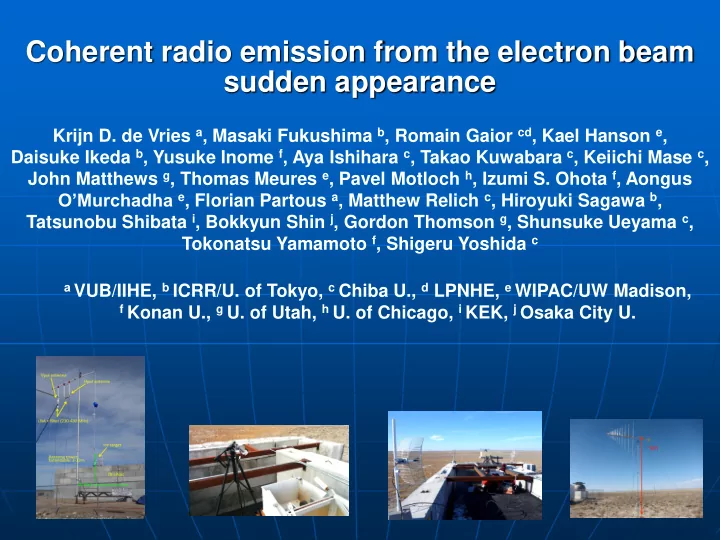
Coherent radio emission from the electron beam sudden appearance Krijn D. de Vries a , Masaki Fukushima b , Romain Gaior cd , Kael Hanson e , Daisuke Ikeda b , Yusuke Inome f , Aya Ishihara c , Takao Kuwabara c , Keiichi Mase c , John Matthews g ,


slide-1
SLIDE 1

Coherent radio emission from the electron beam sudden appearance

1

Krijn D. de Vries a, Masaki Fukushima b, Romain Gaior cd, Kael Hanson e, Daisuke Ikeda b, Yusuke Inome f, Aya Ishihara c, Takao Kuwabara c, Keiichi Mase c, John Matthews g, Thomas Meures e, Pavel Motloch h, Izumi S. Ohota f, Aongus O’Murchadha e, Florian Partous a, Matthew Relich c, Hiroyuki Sagawa b, Tatsunobu Shibata i, Bokkyun Shin j, Gordon Thomson g, Shunsuke Ueyama c, Tokonatsu Yamamoto f, Shigeru Yoshida c

a VUB/IIHE, b ICRR/U. of Tokyo, c Chiba U., d LPNHE, e WIPAC/UW Madison, f Konan U., g U. of Utah, h U. of Chicago, i KEK, j Osaka City U.

slide-2
SLIDE 2

Experimental setup The TA-ELS

1 Electron Beam

~109 (40 MeV) electrons ~ 40 PeV

slide-3
SLIDE 3

Experimental Setups

2

230-400 MHz Askaryan 1.4-3 GHz In-ice Radar 50-66 MHz In-air Radar 12.5 GHz Molecular Bremsstrahlung

slide-4
SLIDE 4

Experimental setup

3

Credits: Romain Gaior

slide-5
SLIDE 5

Results and Coherence

4

50 MHz Power Density: P=1.002 +- 0.014 (stat) +5.17 –0.56 (sys) [10^-24 J/m^2/Hz/pC^2] Charge dependence P~(Q^S): S = 1.639 +- 0.415 230-430 MHz Power Density: P=O(10^-24 – 10^-25) ; Freq dependent, see next slide Charge dependence P~(Q^S): S= 1.87 +- 0.01

slide-6
SLIDE 6

Results and Coherence

5

12.5 GHz Power Density: P=8.46 +- 0.13(stat) +- 4.27 (sys) [10^-29 J/m^2/Hz/pC^2] Charge dependence P~(Q^S) S= 2.16 +- O(0.2) 1.4-3 GHz Power Density: P=O(10^-27); Freq Dep. See next slide Charge dependence P~(Q^S): S=1.93 +- O(0.1)

slide-7
SLIDE 7

Results: Angular distribution (230-430 MHz)

6

Simulation (grey band) agrees very well to data (black dots). See talk Keiichi Mase last Friday.

slide-8
SLIDE 8

Modeling the Beam sudden appearance: Coherent Transition Radiation

7 D: Apparent relativistic (four) distance --> Undefined at a boundary. Coherent TR can be described as the superposition of emission just above and below the boundary.

Particle Cascade

slide-9
SLIDE 9

Modeling the Beam sudden appearance: Coherent Transition Radiation

7 D: Apparent relativistic (four) distance --> Undefined at a boundary. Coherent TR can be described as the superposition of emission just above and below the boundary.

Particle Cascade

slide-10
SLIDE 10

Modeling the Beam sudden appearance: Coherent Transition Radiation

7 D: Apparent relativistic (four) distance --> Undefined at a boundary. Coherent TR can be described as the superposition of emission just above and below the boundary.

Particle Cascade

slide-11
SLIDE 11

Modeling the Beam sudden appearance: Coherent Transition Radiation

8 D: Apparent relativistic (four) distance --> Undefined at a boundary. Coherent TR can be described as the superposition of emission just above and below the boundary.

Emission absorbed / shifted outside the coherent frequency band

slide-12
SLIDE 12

What do we expect to observe? The Beam characteristics

9

~109 (40 MeV) electrons ~ 40 PeV

slide-13
SLIDE 13

Simulation Results: The sudden appearance energy density spectrum

10

Coherence over bunch width Coherence over sub-bunch width

slide-14
SLIDE 14

(Qualitative) Results: The sudden appearance energy density spectrum

11

Four experiments observed the sudden appearance signal in different frequency ranges

50-66 MHz 230-430 MHz 1.4-3 GHz 12.5 GHz

slide-15
SLIDE 15

12

Astropart.Phys. 74 (2016) 96-104 arXiv:1503.02808

Applications in nature:

  • Phys. Rev. D 95, 043004 (2017)

arXiv:1606.07059

ʋ

slide-16
SLIDE 16

Summary

10

  • We report on the measurement of coherent radio emission

from the electron beam sudden appearance.

  • The signal is observed over a wide range of frequencies

from 50 MHz – 12.5 GHz.

  • All measurements show a high-level of coherence.
  • The power density spectrum directly reflects the electron

beam profile, and matches the simulations both qualitatively and quantitatively (still preliminary). The signal is well understood.

  • The in-nature application is found in high-energy particle

cascades traversing different media.