Cohen Textbook Intro For EDUC/PSY 6600 A-B-C format Section C - - PowerPoint PPT Presentation

cohen textbook intro
SMART_READER_LITE
LIVE PREVIEW

Cohen Textbook Intro For EDUC/PSY 6600 A-B-C format Section C - - PowerPoint PPT Presentation

Cohen Textbook Intro For EDUC/PSY 6600 A-B-C format Section C Section A Section B Basic statistical How to use SPSS Simplest case of the to perform the procedure procedure procedures More general cases


slide-1
SLIDE 1

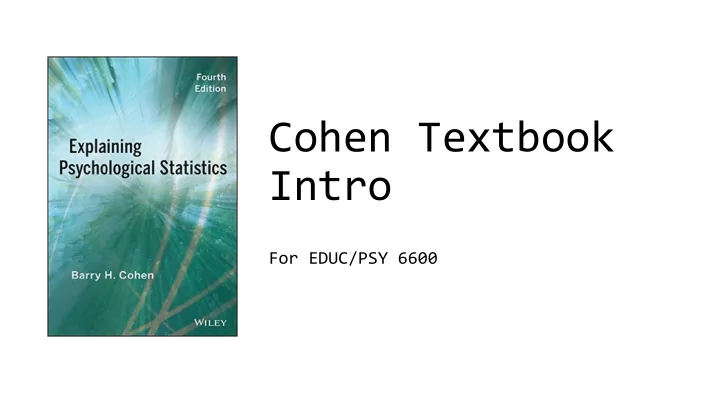
Cohen Textbook Intro

For EDUC/PSY 6600
slide-2
SLIDE 2

“A-B-C” format

Section A

  • Simplest case of the

procedure

  • Explain definitional

formulas (for insight)

  • Emphasis is

underlying similarity

  • f formulas that may

look very different

  • Detailed summary
  • Exercises

Section B

  • Basic statistical

procedure

  • More general cases with

real data

  • Computational formulas
  • Significance tests
  • Comments on research

design

  • Supplementary

procedures

  • How to report in APA

style

  • Detailed summary
  • Exercises

Section C

  • How to use SPSS

to perform the procedures

  • Little known

syntax ‘tricks’

  • SPSS data

management tools

  • How to read SPSS
  • utput
  • All exercises

based on the Ihno Dataset

slide-3
SLIDE 3

Unit Unit Title Chap # Chapter Titles

Basic Introduction 1 Intro to Psychological Statistics APA Style & Journal Articles SPSS Basics & Data Manipulation 1 Exploratory Data Analysis 2 3 4 Exploration Data with Plots Summarizing Data with Descriptive Statistics Standardized Scores & The Normal Distribution 2 Groundwork for Inference 5 6 7 8 Intro to Hypothesis Testing: 1 Sample z-test Confidence Interval Estimation: The t Distribution 2 Independent Samples t-test for Means Statistical Power & Effect Size 3 Hypothesis Tests for 2 Measures per Subject 9 10 11 Linear Correlation Linear Regression Matched t Test 4 ANOVA w/o repeated measures 12 13 14 1-Way ANOVA Multiple Comparisons 2-Way ANOVA 5 ANOVA with repeated measures 15 16 Repeated-Measures ANOVA 2-Way Mixed-Design ANOVA 6 Categorical Data Analysis 19 20 The Binomial Distribution Chi-Squared Test for Independence & Goodness of Fit

slide-4
SLIDE 4

Appendixes

Appendix A

  • Statistical

tables

  • “z” standard

normal

  • “t” student’s t
  • “X2” chi squared
  • Etc.

Appendix B

  • Answers
  • to selected

exercises (*) from sections A & B Appendix C

  • Ihno’s dataset
  • The electronic

‘excel’ version is on CANVAS

  • Do NOT waste time

typing it into the computer!!!

slide-5
SLIDE 5

Ihno’s (Eee-know) experiment

  • Ihno was an advanced PhD student, TA several stats sections
  • 100 participants enrolled in those sections & voluntarily

consented to participate (IRB)

  • Data collected on FIRST day of class
  • Background questionnaire: contact info, gender, major, why enrolled, coffee

drinking habit, # math classes completed

  • Required math placement/diagnostic quiz score (prior to registering)
  • Self rating of math phobia (0-10)
  • Some registered late à some data missing … how do you deal with that ?
  • Data collected a week before the experiment
  • Regular 10-question quiz score
slide-6
SLIDE 6

Ihno’s (Eee-know) experiment

  • Start of class: PRE-quiz:
  • Taught students how to take their own pulse & took two baseline measures (bpm)
  • Self-report: # cups of coffee since waking up that day
  • Self-report: Anxiety questionnaire w/10 items, each rated 0-4 (5-point Likert

scale), total scores 0-40 (baseline anxiety)

  • ANNOUNCEMENT: “POP QUIZ”
  • w/11 multiple choice (10 questions, 1pt each + 11th question = 3 points extra

credit)

  • The 11th question varied (25 each: easy, moderate, difficult, or impossible to

solve)

  • End of class: POST-quiz
  • After collecting quiz, REPEATED the pulse and anxiety collection
  • Ihno explained the quiz would be graded (not 11th question) and returned, but would

NOT count towards their grade