Coding, Corroboration, and Compliance How to assure the 3 Cs are met - - PDF document

coding corroboration and compliance how to assure the 3 c
SMART_READER_LITE
LIVE PREVIEW

Coding, Corroboration, and Compliance How to assure the 3 Cs are met - - PDF document

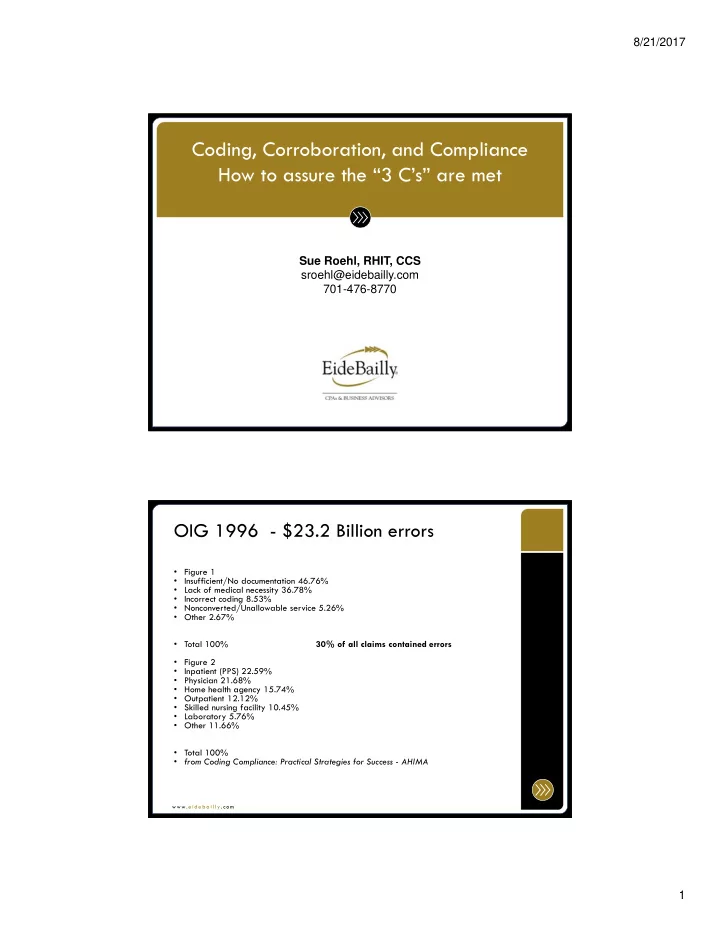
8/21/2017 Coding, Corroboration, and Compliance How to assure the 3 Cs are met Sue Roehl, RHIT, CCS sroehl@eidebailly.com 701-476-8770 OIG 1996 - $23.2 Billion errors Figure 1 Insufficient/No documentation 46.76% Lack of


slide-1
SLIDE 1

8/21/2017 1 Sue Roehl, RHIT, CCS sroehl@eidebailly.com 701-476-8770

Coding, Corroboration, and Compliance How to assure the “3 C’s” are met

www.e ide ba i l l y . co m

OIG 1996 - $23.2 Billion errors

  • Figure 1
  • Insufficient/No documentation 46.76%
  • Lack of medical necessity 36.78%
  • Incorrect coding 8.53%
  • Nonconverted/Unallowable service 5.26%
  • Other 2.67%
  • Total 100%

30% of all claims contained errors

  • Figure 2
  • Inpatient (PPS) 22.59%
  • Physician 21.68%
  • Home health agency 15.74%
  • Outpatient 12.12%
  • Skilled nursing facility 10.45%
  • Laboratory 5.76%
  • Other 11.66%
  • Total 100%
  • from Coding Compliance: Practical Strategies for Success - AHIMA
slide-2
SLIDE 2

8/21/2017 2

www.e ide ba i l l y . co m

OIG 2010 - $6.7 Billion – E/M

  • OIG review – incorrect E/M code assignments- $6.7

billion.

  • 42 percent of claims for E/M services in 2010 were

incorrectly coded, which included both upcoding and downcoding (i.e., billing at levels higher and lower than warranted, respectively), and 19 percent were lacking documentation. Additionally, we found that claims from high-coding physicians were more likely to be incorrectly coded or insufficiently documented than claims from other physicians.

www.e ide ba i l l y . co m

CMS – 2013- $36 Billion

  • Medicare lost over $36 billion to over-billings by

providers in fiscal year 2013, with hospitals accounting for 88% of the waste. According to the Government Accountability Office – these astounding losses are largely due to documentation errors, also referred to as “up-coding,” in which a provider erroneously bills Medicare to recoup higher reimbursements. Even among well-meaning providers, clerical errors on Medicare claims drain billions from the program every year. At a result, billing error rates have steadily increased from 8.5% in 2012 to 10.1% in 2013.

slide-3
SLIDE 3

8/21/2017 3

www.e ide ba i l l y . co m

Conditions of Participation

  • Verify that the patient records contain appropriate

documentation of practitioners' orders, interventions, findings, assessments, records, notes, reports, and

  • ther information necessary to monitor the patient's

condition.

5 www.e ide ba i l l y . co m

Compliance

  • Regulations
  • ICD-10 and CPT coding guidelines
  • Federal Conditions of Participation
  • Medicare and third party payer regulations
slide-4
SLIDE 4

8/21/2017 4

www.e ide ba i l l y . co m

Compliance and the EHR

  • Medical necessity concerns are not new with the EHR
  • They are compounded by a record in which

templates and check boxes are the only documentation present on the record

  • Health professional documentation that was

substandard in the paper record is not improved in the EHR

  • There may be more, but more is not the key to

compliance

  • Timing of entries is of considerable concern
  • Override of time entry for time of actual service
  • r task

7 www.e ide ba i l l y . co m

External Coding Review

  • Preparing for the Audit
  • The first step in preparing for an external coding

audit is identifying clear, concise goals. These goals should be specific to the organization and designed to address current needs. Once audit goals are clearly defined and documented, HIM directors can secure executive support, prepare coders, and identify cases

slide-5
SLIDE 5

8/21/2017 5

www.e ide ba i l l y . co m

Documentation

  • The old “if it isn’t documented, it wasn’t done” still

holds true today

  • Services cannot be reported on a claim to a payer

until the documentation is complete

  • All test results must be present on the record prior to

billing

  • Health Information Management has the final review

before coding and release of the claim

9 www.e ide ba i l l y . co m

External Coding Review

  • Tips to reduce staff anxiety
  • Communicate goals early in the process
  • Position the audit as an educational benefit
  • Let results drive education for each coder
  • Use findings as a tool for improvement
  • Remind staff “no one is perfect”
  • Set individual performance goals, include in

employee evaluation

slide-6
SLIDE 6

8/21/2017 6

www.e ide ba i l l y . co m

Coding and Billing go hand in hand

  • Coding staff today are responsible for billing functions

in addition to code assignment

  • Education is key
  • ICD-10
  • CPT
  • UB-04
  • Billing methodology
  • CAH
  • RHC
  • Provider based
  • RHC versus Free-standing

www.e ide ba i l l y . co m

Top 10 - Frequent Coding Findings

  • #1 – Infusions, injections and hydration
  • #2 – Code assignments from Past History and/or

Problem List

  • Matching diagnoses to medications
  • Incomplete current diagnoses documentation
  • #3 – E/M
  • Upcoded
  • Downcoded
  • #4 – Coding Guidelines
  • #5 – Screening versus diagnostic
slide-7
SLIDE 7

8/21/2017 7

www.e ide ba i l l y . co m

Top 10 - Frequent Coding Findings

  • #6 – Insufficient queries
  • #7 – Lack of medical necessity
  • #8 – Where did that diagnosis come from ?
  • Each record must stand alone
  • #9 - Possible, probable, likely
  • Inpatient – only at the time of discharge
  • Outpatient – cannot code
  • #10 – E/M and Minor procedures

www.e ide ba i l l y . co m

Top 10 – Frequent Billing Findings

  • #1 – Missing charges
  • EKGs
  • #2 – Self administered drugs
  • Revenue Code 637
  • #3 – Unbundling
  • Misuse of modifiers
  • #4 – Screening versus Diagnostic
  • #5 – DME codes on hospital/clinic claims
slide-8
SLIDE 8

8/21/2017 8

www.e ide ba i l l y . co m

Top 10 – Frequent Billing Findings

  • #6 – Units
  • Drugs
  • Observation
  • Infusions/injections
  • #7 – Provider
  • #8 – Place of Service
  • #9 – Discharge status codes
  • #10 – Dates
  • Charge date
  • From and through dates

www.e ide ba i l l y . co m

Conditions of Participation

  • Verify that the patient records contain appropriate

documentation of practitioners' orders, interventions, findings, assessments, records, notes, reports, and

  • ther information necessary to monitor the patient's

condition.

16

slide-9
SLIDE 9

8/21/2017 9

www.e ide ba i l l y . co m

Compliance and documentation

  • Documentation is critical
  • To support admission
  • To support hourly Observation charges
  • To support an admission from Observation to

inpatient status

  • To support a one or two day Inpatient stay
  • To support the medical necessity of a surgical

procedure

  • To support Lab and X-ray procedures
  • To support E/M levels

17 www.e ide ba i l l y . co m

Corroboration through Education

  • Providers - Coding
  • Nursing Staff – Coding/Billing/Providers
  • Ancillary staff – Coding/Billing/Chargemaster
  • Billing Staff – Coding/Chargemaster
  • Chargemaster –Billing/Coding
slide-10
SLIDE 10

8/21/2017 10

www.e ide ba i l l y . co m

Corroboration - Coding

  • Education – ongoing
  • Individual and internal
  • Coding Guidelines
  • Coding Clinic
  • CPT Guidelines
  • CPT Assistant
  • CMS Evaluation and Management Guidelines
  • Medicare Benefit Manual

www.e ide ba i l l y . co m

Corroboration - Coding

  • External Education
  • CMS and Noridian
  • Webinars
  • Audioconferences
  • Newsletters
  • AHIMA
  • NDHIMA
  • AAPC
slide-11
SLIDE 11

8/21/2017 11

www.e ide ba i l l y . co m

Corroboration - Coding

  • Reviews - Develop a compliance plan
  • Internal
  • If staffing allows
  • External
  • Ongoing
  • Quarterly
  • Yearly
  • Focus reviews on previously identified issues

www.e ide ba i l l y . co m

Corroboration - Coding

  • Outsourced Coding services
  • Review is imperative
  • Internal review (ongoing)
  • External review
  • End of year one
  • Periodic, dependent on findings
slide-12
SLIDE 12

8/21/2017 12

www.e ide ba i l l y . co m

Corroboration – Provider Education

  • Cloning of Medical Notes
  • Documentation is considered cloned when each entry

in the medical record for a beneficiary is worded exactly like or similar to the previous entries. Cloning also occurs when medical documentation is exactly the same from beneficiary to beneficiary. It would not be expected that every patient had the exact same problem, symptoms, and required the exact same treatment.

  • CMS Medicare A Bulletin 3Q 2006

www.e ide ba i l l y . co m

Corroboration – Provider Education

  • Cloned documentation does not meet medical necessity

requirements for coverage of services rendered due to the lack of specific, individual information. All documentation in the medical record must be specific to the patient and her/his situation at the time of the encounter.

  • Cloning of documentation is considered a

misrepresentation of the medical necessity requirement for coverage of services. Identification of this type of documentation will lead to denial of services for lack of medical necessity and recoupment of all overpayments made.

  • First Coast Options (Medicare Contractor)
slide-13
SLIDE 13

8/21/2017 13

www.e ide ba i l l y . co m

Corroboration – Provider Education

  • Education
  • Provider assigned codes
  • Review by coding staff (always) and educate
  • Policies – who has the final say?
  • Queries
  • When to query
  • Insufficient/unclear documentation
  • “Lost” diagnoses
  • Final test results
  • Cannot introduce new information

www.e ide ba i l l y . co m

Corroboration - Nursing

  • Education
  • Consistency
  • Documentation in the same place
  • Start times; stop times
  • Time of service or time of documentation?
  • Creates conflicts throughout the medical record
  • EHR defaults to document entry
  • Template/autopopulation/cloning
  • Why is the patient here?
slide-14
SLIDE 14

8/21/2017 14

www.e ide ba i l l y . co m

Corroboration – Ancillary Staff

  • Therapies
  • Documentation requirements
  • Time based codes
  • Nutrition
  • Documentation requirements
  • Qualified staff
  • Radiology
  • Code descriptions
  • Number of views
  • Combination codes
  • Screening versus diagnostic

www.e ide ba i l l y . co m

Corroboration – Ancillary Staff

  • Laboratory
  • Unbundling
  • Modifiers
  • Medical Necessity
  • Emergency Department
  • EMTALA
  • Infusions/injections/hydration
  • Procedures
  • Facility level criteria
slide-15
SLIDE 15

8/21/2017 15

www.e ide ba i l l y . co m

Corroboration – Billing Staff

  • Admission status discrepancies
  • Inpatient versus Observation
  • Date discrepancies
  • Education
  • Preventative services
  • Screening versus diagnostic
  • Modifiers
  • Communication with coding staff
  • Alteration of codes/revenue codes/dates
  • Changes in electronic data submission
  • RTP’s and denials
  • Review with coding staff

www.e ide ba i l l y . co m

Corroboration – Billing Staff

  • Outsourced Billing services
  • Review is imperative
  • Internal review (ongoing)
  • External review
  • End of year one
  • Periodic, dependent on findings
slide-16
SLIDE 16

8/21/2017 16

www.e ide ba i l l y . co m

Corroboration - Chargemaster

  • Keep it clean
  • Departments
  • Understanding of their chargemaster
  • Review of their chargemaster
  • Quarterly updates
  • Yearly – code changes
  • New procedures added
  • Incorrect charging identification

www.e ide ba i l l y . co m

Corroboration - Chargemaster

  • Policies
  • Pricing
  • Technical versus professional
  • Pharmacy
  • Radiopharmaceuticals
  • Supplies
  • Specific to chargeable versus non-chargeable

supplies

  • Room and Board
  • What’s included/excluded
  • Carving out Observation hours
  • General Ledger Assignments
slide-17
SLIDE 17

8/21/2017 17

www.e ide ba i l l y . co m

The 3 C’s Goal

  • Coding – √
  • Corroboration - √
  • Compliance - √
  • Communicate &
  • Commit to the
  • Challenge

This presentation is presented with the understanding that the information contained does not constitute legal, accounting or other professional advice. It is not intended to be responsive to any individual situation or concerns, as the contents of this presentation are intended for general informational purposes

  • nly. Viewers are urged not to act upon the information contained in this presentation without first consulting competent legal, accounting or other professional

advice regarding implications of a particular factual situation. Questions and additional information can be submitted to your Eide Bailly representative, or to the presenter of this session.

Questions?

slide-18
SLIDE 18

8/21/2017 18

Thank You!