Code Blue Pharmacys Role Pharmacists To recognize and participate - - PDF document

code blue pharmacy s role
SMART_READER_LITE
LIVE PREVIEW

Code Blue Pharmacys Role Pharmacists To recognize and participate - - PDF document

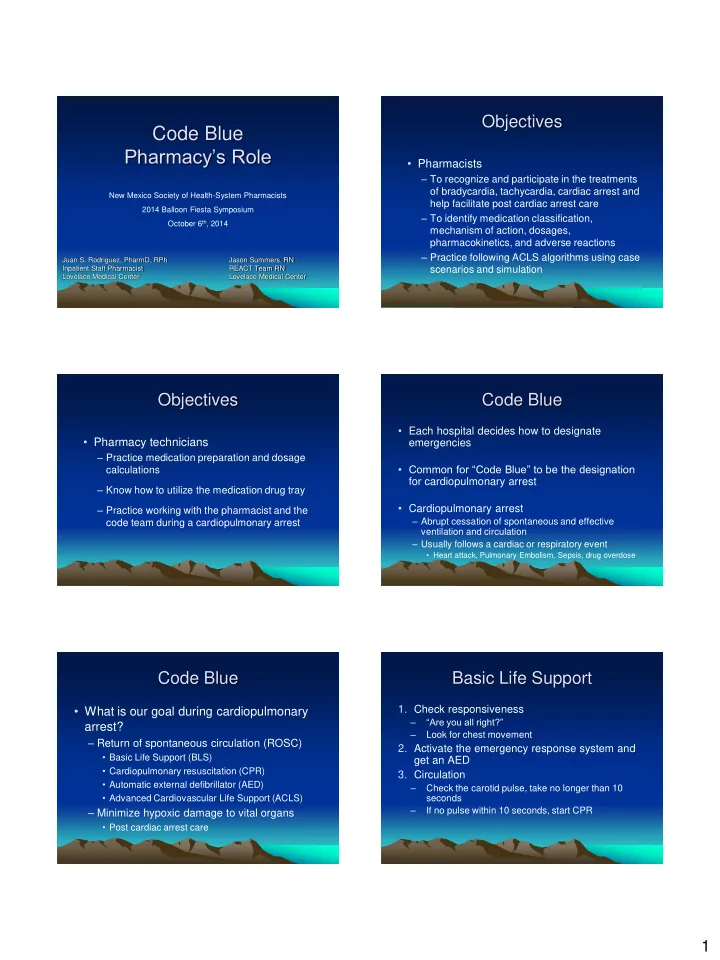
Objectives Code Blue Pharmacys Role Pharmacists To recognize and participate in the treatments of bradycardia, tachycardia, cardiac arrest and New Mexico Society of Health-System Pharmacists help facilitate post cardiac arrest care


slide-1
SLIDE 1

1

Code Blue Pharmacy’s Role

Juan S. Rodriguez, PharmD, RPh Inpatient Staff Pharmacist Lovelace Medical Center

New Mexico Society of Health-System Pharmacists 2014 Balloon Fiesta Symposium October 6th, 2014

Jason Summers, RN REACT Team RN Lovelace Medical Center

Objectives

  • Pharmacists

– To recognize and participate in the treatments

  • f bradycardia, tachycardia, cardiac arrest and

help facilitate post cardiac arrest care – To identify medication classification, mechanism of action, dosages, pharmacokinetics, and adverse reactions – Practice following ACLS algorithms using case scenarios and simulation

Objectives

  • Pharmacy technicians

– Practice medication preparation and dosage calculations – Know how to utilize the medication drug tray – Practice working with the pharmacist and the code team during a cardiopulmonary arrest

Code Blue

  • Each hospital decides how to designate

emergencies

  • Common for “Code Blue” to be the designation

for cardiopulmonary arrest

  • Cardiopulmonary arrest

– Abrupt cessation of spontaneous and effective ventilation and circulation – Usually follows a cardiac or respiratory event

  • Heart attack, Pulmonary Embolism, Sepsis, drug overdose

Code Blue

  • What is our goal during cardiopulmonary

arrest?

– Return of spontaneous circulation (ROSC)

  • Basic Life Support (BLS)
  • Cardiopulmonary resuscitation (CPR)
  • Automatic external defibrillator (AED)
  • Advanced Cardiovascular Life Support (ACLS)

– Minimize hypoxic damage to vital organs

  • Post cardiac arrest care

Basic Life Support

  • 1. Check responsiveness

– “Are you all right?” – Look for chest movement

  • 2. Activate the emergency response system and

get an AED

  • 3. Circulation

– Check the carotid pulse, take no longer than 10 seconds – If no pulse within 10 seconds, start CPR

slide-2
SLIDE 2

2

Basic Life Support

  • CPR

– 30 chest compressions to two breaths – Center of the chest – Hard and fast – Depth of at least 2 inches – Allow complete chest recoil – Minimize interruptions in compressions – Switch providers every 2 minutes – Avoid excessive ventilation

Basic Life Support

  • 4. Defibrillation

– Attach and turn on the AED – Check for a shockable rhythm – Provide shocks as indicated – Follow each shock with CPR

  • Begin with

compressions

Code Blue: Key Members

  • ACLS is a team approach

– Pulmonologist – Emergency Physician – Registered Nurse (RN) – Respiratory Therapist (RT) – Emergency Medical Technician (EMT) – Pharmacist and/or Pharmacy Technician

Code Blue

  • Pharmacy

– Maintenance of drug trays for crash carts – Prepare medication – Drug information – Make recommendations and suggestions based on the situation – Help document medication administration

Crash Cart Med Tray How to assemble a syringe

1.Open the syringe box from the side indicated 2.Let the two parts fall out into your hand 3.Flip off the plastic end-caps using both hands 4.Attach the medication half to the plunger half with a push and a twist until resistance is met

slide-3
SLIDE 3

3

Code Blue

  • Normal Sinus Rhythm

– Heart Rate between 60-100 beats/min – One P wave precedes each QRS – QRS usually narrow with upright P waves – Normal Blood pressure

  • Systolic Blood Pressure: 90-120
  • Diastolic Blood Pressure: 60-80

– Normal Respiratory Rate: 12-18 breaths/min – Normal O2 saturation: > 90%

Code Blue

  • Normal Sinus Rhythm

Bradycardia

  • Heart Rate less than 60 beats/min

– Common in young athletes, asymptomatic – Usually sinus node dysfunction in the elderly

  • Caused by heart disease and/or normal aging

process

– Symptomatic Bradycardia

  • Heart rate< 50 beats/min

Bradycardia

  • Symptoms

– Chest discomfort or pain – Shortness of breath – Decreased level of consciousness – Weakness – Light-headedness – Presyncope or syncope

Bradycardia

  • Signs

– Hypotension – Orthostatic hypotension – Diaphoresis – Pulmonary congestion, congestive heart failure or edema – Frequent premature ventricular complexes or Ventricular Tachycardia

Bradycardia

  • Does the patient have signs or symptoms
  • f poor perfusion caused by bradycardia?

– If perfusion seems adequate and the patient is responsive and answers questions appropriately, then observe and monitor – If the patient has signs and symptoms of poor perfusion, then administer atropine

slide-4
SLIDE 4

4

Bradycardia

  • Atropine

– Anticholinergic Agent

  • Blocks the action of acetylcholine at

parasympathetic sites

  • Increases cardiac output

– 0.5 mg rapid IV bolus

  • every 3 to 5 minutes, up to 3 mg total

– Side effects

  • Increased myocardial oxygen demand

Tachycardia

  • Abnormally fast heart rate of greater than

100 beats/min

  • Regular rhythm
  • Often a response to increased cardiac output

demand or reduced stroke volume

  • Treatment is aimed at correcting the underlying

cause

Tachycardia

– Sympathetic activation – Decreased parasympathetic activity – Fever – Hyperthyroidism – Pain – Increased metabolism – Hypotension – Hypoxia

Tachycardia

  • Correct the underlying causes

– If fever, then antipyretic and/or antibiotics – If pain, then analgesics – If hypotensive, then fluids – If hypoxic, then oxygen

  • If stable and no other correctable causes
  • Vagal maneuvers
  • Consider giving adenosine

Tachycardia

  • Adenosine

– Antiarrhythmic Agent

  • Slows conduction time through the AV node,

interrupting the re-entry pathways, restoring normal sinus rhythm

– Initial dose: 6 mg rapid IV bolus

  • If ineffective, then 12 mg may be given
  • May repeat 12 mg once more
  • Follow each dose with 20 ml normal saline flush

– Side effects

  • Flushing, chest pain, brief asystole, bradycardia

Tachycardia

  • Adenosine cardioversion of SVT
slide-5
SLIDE 5

5

Cardiac Arrest

  • 1. Ventricular Fibrillation
  • 2. Pulseless Ventricular Tachycardia
  • 3. Asystole / Pulseless Electrical Activity (PEA)

Cardiac Arrest

Ventricular Fibrillation (VF)

  • Rapid uncoordinated rhythm
  • Ventricular quivering
  • Ineffective ventricular contraction
  • Pulseless
  • Unconscious patient
  • Often associated with myocardial ischemia

and infarction

Cardiac Arrest

Pulseless Ventricular Tachycardia

  • Three or more consecutive ventricular

complexes

  • Regular rhythm with rate > 100/min
  • Causes

– Drug toxicities, myocardial ischemia, reentry pathways, electrolyte abnormalities

  • Tendency to transition into VF

VF / Pulseless Ventricular Tachycardia Management 1.High Energy Shock 2.CPR 3.High Energy Shock (if indicated) 4.CPR plus epinephrine 5.High Energy Shock (if indicated) 6.CPR plus amiodarone VF / Pulseless Ventricular Tachycardia

  • Epinephrine

– Alpha and beta agonist

  • Stimulates adrenergic receptors
  • Cardiac stimulation

– 1 mg IV every 3 to 5 minutes – Side effects

  • Myocardial ischemia
  • Increase myocardial oxygen demand

VF / Pulseless Ventricular Tachycardia

  • Amiodarone

– Antiarrhythmic

  • Prolongs action potential and refractory period
  • Decreases AV conduction and sinus node function

– First dose: 300 mg IV bolus – Second dose: 150 mg IV – Side effects

  • Hypotension
  • QT prolongation
slide-6
SLIDE 6

6

Cardiac Arrest

  • Asystole / Pulseless Electrical Activity

(PEA)

– Absence of impulse initiation in the heart – Zero cardiac output – Causes

  • Hypovolemia, hypoxia, electrolyte abnormalities,

thrombosis, toxins

Asystole / Pulseless Electrical Activity (PEA)

  • Management
  • 1. CPR
  • 2. Epinephrine
  • 3. Rhythm check
  • If not a shockable rhythm then continue CPR
  • 4. CPR
  • 5. Epinephrine
  • 6. Rhythm check

Asystole / Pulseless Electrical Activity (PEA)

  • Epinephrine

– 1 mg IV every 3 to 5 minutes

  • Vasopressin (antidiuretic hormone)

– May replace the first or second dose of epinephrine – Direct vasoconstrictor – 40 units IV – Side effects

  • Increased peripheral vascular resistance, may provoke

cardiac ischemia

Post Cardiac Arrest Care

  • Optimize ventilation and oxygenation

– Placement of an advanced airway

  • Sedatives and analgesics

– Etomidate, Midazolam, Fentanyl, Propofol, Precedex

  • Neuromuscular blocking agents

– Rocuronium, succinylcholine, cisatracurium

  • Treat hypotension

– IV bolus – Vasopressor infusion

  • Epinephrine, Dopamine, Norepinephrine
slide-7
SLIDE 7

7

Code Blue: Patient Case 1

Diabetes, Hypertension, Renal disease on hemodialysis, GERD

  • Humalog sliding scale ACHS
  • Lantus 30 units subQ QHS
  • Lisinopril 10 mg PO Daily
  • Amlodipine 10 mg PO daily
  • Prevacid 30 mg PO Daily
  • HD on Mon, Wed, Fri
  • Sulfa

BP is a 62 year old female is brought to the emergency room via ambulance Wednesday evening after a fall at home

PMH Home meds Allergies

Code Blue: Patient Case 1

BP had HD in the morning. While there, her nephrologist noticed her blood pressure was not at goal according to the newest guidelines and prescribed amlodipine 10 mg PO Daily. After BP’s 4 hour HD session she went to her local pharmacy and refilled her prescriptions including the

  • amlodipine. Once she got home, she decided to take all her

meds and then prepare herself dinner. After eating dinner, upon standing she became dizzy, light headed, and fainted landing on and breaking her hip. After about an hour, her neighbor heard her yelling for help and 911 was called. An ambulance came to her home and brought her to the emergency room.

Code Blue: Patient Case 1

  • Awake, still lightheaded, a bit confused, short of breath
  • Left hip fracture
  • Blood pressure: 90/60
  • Heart rate: 40 beats/min
  • Respiratory rate: 12 breaths/min
  • O2: 90% on room air
  • Temperature: 37 C
  • UA: nitrates, leukocytes, >100 WBC, many bacteria
  • 2 sets of blood cultures

2.1 12.7 37.9 198 140 3 99 29 23 14.9 147 Phos: 4.7 Mag: 2.4

Code Blue: Patient Case 1

ER physician decides he wants to give BP atropine for her low heart rate. You’re the pharmacist on duty and she asks for your

  • recommendation. What should you suggest as an appropriate

treatment?

A.You suggest treating her UTI with Vancomycin 500 mg after her next dialysis session B.You go the patient and ask her to bear down as if she needs to have a bowel movement C.You agree with atropine, prepare the syringe, suggesting 0.5 mg as an initial dose D.Suggest giving her Pepcid instead of Prevacid to decrease her risk of developing C. diff colitis

Code Blue: Patient Case 1

You give BP atropine 0.5 mg IV push and her heart rate climbs to 70 beats/min her blood pressure is now 100/70. You suggest starting some IV fluids to improve her blood pressure. As the nurses start fluids and

  • xygen you notice this rhythm on the monitor:

Code Blue: Patient Case 1

BP becomes unconscious and no longer has a pulse. The nurses quickly place the defibrillation pads on the patient and prepare to give a shock. As they deliver a shock, what should you do as the pharmacist?

A.Call your IV technician to prepare a loading dose of vancomycin B.Prepare epinephrine 1 mg IV and a NS flush for the nurses to administer C.Prepare amiodarone 150 mg IV D.You suggest giving Zosyn due to the her Pseudomonal risk factors

slide-8
SLIDE 8

8

Code Blue: Patient Case 2

JT is a 49 year old male who is s/p total knee replacement. Today is post operative day two. Last night he complained of some fever for which he was given some ibuprofen. Today is his first day of physical therapy and to feel better he decides to drink a Monster Energy Drink. He also had a regular breakfast with coffee.

Code Blue: Patient Case 2

Chronic back pain, Previous knee replacement

  • Percocet 5/325 1 tab PO Q6H PRN Pain
  • Lovenox 40 mg SubQ Daily
  • Pepcid 20 mg PO BID AC
  • PCN

PMH Current meds Allergies

Code Blue: Patient Case 2

  • Sitting in bed waiting for physical therapy, begins to

complain of heart palpitations

  • Blood pressure: 120/70
  • Heart rate: 195 beats/min
  • Respiratory rate: 12 breaths/min
  • O2: 90% on room air
  • Temperature: 38 C

0.98 13.3 40 150 140 3.7 100 25 8 11 99 Phos: 2.9 Mag: 1.9

Code Blue: Patient Case 2

The Rapid Response Team is called to the patient’s room. You happen to be making your daily rounds and decide to aid the team. JT seems not to be in any acute distress besides his heart pounding. The team turns to you and asks for a recommendation.

  • A. You suggest asking the patient to blow through a straw
  • B. You suggest 30 mins of intense physical therapy instead of 1 hour
  • C. Adenosine 6 mg rapid IV push followed by 20 ml NS flush
  • D. Naloxone 0.4 mg rapid IV push followed by 20 ml NS flush

Code Blue: Patient Case 2

Vagal maneuvers do nothing for the patient so you decide to draw up adenosine for the nurses to

  • administer. One nurse pushes the adenosine while

another nurse quickly follows it with 20 ml of saline. JT’s heart rate slows to 80 beats/min as he cries out in

  • pain. He looks to you and says, “Man! That hurt!” then

his eyes roll back and he becomes unconscious. The monitor now displays asystole.

Code Blue: Patient Case 2

JT has no pulse. One nurse jumps on him and begins CPR. What should you do next?

A.Help prepare a “King” airway in order to intubate the patient B.Stand clear of the patient so that a shock can be administered C.Prepare epinephrine 1 mg IV push D.Prepare an infusion of dopamine 5 mcg/kg per minute

slide-9
SLIDE 9

9

Summary

  • Use of medications is an inherent part of most code

blue emergencies

  • Pharmacists and pharmacy technicians are skilled in

the preparation of intravenous medications

  • When attending a code blue

– Identify yourself and offer to handle medications – Remove the medication tray from the crash cart – Prepare all medications – Provide drug information and recommendations as needed – Ensure that the correct medication is being dispensed – Help code recorder keep track of medications used – Check patient’s age, allergies, height and weight

References

1. Copstead, Lee Ellen., and Jacquelyn L. Banasik.

  • Pathophysiology. St. Louis, MO: Elsevier Saunders, 2005.

Print. 2. DiPiro, Joseph T. Pharmacotherapy: A Pathophysiologic

  • Approach. New York: McGraw-Hill, 2005. Print.

3. Sinz, Elizabeth, Kenneth Navarro, Erik S. Soderberg, and Clifton W. Callaway. Advanced Cardiovascular Life Support. Dallas, TX: American Heart Association, 2011. Print 4. Lexicomp, accessed 01.16.2014 5. Clinical Pharmacology accessed 01.16.2014