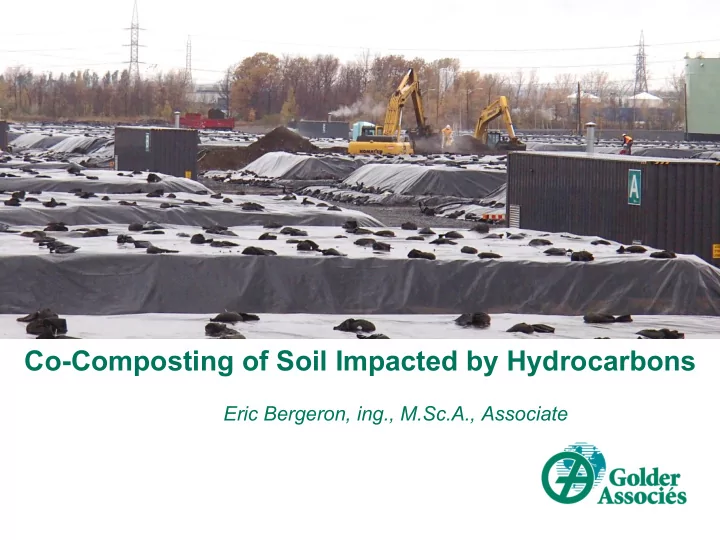
Co-Composting of Soil Impacted by Hydrocarbons Eric Bergeron, ing., - - PowerPoint PPT Presentation

co composting of soil impacted by hydrocarbons
SMART_READER_LITE
LIVE PREVIEW

Co-Composting of Soil Impacted by Hydrocarbons Eric Bergeron, ing., - - PowerPoint PPT Presentation

Co-Composting of Soil Impacted by Hydrocarbons Eric Bergeron, ing., M.Sc.A., Associate Presentation Outline Site description What is co-composting? Treatment strategy Lab and pilot-scale Full-scale Conclusion 16-05-05 2


slide-1
SLIDE 1

Co-Composting of Soil Impacted by Hydrocarbons

Eric Bergeron, ing., M.Sc.A., Associate

slide-2
SLIDE 2

Presentation Outline

Site description What is co-composting? Treatment strategy Lab and pilot-scale Full-scale Conclusion

16-05-05 2

slide-3
SLIDE 3

Site Description

Heavy industrial area Former petrochemical activities Underground/above ground utilities

dismantled

Fractured clay et silt Free phase Heavy TPH and PAH 120 000 m3 of impacted soil Remediation target : 3500 ppm C10C50

16-05-05 3

slide-4
SLIDE 4

Organic amendments + soil + air + water (60% WHC) Typical temperature : 55-70 oC Thermophilic +mesophilic bacteria ↑solubility of C/N/P ↑bioavailability ↓ Clay cohesiveness

  • Composting is a process in which organic matter are degraded quickly by

microorganisms at elevated temperatures under aerobic condition (C/N ≈ 20-30)

  • Co-composting → add organic amendments (manure) to the impacted soil to

enhance biodegradation

What is co-composting?

16-05-05 4

45 46 47 48 49 50 5 10 15 20 20 40 60 80 100 120

Temperature (°C) % O2, CO2 in air Time (min)

Oxygen Carbon dioxide Temperature

slide-5
SLIDE 5

Windrow Modified Biopile

Co-Composting

16-05-05 5

slide-6
SLIDE 6

Strategy

16-05-05 6

SCM Remediation Options Treatability Testing Approach Selection Design et planning Implementation O&M Shut-down

slide-7
SLIDE 7

Remediation Options

16-05-05 7

  • Composting

Thermal desorption Composting and Thermal desorption

slide-8
SLIDE 8

Laboratory Testing

Degradation rate → treatment time Microcosms (Montreal & Calgary) Reactor (200 L - 1 m3)

16-05-05 8

slide-9
SLIDE 9

Laboratory Testing

16-05-05 9

9

Thermocouple Implants/air

slide-10
SLIDE 10

Pilot-Testing

200 m3 biopile Temperature monitoring Gas monitoring 5 months operation 3 mixtures tested

16-05-05 10

slide-11
SLIDE 11

Pilot-Testing

slide-12
SLIDE 12

Full-Scale

16-05-05 12

48 piles of 700-1000 m3 8 air extraction system of 1200 cfm Leachate recirculation system Fully automated system Organic amendments : < 30% v/v

slide-13
SLIDE 13

Full-Scale

16-05-05 13

Excavation

slide-14
SLIDE 14

Full-Scale

16-05-05 14

10 weeks 5-6 days 20 oC →70 oC

Pathogen limit

DARAMEND

slide-15
SLIDE 15

Full-Scale

16-05-05 15

slide-16
SLIDE 16

16-05-05 16

Full-Scale

F2 (C10C16): 5% F3 (C16C34): 27% F4 (C34C50): 12% F4G (C50+): 55%

slide-17
SLIDE 17

CONCLUSIONS

Co-composting is an efficient biological process, cost competitive and sustainable which can treat hydrocarbons that are recalcitrant to conventional biopile

16-05-05 17

slide-18
SLIDE 18

QUESTIONS

16-05-05 18

Québec Engineers Association Leonard Award – 2015