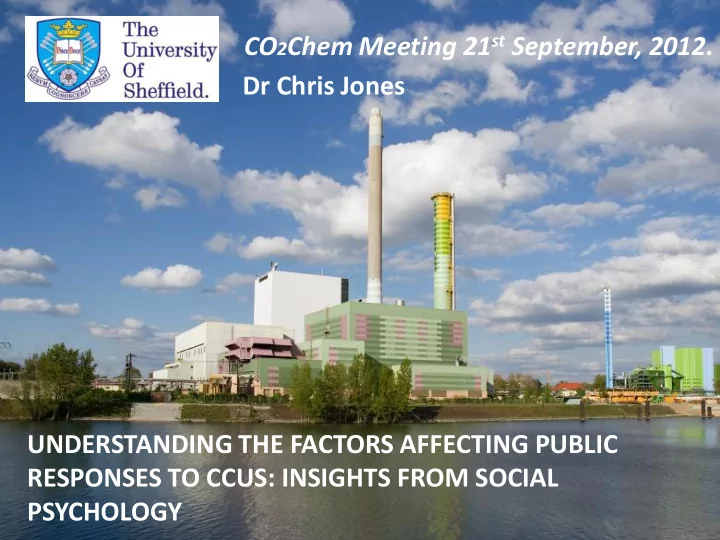
CO 2 Chem Meeting 21 st September, 2012 . Dr Chris Jones - - PowerPoint PPT Presentation

co 2 chem meeting 21 st september 2012 dr chris jones
SMART_READER_LITE
LIVE PREVIEW

CO 2 Chem Meeting 21 st September, 2012 . Dr Chris Jones - - PowerPoint PPT Presentation

CO 2 Chem Meeting 21 st September, 2012 . Dr Chris Jones UNDERSTANDING THE FACTORS AFFECTING PUBLIC RESPONSES TO CCUS: INSIGHTS FROM SOCIAL PSYCHOLOGY A bit about me + plan for today Dr Chris Jones Plan for talk University of Sheffield


slide-1
SLIDE 1

UNDERSTANDING THE FACTORS AFFECTING PUBLIC RESPONSES TO CCUS: INSIGHTS FROM SOCIAL PSYCHOLOGY Dr Chris Jones CO2Chem Meeting 21st September, 2012.

slide-2
SLIDE 2

A bit about me + plan for today

Dr Chris Jones

  • University of Sheffield
  • Lecturer in Environmental/Social

Psychology

  • c.r.jones@shef.ac.uk
  • 0114 222 6592

Research interests: Attitude formation and change. Public perceptions of supply- and demand-side energy production and use initiatives.

Plan for talk

1. Public opinion of CCS. 2. Possible reaction to CCU. 3. Attitude groups. 4. Factors influencing attitudes. 5. Morals & Values 6. Local Opinion 7. Conclusions 8. Contact details

slide-3
SLIDE 3

The importance of public opinion

  • Public opinion can shape technology investment &

deployment.

  • Understanding public opinion and engaging in appropriate

public outreach/education is essential.

  • This importance has been recognized in emerging best

practice guidelines for CCS (e.g., World Resources Institute, 2010).

  • Growing literature assessing opinion of CCS.
  • Awareness is low but improving.
  • Attitudes typically characterized by ambivalence.
  • Very little research into attitudes to utilization of captured

carbon, but presents interesting questions.

slide-4
SLIDE 4

Common perceived concerns and benefits of Carbon Capture and Storage (CCS) Benefits Concerns

  • Might provide a bridge to a low-carbon future
  • Could avoid release of large quantities of CO2
  • Allows for the continued use of fossil fuels
  • Should enhance energy security
  • Helps to clean up coal-fired power plants in

developing countries that require energy

  • Allows reduction of emissions without

necessitating much change to lifestyle

  • Safety risks related to a CO2 leak or explosion
  • The risk of ground water contamination
  • Harm to flora and fauna near storage sites
  • Wrong solution to climate change (a band aid)
  • Availability of storage sites
  • Availability of CCS technology/infrastructure
  • Long term viability of technology
  • Economic cost
  • Scale required for mitigation of CO2
  • Unknown technology
  • Could draw funding from renewables

Adapted and abridged from Ashworth et al. (2010)

Utilization of captured carbon (?)

slide-5
SLIDE 5

What will the public think of CCU?

  • Publics vs. Public
  • Refer to literature on Public Understanding of Science & Tech.
  • Attitudes to Science in the UK (RCUK/DIUS, 2008)

– Science/Tech is generally positive – Science/Tech is generally beneficial – People know more about Science/Tech – Speed of development of less concern

  • Five principal attitudinal groups

1. Confident 2. Sceptical Enthusiasts 3. Less confident 4. Distrustful 5. Indifferent

slide-6
SLIDE 6

The FIVE attitudinal groups

  • Confident people (c.25%) are:

– Positive about science, interested, confident in research and regulation, well-informed, highly educated, have feeling of agency.

  • Sceptical Enthusiasts (c. 12.5%) are:

– Enthusiastic, positive about science, sceptical of authority, question independence of science/scientists, feel they lack agency, desire more communication and engagement.

  • Less Confident people (c. 25%) are:

– Older, low level of education, cautious, concerned with change, feel science is OK but out of control, feel ill- informed but feel science is complicated.

RCUK/DIUS (2008). Public Attitudes to Science 2008. A survey. London: Research Councils UK and the Department for Innovation, Universities and Skills.

slide-7
SLIDE 7

The FIVE attitudinal groups

  • Distrustful people (<20%) are:

– Lack trust in Govt. + authority in general, young, mainly female, not interested in science and do not see benefits, concern with some scientific practices (e.g. animal testing).

  • Indifferent people (c. 20%) are:

– High proportion of females, relatively low education, large number of parents w/ children < 16, limited understanding

  • f science, indifferent to science, not concerned with

control or regulation.

  • In sum: It’s difficult to simply split people into for and against

+ willingness to engage with outreach efforts will differ.

RCUK/DIUS (2008). Public Attitudes to Science 2008. A survey. London: Research Councils UK and the Department for Innovation, Universities and Skills.

slide-8
SLIDE 8

Factors influencing attitudes

  • The perceived purpose of the technology

– Innovation is good, for the right reasons.

  • Trustworthiness of institutions

– Scientists trusted (fragile), govt. and industry less trusted.

  • Feelings of powerlessness and exclusion

– Need for inclusion of publics in decision making.

  • Speed and direction of innovation

– Concern that speed leads to ethical/regulation oversight.

  • Ethics, trade-offs, social distribution of risks/benefits

– Desire for ‘social good’ can lead to acceptance of greater risk.

Chilvers, J. & Macnaghten, P. (2011). The future of science governance: A review of public concerns, governance and institutional response. A literature review for the BIS/Sciencewise-ERC ‘Science, Trust and Public Engagement’ project.

slide-9
SLIDE 9

Morals & Values influence opinion

Religious Faith and CCS

  • Qualitative study into how religious beliefs, environmental

values and climate change relate to attitudes about CCS.

  • Focus groups held with Christian, Muslim and Secular groups.
  • All groups were ‘pro-environmental’ but perceived urgency

for mitigating climate change differed.

– Highest in Secular group, lower in religious groups due to belief in afterlife and/or divine intervention.

  • Attitudes to CCS

– Secular = fairly favourable due to need to address climate change. – Christian = fairly favourable due to environmental ‘mastery’ values. – Muslim = less favourable due to environmental ‘harmony’ values.

Hope, A.L.B., Jones, C.R. (under review). The Impact of Religious Faith on Attitudes to Environmental Issues and Carbon Capture and Storage (CCS) technologies: A Qualitative Analysis

slide-10
SLIDE 10

“West Virginia coal, that’s what we are” Tourism executive @ Mason County

Local opinion can be different

  • Not just NIMBY (Not in my backyard)

– Specific form of opposition characterised by general approval paired with local rejection based on self-interest.

  • Perceived threats to ‘place’ identity can prompt protective

responses (Devine-Wright, 2009).

  • AEP’s “Mountaineer” Case-Study (Jones & Scott, 2012):

– Full post-combustion validation pilot. – Assessment of project related to perceived impact on existing industry.

Jones, C.R., Scott, F., & Kaklamanou, D. (under review). Public attitudes to Carbon Capture and Storage (CCS) in the United States of America and Canada: A qualitative investigation of public opinion in communities hosting demonstration projects. Int. Jnl of Greenhouse Gas Control.

slide-11
SLIDE 11

Conclusions

  • Public opinion will affect investment in and

deployment of CCSU projects.

  • Publics not public
  • Features of technology are important but
  • pinion is shaped by other factors.
  • Local opinion might differ from general
  • pinion – more or less favourable?
  • Communication and Engagement will be key.
slide-12
SLIDE 12

THANK YOU FOR LISTENING

Environment and Behaviour Research Group (EBRG),

  • Dept. of Psychology, University of Sheffield, Sheffield, S10 2TP.

c.r.jones@sheffield.ac.uk 0114 222 6592