CMS Manual System Human Services (DHHS) Pub. 100-04 Medicare Claims - - PDF document

cms manual system
SMART_READER_LITE
LIVE PREVIEW

CMS Manual System Human Services (DHHS) Pub. 100-04 Medicare Claims - - PDF document

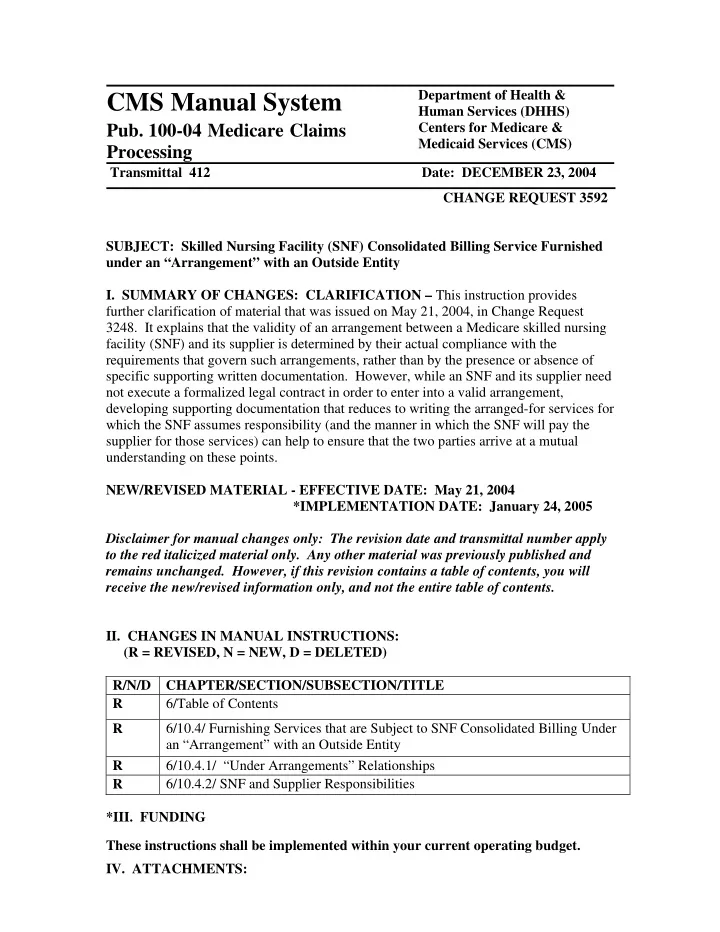
Department of Health & CMS Manual System Human Services (DHHS) Pub. 100-04 Medicare Claims Centers for Medicare & Medicaid Services (CMS) Processing Transmittal 412 Date: DECEMBER 23, 2004 CHANGE REQUEST 3592 SUBJECT: Skilled


slide-1
SLIDE 1

CMS Manual System

Department of Health & Human Services (DHHS)

  • Pub. 100-04 Medicare Claims

Processing

Centers for Medicare & Medicaid Services (CMS) Transmittal 412 Date: DECEMBER 23, 2004 CHANGE REQUEST 3592 SUBJECT: Skilled Nursing Facility (SNF) Consolidated Billing Service Furnished under an “Arrangement” with an Outside Entity

  • I. SUMMARY OF CHANGES: CLARIFICATION – This instruction provides

further clarification of material that was issued on May 21, 2004, in Change Request

  • 3248. It explains that the validity of an arrangement between a Medicare skilled nursing

facility (SNF) and its supplier is determined by their actual compliance with the requirements that govern such arrangements, rather than by the presence or absence of specific supporting written documentation. However, while an SNF and its supplier need not execute a formalized legal contract in order to enter into a valid arrangement, developing supporting documentation that reduces to writing the arranged-for services for which the SNF assumes responsibility (and the manner in which the SNF will pay the supplier for those services) can help to ensure that the two parties arrive at a mutual understanding on these points. NEW/REVISED MATERIAL - EFFECTIVE DATE: May 21, 2004 *IMPLEMENTATION DATE: January 24, 2005 Disclaimer for manual changes only: The revision date and transmittal number apply to the red italicized material only. Any other material was previously published and remains unchanged. However, if this revision contains a table of contents, you will receive the new/revised information only, and not the entire table of contents.

  • II. CHANGES IN MANUAL INSTRUCTIONS:

(R = REVISED, N = NEW, D = DELETED) R/N/D CHAPTER/SECTION/SUBSECTION/TITLE R 6/Table of Contents R 6/10.4/ Furnishing Services that are Subject to SNF Consolidated Billing Under an “Arrangement” with an Outside Entity R 6/10.4.1/ “Under Arrangements” Relationships R 6/10.4.2/ SNF and Supplier Responsibilities *III. FUNDING These instructions shall be implemented within your current operating budget.

  • IV. ATTACHMENTS:
slide-2
SLIDE 2

X Business Requirements X Manual Instruction Confidential Requirements One-Time Notification Recurring Update Notification *Medicare contractors only

slide-3
SLIDE 3

Attachment - Business Requirements

  • Pub. 100-04

Transmittal: 412 Date: December 23, 2004 Change Request 3592 SUBJECT: Skilled Nursing Facility (SNF) Consolidated Billing: Services Furnished Under an “Arrangement” With an Outside Entity I. GENERAL INFORMATION A. Background: The skilled nursing facility (SNF) consolidated billing provisions (at §§1862(a)(18), 1866(a)(1)(H)(ii), and 1888(e)(2)(A) of the Social Security Act (the Act)) place with the SNF itself the Medicare billing responsibility for most of its residents’ services. “Part A” consolidated billing requires that an SNF must include on its Part A bill almost all of the services that a resident receives during the course of a Medicare-covered stay, other than those services that are specifically excluded from the SNF’s global prospective payment system (PPS) per diem payment for the covered stay. (These “excluded” services, such as the services of physicians and certain other practitioners, remain separately billable to Part B directly by the outside entity that actually furnishes them.) In addition, “Part B” consolidated billing makes the SNF itself responsible for submitting the Part B bills for any physical,

  • ccupational, or speech-language therapy services that a resident receives during a

noncovered stay. Further, for any Part A or Part B service that is subject to SNF consolidated billing, the SNF must either furnish the service directly with its own resources, or obtain the service from an

  • utside entity (such as a supplier) under an “arrangement,” as described in §1861(w) of the
  • Act. Under such an arrangement, the SNF must reimburse the outside entity for those

Medicare-covered services that are subject to consolidated billing; i.e., services that are reimbursable only to the SNF as part of its global PPS per diem or those Part B services that must be billed by the SNF. Since the inception of the SNF PPS, several problematic situations have been identified where the SNF resident receives services that are subject to consolidated billing from an outside entity, such as a supplier. (In this context, the term “supplier” can also include those practitioners who, in addition to performing their separately billable professional services, essentially act as a supplier by also furnishing other services that are subject to the consolidated billing requirement.) As discussed in greater detail below, such situations most commonly arise in one of the following two scenarios: 1) An SNF does not accurately identify services as being subject to consolidated billing when ordering such services from a supplier or practitioner; or 2) A supplier fails to ascertain a beneficiary’s status as an SNF resident when the beneficiary (or another individual acting on the beneficiary’s behalf) seeks to obtain such services directly from the supplier without the SNF’s knowledge. The absence of a valid arrangement in the situations described above creates confusion and friction between SNFs and their suppliers. Suppliers need to understand which services are subject to consolidated billing to avoid situations where they might improperly attempt to bill Part B (or other payers such as Medicaid and beneficiaries) directly for the services. In

slide-4
SLIDE 4

addition, when ordering or furnishing services “under arrangements,” both parties need to reach a common understanding on the terms of payment; e.g., how to submit an invoice, how payment rates will be determined, and the turnaround time between billing and payment. Without this understanding, it may become difficult to maintain the strong relationships between SNFs and their suppliers that are necessary to ensure proper coordination of care to the Medicare beneficiaries. Whenever possible, SNFs should document arrangements with suppliers in writing, particularly with suppliers furnishing services on an ongoing basis, such as laboratories, x-ray suppliers, and pharmacies. This also enables the SNF to obtain the supplier’s assurance that the arranged-for services will meet accepted standards of quality (under the regulations at 42 CFR 483.75(h)(2), SNFs must ensure that services obtained under an arrangement with an outside source meet professional standards and principles that apply to professionals providing such services). However, it is important to note that the absence of a valid arrangement does NOT invalidate the SNF’s responsibility to reimburse suppliers for services included in the SNF “bundle” of services represented by the SNF PPS global per diem rate. As the SNF has already been paid for the services, the SNF must be considered the responsible party when medically necessary supplier services are furnished to beneficiaries in Medicare Part A stays. This obligation applies even in cases where the SNF did not specifically order the service; e.g., during a scheduled physician’s visit, the physician performs additional diagnostic tests that had not been

  • rdered by the SNF; a family member arranges a physician visit without the knowledge of SNF

staff and the physician bills the SNF for “incident to” services. Finally, while establishing a valid arrangement prior to ordering services from a supplier minimizes the likelihood of a payment dispute between the parties, it is not unreasonable to expect occasional disagreements between the parties that may result in non-payment of a supplier claim. However, it is important to note that there are potentially adverse consequences to SNFs when patterns of such denials are identified. Specifically, all participating SNFs agree to comply with program regulations when entering into a Medicare provider agreement which, as explained below, requires an SNF to have a valid arrangement in place whenever a resident receives services that are subject to consolidated billing from any entity other than the SNF itself. Moreover, in receiving a bundled per diem payment under the SNF PPS that includes such services, the SNF is accepting Medicare payment--and financial responsibility--for the service. B. Policy: Under an arrangement as defined in §1861(w) of the Act, Medicare’s payment to the SNF represents payment in full for the arranged-for service, and the supplier or practitioner must look to the SNF (rather than to Part B) for its payment. Further, in entering into such an arrangement, the SNF cannot function as a mere billing conduit, but must actually exercise professional responsibility and control over the arranged-for service (see the online CMS Manual System at www.cms.hhs.gov/manuals/cmsindex.asp, Publication 100-01 (“Medicare General Information, Eligibility, and Entitlement”), Chapter 5 (“Definitions”), §10.3 (“Under Arrangements”)). Medicare does not prescribe the actual terms of the SNF’s relationship with its supplier (such as the specific amount or timing of the supplier’s payment by the SNF), which are to be arrived at through direct negotiation between the parties to the agreement. However, in order for a

slide-5
SLIDE 5

valid “arrangement” to exist, the SNF must reach a mutual understanding with its supplier as to how the supplier is to be paid for its services. Documenting the terms of the arrangement confers the added benefit of providing both parties with a ready means of resolution in the event that a dispute arises over a particular service. This type of arrangement has proven to be effective in situations where suppliers regularly provide services to facility residents on an

  • ngoing basis; e.g., laboratory and x-ray suppliers, DME suppliers, etc.

If an SNF elects to utilize an outside supplier to furnish medically appropriate services that are subject to consolidated billing, but then refuses to reimburse the supplier for the services, then there is no valid arrangement as contemplated under §1862(a)(18) of the Act. Not only would this potentially result in Medicare’s noncoverage of the particular services at issue, but the SNF would also risk being found in violation of the terms of its provider agreement. Under §1866(a)(1)(H)(ii) of the Act (and the regulations at 42 CFR 489.20(s)), the SNF’s provider agreement includes a specific commitment to comply with the requirements of the consolidated billing provision. Further, §1866(g) of the Act imposes a civil money penalty on any person who knowingly and willfully presents (or causes to be presented) a bill or request for payment inconsistent with an arrangement or in violation of the requirement for such an arrangement. Problems involving the absence of a valid arrangement between an SNF and its supplier typically tend to arise in one of the following two situations. Problem Scenario 1: An SNF elects to utilize an outside supplier to furnish a type of service that would be subject to Part A consolidated billing, but then fails to inform the supplier that the resident receiving the service is in a covered Part A stay. This causes the supplier to conclude mistakenly that the service it furnishes to that resident is not subject to consolidated billing. Based on the inaccurate impression that the resident’s SNF stay is noncovered, the supplier inappropriately submits a separate Part B claim for the service, and may also improperly bill other insurers and the resident. Then, the supplier only learns of the actual status of the resident’s Medicare-covered SNF stay when that Part B claim is

  • denied. In this scenario, even though the supplier made reasonable efforts to ascertain

from the SNF both the beneficiary’s status as an SNF resident and the specific nature of the beneficiary’s SNF stay, the information from the SNF (on which the supplier relied) proved to be inaccurate. While we recognize that inadvertent errors may occasionally occur in the course of furnishing such information, an SNF should not only make a good faith effort to furnish accurate information to its supplier, but must reimburse the supplier once such an error is called to its

  • attention. If, in the scenario at issue, the SNF refuses to pay the supplier for the service even

after being apprised of the inaccuracy of its initial information, the SNF would not be in compliance with consolidated billing requirements. As discussed previously, having supporting documentation in place for the disputed service would not only help to ensure compliance with the consolidated billing requirements, but should also provide a vehicle for resolving the dispute itself.

slide-6
SLIDE 6

Of course, the SNF can often prevent such disputes from arising to begin with, simply by ensuring that the supplier receives accurate and timely information about the status of a resident’s Medicare-covered SNF stay. The SNF’s responsibility to communicate accurate and timely resident information to its supplier is especially important in those instances where a particular portion of an otherwise bundled service remains separately billable to Part B (for example, the professional component that represents a physician’s interpretation of an

  • therwise bundled diagnostic test).

Problem Scenario 2: A resident temporarily departs from the SNF on a brief leave of absence, typically accompanied by a relative or friend. While briefly offsite, the resident (or the relative or friend, acting on the resident’s behalf) obtains services that are subject to the consolidated billing requirement, but fails to notify the SNF. The SNF refuses to pay for the offsite services, and the supplier bills the beneficiary/family member directly. As in the previous scenario, the SNF remains responsible for any services included in the SNF “bundle” of services subject to consolidated billing that are furnished to the resident by an outside entity, even in the absence of a valid arrangement with the SNF. SNFs can act to prevent such problems from arising by ensuring that each resident (and, if applicable, his or her representative) is fully aware of the applicable requirements. For example, while the Medicare law at §1802 of the Act guarantees a beneficiary’s free choice of any qualified entity that is willing to furnish services to the beneficiary, in selecting a particular SNF, the beneficiary has effectively exercised this right of free choice with respect to the entire package of services for which the SNF is responsible under the consolidated billing requirement, including the use of any outside suppliers from which the SNF chooses to obtain such services. SNF staff need to communicate these requirements to beneficiaries and family members upon admission. Further, in providing such advice periodically throughout each resident’s stay, the SNF should take particular care to include any resident who is about to leave the facility temporarily, in order to ensure that the resident (and, if applicable, the resident’s representative) understands the need to consult the SNF before obtaining any services offsite. Moreover, while the SNF itself should take reasonable steps to prevent such problems from arising, the supplier in this scenario is also responsible for being aware of and complying with the consolidated billing requirements. This means that prior to furnishing services to a Medicare beneficiary, the supplier should routinely ascertain whether the beneficiary is currently receiving any comprehensive Medicare benefits (such as SNF or home health benefits) for which Medicare makes a bundled payment that could potentially include the supplier’s services. If the supplier ascertains that a particular beneficiary is, in fact, a resident

  • f an SNF with which the supplier does not have a valid arrangement in place, then the

supplier should contact the SNF before actually furnishing any services to that beneficiary that are subject to the consolidated billing provision. Further, under the regulations at 42 CFR 489.21(h), the beneficiary cannot be charged for the bundled services.

slide-7
SLIDE 7

C. Provider Education: A provider education article related to this instruction will be available at www.cms.hhs.gov/medlearn/matters shortly after the CR is released. You will receive notification of the article release via the established "medlearn matters" listserv. Contractors shall post this article, or a direct link to this article, on their Web site and include information about it in a listserv message within one week of the availability of the provider education article. In addition, the provider education article must be included in your next regularly scheduled bulletin. II. BUSINESS REQUIREMENTS “Shall" denotes a mandatory requirement "Should" denotes an optional requirement Requirement # Requirements Responsibility 3592.1 Intermediaries and carriers shall notify affected providers of the information contained in this document through the methods described in section I.C. above. Intermediaries and carriers

  • III. SUPPORTING INFORMATION AND POSSIBLE DESIGN CONSIDERATIONS

A. Other Instructions: N/A X-Ref Requirement # Instructions B. Design Considerations: N/A X-Ref Requirement # Recommendation for Medicare System Requirements C. Interfaces: N/A D. Contractor Financial Reporting /Workload Impact: N/A E. Dependencies: N/A F. Testing Considerations: N/A

  • IV. SCHEDULE, CONTACTS, AND FUNDING

Effective Date: May 21, 2004 Implementation Date: January 24, 2004 Pre-Implementation Contact(s): These instructions shall be implemented within your current operating budget.

slide-8
SLIDE 8

Bill Ullman at (410) 786-5667 or BUllman@cms.hhs.gov, or Sheila Lambowitz at (410) 786-7605 or SLambowitz@cms.hhs.gov Post-Implementation Contact(s): Appropriate Regional Office

slide-9
SLIDE 9

Medicare Claims Processing Manual

Chapter 6 - SNF Inpatient Part A Billing

Table of Contents (Rev. 412, 12-23-04) 10.4.1 - “Under Arrangements” Relationships

slide-10
SLIDE 10

10.4 - Furnishing Services that are Subject to SNF Consolidated Billing Under an “Arrangement” With an Outside Entity

(Rev. 412, Issued: 12-23-04, Effective: 05-21-04, Implementation: 01-24-05) As discussed in §10.1 and §10.3, the skilled nursing facility (SNF) consolidated billing provisions (at §1862(a)(18), §1866(a)(1)(H)(ii), and §1888(e)(2)(A) of the Act) place with the SNF itself the Medicare billing responsibility for most of its residents’ services. “Part A” consolidated billing requires that an SNF must include on its Part A bill almost all of the services that a resident receives during the course of a Medicare-covered stay,

  • ther than those services that are specifically excluded from the SNF’s global PPS per

diem payment for the covered stay. (These “excluded” services, such as the services of physicians and certain other practitioners, remain separately billable to Part B directly by the outside entity that actually furnishes them.) In addition, “Part B” consolidated billing makes the SNF itself responsible for submitting the Part B bills for any physical,

  • ccupational, or speech-language therapy services that a resident receives during a

noncovered stay. Further, for any Part A or Part B service that is subject to SNF consolidated billing, the SNF must either furnish the service directly with its own resources, or obtain the service from an outside entity (such as a supplier) under an “arrangement,” as described in §1861(w) of the Act and in §80.5. Under such an arrangement, the SNF must reimburse the outside entity for those Medicare-covered services that are subject to consolidated billing; i.e., services that are reimbursable only to the SNF as part of its global PPS per diem or those Part B services that must be billed by the SNF. Since the inception of the SNF PPS, several problematic situations have been identified where the SNF resident receives services that are subject to consolidated billing from an

  • utside entity, such as a supplier. (In this context, the term “supplier” can also include

those practitioners who, in addition to performing their separately billable professional services, essentially act as a supplier by also furnishing other services that are subject to the consolidated billing requirement.) As discussed in greater detail below, such situations most commonly arise in one of the following two scenarios: 1) An SNF does not accurately identify services as being subject to consolidated billing when ordering such services from a supplier or practitioner; or 2) A supplier fails to ascertain a beneficiary’s status as an SNF resident when the beneficiary (or another individual acting

  • n the beneficiary’s behalf) seeks to obtain such services directly from the supplier

without the SNF’s knowledge. The absence of a valid arrangement in the situations described above creates confusion and friction between SNFs and their suppliers. Suppliers need to understand which services are subject to consolidated billing to avoid situations where they might improperly attempt to bill Part B (or other payers such as Medicaid and beneficiaries) directly for the services. In addition, when ordering or furnishing services “under arrangements,” both parties need to reach a common understanding on the terms of payment; e.g., how to submit an invoice, how payment rates will be determined, and the

slide-11
SLIDE 11

turn-around time between billing and payment. Without this understanding, it may become difficult to maintain the strong relationships between SNFs and their suppliers that are necessary to ensure proper coordination of care to the Medicare beneficiaries. Whenever possible, SNFs should document arrangements with suppliers in writing, particularly with suppliers furnishing services on an ongoing basis, such as laboratories, x-ray suppliers, and pharmacies. This also enables the SNF to obtain the supplier’s assurance that the arranged-for services will meet accepted standards of quality (under the regulations at 42 CFR 483.75(h)(2), SNFs must ensure that services obtained under an arrangement with an outside source meet professional standards and principles that apply to professionals providing such services). However, it is important to note that the absence of a valid arrangement does NOT invalidate the SNF’s responsibility to reimburse suppliers for services included in the SNF “bundle” of services represented by the SNF PPS global per diem rate. As the SNF has already been paid for the services, the SNF must be considered the responsible party when medically necessary supplier services are furnished to beneficiaries in Medicare Part A stays. This obligation applies even in cases where the SNF did not specifically

  • rder the service; e.g., during a scheduled physician’s visit, the physician performs

additional diagnostic tests that had not been ordered by the SNF; a family member arranges a physician visit without the knowledge of SNF staff and the physician bills the SNF for “incident to” services. Finally, while establishing a valid arrangement prior to ordering services from a supplier minimizes the likelihood of a payment dispute between the parties, it is not unreasonable to expect occasional disagreements between the parties that may result in non-payment of a supplier claim. However, it is important to note that there are potentially adverse consequences to SNFs when patterns of such denials are identified. Specifically, all participating SNFs agree to comply with program regulations when entering into a Medicare provider agreement which, as explained below, requires an SNF to have a valid arrangement in place whenever a resident receives services that are subject to consolidated billing from any entity other than the SNF itself. Moreover, in receiving a bundled per diem payment under the SNF PPS that includes such services, the SNF is accepting Medicare payment--and financial responsibility--for the service. Accordingly, these instructions reiterate and clarify the applicable consolidated billing requirements that pertain to SNFs and to the outside suppliers that serve SNF residents.

10.4.1 - “Under Arrangements” Relationships

(Rev. 412, Issued: 12-23-04, Effective: 05-21-04, Implementation: 01-24-05) Under an arrangement as defined in §1861(w) of the Act, Medicare’s payment to the SNF represents payment in full for the arranged-for service, and the supplier must look to the SNF (rather than to Part B) for its payment. Further, in entering into such an arrangement, the SNF cannot function as a mere billing conduit, but must actually exercise professional responsibility and control over the arranged-for service (see the

slide-12
SLIDE 12

Medicare General Information, Eligibility, and Entitlement Manual, Chapter 5, “Definitions,” §10.3, for additional information on services furnished under arrangements). Medicare does not prescribe the actual terms of the SNF’s relationship with its suppliers (such as the specific amount or timing of payment by the SNF), which are to be arrived at through direct negotiation between the parties to the agreement. However, in order for a valid “arrangement” to exist, the SNF must reach a mutual understanding with its supplier as to how the supplier is to be paid for its services. Documenting the terms of the arrangement confers the added benefit of providing both parties with a ready means

  • f resolution in the event that a dispute arises over a particular service. This type of

arrangement has proven to be effective in situations where suppliers regularly provide services to facility residents on an ongoing basis; e.g., laboratory and x-ray suppliers, DME supplies, etc. If an SNF elects to utilize an outside supplier to furnish medically appropriate services that are subject to consolidated billing, but then refuses to reimburse that supplier for the services, then there is no valid arrangement as contemplated under §1862(a)(18) of the

  • Act. Not only would this potentially result in Medicare’s noncoverage of the particular

services at issue, but an SNF demonstrating a pattern of nonpayment would also risk being found in violation of the terms of its provider agreement. Under §1866(a)(1)(H)(ii)

  • f the Act (and 42 CFR 489.20(s)), the SNF’s provider agreement includes a specific

commitment to comply with the requirements of the consolidated billing provision. Further, §1866(g) of the Act imposes a civil money penalty on any person who knowingly and willfully presents (or causes to be presented) a bill or request for payment inconsistent with an arrangement or in violation of the requirement for such an arrangement.

10.4.2 - SNF and Supplier Responsibilities

(Rev. 412, Issued: 12-23-04, Effective: 05-21-04, Implementation: 01-24-05) Problems involving the absence of a valid arrangement between an SNF and its suppliers typically tend to arise in one of the following two situations. Problem Scenario 1: An SNF elects to utilize an outside supplier to furnish a type

  • f service that would be subject to Part A consolidated billing, but then fails to

inform the supplier that the resident receiving the service is in a covered Part A

  • stay. This causes the supplier to conclude mistakenly that the service it furnishes

to that resident is not subject to consolidated billing. Based on the inaccurate impression that the resident’s SNF stay is noncovered, the supplier inappropriately submits a separate Part B claim for the service, and may also improperly bill other insurers and the resident. Then, the supplier only learns of the actual status of the resident’s Medicare-covered SNF stay when that

slide-13
SLIDE 13

Part B claim is denied. In this scenario, even though the supplier made reasonable efforts to ascertain from the SNF both the beneficiary’s status as an SNF resident and the specific nature of the beneficiary’s SNF stay, the information from the SNF (on which the supplier relied) proved to be inaccurate. While we recognize that inadvertent errors may occasionally occur in the course of furnishing such information, an SNF should not only make a good faith effort to furnish accurate information to its supplier, but must reimburse the supplier once such an error is called to its attention. If, in the scenario at issue, the SNF refuses to pay the supplier for the service even after being apprised of the inaccuracy of its initial information, the SNF would not be in compliance with consolidated billing requirements. As discussed previously, having supporting documentation in place for the disputed service would not

  • nly help to ensure compliance with the consolidated billing requirements, but should

also provide a vehicle for resolving the dispute itself. Of course, the SNF can often prevent such disputes from arising to begin with, simply by ensuring that the supplier receives accurate and timely information about the status of a resident’s Medicare-covered SNF stay. The SNF’s responsibility to communicate accurate and timely resident information to its suppliers is especially important in those instances where a particular portion of an otherwise bundled service remains separately billable to Part B (for example, the professional component that represents a physician’s interpretation of an otherwise bundled diagnostic test). Problem Scenario 2: A resident temporarily departs from the SNF on a brief leave of absence, typically accompanied by a relative or friend. While briefly

  • ffsite, the resident (or the relative or friend, acting on the resident’s behalf)
  • btains services that are subject to the consolidated billing requirement, but fails

to notify the SNF. The SNF refuses to pay for the offsite services, and the supplier bills the beneficiary/family member directly. As in the previous scenario, the SNF remains responsible for any services included in the SNF “bundle” of services subject to consolidated billing that are furnished to the resident by an outside entity, even in the absence of a valid arrangement with the SNF. SNFs can act to prevent such problems from arising by ensuring that each resident (and, if applicable, his or her representative) is fully aware of the applicable requirements. For example, while the Medicare law at §1802 of the Act guarantees a beneficiary’s free choice of any qualified entity that is willing to furnish services to the beneficiary, in selecting a particular SNF, the beneficiary has effectively exercised this right of free choice with respect to the entire package of services for which the SNF is responsible under the consolidated billing requirement, including the use of any outside suppliers from which the SNF chooses to obtain such services. SNF staff need to communicate these requirements to beneficiaries and family members upon admission. Further, in providing such advice periodically throughout each resident’s stay, the SNF should take particular care to include any resident who is about to leave the facility temporarily, in

slide-14
SLIDE 14
  • rder to ensure that the resident (and, if applicable, the resident’s representative)

understands the need to consult the SNF before obtaining any services offsite. Moreover, while the SNF itself should take reasonable steps to prevent such problems from arising, the supplier in this scenario is also responsible for being aware of and complying with the consolidated billing requirements. This means that prior to furnishing services to a Medicare beneficiary, the supplier should routinely ascertain whether the beneficiary is currently receiving any comprehensive Medicare benefits (such as SNF or home health benefits) for which Medicare makes a bundled payment that could potentially include the supplier’s services. If the supplier ascertains that a particular beneficiary is, in fact, a resident of an SNF with which the supplier does not have a valid arrangement in place, then the supplier should contact the SNF before actually furnishing any services to that beneficiary that are subject to the consolidated billing provision. Further, under the regulations at 42 CFR 489.21(h), the beneficiary cannot be charged for the bundled services.