Clinico-Pathological Conference Bollen- None Larimer- None Andrew - - PowerPoint PPT Presentation

clinico pathological conference
SMART_READER_LITE
LIVE PREVIEW

Clinico-Pathological Conference Bollen- None Larimer- None Andrew - - PowerPoint PPT Presentation

2/13/2015 Disclosures Betjemann- None Clinico-Pathological Conference Bollen- None Larimer- None Andrew W. Bollen DVM, MD Professor of Pathology, UCSF John Betjemann MD Assistant Professor of Neurology, UCSF Phil Larimer MD, PhD Neurology


slide-1
SLIDE 1

2/13/2015 1

Clinico-Pathological Conference

Andrew W. Bollen DVM, MD Professor of Pathology, UCSF John Betjemann MD Assistant Professor of Neurology, UCSF Phil Larimer MD, PhD Neurology Resident, UCSF

Disclosures

Betjemann- None Bollen- None Larimer- None

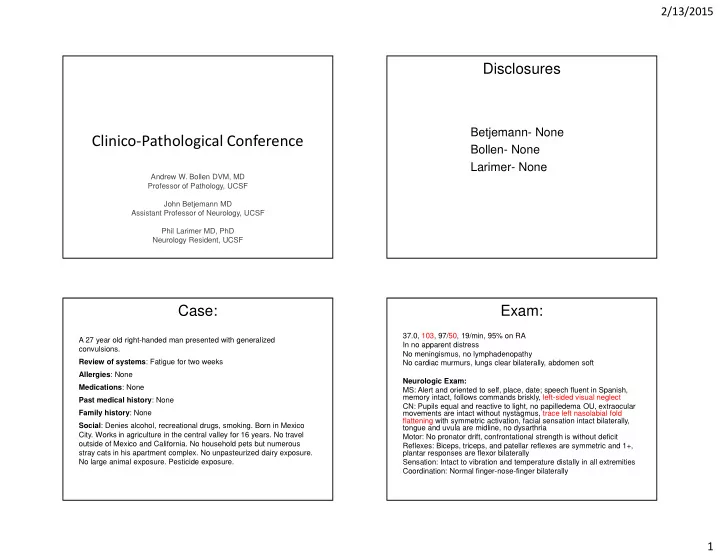
Case:

A 27 year old right-handed man presented with generalized convulsions. Review of systems: Fatigue for two weeks Allergies: None Medications: None Past medical history: None Family history: None Social: Denies alcohol, recreational drugs, smoking. Born in Mexico

  • City. Works in agriculture in the central valley for 16 years. No travel
  • utside of Mexico and California. No household pets but numerous

stray cats in his apartment complex. No unpasteurized dairy exposure. No large animal exposure. Pesticide exposure.

Exam:

37.0, 103, 97/50, 19/min, 95% on RA In no apparent distress No meningismus, no lymphadenopathy No cardiac murmurs, lungs clear bilaterally, abdomen soft Neurologic Exam: MS: Alert and oriented to self, place, date; speech fluent in Spanish, memory intact, follows commands briskly, left-sided visual neglect CN: Pupils equal and reactive to light, no papilledema OU, extraocular movements are intact without nystagmus, trace left nasolabial fold flattening with symmetric activation, facial sensation intact bilaterally, tongue and uvula are midline, no dysarthria Motor: No pronator drift, confrontational strength is without deficit Reflexes: Biceps, triceps, and patellar reflexes are symmetric and 1+, plantar responses are flexor bilaterally Sensation: Intact to vibration and temperature distally in all extremities Coordination: Normal finger-nose-finger bilaterally

slide-2
SLIDE 2

2/13/2015 2

Initial Labs

CRP 5.2 14.8 247 36.9 12.7 5 cm CT head 5 cm FLAIR 5 cm T1 with gadolinium

slide-3
SLIDE 3

2/13/2015 3

5 cm ADC 5 cm GRE

Labs (normal unless otherwise noted):

CRP 5.2 CEA AFP CA 19-9 CA 125 Beta HCG TTE: Normal Computed tomography scans of the chest, abdomen, and pelvis as well as an ultrasound of the testicles did not reveal a primary neoplasm. CTA head/neck: normal RPR Serum cryptococcal antigen Serum cocci immunodiffusion and complement fixation HIV antibody and viral load CD4 228 EBV PCR Cysticercosis IgG Toxoplasmosis IgG, IgM, PCR CSF (HD#4): 5 WBC (98% lymphocytes), 0 RBC, glc 83, protein 30, LDH 14, CrAg, cocci complement fixation, india ink, AFB smear, cysticercosis IgG Blood/CSF bacterial/AFB/fungal cultures: no growth

Therapies:

Vancomycin, Ceftriaxone Albendazole Dexamethasone Ambisome 1 7 14 21 26 (transfer) Hospital Day Voriconazole TMP-SMX Imipenem/cilastin Cefipime Vancomycin Metronidazole Cefazolin

slide-4
SLIDE 4

2/13/2015 4

Clinical Course

Vancomycin, Ceftriaxone Albendazole Dexamethasone 1 7 14 21 26 (transfer) Hospital Day Voriconazole/Vancomycin TMP-SMX Cefipime Metronidazole Cefazolin Opiates for headache Mild encephalopathy and ongoing headaches Seizure Brain Biopsy Fever LP FLAIR T1 with GAD

Scan at day 26

FLAIR T1 with GAD FLAIR T1 with GAD

slide-5
SLIDE 5

2/13/2015 5

FLAIR T1 with GAD FLAIR T1 with GAD FLAIR T1 with GAD FLAIR T1 with GAD

slide-6
SLIDE 6

2/13/2015 6

FLAIR T1 with GAD FLAIR T1 with GAD FLAIR T1 with GAD FLAIR T1 with GAD

slide-7
SLIDE 7

2/13/2015 7

FLAIR T1 with GAD FLAIR T1 with GAD FLAIR T1 with GAD

UCSF Course

1 7 14 21 Hospital Day Mild encephalopathy Seizure Brain Biopsy (inconclusive) Fever 28 35 Coma Intubated EVD Decompression Death

  • He remained in coma with EEG demonstrating
  • nly diffuse slowing.
  • Due to evidence of herniation on arrival, he was

intubated and an EVD was placed.

  • He had elevated intracranial pressure refractory

to CSF diversion and medical management so had a decompressive hemicraniectomy on UCSF HD#3.

  • He did not regain brainstem reflexes, was

transitioned to comfort measures, and succumbed to his illness 35 days after initial presentation

slide-8
SLIDE 8

2/13/2015 8

RECENT ADVANCES IN NEUROLOGY CLINICO-PATHOLOGIC CONFERENCE

John Betjemann, MD

Approach and Overview

Key points History Exam Evaluation Treatment Broad Differential Diagnosis (DDx) Further work up Diagnostic and treatment pearls Make a diagnosis

History and Exam- Key Points

Young healthy man from Mexico working in

agriculture

Subacute onset of fatigue, encephalopathy,

headache and new seizure

Exposure to stray cats Exam: left visual neglect, facial asymmetry

Evaluation and Treatment- Key Points

Labs LP: not consistent with meningitis but was performed

after 4 days of steroids and Abx

CD4= 228 Imaging: Initially multiple ring enhancing lesions with edema.

New lesions on repeat scan despite treatment

Treatment Steroids Polymicrobial, fungal, neurocysticercosis (NCC)

slide-9
SLIDE 9

2/13/2015 9

Differential Diagnosis

Malignancy Lymphoma Multifocal CNS

neoplasm/metastases

Gliomatosis Cerebri Sarcoid Infarct/vasculitis Infection Pyogenic abscess Septic emboli Toxoplasmosis Fungi TB NCC

Low CD4

Walker UA. Curr Opin Rheumatol 2006

Malignancy- CNS Lymphoma

Pros Encephalopathy, focal

deficits, and seizures

Immunodeficiency Cons Age Usually more steroid

responsive

Imaging

Haldorsen IS. AJNR 2011

Malignancy- Multifocal glioma/CNS metastases

Pros Headache, seizures Imaging: ring enhancing masses, gray-white, with

edema

Cons Encephalopathy Age Lack of discernible primary Dramatic progression after 3 weeks

slide-10
SLIDE 10

2/13/2015 10

Malignancy- Gliomatosis Cerebri

Cons Age Usually more extensive radiographic involvement

Freund M. et al. Eur

  • Radiol. 2001

Infection- Pyogenic Abscess

Pros History and exam Ring enhancing lesions Cons (none of these exclude the possibility!) Lack of fever Negative blood cultures CSF classically with pleocytosis and elevated protein Septic emboli Negative TTE and blood Cx, lack of other embolic

strokes and absence of hemosiderin on GRE

Infection- Toxoplasmosis

Pros Immunodeficiency Imaging: multiple ring enhancing

lesions with edema

Cons Not quite immunodeficient enough Negative serologies Majority are IgG positive PCR: 83% sens, 95% spec in CSF of AIDS-infected patients

(similar in serum) (Alfonso Y, et al. 2009 and Mesquita RT et

  • al. 2010)

Infection- Fungi

Cryptococcus Usually immunocompromised Typically meningoencephalitis rather than discrete mass-

like lesions (cryptococcomas)

CSF: elevated OP, pleocytosis (lymphocytic), low gluc, high prot. India ink, culture and CrAg (sens 93-100 and spec 93-98)(Tanner

DC et al. 1994)

Aspergillosis Usually disseminated infection but can be local spread Coccidomycosis Typically a meningitis, but can have abscess formation CSF with lymphocytic pleocytosis

slide-11
SLIDE 11

2/13/2015 11

Infection- TB

Pros Imaging fits well with tuberculomas Low CD4 may serve as risk for TB or may be result of active

TB

CSF often nonspecific in tuberculomas Not treated empirically for TB Negative AFB smear and culture are not terribly helpful Cons Classically causes a meningitis +/- tuberculomas Not from a truly endemic area CT chest without malignancy, but evidence of remote TB?

Infection- Neurocysticercosis

Pros Commonly presents with seizures and focal findings From an endemic area Cons Imaging not classic-not truly cystic, no calcification,

and no scolex

Serum Ab testing negative (up to 98% sensitive) (Del

Brutto OH 2012)

New lesions despite albendazole

Neurosarcoid

Can impact any portion of the CNS without

systemic manifestations

Imaging: can see enhancing parenchymal lesions

but also often meningeal enhancement and cranial neuropathies

Initial treatment involves steroids

Vasculitis

Many of the above conditions can be associated

with a vasculitis

Might somewhat explain the interval progression

  • n MRIs
slide-12
SLIDE 12

2/13/2015 12

Further Diagnostic Considerations

Dental exam: source of bacteremia and septic

emboli

Ophthalmologic exam: sarcoid, lymphoma PET scan: potential biopsy target Labs: Beta-D-glucan, galactomannan

Diagnostic and Treatment Pearls

CSF Timing: when possible LP prior to steroids and Abx For cytology, CSF should be analyzed within few hours For TB and lymphoma key is volume, volume, volume! Lymphoma: cytology sensitivity 2-32% (Scott BJ, 2013).

Lower yield with small CF volume, processing delays and steroids

TB: AFB smear~60%, PCR 56% sensitivity (Thwaites GE

2013)

Steroids Alter imaging, decrease diagnostic yield (lymphoma)

Diagnostic and Treatment Pearls

Our CSF diagnostic testing is limited! What are we good at Viruses CrAg In many cases a negative test doesn’t exclude the

disease (lymphoma, TB)

Steiner I, et al. Eur J Neuol. 2012

Diagnosis

Tuberculosis Lymphoma Neurocysticercosis Pyogenic abscess Toxoplasmosis Neurosarcoid Fungal abscess Metastatic/multifo cal glioma gliomatosis

+/- vasculitis

slide-13
SLIDE 13

2/13/2015 13

Tuberculosis

Tuberculoma/Tubercular abscess

Ripamonti D, et al. Clin Infect Dis 2004

References

1.

Walker UA, Warnatz K. Idiopathic CD4 lymphocytopenia. Curr Opin Rheumatol 2006;18:389-395.

2.

Haldorsen IS, Espeleand A, Larsson E-M. Central nervous system lymphoma: characteristic findings on traditional and advanced imaging. AJNR 2011; 32:984-992.

3.

Freund M, et al. CT and MRI findings in gliomatosis cerebri: a neuroradiologic and neuropathologic review of diffuse infiltrating brain neoplasms. Eur Radiol. 2001;11:309-316.

4.

Alfonso Y, et al. Molecular diagnosis of Toxoplasma gondii infection in cerebrospinal fluid from AIDS

  • patients. Cerebrospinal Fluid Res 2009;6:1-6.

5.

Mesquita RT et al. Molecular diagnosis of cerebral toxoplasmosis: comparing markers that determine toxoplasma gondii by PCR in peripheral blood from HIV-infected patients. Braz J Infect Dis 2010;14:346- 350.

6.

Tanner DC, et al. Comparison of commercial kits for detection of cryptococcal antigen. J Clin Microbiol. 1994;32:1680-1684.

7.

Del Brutto OH. Diagnostic criteria for neurocysticercosis revisited. Pathogens and Global Health 2012;106:299-304

8.

Scott BJ, et al. A systematic approach to the diagnosis of suspected central nervous system lymphoma. Jama Neurol 2013;70:311-319.

9.

Thwaites GE, et al. Tuberculous meningitis: more questions, still too few answers. Lancet Neurol 2013;12:999-1010.

10.

Steiner I, et al. EFNS-ENS guidelines for the use of PCR technology for the diagnosis of infections of the nervous system. Eur J Neuol. 2012;19:1278-1297.

11.

Ripamonti D, et al. New times for an old disease: intracranial mass lesions caused by mycobacterium tuberculosis in 5 HIV-negative African immigrants. Clin Infect Dis 2004;39:e35-e45.

Recent Advances in Neurology -2015 Case: Neuropathology

Andrew Bollen MD, DVM

Department of Anatomic Pathology Neuropathology Division University of California San Francisco

100X

slide-14
SLIDE 14

2/13/2015 14

400X 200X 100X 200X

slide-15
SLIDE 15

2/13/2015 15

100X 200X 400X AFB-400X

slide-16
SLIDE 16

2/13/2015 16

40X 200X 400X AFB-400X

slide-17
SLIDE 17

2/13/2015 17

40X 200X 400X PAS-400X

slide-18
SLIDE 18

2/13/2015 18

PAS-400X 100X 200X 400X

slide-19
SLIDE 19

2/13/2015 19

PAS-400X 40X 100X 200X

slide-20
SLIDE 20

2/13/2015 20

40X GMS-200X

Clinical presentation of CNS TB

Accounts for 1% of TB cases world wide. Occurs during primary infection in children or late reactivation infection in (often immunocompromised) adults. Tuberculous meningitis From rupture of a subependymal tubercle into the subarachnoid space. Complicated by vasculitis and hydrocephalus Three phases Prodromal: 2-3 weeks of malaise, headache, low-grade fever Meningitic: Meningismus, vomiting, confusion, focal signs Paralytic: Coma and seizures Death is usually with 5-8 weeks of symptom onset if untreated CSF has a high protein and low glucose with mild pleocytosis Intracranial tuberculoma Signs of systemic illness or meningeal inflammation are rare CSF unremarkable Tuberular arachnoiditis

Radiological findings in CNS TB

Tuberculous meningitis Hydrocephalus or infarcts from arteritis on CT head Meningeal enhancement (typically basal) or pahcymeningitis on MRI Intracranial tuberculoma T1 isointense with ring enhancement Surrounded by T2 hyerintense vasogenic edema Not diffusion restricted Tuberular arachnoiditis Matted lumbar nerve roots

Reviewed in Indian J Radiol Imaging. 2009; 19:256-65.

slide-21
SLIDE 21

2/13/2015 21

Sensitivity of diagnostic tests in CNS TB

Tuberculous meningitis CSF acid fast bacilli (AFB) smear has sensitivity of 10-91% (dependent the method) CSF AFB culture has 11-83% sensitivity CSF enzyme-linked immuno assay (ELISA) has 52-92% sensitivity CSF antigen assays have 38-94% sensitivity CSF PCR assays have 18-100% sensitivity Intracranial tuberculoma CSF studies are not sensitivce MRI and pathological biopsy are most diagnostic

Reviewed in Clin Microbiol Rev. 2008; 21:243-61.

Must maintain a high clinical suspicion!